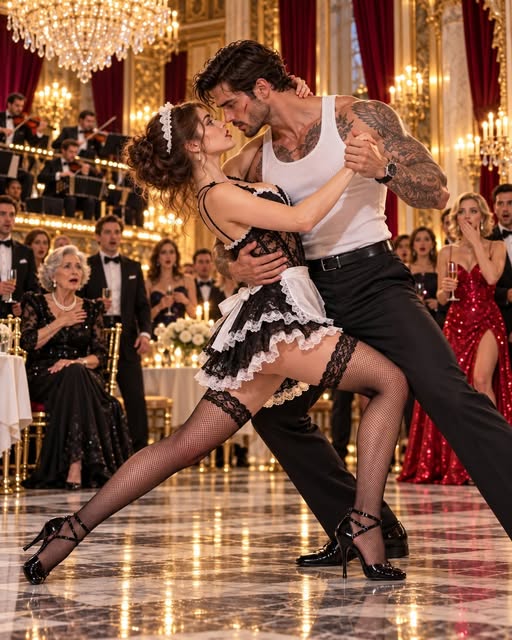
At 11:17 P.M., Chicago's most feared mafia boss held out his hand to his housekeeper in front of two hundred wealthy guests and laughed.
"If you can dance this tango with me, I'll marry you."
But I'm getting ahead of myself. Humiliation like that takes all evening to build. Mine started three hours earlier, with a glass of Cabernet and a woman who had been waiting all night for an excuse.
My name is Emily Brooks. I'm thirty-two years old, and for almost two years I have worked as a housekeeper at the Whitmore estate in Lake Forest, Illinois — twenty-two rooms, nine bathrooms, a ballroom with a floor of Italian marble, and a staff entrance I have used every single day so that people like me never have to be seen by people like them.
Grant Whitmore was forty-one, handsome in the way a loaded gun is handsome, and the head of an organization that controlled whiskey distribution across three states, two shipping companies, a string of private clubs, and some of the most valuable property in Chicago. Powerful men lowered their voices when he entered a room. Politicians returned his calls. His fiancée, Vanessa Hale, feared absolutely nothing.
Especially not hurting someone who couldn't fight back.
That evening the mansion was hosting a celebration for the fortieth anniversary of Whitmore Reserve, the whiskey company Grant's late father, Thomas Whitmore, had founded out of a single lakefront club. The ballroom glittered beneath crystal chandeliers. Two hundred guests wore diamonds and designer suits and the relaxed smiles of people who have never once checked the price of anything.
I wore a gray housekeeping uniform with my name stitched over the pocket in thread that had faded to the exact color of being ignored.
Three hours before the dance, the orchestra was still tuning and the first guests were drifting in, and Vanessa — seated at the edge of the ballroom in a gown the color of fresh blood, surrounded by her laughing friends — deliberately knocked over a full glass of Cabernet.
"Clean that up," she said, "before someone ruins their shoes."
I knelt beside her chair with my cloth and my bucket. "Of course, Ms. Hale."
Then, smiling straight into my eyes, she picked up her friend's glass and tipped the remaining wine slowly down the back of my uniform.
It soaked through the collar. It ran cold between my shoulder blades. Her friends laughed the way people laugh when cruelty is wearing a beautiful dress and nobody is going to stop it.
"Oh my God," Vanessa said sweetly. "I'm so clumsy tonight."
I closed my eyes and counted the things I could not afford to say.
I needed this job. Not wanted — needed. My younger sister Rachel was raising two boys, Ethan and Noah, seven and five, after a divorce so difficult it had taken her two years and everything she owned. Half of every paycheck I earned went to their rent and their groceries and the electric bill that never seemed to stop growing teeth. A housekeeper who argues with the boss's fiancée is a housekeeper updating her résumé by morning.
So I stood up without arguing, wrung out my cloth, and went back to work with wine drying on my skin.
Then a gentle voice called my name.
"Emily. Come here, dear."
Eleanor Whitmore, Grant's eighty-three-year-old grandmother, sat in her chair beside the tall windows, wrapped in silver silk, her white hair pinned up like a crown she had never asked for. The family moved around her carefully, the way you move around a loaded heirloom. She was the only one of them who had ever asked me a question about my own life.
She handed me a clean linen napkin.
"Get that wine off your neck. You'll catch a chill standing there wet."
"Thank you, Mrs. Whitmore."
Eleanor glanced toward Vanessa's table, and her mouth tightened into something almost like a smile.
"That girl has expensive jewelry and cheap manners. One day she'll pay full price for both."
I nearly laughed out loud in the middle of the ballroom. Eleanor patted my hand with fingers cool and papery and strong, and asked after Rachel, and after the boys, by name — she was the only member of that family who had ever remembered my nephews' names, or asked whether my sister was doing okay, or looked at me and seen a person instead of furniture that could polish silver.
"Hold your head up tonight, Emily," she said, for no reason I understood yet. "Whatever happens."
Later, Grant gave his speech.
He stood beneath the portrait of his father with a glass in his hand and two hundred faces turned up toward him, and he talked about legacy, and loyalty, and the word of a Whitmore being a thing a man could build a grave or an empire on. People applauded in the right places. Vanessa glowed beside him like a woman already spending the inheritance.
Then the speech ended, the waiters began clearing the dessert plates, and the orchestra began to play.
And I heard something that made my heart stop and ache at the same time.
A bandoneon.
A tango.
Not just any tango — the exact arrangement, note for note, breath for breath, that my father used to play every Saturday morning at the Brooks Dance Studio on Ashland Avenue, with the windows open and the sunlight coming through the dust and the smell of floor polish and coffee in the air.
Suddenly I could see him again, as clearly as if the last eight years had folded away.
Daniel Brooks. White shirt. Sleeves rolled to the elbow. A gentle smile that made every nervous student in Chicago believe, for one hour a week, that grace was something ordinary people were allowed to have.
He would set the bandoneon aside, hold out his hands to me — I was six years old, missing a front tooth, drowning in a practice skirt — and he would say the thing he said ten thousand times, to me and to every student who ever walked through his door:
"A good tango isn't about controlling someone, sweetheart. It's about making sure they never lose their balance."
I have worked at the Whitmore estate for two years. I have served senators and swallowed insults and learned to be invisible in rooms full of mirrors. But my body remembered that music before my mind could stop it.
Without thinking, I shifted my feet.
Heel.
Toe.
Pause.
Vanessa noticed.
She had been watching me the way a cat watches a bird through glass, and now she sat up straight, delighted, and pointed with one long lacquered finger.
"Look, everyone!" she called out, bright as a bell. "The maid thinks she's a dancer!"
People turned. Two hundred faces. My cheeks burned so hot I thought my skin would split. Someone near the bar actually laughed. I set down my tray with hands that had started to tremble and tried to leave — there was a service door twelve feet away, twelve feet to invisibility —
But Grant Whitmore stepped into my path, champagne glass in hand, amusement all over his face.
"Wait." He looked me up and down, at the gray uniform, at the dark stain of his fiancée's wine still drying down my back. "What's your name again?"
"Emily, sir."
He grinned at the crowd — his crowd, his ballroom, his joke — and then, at 11:17 P.M., in front of two hundred wealthy guests and God and every phone in the room rising to record my humiliation, he held out his hand to his housekeeper.
"Dance this tango with me, Emily," he said, "and I'll marry you."
The ballroom erupted. Vanessa clung to his shoulder, laughing hardest of all, her diamonds shaking. Someone at the back shouted, "Go on, sweetheart! Here's your chance to become rich!" and the laughter doubled, and rolled, and found its rhythm, the way cruel laughter does.
I stared at Grant's outstretched hand.
He expected me to run away crying. Or to take his hand and stumble across that marble floor in my work shoes so everyone could laugh harder, and film it, and show it at brunch. I was the evening's entertainment, and the entertainment was supposed to know its place.
But then I looked across the ballroom, toward the windows.
Eleanor Whitmore wasn't laughing.
She was staring at my feet — at the exact position of them, heel, toe, the pause still held in my body like a held breath. Her face had gone the color of old paper. Her eyes had filled with tears.
And something in her expression reached across forty feet of marble and steadied me the way my father's hands used to, at the barre, when I was small and frightened and certain I was about to fall.
Slowly, in front of everyone, I untied my stained apron. I folded it once, and placed it over the back of a chair like a woman setting down a weight she had decided, finally, not to carry.
Then I looked directly into the eyes of the most feared mafia boss in Chicago.
"Are you sure you want to make that promise, Mr. Whitmore?"
His smile faltered.
The laughter thinned at the edges, confused. Vanessa's hand slid off his shoulder. Grant looked at me — really looked, for the first time in two years — at the wine on my collar and the steadiness in my face, and something in his expression shifted from amusement to the first small shadow of a man who has said a thing in public that he may not be able to take back.
"I'm a man of my word," he said, more quietly.
"Then dance," I said, and I took his hand.
His hand was warm. Scarred across the knuckles. The hand of a man who had built an empire out of whiskey and fear — and it tightened on mine, I swear this is true, the tiniest fraction, the way a man's hand tightens when he has just realized the floor under him is not where he left it.
The conductor, God bless him, had been watching. He lifted his baton. The bandoneon drew its long breath.
And we danced.
Grant could dance the way rich men dance — club tango, taught by instructors who charge by the hour and flatter by the minute, all frame and confidence and command. For the first four bars he led the way he ran his empire: certain that the floor, and the music, and the woman, would arrange themselves around him.
Then my father's music reached the turn — the place in the arrangement where the bandoneon drops away and the violin asks a question — and twenty-six years of Saturday mornings answered through my body before I had decided anything at all.
I didn't fight his lead. Tango isn't war. I did what Daniel Brooks taught me to do: I listened with my whole body, and I answered. The cross. The ochos, clean as handwriting. The pause where a lesser dancer fills the silence with fuss, and a Brooks dancer stands perfectly still and lets the silence do the work. Grant's step checked — a half-beat of genuine surprise against my shoulder — and then, to his credit and my astonishment, the most feared man in Chicago did the thing powerful men almost never do.
He started listening back.
The dance changed. It stopped being a joke and became a conversation, the oldest one there is: question, answer, trust, risk. He sent me out into a turn that would have put a beginner on the floor, and I was exactly where he needed me to be when he reached. I let my weight go — all of it, the way you only can when you trust the hands — through the dip that ends the second chorus, and somewhere in the ballroom a woman gasped, and I heard, very faintly, the sound of two hundred phones being slowly, unconsciously lowered.
Grant's face had changed completely. The amusement was gone. So was the cruelty. He was looking at me the way a man looks at a locked door in his own house that he has walked past for two years — and just heard a voice on the other side of it.
"Who taught you to dance like that?" he said, low, as the music climbed.
"You wouldn't know his name," I said.
"Try me."
The music reached its last bars. The ballroom had gone so quiet I could hear the chandeliers. Grant turned me once more — clean, slow, deliberate — and brought me down into the final dip, my back arched over his arm, my face turned up to his, the last note of the bandoneon hanging in the air like a held breath over two hundred people.
And nobody laughed.
Nobody even breathed.
Then, from the far side of the ballroom, there was the scrape of a chair.
Eleanor Whitmore had risen to her feet. Eighty-three years old, silver silk, one hand pressed flat against her heart, staring at me across the marble with tears running openly down her face — staring not at my face, but at my feet, at the line of the turn, at the shape of an answer my body had given in a language almost nobody alive still spoke.
Because she had recognized the way I moved.
And she had recognized the man who taught me.
"Daniel Brooks…" she whispered.
And the whole ballroom heard it.