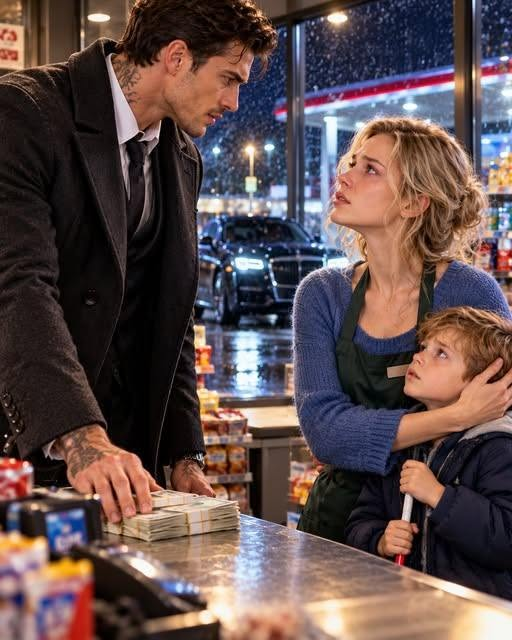
The cold came into Miller's Fuel & Grocery every time the door opened, and that evening it opened like the door was tired of fighting it.
It was the kind of February cold Pennsylvania keeps in reserve for people who have nowhere better to be. It slid under the door seal and pooled around my ankles. It lived in the concrete floor and crept up through the soles of my shoes until my feet ached in that deep, bone-humming way that no amount of shifting my weight could fix. The heater behind the counter rattled and blew out air that smelled faintly of dust and old pennies, and the fluorescent tubes overhead hummed a note I had stopped hearing sometime in my third year behind that register.
F sharp. Even dying, even here, my ear named it. Some training never leaves you.
My hands were chapped raw at the knuckles. The skin between my thumb and forefinger had split again, and I could feel the sting every time I keyed the register or dragged a pack of cigarettes across the scanner. These hands had once been insured by a music school's hopes, if not by any actual policy. These hands had played Chopin in a hall with velvet seats when I was sixteen, and a judge with kind eyes had told my mother that her daughter's touch was "a conversation with the divine." Now they knew the exact drag-weight of a gallon of milk. They knew which lottery tickets the truckers liked and how to palm the scanner gun so the barcode caught on the first pass.
I was restocking the cigarette wall when the headlights came through the front windows.
They didn't sweep past the way through-traffic did on Route 322. They slowed. They turned. A black sedan — long, low, polished to a mirror shine despite the road salt — eased into the lot and stopped at pump six, and the whole shabby forecourt suddenly looked like a photograph of itself: the leaning ice freezer, the hand-lettered sign for firewood, the propane cage, all of it lit up and found wanting in that clean white light.
Nobody local drove a car like that. Nobody local's car cost more than the building it was parked in front of.
My heart knew before my eyes did. That's the truth of it, and I've had seven years to practice lying about everything else, so I'll give you that one for free. My heart slammed once, hard, against my ribs, and then it tried to climb up into my throat.
The driver's door didn't open. The rear door did.
He unfolded himself from the back seat the way tall men do, one hand on the frame, and stood for a moment in the freezing rain that had just begun to spit down, looking at the store the way a man looks at a house he used to live in and has come back to watch burn.
Ethan Hale.
His hair was dark and tousled, longer on top, the kind of careless that cost money now. Rain silvered it at the temples of his forehead. He wore a black wool overcoat over a white shirt and a black tie, and when he pushed the door open and the bell over it gave its cheap, cheerful jingle, I saw the tattoos first — dark ink climbing out of his collar up the side of his neck, more of it across the backs of his hands, his fingers. At eighteen his hands had been clean and scarred only by work. Now they were marked like a document.
Seven years. He had built himself into a rumor men lowered their voices for, and I had watched the edges of that rumor reach even this nowhere town — a name in a news crawl, a photograph I pretended not to look at. Chicago. Shipping. Warehouses. Clubs. The other words people used when they thought no one was listening.
He stopped three feet inside the door and let it swing shut behind him, and the cold that had followed him in stayed, standing between us like a third person.
He looked at me for a long time. I made myself look back. I have had a great deal of practice at not flinching; I have a son, and the world does not care whether you flinch.
"Pump six?" I said.
My voice came out steady, and I was so grateful for that small treason of my body that I could have wept.
Something moved in his face — not surprise. Amusement, maybe, of the bitterest vintage. The corner of his mouth pulled.
"Seven years, Claire."
He said my name the way you'd set down something heavy you'd carried too long.
I tightened my grip on the scanner until the split in my skin sang. "If you're buying something, buy it. The coffee's from this morning. I wouldn't."
He didn't answer that. He walked — slowly, the way a man walks through a museum of his own worst memories — down the short aisle past the beef jerky and the motor oil, trailing two fingers along a shelf of canned soup. He took in the water stain on the ceiling tiles shaped like Florida. The flickering tube over the dairy case. The rack of marked-down Valentine's candy, eleven months proud.
"So," he said at last, conversationally, "this is the life you wanted."
I said nothing. There was no answer to that that wasn't a door I had nailed shut with my own hands.
He turned. The coat swung with him, heavy, beautiful. A coat like that cost more than I made in a month. More than two months, some months.
"Where's Blake?"
My chest tightened so fast it was almost a sound.
"Who?"
"The rich boy you left me for." His eyes didn't leave mine. "Don't tell me the romance didn't last, Claire. You were so sure about him. You were so sure about all of it."
"Ethan. We were eighteen."
"You told me loving me was a mistake." He said it quietly, and somehow the quiet was worse than if he had shouted. Shouting I could have weathered. "You said that to my face. Standing in the rain. Do you remember what else you said?"
"I remember."
"You said I could never afford the life you deserved."
"I remember that too."
I remembered all of it with a precision I would have paid money to lose. I remembered his leg in a cast propped on the trailer steps — broken in a fall from a warehouse ladder three weeks before, the job already gone, the medical bill already on the counter like a fourth person in that tin box of a home. I remembered the rain coming through the collar of his only good shirt. I remembered climbing into Blake's car because the passenger door was already open and because if I had stood there one second longer I would have said the true thing instead of the necessary thing, and the true thing would have gotten him killed.
I had said the cruel words the way you set a bone. Fast. Deliberately. Praying the scream meant it was working.
"Well." Ethan spread his hands a little, the inked backs of them catching the fluorescent light, and the gesture took in the whole of him: the coat, the car, the empire folded inside his silhouette like a held breath. "Look at me now."
He reached into his coat.
I will not pretend I didn't think of a gun. Everyone in three counties knew what Ethan Hale had become, and I knew better than anyone alive what he was capable of surviving — which is its own kind of warning. But his hand came out holding money.
Five bills. He laid them on the counter between us one at a time, unhurried, the way a man lays down cards he knows will win. Five hundred-dollar bills, crisp as church clothes, fanned on the scarred laminate beside the register, beside the little dish of pennies for the next customer, beside the photograph of Mr. Miller's grandkids taped to the till.
"Buy yourself a decent coat," he said.
I stared at the money. Somewhere behind me the dairy case clicked and hummed. Outside, the rain needled the windows.
His gaze dropped, briefly, to the thin blue sweater I wore under my green apron — a sweater that had been washed into softness and out of warmth about two winters ago — and I understood that he had chosen the amount the way he'd chosen everything else about this visit: precisely, and to wound.
I put my palm flat on the bills and slid them back across the counter toward him.
"I don't want it."
His smile had no warmth in it at all. "Come on, Claire. You always loved money."
Those words hurt. I want to be honest about that, because honesty is the only luxury I have left. They hurt the way a diagnosis hurts — not because they were false in the way the world could see, but because I had built them, brick by brick, to be believed. I had made sure he believed them. You do not get to build a lie that strong and then complain when it stands up and walks around.
"You came a long way to say that," I said.
"I came a long way to say one thing." He leaned in, both hands flat on the counter now, close enough that I could smell the rain on his coat and something darker under it — cedar, maybe, or the inside of an expensive car. The tattoos on his neck moved when he swallowed. "Tell me you regret leaving me."
For a moment — God help me, for one unguarded moment — I wasn't in the store at all. I was seventeen, barefoot on the hot tin roof of his mother's trailer with a stolen birthday candle stuck in a hamburger because we'd decided, the two of us, that birthdays were too important to wait for cake money. I was eighteen with his hand wrapped around mine under the bleachers, his thumb tracing the tendons of my wrist like he was already memorizing me for a future he was certain of. He had been certain. That was the thing about Ethan. He had loved me with the terrifying total confidence of a boy who has never once been given a reason to believe the world would let him keep anything, and decided to keep me anyway.
I had loved him more than anything. More than the piano. More than my own life, in the end, which is exactly the arithmetic that had been presented to me, and exactly the price I had paid.
"No," I whispered. "I don't regret leaving."
His face hardened — all at once, like water going to ice — and I watched the boy I'd known finish disappearing behind the man who'd come to collect a debt.
And that was when a small voice came from the doorway of the back room.
"Mommy?"
Every muscle in my body froze.
I knew that voice the way I knew my own pulse. I knew the careful sound that came with it — the soft tap, pause, tap of a white cane against the floorboards of the little back room where Noah did his puzzles at the card table and napped on the cot under my spare coat when my shift ran long. Tap. Pause. Tap. He was navigating by memory and echo, the way he navigated everything: bravely, and entirely without doubt that I would be where I said I'd be.
"Mommy, is that thunder?"
Noah stood in the doorway in his navy jacket, six years old and small for it, his pale brown hair falling over his forehead. His eyes were open — beautiful eyes, the gray-blue of deep water — and they looked at the world the way a locked house looks at a street. His white cane, with its worn red tip, rested angled against his leg, and his free hand was raised a little, fingers spread, the way he reached for weather he couldn't see.
"I don't like the noise," he said, uncertain, and tilted his head. He had heard the rain thicken against the windows. He had heard, maybe, a stranger's voice where no stranger's voice was ever supposed to be.
I was around the counter before I knew I'd moved.
"No, sweetheart. Not thunder. Just trucks on the wet road." I crouched down and took his reaching hands and put them on my face, the way we'd done since he was two — his palms warm against my cheeks, his thumbs finding the corners of my smile so he could read it. "You're safe. Mommy's right here."
He pressed his forehead to mine, and I kissed his hair, and for three seconds the store and the man and the money and the seven years all fell away, because my son smelled like the apple juice on his breath and the wool of his hat, and there has never been a force on this earth that could stand between me and that smell.
Then I remembered we were not alone, and I looked up.
Ethan had not moved. But the man standing at my counter was not the man who had leaned across it a moment before. The ice was gone. In its place was something raw and entirely unguarded — shock, yes, but under the shock a kind of recognition moving like a hand groping in the dark for a light switch it is suddenly terrified to find.
His eyes went from Noah to me. From me to Noah. Cataloguing. The pale brown hair. The small chin. The age of him — doing the arithmetic that I had watched a hundred strangers do and brush past, but Ethan did not brush past it, because Ethan was counting backward from a rain-soaked night seven years ago, and I could see the number he was arriving at written all over his face.
"Is he Blake's?" he asked.
The words came out hoarse. Not an accusation. A man asking whether the floor he was standing on was real.
I stood up and put myself between them — not dramatically, just a mother stepping to the side her body always steps to — and rested my hand on the top of Noah's head.
"Leave, Ethan."
"Claire—"
"Please." I heard my voice crack on it and hated that he heard it too. "Please. Just go."
His jaw worked. His eyes dropped to my son again, and Noah — who could read a room better than most sighted men I've known, who navigated the world by tension and warmth and the tiny weather of other people's breathing — turned his face up toward the stranger's silence with an expression of pure, open curiosity.
"Mommy," he said, "who's talking?"
I swallowed. My hand tightened, just a little, in his hair.
"No one, sweetheart," I said. "No one's talking."
Ethan flinched.
I have seen men on the news flinch less at gunfire. It went through him visibly, that small sentence — *no one* — and I understood too late that I had handed him the cruelest possible echo of the thing I had done to him at eighteen: I had erased him. Again. In front of his—
In front of Noah.
"Congratulations, Claire."
His voice was level and dead and absolutely controlled, and it was worse than anything he'd said since he walked in, worse than the five hundred dollars, worse than *you always loved money*. He picked up the bills from the counter one at a time and put them back inside his coat, and he did it without looking at them, the way you handle something that has embarrassed you.
"Looks like you got everything you wanted."
He walked out. The bell over the door jingled its stupid, cheerful jingle. I gathered Noah up — too big to carry, really, at six, all knees and elbows, but he let me, because he could feel me shaking — and I stood in the window of Miller's Fuel & Grocery and watched Ethan Hale cross the wet lot through the freezing rain, watched the driver hold the door, watched him fold himself into the back of that black car without once looking back.
I held my son until the sedan's taillights had thinned to two red threads on Route 322, and then gone.
"Mommy," Noah said into my shoulder, patient as scripture, "your heart is being loud."
"I know, baby," I said. "I'm sorry. It's just the thunder."
Inside the car, Ethan sat in the dark and watched the little store shrink in the rain-streaked glass, its neon sign buzzing pink and white against the wet night — MILLER'S FUEL & GROCERY, the L in FUEL flickering the way it had flickered for years. His coat was wet at the shoulders. His hands, flat on his knees, were not entirely steady.
Lucas Grant glanced up from the tablet on the seat beside him. Lucas had been with him since the beginning — since before the beginning, since two broke kids with one working car between them — and he was the only man alive who could ask Ethan Hale a question like the one he asked next.
"Boss. Was that her?"
Ethan nodded once.
"She has a son."
"With the rich guy?"
Ethan stared out at the rain, at the small lit windows falling away behind them.
"I don't care."
Lucas, who knew better than to believe him, said nothing at all.
The car turned onto the highway entrance. Ethan watched the dark fields of Pennsylvania unspool past the glass, and when he finally spoke, his voice had the quiet in it that his men had learned to fear more than his temper — the quiet of a decision already made and already paid for.
"Find out who owns that gas station."
Lucas frowned. "Why?"
"I want to buy it."
"And then, Boss?"
Ethan's eyes stayed fixed on the road unwinding behind them, on everything he couldn't see anymore.
"Then I want to know what happened to the girl who destroyed my life."
He never found the answer that night. It was closer than the rain on his window. It was sitting where it had sat for seven years, in the locked drawer behind the counter of Miller's Fuel & Grocery, under the spare register tape and a tangle of rubber bands, in an envelope gone soft at the corners.
An old hospital receipt.
A name written on it that was not the name Ethan Hale expected — a name that, if he ever read it, would burn the whole story of Claire Whitmore down to the ground and show him the one thing buried in the ashes:
That I had not left him because I stopped loving him.
I had left him because loving him was the only weapon anyone had ever found that could be used to kill him — and I had taken the blow myself, in his place, and let him hate me for seven years rather than watch him die for the truth.