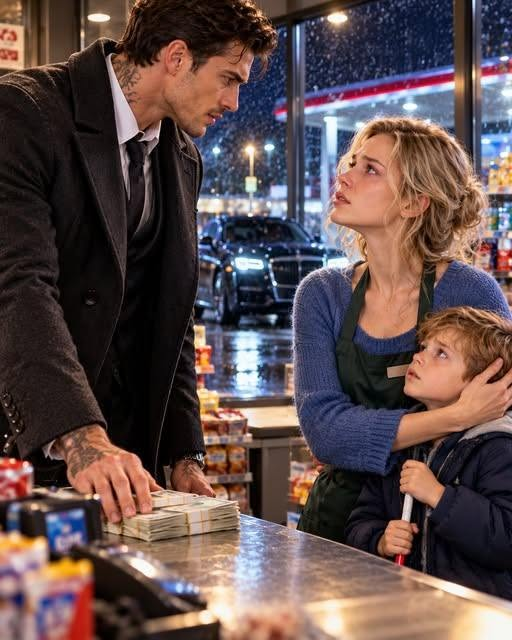
I did not sleep that night.
I lay on the pull-out couch in the back room with Noah curled against my side, his small hand fisted in the hem of my sweater, and I listened to the rain work its way across the roof of Miller's Fuel & Grocery until the rain stopped and the silence it left behind was worse. Every time I closed my eyes I saw Ethan's face in the doorway of my store — not the face of the boy I had loved, but the face of the man who had stood over my counter with five hundred dollars and seven years of hatred arranged neatly in his eyes.
At five forty the alarm on my phone buzzed against the counter where I had left it charging, and I got up the way I got up every morning, because Noah still needed breakfast and the store still opened at six and the world did not pause for ghosts.
My hands shook while I made his oatmeal. That was the thing I noticed. My hands, which had once been steady enough to play Chopin in a recital hall in front of three hundred people, shook so badly I spilled brown sugar across the counter and had to sweep it up with the side of my palm.
"Mommy's making the floor crunchy," Noah said from the doorway, and I turned around.
He stood there in his dinosaur pajamas with his hair flattened on one side, one hand trailing along the doorframe out of habit even though he knew that room the way I knew the keys of a piano. My son did not need his eyes in the back room. He had built the whole place out of sound and touch and counting, the way he built everything.
"From my bed to the door is nine steps," he informed me, in the serious voice he used for facts he had personally verified. "From the door to the couch is four. From the couch to where you are is six, but if the stool is out it's six and a hop."
"And how many steps to the counter?" I asked, because it was his favorite question and because my voice needed something ordinary to hold on to.
"Eleven from the back door. Twelve if I go around the freezer because the freezer hums and I like it." He tilted his head. "You're sad this morning. Your voice is low."
Children who cannot see learn to hear everything. Noah could tell the difference between my tired voice and my frightened voice and my pretending voice, and at six years old he already knew better than to believe the pretending one. I crouched down and he found my face with both hands, the way he had done since he was two years old, his palms warm against my cheeks, reading me.
"I'm just tired, baby."
"You didn't sleep. The couch creaked all night. You only creak the couch when you're scared." He said it without accusation, the way he reported the weather. "Was it the thunder?"
"No, sweetheart. It wasn't the thunder."
He considered this with his whole face. Then he patted my cheek twice, which in Noah's language meant the matter was settled for now, and said, "Oatmeal's getting cold. I can smell it."
The store had a smell in the morning before the doors opened — floor cleaner and old coffee and the faint sweetness of the doughnuts that came in a plastic tray from a bakery two towns over. Noah knew the store by its sounds the way other children knew places by their colors. He knew the bell over the front door, which gave a double chime, one note going up and one coming down. He knew the freezer's hum and the ice machine's clatter and the exact creak of the third floorboard from the register, which he avoided the way you or I would step around a puddle. He knew that rain on the awning sounded like fingers drumming and that rain on the dumpster out back sounded like coins, and that the big trucks on Route 11 made the windows buzz in their frames starting low and climbing, like a note being tuned.
I set him up in his corner behind the counter with his Braille picture book and his cup of milk with the straw he could find by the ridged band he had insisted I wrap around it, and I unlocked the front doors at six with my heart slamming against my ribs — because some part of me, some traitorous terrified part, expected Ethan Hale to be standing in the parking lot in the gray morning light.
He wasn't. There was only Mrs. Delgado buying lottery tickets and a state trooper drinking coffee by the pumps, and the ordinary world going on as if a mafia boss had not walked into my life the night before and set fire to seven years of careful hiding.
By nine o'clock I had convinced myself of two things. First, that he was gone for good, that seeing me like this — cheap sweater, scarred counter, a child he believed belonged to another man — had satisfied whatever he came for. Second, that I was a fool for believing the first thing, because I had known Ethan Hale since I was eleven years old and Ethan Hale had never once in his life let go of anything.
The piano lived in the back room because Mr. Miller's wife had played it and Mr. Miller could not bring himself to sell it after she died, and could not stand to look at it either, so it sat under a quilted cover between the mop sink and the shelves of motor oil, slowly going out of tune in the damp. Noah found it by accident when he was four — eleven steps from the door, four past the couch, both hands out — and came to me vibrating like a struck string. *Mommy. There's a piano in the wall.*
That morning, after the breakfast rush, I took the cover off. I don't know why. My hands needed it, maybe. Or I needed to remember that before I was a cashier with a locked drawer and a lie for a life, I had been a girl whose hands were famous in three counties.
Noah climbed onto the bench beside me by memory and put his fingers where I put mine.
"Soft hands," I said. "Don't push. The keys come to you."
I taught him the first three notes of the Nocturne — the piece I had only ever played for one person, on a borrowed piano in a music room after school, while a poor boy with a broken leg healed in a cast on the bench beside me and told me that when he heard me play he could forget his leg hurt. I had not played it in seven years. My fingers found it anyway. Grief lives in the hands longer than it lives anywhere else.
Noah pressed the keys with enormous concentration, tongue caught between his teeth, and when he got the three notes in the right order he gasped like he had caught a fish. "Again," he demanded. "Again, again." And I hummed under my breath while he played it, wrong rhythm, wrong everything, perfect — and for eleven minutes I was not afraid.
Then the bell over the front door chimed its two notes, up and down, and my whole body went cold, and it was only a courier with a clipboard and a manila envelope and no reason at all to know he had just handed me the end of the world.
The letter inside was on paper so thick it felt like cloth. A law firm in Chicago — I read the city name and had to sit down on the stool behind the register — writing to inform the staff of Miller's Fuel & Grocery that the business had been sold, effective immediately, to a holding company called H&G Acquisitions. All current employees would retain their positions and pay rates *for the present time*. Nothing about the new owner. Nothing about why a Chicago holding company would want a failing gas station in Pennsylvania. Just that sentence, *for the present time*, sitting in the middle of the page like a crack in ice.
Mr. Miller came in at noon with his good coat on and a shine on his face I had never seen in four years of working for him.
"You heard, then," he said.
"You sold the store." My voice came out flat. "You didn't say a word, Mr. Miller. Not one word, in four years I never missed a shift—"
"Claire." He held up both hands, and he was smiling, actually smiling, the way a man smiles at a winning ticket. "They offered me more than this place has been worth in twenty years. More than my boy would've paid, God rest him. Cash. I asked them why — I'll be honest with you, girl, I asked them three times why — and the fellow on the phone just said the company is expanding into the region." He shrugged, helpless and delighted. "What was I supposed to do? I'm seventy-four. My knees—"
He talked for ten more minutes. About his knees, and Florida, and his sister in Sarasota. He never once said the name of the man on the phone, and I never asked, because I already knew whose hand was on the other end of that pen. I knew the shape of it. I had spent seven years building a life small enough and quiet enough that Ethan Hale would never find it, and he had found it anyway, and instead of burning it down he had simply *bought* it. The floor. The shelves. The counter. The eleven steps from the back door. All of it, purchased, the way rich men purchase everything that has ever refused them.
That night I counted my money in the back room after Noah fell asleep, the way I counted it every Thursday. Rent on the room and board arrangement with Mr. Miller — which was part of the store now, which meant my home had been sold out from under me too, and wasn't that a detail the thick paper hadn't mentioned. The envelope for the eye specialist in Pittsburgh, who could tell me nothing new but whom I paid anyway because hope is a bill that comes due every month. The envelope for Noah's new cane, because he was growing and the red tip on the old one had worn smooth. Forty-one dollars in the envelope marked *just in case*, which had been forty-one dollars for five months.
I thought about running. I want to be honest about that. I stood in that little room with forty-one dollars in my hand and I planned it — the bus station in Scranton, a city where nobody knew my name, a new store, a new counter, a new set of steps for Noah to count. And then I looked at my son asleep with his hand curled around the worn red tip of his cane, and I understood that Ethan Hale owned shipping companies and warehouses and nightclubs, and that men like him did not lose women in bus stations. If I ran, he would know I was running. And if he knew I was running, he would start asking himself what I was running from — and that question, that one question, was the door I had kept locked for seven years with both hands.
So I stayed. I opened the store every morning. I stocked milk and scanned cigarettes and taught my son three notes of Chopin at a time. And three nights after the letter came, I saw the sedan for the first time — black, clean in a way nothing on Route 11 stayed clean, parked across the street by the darkened feed store with its lights off and its windows up. It was there when I locked up at ten. It was there the next night, and the next. It never came closer. It never left before I did. I began to understand that it was not a threat. It was a metronome. It was Ethan Hale keeping time while he decided what to do with me.
On the fifth night, Noah asked about the thunder man.
"Why hasn't he come back?" he said, swinging his legs off the edge of the counter while I counted the register down. "The man from the storm. His voice was in my dream."
My hands stopped on the money. "You remember his voice?"
"It was low," Noah said, with the authority of a boy who built people out of voices the way other boys built them out of faces. "It went down at the ends of the words, like the freezer hum but a person. It wasn't a mean voice, Mommy. It was a sad voice that was pretending to be mean." He tilted his head toward me, and his unseeing eyes aimed at my face with terrible accuracy. "I liked the sound of it. When is he coming back?"
"I don't know, baby," I said, and my voice did the thing he could always hear. "I don't think he is."
Noah was quiet for a moment. Then he said, "You creaked the couch again last night," and slid down off the counter and counted his eleven steps to the back room to get ready for bed, trailing his fingers along the counter's edge, unhurried, at home in the dark in a way I would never be.
I finished the closing the way I always finished it. Wipe down the counter. Empty the drip tray. Count the register twice. And that was when I saw the second envelope — plain white, no markings, tucked half under the register where the courier's stack of delivery slips lived, where I must have missed it in the morning's pile. It had my name on the front. Not *Claire*. *Night-shift cashier.* Typed.
Inside was a single staff notice, the kind the new management had been sending all week about schedules and suppliers, and clipped to it was a yellow routing slip covered in handwriting. I recognized the handwriting before I read a single word. I would have recognized it on a wall in another country. Ethan had terrible handwriting — tall, slanted, impatient, the letters leaning forward like they were in a hurry to be finished. He had signed my birthday cards with it. He had written my name in it on the inside cover of a library book in the summer we were seventeen.
Most of the slip was instructions to someone in an office — *forward, confirm, file* — initialed in other hands. But one line had been circled, twice, in black ink, hard enough to score the paper. It was the last line on the slip, written in that tall leaning hand above two initials I had once traced with my fingertip on a boy's wrist in the dark.
*The night-shift cashier stays. — E.H.*