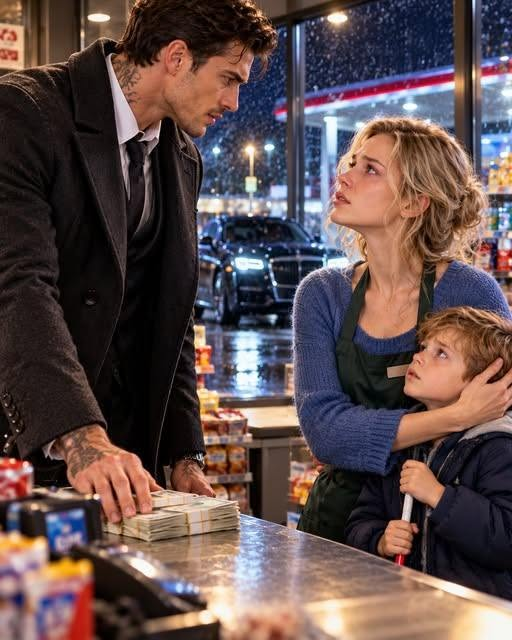
Three days after Ethan Hale bought Miller's Fuel & Grocery, the locks changed.
I came in for my shift on Thursday morning and found a locksmith's van in the lot and a man I didn't know standing at the pumps with his arms folded, watching the road like the road owed him money. By noon there were cameras over the register and over the door. By Friday, a delivery truck I had never seen before was unloading stock we had never been able to afford, and Mrs. Abernathy from the diner across the street came in just to whisper, "Claire, honey, who *is* this man?" and I said, "The new owner," like those three words didn't taste like ash.
Ethan didn't come back in person. That was almost worse. He was everywhere without being anywhere — in the new alarm code they'd given me, in the envelope of cash wages that replaced my checks, in the way the man at the pumps straightened up when a black car passed on Route 11, even when it wasn't his. I told myself the cameras were for the store. I told myself the guard was for the inventory. I was very good, by then, at telling myself things.
Noah asked about the tall man exactly once.
"Did the thunder man buy your store, Mommy?"
"He bought the building, sweetheart. Not the people in it."
He considered this with the seriousness he gave everything. "Good," he said finally. "Because you're mine."
I held onto that sentence for two days like a handrail.
Blake Caruso walked in on Sunday, just after one o'clock, in full daylight, with the bell over the door announcing him like any other customer.
I knew him before I saw him. That's the strange thing. I knew him by the pause — the way the door didn't swing shut right away, the way a person stands in a doorway deciding whether they have the right to come in. My hand was already reaching for the register to call up the screen I didn't need. Then I looked up, and my whole body went back seven years in one sick lurch.
He was thinner. That was the first thing. The Blake I remembered had been soft with money — good shoes, good haircut, that loose rich-boy grin that said the world had never once told him no. This man had cheekbones. This man had shadows under his eyes that no amount of sleep had fixed, and a tiredness that went deeper than one bad night. His coat was plain and old. His hands, when he took them out of his pockets, were a working man's hands, nicked and dry.
Seven years ago he had driven me out of town in his father's car with my whole life in a duffel bag at my feet, and he hadn't said one word for the first hundred miles. I had hated him for that silence once. Standing there in the refrigerated hum of Miller's, looking at what time had done to him, I understood for the first time that the silence might not have been cruelty.
It might have been the sound of a eighteen-year-old boy understanding what his father was.
"Hi, Claire," he said.
"You can't be here," I said. It came out before anything else could — before hello, before how did you find me. Seven years of practice. "Blake. You can't be here."
"I know." He didn't come any closer to the counter. "I wouldn't have come if it wasn't — Claire, I wouldn't have come at all. Can I have five minutes? Please. I drove four hours."
The store was empty. Through the glass, the man at the pumps was looking at his phone. Noah was at Mrs. Abernathy's for the afternoon, eating grilled cheese and listening to her television too loud, safe in the one place in this town where nobody new ever went.
"Five minutes," I said. "Talk."
He told me his father was dying.
Vince Caruso — the name I had not said out loud in seven years, the name that lived in my locked drawer and in the back of my throat — was in a hospital bed in a house outside Scranton with a liver that had finally presented the bill for sixty years of being Vince Caruso. Dying, Blake said, but slowly, and mean about it, and lucid. Lucid was the dangerous part. Because a man in a bed with nothing left to protect except his own legend starts listening to everything, and word travels up to a bed like that the way water finds a crack.
"A man he still has in Chicago brought him a name," Blake said. "Ethan Hale is buying up property in Pennsylvania. Ethan Hale has been asking questions about seven years ago. About a girl. About a night." He looked at me, and there was no triumph in it, only dread. "My father built his whole life on one rule, Claire — nobody ever learns what he did. Nobody can ever prove it. He broke a poor kid's leg and threatened to finish the job, and then he made the kid's girl disappear, and Ethan Hale never even knew his name. That's the story my father tells himself about his own power. And now Ethan is out there pulling threads."
"He doesn't know anything," I said. "Blake, I've made sure of it. He thinks I left him for you. He thinks Noah is—" I stopped.
"I know what he thinks." Blake's voice went rough. "I've known what he thinks for seven years. I read about him, Claire. Every few months I'd search his name and there'd be more of it — the warehouses, the indictments that never stuck, the men who disappeared. I built that. We built that. My father aimed him like a gun and my job was to drive the car and smile." He shook his head. "I got out. I want you to know that, even if it doesn't matter. I haven't taken a dollar of his money in five years. I fix commercial refrigeration in Ohio. That's my life now. It's small and it's clean and it's mine. And I'm standing here risking all of it because when my father's people move, they won't send a letter. They'll send the kind of men who don't leave witnesses to feel guilty about."
"Then I'll tell him it was nothing," I said. "If anyone asks—"
"Nobody will *ask*, Claire. That's not how it works. He's dying and he's scared, and a scared man's first instinct is to clean house. You are the house. You and the boy." He leaned forward then, just a fraction, and I saw the boy he'd been flicker in his face. "So I'm begging you. Run. Today. Take Noah and go somewhere with no cameras and no new owner, and let me figure out how to keep you ahead of it. Or — " He stopped.
"Or what?"
"Or tell Ethan everything. All of it. The leg. The choice my father gave you. Whose son Noah is." He said it quietly, like a man setting down something heavy he'd carried up a long flight of stairs. "He's the only person on earth dangerous enough that my father might hesitate. You know that. It's why you hid the truth *from* him — because the truth turns him into a war."
"Don't," I said.
"Claire—"
"No. You don't get to come in here and say that like it's a plan." My voice was shaking and I let it. "Listen to me. Noah has a life here. He has a school that knows his name and a teacher who braille-labels his cubby. He has a route to the park he can walk by counting the cracks in the sidewalk, Blake, he *counts* them, he knows this town by heart in the dark, which is the only way he will ever know any town. You want me to take that from him and put him in a motel room in a state he's never heard, with a mother who jumps at headlights? No. I ran once. I was eighteen and I ran, and it cost everything it cost, and I will not do it to him."
"And telling Ethan?"
"If Ethan learns the truth, he goes after your father." I could see it as clearly as if it had already happened — I had been seeing it, in pieces, for seven years, every time I let myself. "Your father has men. Ethan has more. Men die, Blake. Men with mothers. And at the end of it, what does Noah have? A father in the ground, or a father in prison, or a father who looks at him and sees the thing that was stolen. There is no version of the truth where my son keeps his father. Either way, he loses him. Either way." I was crying by then, quietly, the way you learn to cry at a register, without moving your face much. "He's already lost him for six years. I did that. I chose it, every single day, because the other choices were worse. Don't stand in my store and tell me the math has changed just because your father is dying."
Blake was silent for a long time. The cooler case hummed. A truck went past on the wet road.
"The math hasn't changed," he said at last. "That's the hell of it. I drove four hours knowing you'd say exactly this, and you're right, and he's still dying with your name in his mouth." He put his hands flat on the counter, gently, the way you approach something that might bolt. "I'm not leaving town tonight. I got a room at the motel by the interstate. If anything happens — anything, Claire, a car you don't recognize, a question from a stranger — you call me. I'm in the book under my own name now. I've been in every book under my own name for five years, waiting for one of you to need me to not be a coward."
He bought a coffee he didn't drink, so the man at the pumps would see a customer, and he sat in his old car in the lot for a while before he went in to Mrs. Abernathy's side of the street — no. He just sat. I watched his windshield fog. I told myself he would leave by dark.
He was still parked there at seven, when the rain started up again, and I was counting the register down with the door locked when headlights swept the lot and stopped my heart the way they had learned to.
Ethan didn't knock. He had a key now; of course he had a key, it was his store. He came in out of the rain with water in his dark hair and his coat over one arm, and he was already looking at me when the bell finished ringing, already wearing that expression he wore when he'd rehearsed a thing and intended to say it — and then he saw Blake, who had come back in out of the rain an hour before to use the restroom and stayed, God help us both, because neither of us had known how to end it.
Blake stood up from the stool by the coffee machine.
And I watched seven years of control come off Ethan Hale's face like a mask in a fire.
He crossed the store in four strides. He took Blake by the wrist and the collar — not a punch, never a punch, something worse, something *measured* — and put him back against the cooler doors hard enough that the bottles rattled in their racks, and held him there with one tattooed hand twisted in his shirt, close enough to speak quietly.
"You," Ethan said. Not loud. That's what I'll remember — how not loud it was. "You walk into *my* station. You sit in *my* store. You put your eyes on *my*—" He stopped. The word died in his mouth like he'd bitten down on it. His jaw worked. Whatever he'd almost said, he swallowed it back into the place where he kept everything he'd never let himself want. "Get out. Get out of this town. If I see your face again—"
"Ethan," I said. My voice didn't feel like mine. "Let him go. Please. He's not— he never—"
He didn't look at me. "Stay out of this, Claire."
But Blake wasn't struggling. That was the terrible thing. Blake stood in Ethan's grip with his hands open at his sides, not fighting, not even flinching, looking past the hand at his collar at me — and then at Ethan, with an expression I had never seen on any living face: a man at the very end of a long debt, setting down the last of it.
"I'm not doing this anymore," Blake said. Very quietly. To me first, like an apology. Then to Ethan, like a sentence. "Seven years I've carried it. I won't carry it into his grave, and I won't carry it into yours."
"Blake," I said. "Don't. Please don't."
"Ask her about the hospital, Ethan," Blake said. "Ask her whose name is on the paper."
Then he pulled his collar free — gently, the way you'd free a snagged sleeve, nothing Ethan couldn't have stopped — and he walked out into the rain without his coffee, and the bell over the door rang, and Ethan didn't go after him.
Ethan turned around.
He looked at me the way he'd looked at me the night he put five hundred dollars on my counter — except this time there was no contempt in it, no performance at all, only a question so big it had changed the shape of his face.
And behind me, in the locked drawer under the register, under seven years of dust and denial, sat a folded hospital receipt with his name on it.