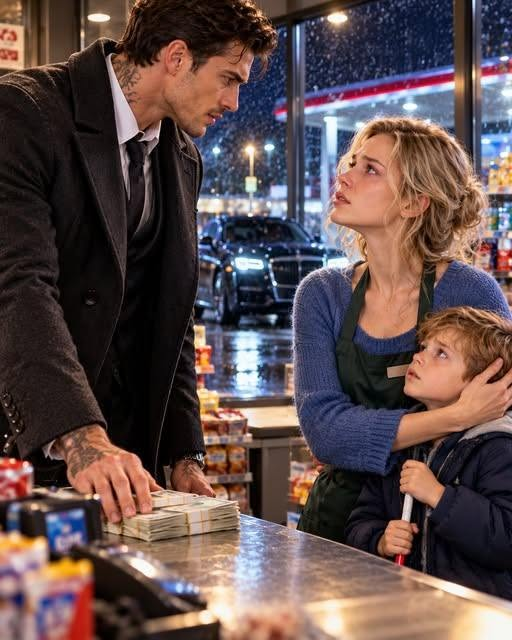
That night, the storm came down off the hills the way I had always known it would. Not as weather. As a reckoning.
I had closed the station at eight. I had counted the register twice, because my hands needed something to do, and I had checked the lock on the drawer behind the counter three times, the way I had checked it every night for seven years — a little prayer made of brass and habit. Noah was asleep in the back office on the cot I kept there for storm nights, his white cane folded on the chair beside him, his breathing slow and even over the sound of the rain starting to needle the roof.
I knew Ethan would come. Blake's words had been ticking in my head all afternoon like a second pulse. Ask her about the hospital, Ethan. Ask her whose name is on the paper.
He came at nine, out of the rain, in a coat already dark with it. He didn't knock. The bell over the door made its small, cheerful sound, and it sounded obscene.
"Blake found me today," he said.
I kept my hands flat on the counter. "Then you wasted a trip."
"He said something I can't get out of my head." Ethan came closer, and the wet cold came with him, off his coat, off his skin. "He said, 'Ask her about the hospital. Ask her whose name is on the paper.'" His eyes never left mine. "So I'm asking, Claire. What hospital? What paper?"
Seven years of locks. Seven years of swallowing. I stood there with my heart slamming against my ribs and I did the thing I had trained myself to do — nothing. I said nothing, and my silence said everything, and I watched him read it.
"Claire." His voice dropped. "I'm done being lied to in pieces. Whatever it is — give it to me whole, or I swear to God I'll tear this place apart looking for it."
He took one more step toward the counter.
And the lights went out.
Not flickered. Not the storm worrying the lines the way it did out here, a brown sag and a recovery. Gone — all of it at once, the fluorescents, the cooler hum, the little red eye of the register — cut clean, the way a thing is cut on purpose. The whole store held its breath in the dark.
"Ethan," I said.
"I hear it," he said quietly. "Stay where you are."
Then, from the back of the store, past the stockroom door: the sound of glass giving way. Not a bottle knocked off a shelf. A pane. Deliberate. Followed by a silence so careful it had hands.
Noah was back there.
I don't remember moving. I remember the counter edge hitting my hip as I came around it, and Ethan's hand catching my arm in the dark, hard, and his voice low in my ear: "Office door is closer from my side. We go together. Stay behind me."
The smell reached us before the men did — kerosene, sharp and sweet, poured over cardboard and stockroom shelving. One of them had a flashlight, and its beam swung crazed patterns across the aisles as they worked. They hadn't come to rob the place. Men who rob a gas station go for the register and the safe. These men had come with a can and a purpose, and the purpose was a message, and I knew whose handwriting it was written in before either of them spoke.
Vince Caruso had been sending messages with fire and broken bones since before I was old enough to understand what a message was.
"Mommy?"
Noah's voice, small and sleep-frightened, from the office doorway. He had woken to the dark — his whole world was always dark, but this dark was wrong, full of noise and strangers and that smell — and he had come feeling his way along the wall for me, the way I'd taught him, one hand trailing the shelves.
"Noah, freeze," I said, and I made my voice the calmest thing in that store. "Freeze right there, baby. Mommy's coming."
The flashlight beam found him first.
What happened next happened very fast and has stayed very slow in my memory, the way the worst seconds do. One of the men came down the aisle toward the noise — toward my son — crowbar swinging loose at his side, not even hurried, just clearing a path through stock, sending a rack of motor oil crashing down. Ethan went past me like the dark itself had decided to move. He didn't go for the man. He went for Noah. He scooped my six-year-old up and turned his own back to the falling shelf in one motion, and I heard the impact — bottles, metal, glass — hit Ethan instead of my son, heard the breath go out of him, and he did not let go and he did not go down.
I got the office door open. "Here — Ethan, here—"
He backed in with Noah locked against his chest, set him into my arms in the doorway, and said, "Out the side. Don't stop for anything. Not even for me."
"The window in the office—" I was already moving, Noah's arms around my neck, his face buried, his whole small body shaking. "It sticks. Ethan, the frame sticks—"
"Then I'll buy you time to unstick it."
Behind us the kerosene smell thickened — and then, miraculously, thinned, because the rain was coming through the broken stockroom window in sheets and the stockroom floor was already awash, and whatever fire they'd dreamed of was drowning in its own weather. I heard Ethan's voice, very calm, the calm I'd heard strangers go quiet for: "You're doing this for a dying man. Think about that." And a scuffle — a body into shelving, a grunt, the crowbar clattering — and then headlights. Headlights raking the windows, one car and then another, doors, voices — Lucas's voice, above the rain, using words like orders.
The two men went out the back the way they'd come in, through the rain and the mud behind the pumps, and they did not stop to finish anything.
I got the office window up on the second try. I passed Noah out into the wet and climbed after him, and by the time I carried him around the front of the store, Lucas was there, taking him from my arms with a gentleness I would not have believed his hands knew, settling him in the back seat of the sedan with a blanket off the rear shelf.
"Mommy?" Noah's hands searched the air.
"I'm right here." I held his face. "You're safe. That was just the storm being loud, and it's over now."
"Was that the thunder man?" he whispered. "The one with the rain voice?"
I looked up. Ethan stood in the wrecked front of my store, in the light of the one emergency lamp, rain blowing sideways through the propped door, his ruined coat hanging off him, blood or kerosene or rain — I couldn't tell — dark down one sleeve. He was looking at us. He had heard.
"Yes, baby," I said. "That was him. He kept the storm off you."
Inside the store, the damage had the shape of a tantrum that had been interrupted. Smashed cooler door. Oil and glass across the floor. The kerosene can on its side in a spreading rainbow sheen that the rain kept diluting. And behind the counter — where one of them had gone hunting for the register money with the crowbar — the little locked drawer I had checked three times that evening hung open and crooked on its runners, its lock splintered out of the wood.
Seven years I had kept that drawer between Ethan Hale and the truth.
Now it stood open, and there was nothing between them at all.
He saw it. Of course he saw it. He stood in the wreckage with the rain dripping off him and his eyes went from the broken drawer to my face, and I understood that this was the moment — not chosen by me, not timed by me, ripped open by strangers' hands — and that every instinct I had left was screaming at me to run to it, to slam it, to beg.
I didn't move.
"Open it," I said.
His jaw worked. "Claire—"
"You came here tonight to ask me whose name is on the paper." My voice was shaking and I let it shake. "Open the drawer, Ethan."
He crossed the store slowly, glass crunching under his shoes. From the drawer he took the envelope — soft at the corners, gone gray at the folds from my own hands — and he drew out the receipt with a care that undid me. Hospital letterhead. A small-town hospital three hours from anywhere he'd ever looked for me. He read it the way a man reads his own sentence. I watched his eyes find the date first, and stop, and do the thing I'd watched him do in my nightmares for six years: the math.
His eyes found the other line.
FATHER: ETHAN HALE.
The store was very quiet. Rain on the roof. Water dripping off his coat onto the broken glass.
"He's six," Ethan said at last, to the paper. "Six years and nine months ago." His voice cracked on something that wasn't quite a word. "He was already— Claire, he was already on his way. When you stood in the rain and told me you wanted money. When you got in that car. He was already—"
"Yes," I said. "I found out three weeks before your leg."
And then, because there was nothing left to protect except him, I told him everything. All of it, standing in the wreck of the store he'd bought to punish me, while my son slept in his man's car outside.
"Your leg wasn't an accident, Ethan. It wasn't bad luck on a wet road. That was Vince Caruso's men, with a tire iron, in the dark behind the garage — a warning, for the debt. You were eighteen and you thought the world had just been cruel to you in an ordinary way, and I let you think it, because four days later Vince Caruso came to me himself. Not a phone call. Himself, in a car outside the school, with a man in the front seat who never turned around. I was pregnant and I was eighteen and he told me exactly how it worked. You were a message he was still writing. If I vanished — if I made you hate me so completely that you would never come looking, never ask questions, never go digging near his name — then the message was finished, and you'd live. If I told you the truth, if I ran to you, he'd finish what the tire iron started. He said, 'He's got one good leg left, sweetheart. Spend it wisely.'"
Ethan had gone utterly still.
"Blake wasn't anything," I said. "There was no rich boy, Ethan. There was never a rich boy. Blake was a kid with a car who got told to drive and not ask questions, and I sat in the back seat of that car and I rehearsed. All the way out of town I rehearsed the words, because Caruso said they had to be cruel enough that you'd believe them forever — and I knew you, and I knew the only thing that would keep you from following me was if I made you ashamed you'd ever loved me. 'I want money. I want a life you can't give me.' I said them in that car a hundred times with my hands over my mouth so Blake wouldn't hear me crying in between."
His face. I have no words big enough for his face.
"I had Noah in that hospital on the receipt because it was far enough that nobody knew my name. I was nineteen and alone and it took eleven hours and when they put him on my chest he turned his face toward my voice like he already knew it. And when the nurse asked me the father's name for the certificate — Ethan, I could have said anything. I could have said nothing; women did, nobody would have stopped me. But it was the only piece of you I was allowed to keep. So I said your name, and I made them write it down, so that somewhere in the world there would be one true thing about us that I hadn't had to kill."
The silence after that had a weight I could feel in my teeth.
"Noah's eyes," Ethan said suddenly, hoarsely. "Was that— Caruso too? Is that why he—"
"No." I shook my head, hard. "No. The doctors said it was just — it happens, Ethan. It doesn't need a villain. He was born that way and he is not broken, he is the best thing that ever—" I stopped. "He hums when he eats toast. He knows my footsteps on gravel. He is not a tragedy. He's your son."
Ethan looked down at the receipt in his hands like it had become too heavy to hold, and when he spoke, the rage that had lived in him for seven years came up out of his chest turned entirely outward, pointed like a weapon finding its true target at last.
"Caruso," he said. "Dying or not — I want him where I can reach him."
"Ethan, no." I caught his arm — actually caught it, my hand around his forearm, feeling the tremor running through him like current. "Listen to me. Listen. Two men came here tonight, for a man who's supposed to be dying in a bed somewhere. Dying men don't send messages, Ethan. Whatever is left of him, it still has hands, and those hands just reached into my son's home. If you go at him now — blind, shaking, with this—" I nodded at the receipt — "burning a hole through you, you will walk into whatever is waiting with your guard down, and I did not spend seven years in hell to lose you in a week. Noah just got a father. Let him keep one."
For a long moment he just stood there, breathing, my hand on his arm, the receipt in his other hand. Then, very carefully — as if it were made of something that could shatter — he laid the receipt down on the counter between us.
"He's six," he said quietly. "He's mine."
"Ethan—"
"You should have let me die, Claire." Quieter than any shout he had ever aimed at me. Quieter than the rain. "It would have hurt less than this."
He walked out of my wrecked store into the storm, past his men, past the car where his son slept under a blanket, and the rain took him in a dozen steps.
I stood behind the counter with the receipt between my hands and did not call after him. I had lost Ethan Hale once for lying to him. I had no idea, standing there, whether I had just lost him again for finally telling him the truth.