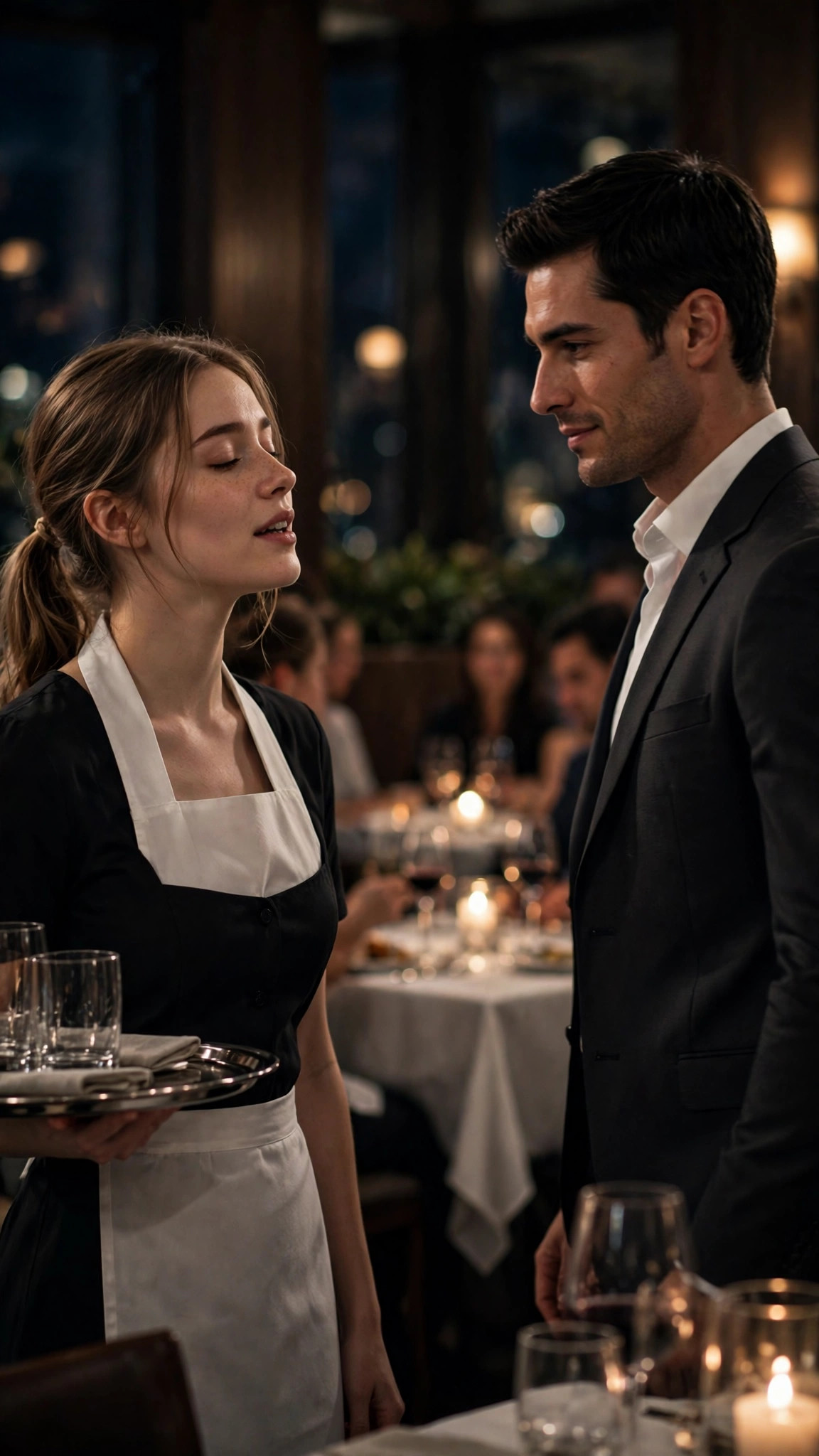
The hours between Lorenzo's command and closing time were the longest of Emily Carter's life.
She worked them the way a person walks through a burning building — one step at a time, eyes forward, not thinking about what comes next, because thinking about what comes next would mean stopping, and stopping would mean falling apart. She carried trays. She poured wine. She smiled at tables. She said "enjoy your meal" and "can I get you anything else" and "of course, right away," and every word came out steady and normal, and none of it felt real, because underneath all of it, underneath the dress and the apron and the smile, her mind was running in circles around a single sentence: Sing that again. Tonight, after closing.
Tony found her in the service corridor, halfway through the evening, and grabbed her elbow — not roughly, but firmly, the way a man grabs someone who is about to step off a curb into traffic.
"What did you do?" he hissed.
"I didn't mean to," Emily said. "It just — the piano — I didn't even realize I was doing it until—"
"Do you have any idea who that man is?" Tony's face was pale. He had worked at Il Cielo for twenty-two years, and Emily had never seen him afraid before, and that frightened her more than anything else that night. "That's Lorenzo Bianchi. He owns this restaurant. He owns half the restaurants on this street. And the last time anyone sang in his dining room, his fiancée disappeared the next morning and was never seen again. Do you understand what I'm saying to you?"
"I understand," Emily said, and she did — she understood better than Tony could possibly know, because she had been there, three years ago, in the foundation's office, typing the transfer orders that had made that disappearance possible, and she had spent three years running from the consequences, and now she had walked directly into the center of them and started singing.
"He told me to sing again after closing," she said.
Tony closed his eyes. "Then you sing again after closing," he said. "You do exactly what he says. You don't argue. You don't ask questions. You sing the song, and then you go home, and you pray he forgets you by morning."
"I don't think he'll forget me," Emily said quietly.
"No," Tony agreed. "I don't think he will either."
The rest of the evening passed in a blur of trays and tables and wine glasses, and Emily worked it the way a person walks a tightrope — carefully, and without looking down.
Table twelve sent back a plate, and then sent it back again, and Sofia leaned over in the service corridor and whispered, "They do that every week. The wife hates the chef. The husband hates the wife. Don't take it personally." Table four's anniversary couple asked Emily to take their photograph, and she did, and the husband said, "Fifty years," with the wonder of a man who still cannot believe his luck, and the wife said, "Fifty-one next year, if he behaves," and Emily laughed, and for a moment, she almost forgot why she was afraid.
She almost dropped a tray near the piano. Old Enzo caught her eye and winked — a slow, deliberate wink, the wink of a man who has seen everything and is surprised by nothing — and he played a few bars of something soft and wordless, and Emily understood, suddenly, that he knew. He had heard her sing that afternoon. He had heard Lorenzo stop in his tracks. He knew what the song was, and he knew what it meant, and he was telling her, in the only language he had, that it was all right.
At ten o'clock, the dining room began to empty. At ten-thirty, Tony started turning down the lights. At eleven, the last table left — a pair of businessmen who had argued quietly over dessert and then shaken hands, the way men do when they have decided to pretend the argument never happened — and Carlo the chef came out of the kitchen, wiping his hands on his apron, and looked around the empty room, and said, "Bene. We survived another one."
The staff began their closing routine: wiping tables, stacking chairs, polishing glasses, counting the till. Sofia found Emily in the service corridor and grabbed her arm. "Are you all right?" she asked. "You've been white as a sheet since seven o'clock."
"I'm fine," Emily said, and it was a lie, and Sofia knew it was a lie, and Sofia did not push, because Sofia was the kind of friend who knows when to push and when to wait, and this was a time to wait.
"Whatever he wants," Sofia said quietly, "you give it to him. And then you go home. And tomorrow, if you need a day off, you take it. I'll cover for you. All right?"
"All right," Emily said, and she meant it, and she was grateful, and she was also certain, in a way she could not explain, that tomorrow she would not need a day off — because tomorrow, everything was going to be different, and she could feel it, the way you can feel a storm coming, in your bones, before the first drop of rain.
The dining room emptied slowly, the way a tide goes out — table by table, candle by candle, until the only people left were the staff, wiping tables and stacking chairs, and Lorenzo Bianchi, sitting alone at his table by the window, a glass of red wine untouched in front of him, watching the door to the kitchen as if he were waiting for something he had been waiting for for three years.
Emily stood in the kitchen doorway for a long time. Her hands were shaking. She pressed them flat against her apron and took a breath, and then another, and then she walked out into the empty dining room, and the room was so quiet that her footsteps sounded too loud, and the chandeliers seemed too bright, and Lorenzo Bianchi looked up at her, and his eyes were not cold at all.
Up close, in the empty restaurant, he looked different. Not softer — he would never look soft — but younger, somehow. The stone was still there, but underneath it, she could see the man he had been three years ago, the man who had smiled at a song on the night before his wedding, waiting.
"Where did you learn that song?" he asked.
"I wrote it," Emily said.
"When?"
"Three years ago." She swallowed. "On the worst night of my life."
Something moved behind his eyes. "What is it about?"
Emily looked at him for a long moment. She could lie. She had been lying for three years — lying about where she had worked, lying about where she had lived, lying about who she was. Lying had kept her alive. But standing in front of this man, in the empty restaurant, with the piano silent behind her, she found that she did not want to lie. Not about the song. The song was the only true thing she had left.
"It's about a woman who leaves everything behind," she said. "And the man she leaves. And how both of them are still singing the same song, three years later, even though they're in different rooms."
Lorenzo was quiet for a long time. Then he said, "Sing it. All of it. From the beginning."
And so Emily sang.
She sang the whole song, the way she had written it, in that one-room apartment with the curtains drawn, on the worst night of her life. She sang about the door closing, and the car driving away, and the ring left on the passenger seat. She sang about the money, and the silence, and the years. She sang about a woman who had wanted to escape the darkness and had not known any other way, and a man who had been left standing in the dark, holding a ring that did not belong to anyone anymore.
And then, because he asked her to — because Lorenzo Bianchi, sitting at his table by the window, leaned forward and said, very quietly, "The last verse. Sing the last verse" — she sang the last verse, the one she had never sung for anyone, not even for herself, not since the night she wrote it. It was the verse about the singer herself: about a girl in an office with a notebook, who had seen something she should not have seen, and who had run, and who had spent three years waiting for someone to tell her that running was not the same as living. Her voice broke, just once, on the line about the notebook, and she stopped, and she looked at him, and she saw that his eyes were wet — not with tears, exactly, but with something that looked like tears, and that she understood, suddenly, was recognition. He had heard his own story in her song. He had heard the three years. He had heard the silence. He had heard everything. And her voice — soft yet powerful, the way it always was when she stopped being afraid of it — filled the empty dining room, and rose to the chandeliers, and came back down again, and Lorenzo Bianchi sat at his table by the window, and he listened, and he did not move, and he did not speak, and when she finished, the silence that followed was so complete that it felt like the whole city was holding its breath.
"That melody," he said, very quietly. "The middle part. Where does it come from?"
Emily's heart stopped. "What do you mean?"
"The middle part," he said. "The part about the woman in the doorway. I've heard it before." He looked at her, and his eyes were sharp now, sharp and cold and dangerous, and she understood, suddenly, that the stone was still there, and that it had teeth. "My fiancée used to hum a melody. An old Italian song her grandmother sang. That was the melody. You just sang it. So I am going to ask you one more time, and I want the truth. Where did you learn that song?"
Emily opened her mouth. She closed it. She looked at the door, and she looked at the windows, and she looked at Lorenzo Bianchi, and she understood that there was nowhere left to run — not in this restaurant, not in this city, not anywhere, because the man in front of her was the man she had been running from for three years, and he had finally caught her, not with his hands, but with a song.
"I heard her hum it," she whispered. "In the foundation's office. I was her assistant. I typed her letters. I made her coffee. I heard her hum that melody a hundred times, and I didn't even know I remembered it until tonight, when the piano played it, and it just — it just came out."
Lorenzo went very still. "Her assistant," he said. "You worked for Isabella."
"Yes."
"And you left. Three years ago. The same week she disappeared."
"Yes."
"Why?"
"Because I knew something," Emily said, and her voice was shaking now, and she did not try to stop it. "Because I typed the transfer orders. I saw the money moving. Forty million dollars, a little at a time, into a trust in Geneva. And then she was gone, and Giovanni's men came to the office asking questions, and I knew — I knew that if I stayed, I would disappear too. So I ran. I've been running for three years. And tonight, I walked into your restaurant, and I sang a song I didn't even know I remembered, and —" She stopped. She looked at him. "I'm sorry," she said. "I didn't mean to come here. I didn't mean to sing. I didn't mean any of it."
Lorenzo stood up. He was taller than she remembered, and the room seemed smaller with him standing in it, and Emily braced herself — for anger, for shouting, for the cold fury she had heard about all her life, the fury of the man who had built walls around his heart and never let anyone through.
But he did not shout. He walked to the piano, and he stood there for a long moment with his hand resting on the polished wood, and when he turned back to her, his face was not angry. It was something else. It was the face of a man who has been carrying a question for three years, and who has just been handed the first piece of the answer.
"You're going to tell me everything," he said. "Not tonight. Tonight, you go home. You sleep. Tomorrow, you come back, and you tell me everything — the transfers, the trust, the men who came to the office, all of it. Do you understand?"
Emily nodded. She could not speak. She did not trust her voice.
"And Emily," he said, and his voice was low, and it was not a threat, and it was not a kindness, and it was something in between, something she had never heard from anyone in three years. "Thank you. For the song."
She left the restaurant that night with her hands still shaking, and she walked home through the dark Chicago streets, and she did not see the man standing in the shadows across from Il Cielo, watching her go. She did not see him lift a phone to his ear. She did not hear him say, very quietly, "She's back. The girl from the office. She's working in his restaurant, and she's singing."
She did not hear the voice on the other end of the line — calm, and silver, and dangerous — say, "Then we have a problem. Bring her to me. No — wait. Not yet. Let her sing one more time. Let him believe he has found the truth. And then, when the time is right, we will finish what we started three years ago."
But Giovanni Ferrante heard it. And Giovanni Ferrante smiled — the cold, thin smile of a man who has waited three years for the final piece of his plan to walk into his restaurant and start singing.