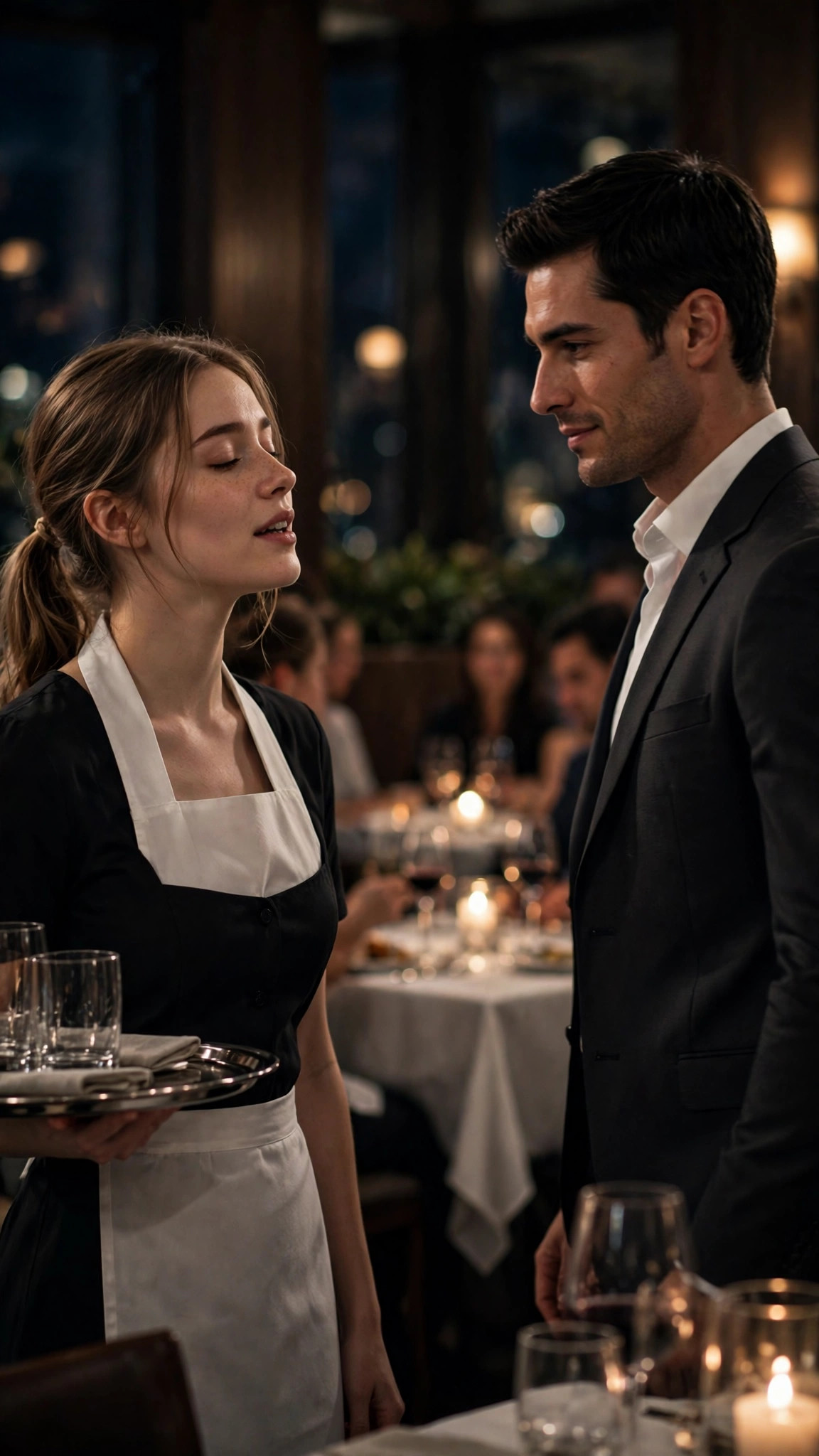
One year later, on a Friday night in October, Il Cielo was full again.
The white tablecloths were back. The candles were lit. The pianist was playing in the corner — and this time, when the melody rose and fell, nobody told him to stop, because the rule about no singing in the dining room had been broken, and broken for good, and the man who had made the rule had been the one to break it.
Lorenzo Bianchi sat at his table by the window, and he was smiling.
It was not the faintest smile. It was not a crack in the ice. It was a real smile — wide, and warm, and unguarded, the smile of a man who has finally, after a very long time, come home to himself — and the whole dining room could see it, and the whole dining room smiled back, because a year is a long time, and a lot had changed in a year.
Giovanni Ferrante had been sentenced to life in prison, without parole, for attempted murder, embezzlement, money laundering, conspiracy, and racketeering. The trial had lasted six weeks. Emily had testified. Isabella had testified. Marco Santini had testified, with his arm still in a sling, and the jury had taken less than a day to convict. Giovanni had not spoken a word in his own defense. He had sat at the defendant's table, silver-haired and calm, and he had looked at Lorenzo exactly once, and Lorenzo had looked back at him, and neither of them had said anything, because there was nothing left to say.
Isabella Romano had pleaded guilty to wire fraud and embezzlement, and she had returned every cent of the forty million dollars — including Giovanni's half, which the FBI had frozen the night of the raid — and she had cooperated fully, and the judge, taking into account her cooperation and the restitution and the three years she had already spent as Giovanni's prisoner in all but name, had sentenced her to four years in a minimum-security facility, with the possibility of parole after two. She wrote to Lorenzo once a month, from prison, and he wrote back, and the letters were not love letters — they were something better, and something harder: they were honest. In her last letter, she had written, "You were right. I was wrong about the way out. But I was right about one thing: you did change. I just wish I had stayed to see it." And Lorenzo had written back, "I wish you had stayed too. But I'm glad you're somewhere safe. And I'm glad you're still singing, even if it's only in the shower."
Marco Santini had recovered fully. He had spent two months in physical therapy, complaining the entire time, and then he had gone back to work, standing behind Lorenzo, watching the doors, exactly as he had always done — except now, when Lorenzo smiled, Marco smiled too, and when the waitress sang, Marco hummed along, very quietly, very badly, and pretended not to notice when everyone laughed.
The family had changed, too. Lorenzo had spent the year doing something no Bianchi had ever done before: he had legitimized the business. The docks, the warehouses, the restaurants — all of it, brought into the light, audited, taxed, legal. Some of the old capos had left. Some had stayed. The ones who stayed were the ones who understood what Lorenzo had understood on the night of the raid: that a family built on fear is a family that will always be afraid, and that a family built on something better is a family that can last.
The foundation had changed most of all.
The Bianchi Family Foundation — the charity arm Isabella had run, the legitimate face of the family, the clinics and the scholarships and the galas — had been drifting for three years, leaderless, kept alive by habit and by the staff who refused to let it die. Lorenzo had walked into its offices a month after the trial, and he had looked around at the empty desks and the dusty files, and he had said to Emily, who had come with him because she went everywhere with him now, "This was hers. She built this. And I let it rot."
"Then rebuild it," Emily had said. "Not for her. For the people it was supposed to help."
And so they had. Emily took over the foundation — not as a figurehead, but as its director, with a real office and a real budget and a real staff, and she threw herself into it the way she had once thrown herself into typing transfer orders: carefully, and completely, and with a notebook in which she wrote down everything. She reopened the clinic on the South Side. She funded twenty scholarships for girls who wanted to study music. She started a program, in Marco's name, for the families of men who had been hurt protecting others — because Marco had been hurt protecting Lorenzo, and because Emily believed that a family should take care of the people who take care of it.
The first Friday-night singing tradition had started by accident. A month after the trial, on a slow Friday, old Enzo had begun to play Emily's song — the song about the woman who leaves everything behind — and Emily, who was carrying a tray past the piano, had joined in, softly, without thinking, the way she had a year ago, on the night it had all begun. And Lorenzo, sitting at his table by the window, had looked up, and he had smiled, and the whole dining room had gone quiet, and when she finished, the diners had applauded — not politely, but truly, the way people applaud when they have been moved — and Tony the maître d' had come to her afterward, with tears in his eyes, and said, "Every Friday. You sing every Friday. It's a rule now. I just made it up, and it's a rule."
So every Friday, she sang. Sometimes the old song. Sometimes new ones — songs she had written in the year since the trial, songs about coming home, and about second chances, and about a man who had not smiled in three years. The regulars began to come on Fridays specifically to hear her. A music critic from the Tribune came, once, and wrote a small, kind review that called her "the voice of Il Cielo," and Emily had cut it out and put it in her notebook, next to the transfer records, because her mother had taught her to always keep a copy, and because this, too, was a kind of proof: proof that the truth had not destroyed her, and that she had built something better out of it.
And there was the plaque. Lorenzo had put it up himself, on a quiet Tuesday afternoon, with a drill and a level and Marco holding the ladder, and it was small and brass and simple, and it read: "In this room, a waitress sang, and a man remembered how to smile." He had not told anyone he was putting it up. He had simply done it, and when Emily found it, she had cried, and he had held her, and he had said, "It's the truest thing in this building."
Isabella's letters came once a month, from the minimum-security facility upstate, and Lorenzo read them, and he wrote back, and Emily read them too, when Lorenzo asked her to, because there were no more secrets in their house. In her last letter, Isabella had written about the prison choir — she had joined it, she said, because it was the only place where she could sing without anyone asking her why — and she had written, "I sing your song sometimes, Emily. The one about the woman who leaves. I sing it differently now. I sing it as a warning, not as an excuse." And Emily had written back, "Sing it however you need to sing it. That's what songs are for."
And Marco — Marco had recovered fully, and he had gone back to work, and he had also, to everyone's surprise, started dating a nurse from the hospital, a woman named Rosa, who had no patience for his jokes and no fear of his temper, and who had told him, on their third date, that if he ever stepped in front of a bullet again, she would kill him herself. Marco had laughed, and then he had proposed, six months later, in the hospital cafeteria, with a ring he had bought with his own money, and Rosa had said yes, and the wedding was set for the spring.
And Emily Carter —
Emily Carter was standing in the middle of the dining room, holding a tray, wearing her black dress and her white apron, with her light brown hair tied back, and she was singing.
She sang every Friday night now. It was a tradition, one that Lorenzo had started the week after the trial, when he had stood up in the middle of dinner and said, very simply, "From now on, this restaurant has music with words. And the first song is hers." She sang the song she had written three years ago, about a woman who leaves everything behind, and she sang new songs, too — songs about coming home, and about second chances, and about a man who had not smiled in three years and then had smiled at her, in a hushed restaurant, on a Thursday night in October.
And tonight, as she sang, Lorenzo stood up from his table, and he walked across the dining room, and he took her hand — gently, in front of everyone, with no shame and no fear — and he knelt down on one knee, in the middle of Il Cielo, under the chandeliers, with a ring in his hand that was not an engagement ring left on a passenger seat, but a new ring, bought with clean money, for a woman who had chosen to stay.
"Emily Carter," he said, and his voice was low, and it was steady, and the whole dining room was holding its breath, the way it had held its breath a year ago, when a waitress had started singing and a man who never smiled had stopped dead in his tracks. "Sing that again. Tonight, after closing. And tomorrow night. And every night after that. For the rest of our lives. Will you marry me?"
Emily looked down at him, and she laughed, and she cried, and she said, "Yes," and the dining room erupted — not into chaos, but into applause, and cheering, and the clink of glasses raised in a toast, and the pianist played her song, and she sang it, right there, with Lorenzo Bianchi holding her hand and smiling up at her, and it was the most beautiful sound she had ever heard, because it was the sound of a man who had been made of stone, learning, at last, how to be a man.
They were married six months later, in the dining room of Il Cielo, under the chandeliers, with Marco Santini standing as best man and Tony the maître d' crying into a handkerchief and the whole family — the real family, the one Lorenzo had chosen, not the one he had inherited — gathered around them. Emily wore a white dress, and she sang as she walked down the aisle, and Lorenzo smiled, and he did not stop smiling, not for the rest of the night, not for the rest of the week, not for the rest of his life.
The wedding was small, by Bianchi standards — only a hundred people, which in this family counted as intimate — and it was held on a Friday night, because of course it was, because Fridays belonged to Emily's song, and Lorenzo had insisted that their wedding night be a Friday, so that the song would be part of it. Emily walked down the aisle between the tables, past the white tablecloths and the candles, past Sofia crying into a napkin and Rosa the nurse holding Marco's hand and old Enzo at the piano, playing the melody — the old Italian melody, the one Isabella's grandmother used to hum, the one Emily had built her song around without knowing it — and she sang as she walked, softly, the verse about coming home, and Lorenzo stood at the front of the room, in his dark suit with his white shirt and no tie, and he watched her come toward him, and he smiled, and the whole room smiled with him.
The vows were simple. Lorenzo said, "I spent three years being made of stone, and you sang, and I remembered how to be a man. I promise to never be stone again." And Emily said, "I spent three years running, and you asked me to sing, and I remembered how to stand still. I promise to never run again." And Marco, standing as best man with his arm — fully healed now, though he still complained about it when it rained — raised his glass and said, "To the boss, who finally learned that the strongest thing a man can do is let someone in. And to Emily, who had the courage to sing first."
They danced their first dance to the piano, to the old melody, and Emily sang the last verse of her song — the verse about the notebook, and the truth, and the woman who had finally stopped running — and Lorenzo held her, and he did not let go, and the chandeliers burned above them, and the whole dining room, full of the people they had chosen, full of the family they had built out of truth and mercy and second chances, sang along, softly, on the chorus, because by then, everyone in the room knew the words.
And on the wall of the restaurant, next to the piano, there is a small brass plaque, put there by Lorenzo himself, and it reads, in simple letters:
"In this room, a waitress sang, and a man remembered how to smile."
And every Friday night, if you go to Il Cielo in Chicago, and you sit at a table by the window, and you listen very carefully, you can still hear her — soft yet powerful, the way she always was when she stopped being afraid of it — singing the song she wrote three years ago, about love, and loss, and everything in between.
And Lorenzo Bianchi, sitting at his table, listening to his wife sing, smiles.
The End.
THE END