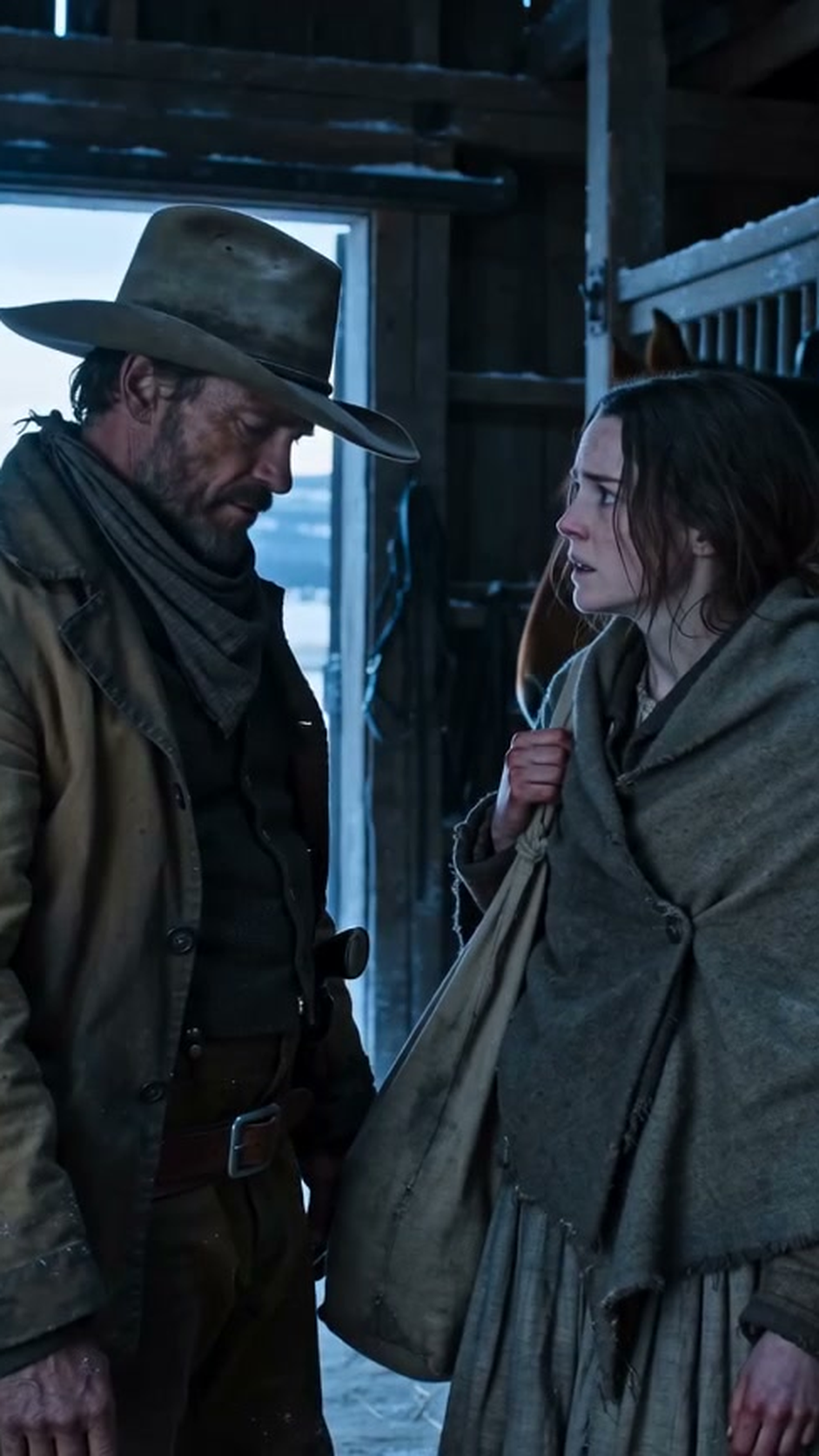
"What kind of work can you do?"
The question hung in the cold air of the barn between them, and Tessa Ren — who had been ready for a rope, a beating, the marshal, the snow — found she had no defense prepared for it at all. Men had asked her for three weeks what she had stolen. This one asked what she could do, as if the answer might be worth something. As if she might be.
She lifted her chin. Her voice, when it came, was not the voice of a beggar, and she was fiercely glad of it.
"I can cook for a crew of six and have it on the table hot when they come in, not after. I can sew a seam that holds a winter, mend tack, and patch a shirt so the patch outlasts the shirt. I kept my father's books and the Brandt Hotel's books both, in a hand the county auditor complimented, and I can cipher to the penny. I can doctor a horse — colic, thrush, a thrown shoe, a wire cut — and I can sit up all night with a calving cow and bring them both through. I can set a fence post plumb and chop a cord of wood without stopping to be admired for it."
She paused, breathing hard, the bag strap biting her shoulder.
"And I don't steal," she said. "Whatever you've heard or haven't heard. I don't steal."
Ransom Calder looked at her for a long moment, and she made herself hold his eyes, though every instinct of the last three weeks told her to look at the floor.
"Breakfast first," he said at last, and turned, and walked out into the snow as if the matter were settled and the weather were nothing, and left her to follow or not, exactly as promised.
The house was big and cold and smelled of dust and woodsmoke and neglect. He built up the fire in the kitchen stove himself — wouldn't let her do it, the first morning, though her hands ached to be useful — and fried bacon and eggs in a pan he handled like a man defusing something, and made coffee strong enough to stand a spoon in, and set two plates on the table. Two. He sat across from her, when she would have eaten standing at the door like a dog being fed, and he waited until she sat.
She ate slowly. It cost her more than she would ever tell him. Three days of near-nothing had made her stomach a fist, and the bacon smelled like heaven and sin together, and every mouthful wanted to be ten. She cut her food. She chewed. She set her fork down between bites the way her mother had taught her in a house that no longer existed, because manners were a thing no one could foreclose on, and she would be a person at this table or she would not sit at it.
He watched her hands stop shaking, somewhere around the second cup of coffee, and said nothing about it.
"Terms," he said instead, when the plates were empty, in the tone of a man raising a fence line — plainly, so there'd be no arguing about where it stood later. "The east room, off the kitchen. It's got a stove and a door that latches. Twenty dollars a month and your keep, paid the first of every month, in coin, whether the month was lean or fat. Crew's fed three meals. Sundays you rest except for cookin', same as the rest of us. Winter's the trial. Come spring we decide again — both of us decide. That's the whole of it."
"And the two nights," Tessa said.
His eyebrows went up a fraction.
"I slept in your loft two nights. In your hay, under your blanket, without leave. Hay's worth something and a roof's worth something, and I won't start here owing." She folded her hands to keep them still. "Take it out of the first month's wages. Two dollars. It's dear for hay, but the blanket was warm, and I won't have it said I took what I didn't pay for."
Something moved across his face then that she couldn't read — it might, in another man, have been the beginning of a smile.
"Two dollars," he agreed gravely, "and I'll want a receipt of you, since you're so set on accounts." And he said it without a trace of mockery, which is how she knew he understood: it wasn't the money. It was that she would rather be a debtor than a beggar, and he was a man who could tell the difference.
She was washing his plate and hers — she'd insisted; she'd already started, in her mind, before he'd finished eating — when the sound came from the barn.
It was not a loud sound. It was worse than loud. A stallion's scream is loud. This was a thud, and then another, wood taking a blow it wasn't built for, and then a thrashing, rhythmic and horrible, and Gus's voice shouting Will's name in a key Tessa had never heard from him.
Ransom was out of his chair and into his coat before the second thud. Tessa was one step behind him, apron still on, because her feet decided before her mind caught up: someone was hurt, or an animal was.
It was Comet. The black stallion — the pride of Silver Crown, the horse men rode two counties to breed to — was down in his stall, down and rolling in the straw in the grip of the colic, his great body slamming the stall boards, his eyes white-rimmed, his coat dark with sweat despite the freezing air. Gus had a rope on him and was trying to keep him from wedging himself against the wall. Will, white as paper, held a lantern that shook.
"He was fine at feedin'," Gus said through his teeth. "Fine. Then he went off his grain an' started pawin', an' then he went down like he was shot. Boss, if it's the twisted gut—"
"Don't say it," Ransom said. He was already in the stall, one hand on the horse's neck, his voice gone low and even. "Comet. Comet, boy."
Tessa took in the scene the way her father had taught her, in pieces, fast: the stallion's gums, when she got her fingers to his mouth — pink, not purple, not white. Life there. The sweat — bad, but a horse with a twisted gut sweats in a different way, a dying way. She laid her ear, shameless, against the great barrel of his side, ignoring Gus's startled look, and listened to the gut sounds: present. Slow, cramping, but present. A twisted gut is silent. A silent gut is a grave. This gut was talking.
"It's not the twist," she said, and her voice came out with her father's steadiness in it, fifteen years of helping him doctor stock rising up through her hands. "It's the spasm kind — cold water on top of grain, most like, or the weather turning. His gut's cramping, not dead. He needs walking, and warm water with a little molasses, and linseed oil if you've got it, and he needs to not be let roll and twist himself into the real thing while we do it. An hour. Maybe two."
The barn went quiet except for the horse.
"She's the new cook," Ransom said to Gus, without looking away from Tessa. "Seems she's other things too. Gus — oil's in the tack room, blue bottle. Will, warm water, not hot. Miss Ren—" He met her eyes over the stallion's heaving side, and there was a question in it, and she understood that he was asking, not ordering, because that was how this man was built. "Can you bring him through?"
"He'll stand up cursing us all," Tessa said, "if you'll all do exactly what I tell you."
Walking the great horse in the snow, her hand on his halter rope and her other hand flat against the warm, heaving wall of him, Tessa thought of her father — which was where all her knowledge of horses lived, the way other women's knowledge of quilting lived in their mothers. She had been twelve the winter their mare Jess went down with the colic in the night, and her father had walked that mare in circles in their little barn until near dawn, and had let Tessa walk her too, her small hands swallowed in the rope, and had told her the things that mattered in the voice he used for important business. You don't doctor the horse you wish you had, Tess. You doctor the one that's down. You listen more than you talk. An animal in pain will tell you the truth if you're quiet enough to hear it, which is more than can be said for most people. And when she'd asked, frightened, whether Jess would die, her father had said: Not tonight, and tonight's what we've got. We do tonight properly and let tomorrow bring its own troubles to the door like everybody else.
Jess had lived six more years. Tessa had carried those sentences out of Montana winters and into the Brandt Hotel's kitchen and back out again, and they had never once failed to be useful — about horses, about bankers, about storms, about men.
"Tell me the truth, then," she murmured to Comet, as he swung his great head down and blew, hard, into the snow. "That's it. That's exactly it. You tell it and I'll listen."
For an hour and a half, in a freezing barn in her one good dress, with her apron soaked and her hair coming down and her split boot filling with straw, Tessa Ren walked a half-ton black stallion in circles in the yard while the snow came down in earnest. She walked him when he wanted to go down, talking to him in the low crooning voice her father had used, the voice that says I am here and the world is not ending. She dosed him with warm molasses water and oil. She read his body like a page — the easing of the cramp, the gut sounds strengthening, the first blessed, ordinary heap of manure steaming in the snow, which made Will whoop like a boy and Gus spit and grin and Ransom stand very still with his hat in his hands.
When Comet finally stood quiet, blowing, and nosed at a bucket of warm mash with actual interest, the yard and the barn and the morning seemed to let out a breath they'd been holding since the first thud.
"That horse," Gus said, with enormous reluctance and respect, "has bit two men an' kicked a vet from Miles City into a water trough. An' he walked for you like a lamb to Sunday school."
"Horses know," Tessa said, wringing out her apron, suddenly exhausted to her bones, "when you're not afraid of the wrong things."
She was aware, then, of Ransom watching her — not the way Brandt had watched her, with appetite, nor the way Elkhorn had watched her, with judgment. He watched her the way Smoke the gray had, ears pricked, interested, as if something he had thought extinct in the world had just walked through his barn in a split boot.
She never got to wonder what he would have said next, because that was when the rider came through the gate.
He came at a trot through the falling snow, a youngish man with Brandt's hotel livery stable colors on his hatband, and Tessa knew his face before he was halfway across the yard — Doyle, who mucked stalls at the hotel and ran Brandt's errands and had stood in the street, three weeks before, and watched the marshal search her room and said nothing. He reined up, taking in the yard — the crew, the stallion, and her, standing in the middle of it all with a soaked apron and a bucket in her hand.
His eyes widened. Then they narrowed, with the particular brightness of a man who has just found the thing he was sent to find and is already spending the reward.
"Well, now," Doyle said. "Mr. Brandt's been wonderin' where his runaway thief got to."