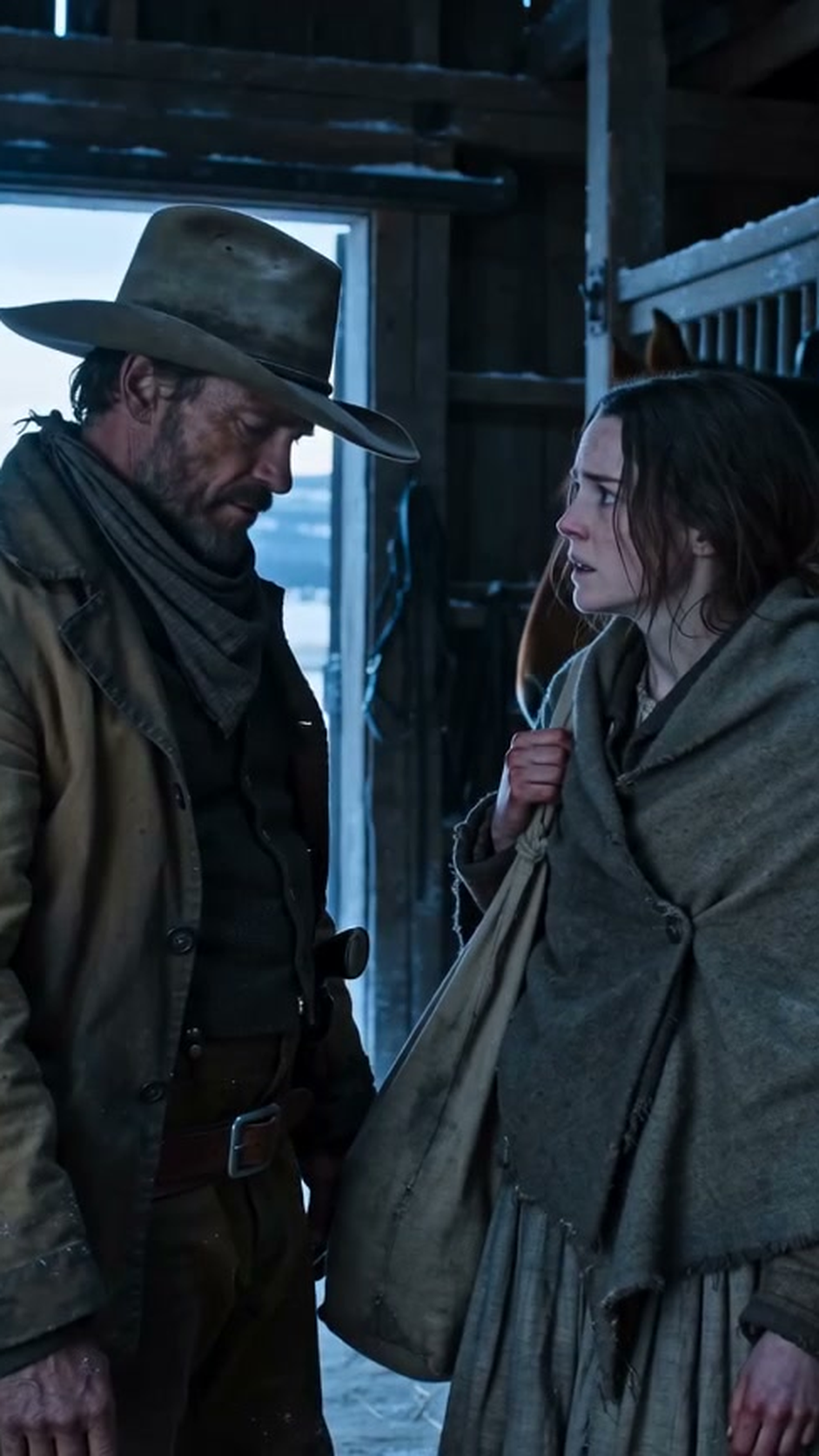
"Morning, Doyle," Ransom said.
He said it the way a man comments on weather, and he stepped — unhurriedly, as if merely shifting his weight — between Doyle's horse and Tessa, and the whole yard understood that a line had been drawn and where.
"Ain't no runaway here," Ransom said. "You're looking at my cook. Miss Ren's been engaged at Silver Crown since October."
It was a lie. It was a lie so smooth and complete that Tessa, standing behind him with her heart in her throat, almost believed it herself. Since October. He had not hesitated, had not looked at her, had not weighed it. A man who had known her name for four hours had just lied to Brandt's errand-runner in front of witnesses, and lies like that have teeth — they can be checked, and fed back, and used.
Doyle's smile went uncertain. "Since October, is it? Funny. Word in town was she only just—"
"Word in town," Ransom said, "is worth what it costs. You can tell Mr. Brandt that if he's lost something, he should ask the marshal to look for it, the way honest men do. And you can tell him something else from me." He took off his hat, though the snow was falling into his hair, which somehow made it worse. "Tell him Calder land is posted. My crew's business is my business. He wants to talk to me about my cook, he can ride out himself and use her name when he does it. Miss Ren."
Doyle looked past him at Tessa. Whatever he saw in her face — she hoped it was the skillet-from-the-pantry face, the fence-going-up face — it did not invite him to linger. He touched his hat with the air of a man retreating in good order, turned his horse, and rode back out through the gate into the snow, and the yard let out its second held breath of the morning.
"You lied," Tessa said quietly, when the hoofbeats had faded.
"I did."
"To a man who'll carry it straight back. For a woman you found in your hay four hours ago, who might be everything he said." She made herself say it. "I might be. You don't know."
"I know my stallion," Ransom said. "Comet's bit two men and kicked a veterinarian into a water trough, and he walked for you like a lamb because you weren't afraid of him and you weren't going to hurt him. Horses are poor liars and excellent judges, Miss Ren. It's men who get it backwards." He put his hat back on. "And I know what I saw this morning. A thief doesn't refuse charity with her stomach caving in. A thief doesn't stop on her way out a man's door to argue about two dollars' worth of hay."
He walked past her toward the barn, then stopped, and added, over his shoulder, without sentimentality: "Also, I expect Brandt's brooch is wherever Brandt put it. That man's been stealing small for years and blaming it on whoever's cheapest. You're just the first one he blamed out loud."
She stood in the falling snow with the bucket in her hand and cried for the second time in his barn's vicinity — silently, furiously, wiping it away with a wrist that smelled of linseed oil, angry at herself for it. Not because she was sad. Because a man had believed her before she'd finished being believed in, and she did not know where to put a thing like that. She had no shelf for it. Three weeks of closed doors had seen to that.
The days that followed built themselves into a shape she had not expected: the shape of a life.
She took the east room — small, clean, a stove of her own, a door that latched, a window facing the sunrise over the corral — and if she stood in it the first night with her bag still packed by the door, ready out of habit to be gone in the dark, no one knew it but her. She rose at four. She cooked as she had promised: hot food, on time, enough of it — biscuits that made Will close his eyes, stews that put color back in men's faces, coffee Gus pronounced "fit for a church social, if churches had any sense." The house began, room by room, to come back from its long neglect. She beat rugs. She blacked the stove. She mended shirts with stitches like rows of tiny soldiers and tack with stitches like toothed iron, and Gus, who had opposed on principle the presence of any female who might reorganize his universe, surrendered by degrees and then entirely, and began leaving the best of the bacon on the side of the pan where she would find it.
In the second week she dusted the piano.
It stood in the front room, which the men never entered, under a silence three years deep, and she had left it alone at first out of an instinct she couldn't have named. But dust is a debt too, in a house, and one gray afternoon, when the men were out with the herd and the light was failing early, she opened the lid and cleaned Eleanor Calder's piano key by key with a soft cloth, not playing it — she could not play; her mother had taught her letters, not music — only cleaning it, the way you tend something that belongs to somebody's memory and is not yours to use or to mourn.
She did not hear Ransom come in. She rarely did, that winter; for a big man he moved like weather arriving. She only knew, at some point, that he was standing in the doorway with his hat in his hands, watching her hands move over his dead wife's piano, and her first thought was that she had trespassed somewhere worse than a hay loft, and her second was that she would not apologize for cleanliness, not even for this.
"It was dusty," she said, before he could speak. "Dust gets in the action and ruins the felts. My mother had a neighbor with one. I wasn't playing it. I can't play."
"I know," he said. "She used to say the same thing about the felts. Word for word, near enough."
He crossed the room — she had never seen him in the front room; the men lived in the kitchen and the porch, and the front room was a country he had surrendered — and he stood beside her, and put one finger down, gently, on a key in the middle of the keyboard. The note came up out of the clean dark of the instrument, soft and true and three years out of practice, and it hung in the cold room between them.
"She played every night," he said. "Bad weather, good weather. I used to do the accounts at that table and listen." His hand rested on the piano's lid, flat, the way his hand had rested on the ledger. "House has been too quiet, Miss Ren. I hadn't let myself know how quiet."
He closed the lid himself, carefully, and went out to the barn, and she stood in the front room a long time with the cloth in her hand, understanding that she had been permitted to witness something — not forgiven a trespass, but permitted, which is a different and larger thing.
And in the evenings, when the crew had gone to the bunkhouse, she sat at the kitchen table with the ranch ledger — which she had asked for, with apologies, and received from Ransom with an expression of profound relief — and did what she did best.
The Silver Crown books were not dishonest. They were worse: they were tired. Three winters of a grieving man's indifference lay on them like dust. Entries stopped mid-page. A season's worth of breeding fees was recorded in Gus's hand in the margins of a feed receipt. And the bank — the bank was a different matter. The note at Brandt's bank, the feed loan against the spring drive, carried interest figures that Tessa added three times, certain she had erred, before she accepted what the numbers were saying: the interest had been figured twice on the same quarter, in a hand that hoped no one at Silver Crown could cipher well enough to notice.
She said nothing. Not yet. A woman four hours believed and three weeks ruined learns to hold a fact until it can stand up in company. But she copied the figures fair onto a clean page, in her clean hand, and put the page in her Bible, and went on with the books.
August Keller rode over on a Thursday, all smiles and a new beaver hat, with an offer written out fair for the north coulee grazing and its water — a good price, he said, a neighborly price, times being hard and the Calder note being what it was, a thing a man in Ransom's position might be grateful to consider. His eyes, while he talked, went around the kitchen and found Tessa at the stove, and something moved in them that she recognized: the bright, spending look Doyle's eyes had had. News, in a valley, is a crop everyone harvests.
"Didn't know you'd taken on help, Calder," Keller said.
"There's a deal you don't know," Ransom said mildly, and walked him out, and came back in with his jaw set like a gate latch. "He'll go to Brandt," he said. "If he hasn't already."
"Then let me go," Tessa said, that night, standing straight in the kitchen with her hands flat on the table — she had rehearsed it while she kneaded the morning's bread, every word. "Before this grows teeth. You've done a thing for me no one else would do, and I won't be the ruin of this ranch. I'll go to Avery myself. I'll face the charge in town. A charge has to be proven, and he can't prove what didn't happen."
"And if he doesn't have to prove it?" Ransom said. "If a rich man's word and a poor girl's record is proof enough in Elkhorn these days?" He shook his head slowly. "You'd be convicted by Friday and in the territorial prison by Christmas, and Brandt would own the north coulee by spring, and I would have sent you to it. No."
"You can't fight the bank and the whole town for your cook."
"I'm not fighting for my cook." He said it quietly, looking not at her but at the ledger lying between them on the table, his big scarred hand resting on its cover. "I'm fighting a man who steals small and blames it on whoever's cheapest, on my land, out of my barn. The cook's incidental." A pause. "The cook is also the best hand with a horse I've seen in twenty years, and she makes biscuits Gus Pruitt dreams about, and if Brandt thinks I'm handing her over, he has misjudged the situation in a way I intend to correct personally."
It was the longest speech she had ever heard him make. She did not trust her voice, so she opened the ledger instead and showed him the page — the doubled interest, figured three ways, in her clean hand.
Ransom Calder looked at it for a long time. The lamplight showed her every line in his face.
"How long has he been doing that?" he asked at last.
"Two quarters that I can prove," Tessa said. "Maybe more, before the books got tired. Mr. Calder — Ransom. He isn't just a man who lies about brooches. He steals on paper, where it's quiet. He did it to my father's account too, I think. I could never make the fees add up after Pa died. I think that's why the claim went. Not debts. Arithmetic."
The silence in the kitchen had a weight to it, like the silence before weather.
"Keep that page safe," Ransom said. "Keep all of it safe."
He stood up then, and went to the window, and she followed his look: the glass was feathered with frost at the edges, and beyond it the dark was the wrong kind of dark, dense and still, and the wind had stopped in the way it stops in Montana in November when it is not finished but gathering.
"Barometer's fallen out of its boots," Gus said from the doorway, where neither of them had heard him come in. He was looking at the sky through the door crack, and his face was the face of a man who has wintered sixty years in that country and respects exactly one thing in it. "That storm everybody's been promisin' since Tuesday — she ain't comin' Thursday, boss. She's comin' tonight. An' the north herd's still out on the coulee with the yearlings, an' if she catches them in the open when the wind turns—"
He didn't finish. He didn't have to.
North herd, in the open, in the worst kind of storm there is. And somewhere on the road from Elkhorn, if Keller had ridden fast and Brandt had moved faster, a marshal with a warrant might be riding into the same white dark, coming for the cook.
The wind began again at the eaves, high and thin, like a wire being drawn tight.