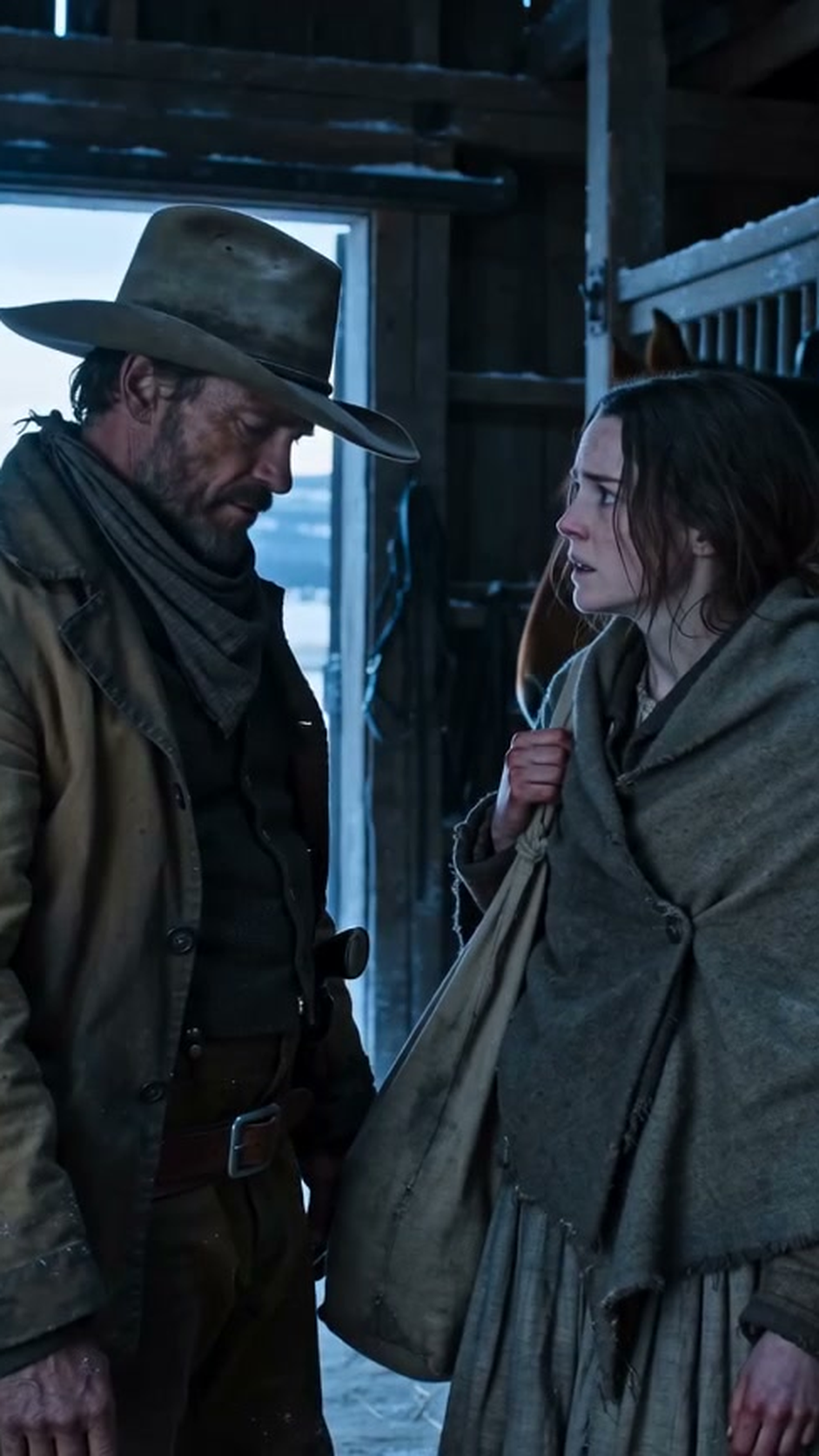
Doyle woke on the second day, weak as a kitten and clear as well water — and recanted before his eyes were fully open.
"Don't recollect nothin'," he said to the ceiling, while Tessa stood in the doorway with his broth. "Fever talk. A man says anything with the fever on him. Mr. Brandt pays me fair an' I ain't got a word against him. Not a word."
Gus, from his chair by the fire where he now reigned like a wounded king, snorted. But Tessa only set the broth down carefully and went out, because she had expected it, and because she had already decided, in the night, what she was going to do — the thing she had tried to do in the kitchen a week before, when Ransom had talked her out of it with the memory of a rigged scale. The scale had not changed. What had changed was her.
She packed her canvas bag. The mended dress. The Bible with her mother's name in the front and a copied page of bank figures between its leaves. Her father's clasp knife. The tin, which now held eleven dollars of her first wages, advanced and receipted, with the two dollars for the hay already deducted — because Tessa Ren paid her debts, even now, especially now.
She was at the door with her bag when Ransom came in from the barn, and read the whole of it off her face in one look, the way he read weather.
"No," he said.
"I'm not asking your leave, and I'm not stealing your horse," she said. "I'll walk to Elkhorn if I must. Avery is a decent man, whatever else. I'll surrender to the marshal, and I'll stand in front of whoever Brandt puts me in front of, and I'll say the truth in a room where it has to be written down. If they convict me anyway — " Her voice held. She made it hold. "Then they convict me standing up, and I will have stopped running, and that will have to be enough. I won't have you ruined for me. I won't have Silver Crown spent on a cook. Brandt wants the north coulee and your note and your name in the mud, and I'm the lever he's using, and the only way to break a lever is to take hold of it yourself."
Ransom stood in his own kitchen doorway, snow melting off his coat onto her clean floor, and looked at her for a long time. She watched him understand that arguing would be a kind of theft — that her pride was not an obstacle to her rescue but the whole substance of the woman he was trying to rescue, and that a man who overruled it would lose the very thing he was fighting for.
"Afterward, you decide," he said at last, quietly. "That's what I told you in the barn. I don't go back on it in my own kitchen." He took his hat off the peg. "But I'm riding with you. That's not a decision you've got to make. That's mine."
They rode into Elkhorn on a Saturday, which was market day, with Gus's blessing and Gus's best scarf and Gus himself propped in the wagon bed behind them like a piece of siege equipment, splint and all — "I wouldn't miss this for a sound leg an' a gold watch," he'd said, and no power on earth could have kept him home. Will drove the wagon. Doyle, wrapped in blankets, rode in it too, white and silent, because Ransom had informed him, without heat, that he was coming to town to hear a thing said in public, and that a man got one chance in his life to decide which side of his own story he stood on.
Half of Elkhorn was in the street when they arrived, because word had outrun them — word always outruns everyone — that Calder was bringing his thief in, or bringing her to clear her, depending on who was telling it.
Marshal Avery met them in front of the hotel. He was a lean, tired, honest man, and Tessa saw at once that he had been dreading this day from the hour he'd searched her room and found nothing, and she was sorry for him, and it strengthened her.
"Miss Ren," he said. "There's a charge of theft, sworn by Mr. Brandt."
"Then let's have it in the open, Marshal," Tessa said, from the wagon, in a voice that carried the length of the boardwalk, "where everybody can hear it proved."
They had it in the open. Silas Brandt came out of his hotel in his good coat with his wife two steps behind him in hers, and he made his speech — the brooch, the ingratitude, the girl he'd fed out of charity and been robbed for his trouble — and he made it well, because he had made it often, and practice is a kind of truth if nobody checks the figures.
Then Tessa Ren climbed down from the wagon and stood in the street in her mended dress and her split, cord-tied boot, and told hers.
She told about the pantry. She did not blush and she did not hurry. She told about the skillet set down like a fence. She told about dusting the office, and the county school fund ledger lying open, and the two columns that did not match — and then she took from her Bible the page she had copied fair from the Silver Crown books, and she recited, from memory, the dates and the sums of the hotel ledger she had seen that October afternoon, the real column and the false one, in a clear voice, one after another after another, while the street went quiet in the particular way a crowd goes quiet when arithmetic enters a room where it was not invited.
A man had stepped out of the crowd by then — a stranger in a city coat, with a valise, who had come in on the morning stage and been standing unnoticed by the bank door. The county auditor, in Elkhorn a week early for the territorial audit, whose arrival Brandt had not expected until Monday.
"I'd like those figures again, miss," the auditor said mildly, opening his notebook. "Slower, if you please."
Brandt laughed — a short, rich man's laugh, meant to carry the street with it. "Figures," he said. "A dismissed cook's memory, gentlemen. Numbers she claims to have seen while dusting. I could recite you the Lord's Prayer backwards; it wouldn't make me a bishop. Where is her paper? Where is her proof? There is none, because there was nothing to see. This is a grudge dressed up as arithmetic, and every man here knows why she bears it."
"The bank keeps duplicates of the county fund statements," the auditor said, in the same mild tone, without looking up from his notebook. "Filed quarterly. Across the street, I believe." He raised his head then, and looked at Brandt for the first time, and there was nothing mild in it at all. "Marshal, I'd be obliged if your deputy would step over to the bank and ask the cashier — in my name, and in the presence of a witness — for the county school fund statements for the last two quarters. If Miss Ren's memory is a grudge, the duplicates will say so in five minutes, and I'll apologize to Mr. Brandt in this street and buy his dinner. If it isn't—" He let the sentence finish itself.
It took eleven minutes. Tessa knew, because she counted the marshal's pocket-watch chain swinging as he stood beside her, because counting was what her mind did when it could not afford to shake. The deputy came back across the street at something just under a run, with a folder in his hand and the bank's young cashier at his heels, and the cashier's face told the whole street the answer before a word was read out.
Two sums were read aloud, there in the street, hers and the bank's, figure by figure. They matched to the cent. The third figure — the one in the ledger she had dusted, the one Silas Brandt had sworn was the county's own total — existed in no duplicate anywhere, because it had been invented, in a hand the auditor turned the page toward the light to examine with professional interest, and it differed from the truth by an amount that would have bought Silver Crown's north coulee outright.
"Eleven minutes," Gus remarked from the wagon, to no one in particular, with deep satisfaction. "Includin' the walk."
Brandt's face, witnesses said afterward, did what faces do when the floor of a house a man built out of other people's money decides to become a door.
But it was Clara Brandt who finished it. Clara, in her good coat, with her hands twisting together, who had worn an empty place at her breast for three weeks where a silver wheat-sheaf brooch used to sit, stepped out from behind her husband — and spoke, in a voice that shook and then steadied, to the marshal and not to Silas at all.
"It was in his coat," she said. "A week after she was gone, I found it in the pocket of his gray coat, where it had been the whole time. I knew what it meant. I have known every day since, and I have put on this coat and gone to church and said nothing, and I am done saying nothing." She unpinned nothing — there was nothing to unpin — but she held out her empty hand, palm up, as if offering the brooch that wasn't there to the whole street. "She never took anything from this house, Marshal. What was taken in this house was taken by my husband, and some of it was taken from her."
The silence after that had a texture. And into it, from the wagon bed, weak and clear and final, came Doyle's voice — a man who had decided, at last, which side of his own story he stood on:
"I put it in the coat, Marshal. Night before the search. He told me where, an' he told me why, an' he owes me ten dollars for it yet."
By sundown, Silas Brandt was in Avery's one good cell, charged with fraud and the embezzlement of county funds, pending the auditor's pleasure; the bank's directors, meeting in emergency session without him, discovered a sudden and passionate interest in the accuracy of the Silver Crown note, and the doubled interest was struck from it in a hand that shook only a little. August Keller, it was noticed, left town before the lamps were lit and did not come back for a month.
And Tessa Ren stood on the boardwalk in the dusk with her name handed back to her in front of the whole of Elkhorn, and found that a name, restored, is a heavier thing to carry than a ruined one — because now it was hers to spend, and everyone was waiting to see what she would buy with it.
The first offer came before she had even left town. The marshal's wife, who ran the town's one respectable boarding house and had a cook's hands herself, took Tessa's arm and said the Grand Hotel in Miles City — the fine new one, with the railroad contract — was looking for a head cook, a woman with a reputation, and that after today there was not a town in the territory where the story wouldn't open doors for her. A letter to that effect, on the hotel's own paper, was pressed into her hand that evening at the ranch, forwarded out by a drummer who'd heard the story in town: forty dollars a month, a room of her own, and her name — her clean, famous, vindicated name — as the making of the place.
She read it twice at the kitchen table, after the crew had gone, with the lamp between her and Ransom Calder, who had said not one word on the ride home about Miles City, or names, or doors.
He got up, when she'd read it the second time, and took his hat off the peg, and went out to check the horses for the night, and left her alone with the letter — exactly as he had left her alone with a doorway and a choice, in a barn, a lifetime and a few weeks ago.