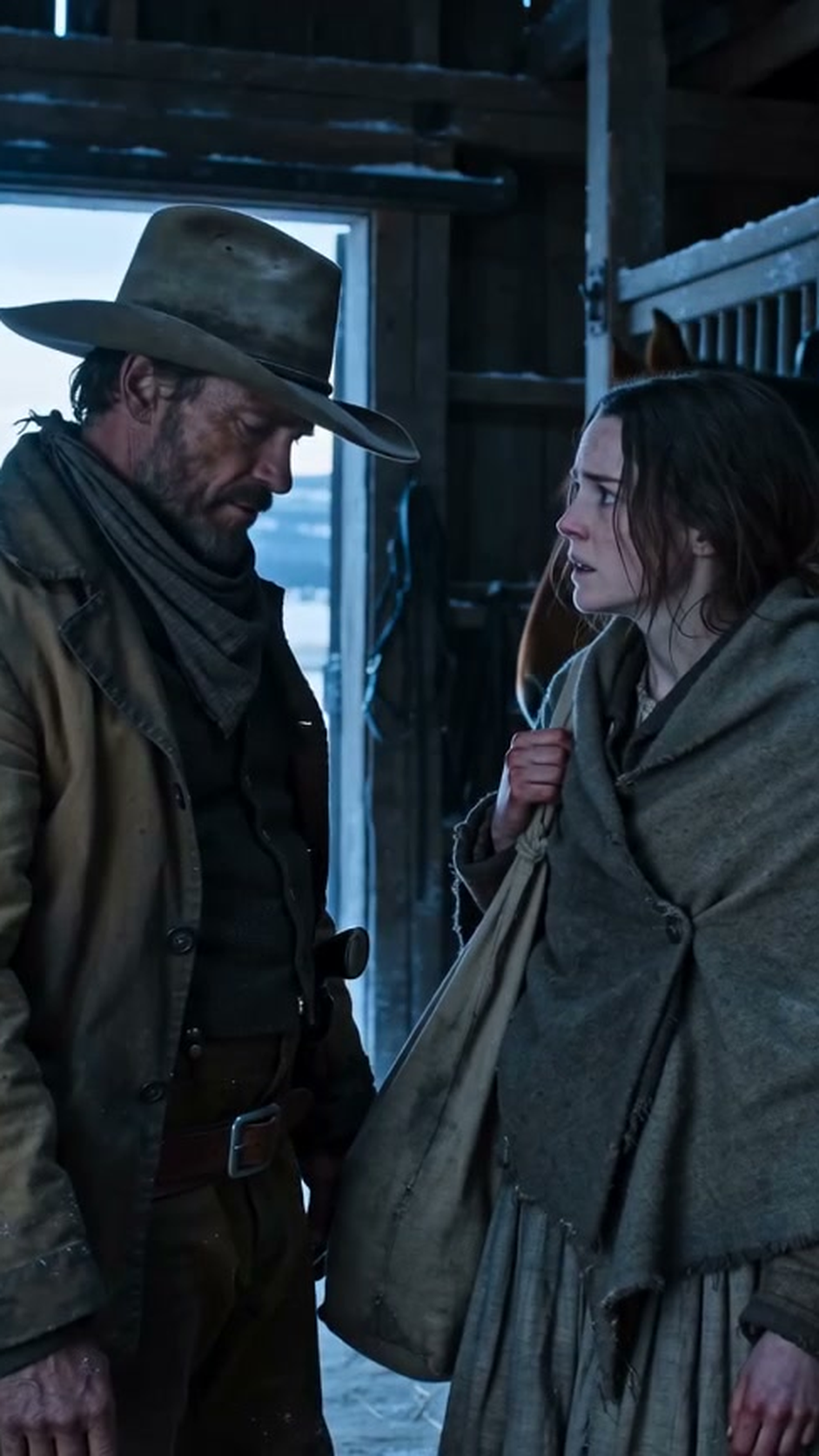
She did not answer the letter that night, or the next day, or the day after that.
What she did was go on cooking. She cooked through the week that followed — through Doyle's departure (paid his ten dollars by the bank, out of Brandt's seized accounts, in a transaction the auditor insisted on recording personally, with something almost like relish), through Gus's removal to a chair by the stove with his leg up and his authority undiminished, through the first rumor and the second and the tenth that came out from Elkhorn like ripples from a stone. She cooked, and she kept the books, and she walked Comet every morning in the yard, because the stallion had decided, with the whole force of his considerable personality, that she was his person, and had bitten Will twice to underline the point.
On the fourth morning, Ransom found her at the kitchen table before dawn with the letter and the ranch ledger side by side, and a pencil in her hand, and he stood in the doorway with his coffee and waited, because he was a man who had learned, at cost, the difference between waiting with a woman and waiting at her.
"I've done the sums," Tessa said at last. "Forty dollars a month is more money than I've ever been offered for anything. It's more than you pay me. It's nearly double."
"I know what it is," Ransom said.
"My name would be on it. Head cook. In a place with linen. Nobody there would know I'd ever slept in hay, except — " she smiled a little, tiredly — "except that everybody would know, because that's why they're offering. The story opens the door. The story is the advertisement."
"It is."
"And here," she said, and put her hand flat on the ledger, "I'm the cook. The cook who was cleared. The cook who stays in the east room because there isn't a word in this country for what else she might be." Her voice did not shake. She had promised herself it would not. "You've never once asked me to stay, Ransom Calder. Not in the barn, not in town. I want to know if that's because it wouldn't be right to ask, or because it wouldn't matter to you if I went."
The silence that followed was the longest of her life, and she had counted seconds through some long ones.
Ransom set his coffee down with great care, like a man handling something loaded.
"Tessa," he said, "when Eleanor died, I made a bargain with the Almighty that I have kept for three winters: I would not ask for anything again, because asking had been answered once and I had no right to twice. I broke it the morning I found you in my loft. I have been breaking it every day since, in ways I am not proud of — hoping Gus's leg would mend slow, hoping the auditor would take his time, hoping a letter from Miles City would get lost in the snow." He looked at her then, full and plain, with everything in his face that he had kept out of it for thirty-nine years of weather. "I am not offering you charity, and I am not offering you a position, and God knows I'm not offering you safety, because you have never once in your life chosen the safe thing when there was a true thing standing next to it. I am asking you — which is a different animal entirely — whether the woman who walked twelve miles through snow rather than bend her neck in Elkhorn would consider bending it nowhere, ever again, as the mistress of this ranch and the keeper of these books and the — "
He stopped. For the first time since she'd known him, Ransom Calder ran out of words in the middle of a fence line.
"As your wife," Tessa said, because somebody had to finish the fence. "You're asking me to marry you, Ransom. Say it plain. I've had a bellyful of men who talk around things."
"I'm asking you to marry me," he said. "Plain. On whatever terms you set, with the east room yours by right and not by wages, and your name on the ranch books as Calder — as a partner, Tessa, entered fair, in your own hand, since yours is better than mine. Marry me, and let the whole valley make what it likes of it."
"And if I say I need until spring to decide?" she asked, and she was smiling now, and crying a little too, in the way she did everything — without asking anyone's leave.
"Then I'll wait until spring," he said. "I've had the practice."
She decided in eleven days, which Gus said was showing off, and which Ransom said was faster than the auditor.
She spent the eleven days the way she spent everything: working, and watching, and doing sums no one could see. She rode out with Gus — cane lashed to his saddle, leg stiff as a fence post, authority absolute — to count the north herd in the new grass, and stood with him at the coulee mouth where she had turned the red cow in the white dark, and Gus said, "Ground remembers, girl. So does a valley, once it's seen a thing plain," and she understood he was not talking about cattle. She climbed the ladder to the loft alone one dawn and sat in the hay where she had hidden, with her bag in her lap, and made herself remember all of it — the cold, the cord around her boot, the exact sound of the ladder creaking — because a decision made by running away from a memory was no better than running, and Tessa Ren was done running in every direction there is. She sat with Clara Brandt — Clara, leaving Elkhorn for a sister in Dakota, who came out to the ranch kitchen uninvited and sat straight-backed at Tessa's table and said, "I wore that brooch ten years and it never once kept me warm. You keep this house warm. That's the whole of my errand," and rode away before Tessa could find an answer. And she wrote the letter to Miles City at last, in her clean hand, thanking them for their confidence and declining their offer with regret, and posted it herself in town, standing at the counter a full minute with it in her hand before she let it go — because a door you close yourself stays closed, and she wanted this one closed by her own hand and no one else's.
The wedding was in May, when the coulee ran with meltwater and the cottonwood on the hill put out its first leaves over Eleanor's grave — where Tessa had gone, alone, the week before, with flowers she had no name for but the ones her mother taught her, and had stood a while and said some things out loud that were nobody's business, and come down the hill lighter than she went up. She wore a new dress of dark green wool that she had bought with her own wages and sewn with her own hands, a seam that would hold a winter. Ransom wore his good coat and an expression Gus described as "poleaxed, in a favorable direction." Gus, on a cane of his own carving, gave her away, on the grounds that he had seniority over everyone present including the groom. Will played the fiddle. The marshal came, and his wife, and Clara Brandt — who was divorcing Silas with the territory's full sympathy and had taken to wearing, at her breast, a small plain pin of no value whatsoever, which she touched, once, during the ceremony, and smiled like a woman setting down a weight.
The preacher from Elkhorn stayed to dinner, and Tessa fed the whole valley at the long table under the cottonwood — ham and beans and the first greens of the year, coffee strong enough to stand a spoon in. Nobody made a speech. Ransom carved, and Clara passed the bread, and when Will scraped his fiddle out on the porch after, the dancing went on in the yard until the light failed and the lanterns came out one by one.
In June, the valley sent Silver Crown a reminder that the wheel comes around for everyone. Her name was Pearl, she was nineteen, she had been the laundry girl at the Brandt Hotel under its new owners, and she arrived at the ranch gate on foot on a Tuesday with a carpetbag and a black eye she tried to keep turned away from the light, having been dismissed without a character for answering back to a man who had put his hand where it didn't belong in the pantry — the same pantry, in the same hotel, as if the building itself had learned nothing.
Tessa looked at the girl for a long moment. Then she took the carpetbag out of her hand, set it inside the gate, and said, "You'll eat first. A person can't answer questions on an empty stomach, and nobody in this house interrogates a guest."
She fed her at the table — at it, not at the door — and when Pearl, halfway through a plate of food she was eating with the desperate care of the long-hungry, finally whispered, "I didn't steal anything, ma'am. Whatever they say in town. I never stole a thing in my life," Tessa Ren Calder set down her coffee cup and felt the whole shape of her own life turn over, gently, like a page.
"I know," she said. "I believe you. Now — what kind of work can you do?"
Pearl was hired by Friday — wages, plain terms, a room of her own off the pantry with a door that latched, and the two rules of the house explained to her while Tessa showed her the stove: in this house nobody eats standing, and the accounts are kept fair, to the penny, where anybody may look at them. Gus, watching from the doorway with his cane, delivered himself of the opinion that the place was going to the dogs entirely, and then went out and quietly built the girl a shelf for her room with his own hands.
And the three stallions watched over the corral fence the whole time, grave as elders: the bay, the gray Smoke with his ears pricked toward the loft, and Comet the black, who had walked for her like a lamb in the snow.
There was one last piece of business, and Ransom attended to it himself, the week after the wedding, with an awkwardness that told her exactly how long he had been planning it. He rode into Elkhorn and came back with a parcel from the cobbler: her boot. The left one. The split, cord-tied ruin that had carried her twelve miles through the snow and nearly cost her the foot in the blizzard — washed, restitched, resoled in new leather, the cord replaced with proper lacing, made whole.
"You kept it," she said.
"You left it by the stove the night of the storm," he said, "and I am a man who mends what matters, when he's allowed. A hand's tools should be kept, Tessa. You taught me that. You and a pitchfork on the wrong peg."
She put the boot on the shelf in the east room — her room still, by right and by her own decree, where she kept her accounts and her privacy and her mother's Bible — next to the new boots she had bought herself out of her first month's wages as a partner of Silver Crown Ranch, entered in the ledger, in her own clean hand, with the interest figured once and only once.
And on the first morning of June, at dawn, she climbed the ladder to the hay loft with a needle and thread, and sat in the place where she had once hidden for her life, and mended the gray horse blanket with small, even stitches, while below her the stallions breathed and shifted, and the man she had married leaned his rifle — no. Leaned his shoulder — against the ladder, and looked up at her the way he had that first morning, and asked her, for old times' sake, the question that had started everything.
"What kind of work can you do?"
"All of it," said Tessa Calder, from the loft, in the light. "For the rest of my life."
THE END