The second storm came on a Tuesday, and it came fast.
In the morning the sky was grey and still, and by noon the wind had risen, and by supper the snow was falling sideways, and Silas McCready, standing at the window with his hands on his hips, said, "That is the same storm as before, boys, only angrier," and everyone laughed, but the laughter was thin, because the road had barely been dug out from the first storm, and no one wanted to be snowed in again so soon.
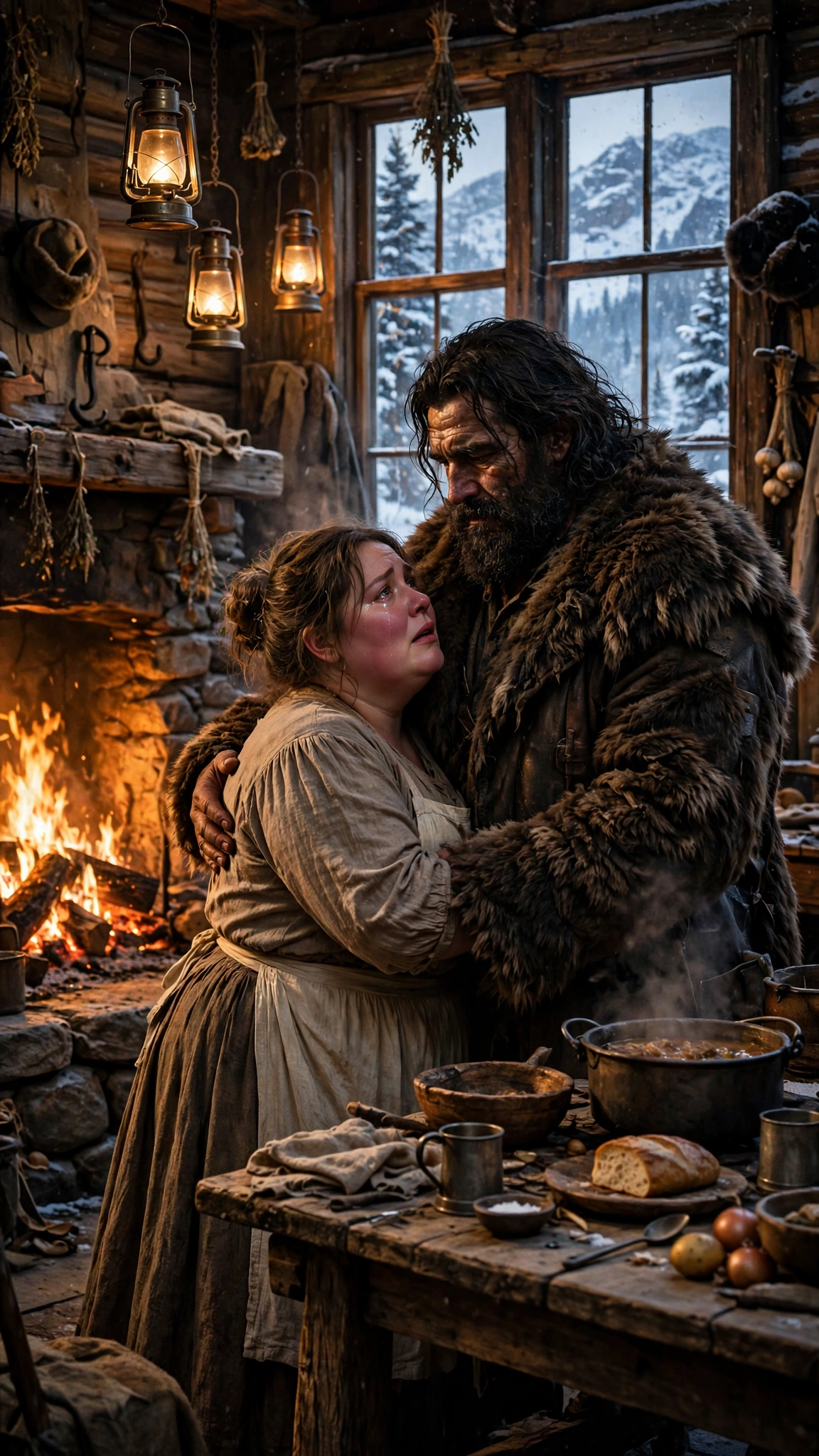
Matilda was setting the table for supper — six places, the stew pot on the stove, the bread in the oven — when she heard the sleigh bells.
She stopped with a plate in her hand, and she listened, and the bells came again, faint and far away, and then closer, and then she heard the horses stamping outside, and the barn door opening, and a man's voice, sharp and impatient, giving orders to someone in the yard. The men at the table looked up from their supper, spoons halfway to their mouths, and Silas McCready frowned at the window, and Tom Ellery said, "Who would come up this mountain in a storm like this?"
No one answered him. The stew sat steaming on the stove, and the bread sat cooling on the table, and the whole house held its breath, listening to the sleigh bells come closer, and closer, until they stopped right outside the door.
Cornelius Vane had arrived.
He came into the house like a man entering a property he already owned — tall, thin, wrapped in a fine black coat with a fur collar, his boots polished, his gloves spotless, a leather case under his arm, Mr. Pritchard scurrying behind him like a shadow. He did not stamp the snow from his boots. He did not nod to the men. He looked around the dining room with the slow, assessing gaze of a man pricing furniture — the tables, the fireplace, the lanterns, the windows — and then he looked at the cowboys, one by one, the way a man looks at cattle he means to sell, and then he looked at Matilda, standing by the stove with a plate in her hand, and his lip curled, just a little, the way a man's lip curls at something unpleasant on his shoe. Then he turned to Abigail, who stood in the parlor doorway with her hands clasped tight, and he said, "Mrs. Thatcher. I trust the house is ready."
Abigail's face was pale. "Mr. Vane. You are early. The spring —"
"The spring is a long way off, and I am a busy man," Vane said, setting his leather case on the table with a thump that made the mugs rattle. "I have come to settle the matter now. The note is due. The house is mine. I have the papers here." He opened the case and took out a sheaf of documents, tied with ribbon, and he laid them on the table like a winning hand of cards, smoothing them flat with a thin, pale hand, and Pritchard hovered at his elbow, nodding eagerly, as though the papers themselves were proof enough of anything.
"Here is the mortgage," Vane said, tapping the topmost sheet with one long finger. "Signed by your late husband, Mrs. Thatcher, in the year 1875. Four hundred dollars, at interest, secured against this house and the land it stands on. Here is the record of payments — or rather, the record of the payments you have not made. And here —" He drew out a second sheaf, tied with red ribbon, and laid it beside the first with a flourish. "Here is the transfer. Sign it tonight, and the debt is forgiven, and you will have your two hundred dollars, and you will be on the morning stage to Denver. Refuse, and I will call in the note in full, and the house will be sold at auction, and you will have nothing."
The cowboys stared at the papers, and no one touched them. Silas McCready leaned forward, squinting at the topmost sheet, and his lips moved as he read, slowly, the way a man reads something he does not trust. Tom Ellery's hands were clenched in his lap. Wade Conroy muttered, "Four hundred dollars," under his breath, as though the number itself were a kind of curse. The stew on the stove began to scorch, filling the kitchen with a bitter smell, and no one moved to save it.
Abigail looked at the papers, and her face was the color of the snow outside, and her hands, clasped tight in front of her, were shaking so hard that the lace at her cuffs trembled. Three years. Three years of fear, of adding columns in her ledger book late at night, of lying awake wondering how she would pay, and now the man who owned her fear was standing in her dining room, laying it out on her own table, like cuts of meat in a butcher's shop.
"You will sign the transfer tonight, and you will have your two hundred dollars, and you will be on the morning stage to Denver. And the house will be cleared — tonight."
"Tonight?" Abigail said. "Mr. Vane, it is a blizzard. The road —"
"The road is my concern, not yours," Vane said. "The house will be cleared tonight. All of it. The cowboys can go to the mines. And the cook —" His eyes found Matilda, standing by the stove with a plate in her hand, and his lip curled, just a little, the way a man's lip curls at something unpleasant on his shoe. "The cook will go first. I will not have a fat widow in my club. Get her out of my sight."
The room went very still. Silas McCready set down his coffee cup. Tom Ellery stood up from his chair. Wade Conroy and Ephraim Doyle looked at each other, and then at the floor.
Abigail took a step forward, and her hands were shaking, and her voice, when she spoke, was thin and high, the voice of a woman who has rehearsed a thing many times and still cannot believe she is saying it.
"Matilda Hart," she said. "You heard Mr. Vane. You will pack your things and leave this house tonight. Your week is up. I will not have you here a day longer."
"Ma'am," Silas said, standing up, his face dark, "it is a blizzard out there. You cannot send a woman out into that. She will die."
"She should have thought of that before she stole from me," Abigail said.
"I did not steal anything," Matilda said, and her voice shook, but she did not back down. "I have never stolen anything in my life."
"Then where is my husband's watch?" Abigail cried. "Where is it, if you did not take it?"
"I do not know," Matilda said. "But I did not take it. And I will not walk out into that storm to die for something I did not do."
Vane laughed — a short, cold sound, like a door slamming. "Then she will be carried out. Pritchard, fetch the sheriff's man from —"
"There is no sheriff here," Jedodiah Boon said.
He had come in from the barn so quietly that no one had heard him, and now he stood in the doorway, snow on his shoulders, his great frame filling the door, his icy-blue eyes fixed on Vane. He did not raise his voice. He did not move. He simply stood there, and the room seemed to rearrange itself around him, the way a river rearranges itself around a stone.
"Mr. Vane," he said. "You are a guest in this house. You will behave as a guest. You will not order a woman out into a blizzard in my presence."
"And who are you?" Vane said, drawing himself up. "Some trapper? Some mountain man who smells of bear grease? I am Cornelius Vane. I own the silver mines of Leadville. I own the mortgage on this house. I do not take orders from trappers."
"You do not own this house," Jedodiah said. "Not yet. And you do not own the people in it."
"I own the debt," Vane said, tapping the sheaf of papers on the table. "And the debt is due. The law is on my side. If the woman will not leave, I will have the law remove her."
"The law," Jedodiah said, "is ten miles down a mountain in a blizzard. The law is not coming tonight. And neither is that woman leaving."
He stepped forward, into the room, and his shadow fell across the table, and Vane took a step back, and Pritchard took two, and the cowboys — Silas first, then Tom, then Wade, then Ephraim, one by one, like men making up their minds — stood up from their chairs and moved to stand behind Jedodiah, between Vane and the kitchen door.
Silas was the first. He pushed his chair back slowly, the legs scraping on the wooden floor, and he stood, and he folded his arms, and he looked at Vane the way a foreman looks at a man who has just insulted his crew. Tom was next, young and shaking and furious, his jaw set, his fists clenched at his sides, the boy who had offered to walk down the mountain with Matilda now standing like a man twice his age. Wade rose with a sigh, as though he had been waiting all day for someone to give him a reason, and Ephraim stood last, bowing his head for a moment — a prayer, or a decision — before he stepped forward to join the line.
It was not a fight. There was no shouting, no shoving, no raised fists. It was something quieter and stronger than a fight: a room full of men, standing together, saying, without a word, that this would not happen here.
Abigail watched them, and her face was a battlefield — fear and pride and shame, all at once. She had wanted this. She had asked for this. Vane was her way out, her two hundred dollars, her sister in Denver. And yet, watching her boarders stand against him, watching the trapper stand like a wall between Vane and her cook, she felt something she had not expected to feel: a small, cold shame, settling in her chest like a stone in a well. These were her men. This was her house. And she had invited a stranger in to clear it out.
Vane saw the line of men, and his thin face went red. "You are all fools," he said, his voice rising. "You are cowboys and trappers, and you know nothing of business. This house is mortgaged. The debt is mine. The law is mine. I will have the sheriff up here, and I will have every one of you thrown off this mountain —"
"The law," Jedodiah said, "is ten miles down a mountain in a blizzard. The law is not coming tonight. And neither is that woman leaving."
Vane looked at them — at the trapper and the foreman and the young cowboy and the old ones — and his face went red, and then white, and he snatched up his papers, and he pointed a thin, shaking finger at Abigail, and he said, "You will regret this, Mrs. Thatcher. I will be back with the sheriff. I will be back with the law. And when I come back, this house will be mine, and that woman will be gone, and you will have nothing — nothing at all."
He swept out of the house, Pritchard scurrying after him, and the sleigh bells jingled away down the mountain road, and the storm swallowed them, and the house was quiet.
Abigail stood in the middle of the dining room, and her hands were shaking, and her face was white, and she looked at Matilda, and she looked at Jedodiah, and she looked at the cowboys, and she said, in a voice that was barely a whisper, "You have ruined me. All of you. You have ruined me."
And then she turned, and she went into her parlor, and she closed the door, and Matilda stood in the kitchen with a plate still in her hand, and she looked at Jedodiah, and she said, "He will come back. With the sheriff. With the law."
"Let him come," Jedodiah said. "We will be ready."
Matilda nodded, and she set the plate down, very carefully, and she went to her small room, and she took her mother's recipe book from the drawer, and she opened it to the page for venison stew, and she looked at the folded paper tucked between the stew page and the chokecherry jam page, and she thought, "Tomorrow. Tomorrow, when the storm breaks, I will show them what I found."
She slept that night with the recipe book pressed against her chest, and outside, the blizzard raged, and inside, the fire burned low and steady, and the house — her house, for one more night at least — stood firm against the storm.
=== STEP 6 — APPEND Chapter 6 ===