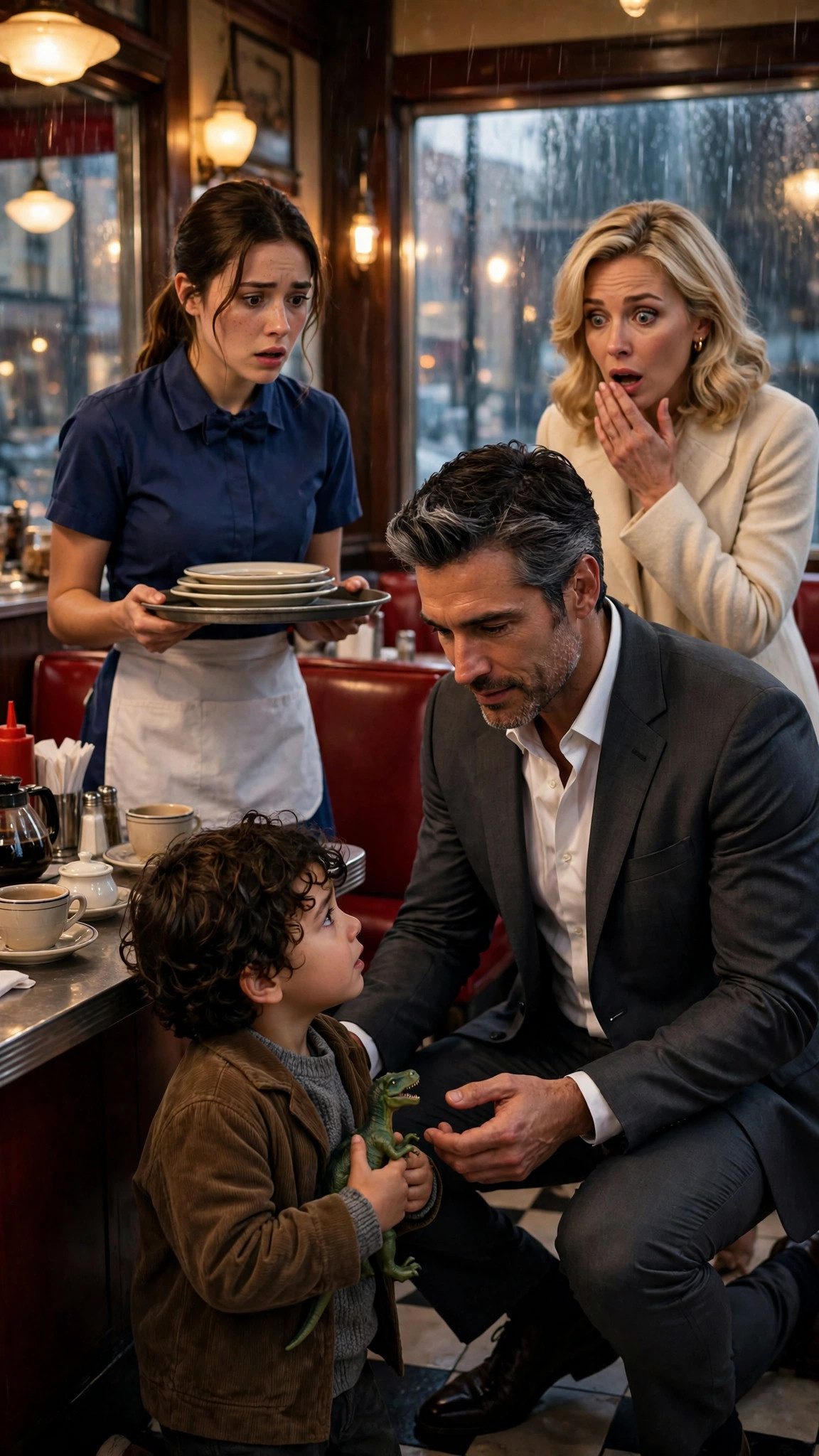
I knew the moment I saw him walk through the diner door that the life I had spent six years protecting was about to disappear.
The man I had run from stood only ten feet away, staring at the little boy I had raised alone. And then my five-year-old son looked directly into his eyes and asked the one question I had prayed he would never ask.
"Mister… why are your eyes just like mine?"
My hands almost dropped the plates I was carrying.
For six years, I had hidden behind a different name, a different town, and a life small enough that no one would ever find me. I thought I had escaped. I thought the past had finally buried itself. But that rainy afternoon inside Rosie's diner, surrounded by strangers and the smell of coffee and warm food, the secret I had protected with every breath I had taken suddenly stood in front of me.
And his name was Matthew Vieri.
My husband.
The most dangerous man I had ever loved.
—
Earlier that morning, I had promised myself that nothing would change today. I would serve coffee. I would smile at regulars. I would go home to my son, cook dinner, and pretend that my past no longer existed.
The morning had started the way all our mornings started. Leo woke me at six-fifteen by climbing onto my bed with his green plastic dinosaur and announcing that Rex was hungry and that Rex only ate pancakes shaped like volcanoes. I made the pancakes. I cut his toast into triangles because squares were, in his expert opinion, for people who had given up on life. I packed his backpack — the blue one with the broken zipper I kept meaning to replace — and walked him the four blocks to Millbrook Elementary in the thin October light, holding his small hand in mine while he told me, in exhaustive detail, about a worm he had found on the playground and named Captain.
"Captain is the bravest worm in the whole school," Leo informed me, swinging our joined hands. "He went under the slide all by himself."
"That is very brave," I said.
"Mommy, when I grow up, will I be brave like Captain?"
"You already are," I told him, and I meant it. My son had never known his father, had never lived in a big house, had never had anything but a small apartment above a hardware store and a mother who worked double shifts — and he had never once complained. He was brave in the way only a child who has never been given a reason to be afraid can be brave. I intended to keep it that way for as long as I possibly could.
At the school gate, he hugged me hard around the waist, the way he always did, and then he ran inside without looking back. I stood there for a moment longer than I needed to, watching the door close behind him, the way I did every morning. Then I walked to the diner.
Rosie's Diner sat on the corner of Main and Cedar, a low brick building with a striped awning and a neon sign that buzzed faintly whenever it rained. Inside, the air always smelled of coffee and bacon and warm pie crust, and the fluorescent lights hummed a low, steady song over the chipped Formica counter and the row of red vinyl booths. I had worked there for five years, ever since Rosie Alvarez had hired me on a Tuesday morning when I walked in with a two-month-old baby in a borrowed carrier and no references and no history she could check. She had looked at me for a long moment, looked at the baby, and said, "You start Thursday. Don't be late."
She had never asked me where I came from. In five years, she had never asked once. That was why I loved her.
That morning, the diner was its usual self. Old Mr. Henderson read his newspaper in booth three and complained that the coffee was too hot, the way he did every day. Two truck drivers argued about baseball at the counter. A young mother with a baby in a stroller ordered toast and kept one hand on the stroller the whole time, rocking it gently, the way I used to do with Leo. I moved between the tables with the coffeepot, refilling cups, smiling at the regulars, calling out orders to Eddie in the kitchen. It was ordinary. It was small. It was safe.
At noon, Rosie came out of the back office with the payroll envelopes and handed me mine. "You look tired, Sofia," she said, the way she did every week. "You work too many shifts."
"I like the shifts," I said, which was true, and also not true. I liked the shifts because the shifts kept me too busy to think, and thinking was the one thing I could not afford.
"Leo's school play is next month," Rosie said. "He told me yesterday he's going to be a dinosaur. Not a boy dressed as a dinosaur. An actual dinosaur."
"He's very committed to the role," I said.
Rosie laughed, and then her face went serious in the way it only did when she was about to say something she had been holding back. "Sofia," she said quietly. "You've been here five years. You're the best waitress I've ever had. But someday you're going to have to tell me who you're hiding from."
"I'm not hiding from anyone," I said, too quickly.
Rosie looked at me for a long moment with those sharp old eyes that missed nothing. "All right," she said. "You're not hiding from anyone."
She went back to the office. I went back to the tables. And I told myself, the way I told myself every day, that she was wrong, that I was not hiding, that I was simply living. I had a name — Sofia Hart, not Sofia Vieri. I had a town — Millbrook, population nine thousand, three hours from New York. I had a job, a small apartment, a son who believed his father was a man who had died before he was born. I had built a life small enough that no one would ever find me in it.
I believed it. I had believed it for six years.
But the rain started falling around five.
The door opened.
And my world stopped.
He was taller than I remembered. Sharper. Quieter. Not the cold control everyone feared. The kind of stillness that made an entire room hold its breath without knowing why.
Matthew didn't look for me. He looked at THE BOY.
A woman beside him kept talking, pointing at the menu, asking him questions he didn't answer. She was beautiful in the polished, expensive way of women who had never once worried about a bill — blonde hair in a smooth twist, a cream coat, diamond earrings that caught the light. She touched his arm as she spoke, and he did not pull away, but he did not look at her either.
And then he turned.
His gaze moved across the counter. Across the booths. And then it stopped on me.
I watched his expression change in a way I had never seen before. Not anger. Not surprise. Recognition. A recognition so deep it seemed to pull the air out of the room. Because he wasn't only seeing me. He was seeing the face of a child he did not know existed — a child with eyes that mirrored his own.
Leo was standing beside the counter, where he always stood after school, doing his homework on the last stool with a juice box and a pencil that was missing its eraser. He had looked up when the door opened, the way children do, curious about strangers. And now he was staring at Matthew with his head tilted, the way he tilted it when he was working out a puzzle.
He took a step forward.
"Stop."
The word left my mouth before I could think. Every head in the diner turned. Even Eddie stopped stirring in the kitchen.
Matthew froze. His eyes flickered between me and the little boy beside the counter.
"Is he…?" he started.
"No," I said too quickly.
"Yes," the little voice beside me answered.
"Leo," I whispered.
But Leo was already stepping forward, holding his little toy dinosaur, staring up at the man who had no idea he was a father. And then my little boy whispered the question that destroyed six years of hiding:
"Are you my daddy?"
My heart shattered.
Because Matthew Vieri — the man who had broken me, the man I had run from, the man who never looked back when I disappeared — dropped to one knee. Right there. In front of strangers. In front of his companion. In front of the entire diner. And then… he reached for my son's hand.
And his voice trembled.
"I don't know yet," he whispered. "But if you are mine… then I have been missing the only thing I never knew I wanted."
"Then stay," Leo whispered, "and find out."
Men like Matthew Vieri didn't need to threaten anyone. Their silence did it for them. But that night, for the first time, his silence wasn't frightening. It was breaking.
And then, the words that changed everything came from my son. "Whose eyes match mine," he said. "Mommy, is he the reason I never had a daddy?"
I couldn't answer. Because the answer had never been easy.
The truth was: I had run from Matthew Vieri. Not because he was dangerous. But because loving him meant losing myself. I thought distance would protect my son. I thought silence would protect us both.
But the truth always finds a way. And it found me in the one place I believed was safe. Right there. In the middle of the diner, under the fluorescent lights, with coffee cooling and the world staring, my past walked back into my life.
And it was holding my son's hand.
The blonde woman said his name then, sharply — "Matthew" — and the sound of it cut through the silence like a bell. Matthew did not look at her. He was still on one knee, still holding Leo's small hand in his large one, staring into my son's face as if he were reading a letter he had waited six years to receive. Leo stared back, unafraid, his green dinosaur clutched tight in his other fist.
Rosie came out from behind the counter then, wiping her hands on her apron, and her voice was calm and firm in the way it got when a customer was about to cause trouble. "Sir," she said, "I think you should stand up now. You're scaring my waitress."
Matthew rose slowly to his feet. He was taller than every man in the room, and the diner suddenly felt very small. His eyes moved from Leo to me, and in them I saw something I had never seen in all the years I had known him — not the cold control, not the stillness, not the man the whole city feared. I saw a man who had just been handed a question he did not know how to answer.
"Sofia," he said. My name in his mouth sounded like a door opening in a house that had been locked for six years. "We need to talk."
"No," I said. My voice shook, but I said it anyway. "We needed to talk six years ago. You didn't come then. Don't come now."
"I didn't know where you were," he said quietly. "I looked for a year. Then I stopped, because—" He stopped. His jaw tightened. "Because I believed you didn't want to be found."
"Then keep believing it," I said. I set the plates down on the counter with hands that would not stop shaking. "Leo, get your backpack. We're going home."
"But Mommy—" Leo started.
"Now, Leo."
He looked up at Matthew once more, and then at me, and something in my face must have told him this was not a moment to argue, because he slid off the stool and went to fetch his backpack from under the counter. Matthew watched him go, and I watched Matthew watching him, and for one terrible second I could see the arithmetic happening behind his eyes — five years old, six years gone, the eyes, the hair, the shape of the small chin.
"Five," Matthew said softly. Not a question. A calculation.
"Get out of my diner," I said. "Please. Just get out."
The blonde woman took his arm then, her fingers tight around his sleeve. "Matthew, we have a reservation at seven," she said, her voice bright and brittle. "We should go."
Matthew looked at her. Then he looked at me. And then, slowly, he reached into the inside pocket of his suit and took out a card, and set it on the counter between us. It was plain white, with only a phone number written on it in black ink. No name. He had never needed a name.
"When you're ready," he said. "Not before. When you're ready."
Then he turned and walked out of the diner, and the blonde woman followed him, and the bell over the door rang, and the rain kept falling, and the whole diner exhaled at once, and Mr. Henderson went back to his newspaper as if nothing had happened, and Eddie started stirring again, and the world went on being ordinary.
Except it wasn't ordinary anymore. It would never be ordinary again.
Rosie put a hand on my shoulder. "Sofia," she said gently. "Go home. Take the rest of the night off. I'll close up."
I nodded. I couldn't speak. I gathered Leo, and his backpack, and his dinosaur, and I walked out into the rain, and I held my son's hand very tightly, and I did not look back at the diner, because if I looked back I was afraid I would see him standing there.
Leo was quiet all the way home, which was not like him at all. When we got to our apartment, he climbed onto the couch with Rex and looked at me with those grey eyes — his father's eyes, eyes I had spent five years pretending were only mine — and asked, in a small, careful voice, "Mommy, was that man my daddy?"
I sat down beside him. I took his small hand in mine. And for the first time in six years, I did not lie to my son.
"I don't know, baby," I said. "But I think… I think he might be. And I think we have to find out."
Leo nodded slowly. Then he held up Rex and said, in his most serious voice, "Rex says it's okay. Rex says daddies are supposed to come home."
I pulled him into my arms and held him, and I thought about the card sitting on the counter at the diner, with a phone number written in black ink, and I thought about six years of running, and six years of hiding, and six years of telling myself that distance would protect us.
It hadn't protected us. It had only delayed the truth.
And the truth was standing ten feet away in a diner in Millbrook, wearing a charcoal suit, with my son's eyes in his face and my son's hand in his.
Tomorrow, I would call the number. Tomorrow, I would find out what six years had cost us all.
But tonight, I held my little boy, and I listened to the rain on the window, and I whispered the words I had not said in six years — not to anyone, not even to myself.
"Matthew," I whispered. "I'm sorry. I was afraid. I was so afraid."
And somewhere across town, in a hotel room I had never seen, I wondered if the most dangerous man I had ever loved was sitting awake in the dark, staring at a photograph he had carried for six years, asking himself the same question my son had asked in the diner.
Are you my daddy?
And for the first time since the night I ran, I let myself hope that the answer might be yes — and that yes might be enough to bring us all home.