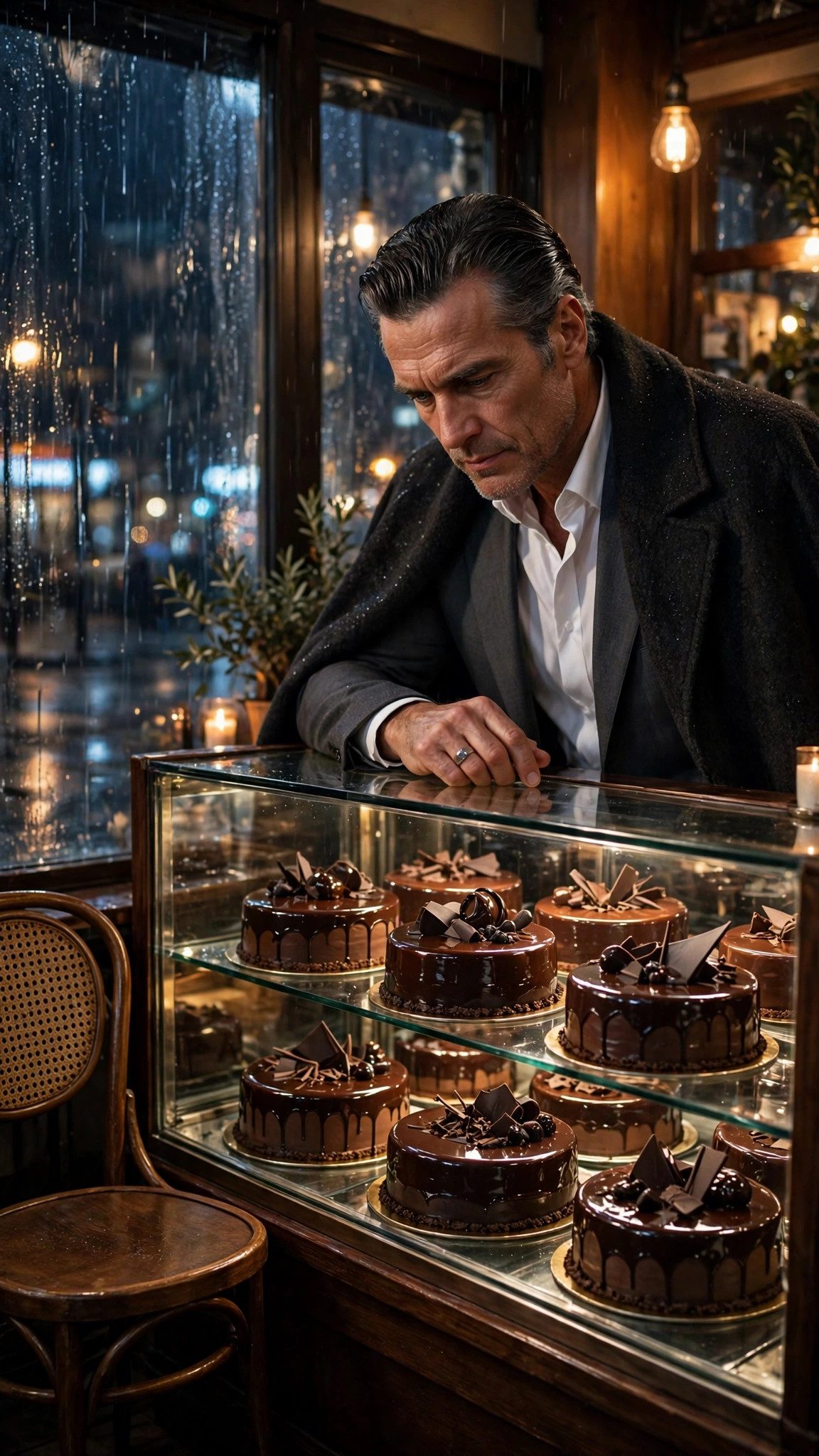
Claraara Hart had not always been the girl who counted her coins in the rain.
There had been a time, not so long ago, when Maple Street smelled of fresh bread every morning, and the little bakery with the blue awning — Hart's Bakery, the sign had said, in cheerful yellow letters — opened its doors at six o'clock sharp, and her father stood behind the counter in his white apron, flour on his forearms, calling out greetings to the neighbors as they came in for their morning rolls.
Daniel Hart had been a good man. Everybody on Maple Street said so, and in a neighborhood like theirs, where people kept their doors locked and their opinions to themselves, that meant something. He had come to the street as a young man with nothing but a recipe book his own mother had given him and a pair of strong hands, and he had built the bakery the slow way, one loaf at a time, one customer at a time, until mothers sent their children to his shop with coins clutched in their fists and old men argued over whether his sourdough or his rye was the best in the city.
His chocolate cake was the best thing he made. That was not an opinion. That was a fact, agreed upon by everyone who had ever tasted it — dark and dense and rich, with frosting so smooth it shone like polished wood. People came from three neighborhoods away for a slice on Sundays. Brides ordered it for weddings. And every Saturday morning, Daniel would lift his little daughter onto a stool in the back kitchen, tie a too-big apron around her waist, and teach her.
"Watch, Clara," he would say, his hands guiding hers on the wooden spoon. "Slow. The chocolate is shy. You have to coax it. You cannot rush a cake, and you cannot rush a person. Both of them know when you are impatient."
Claraara had been seven then, all elbows and questions, and she had believed her father knew everything in the world. She believed the bakery would always be there. She believed the smell of bread would always fill the street in the morning. She believed that her mother, Maria, would always hum while she swept the shop floor, and that her baby brother Ethan, born when Claraara was six, would always be the small, warm weight in her arms, smelling of milk and clean blankets.
She had been wrong about the bakery. She had been wrong about the smell of bread. But she had never stopped believing her father knew everything, even after he was gone — because the things he had taught her, about cakes and about people, had stayed.
Maria Hart was thirty-four years old, a quiet woman with dark hair she wore in a braid down her back and hands that were never still. After Daniel died, she cleaned offices at night, from ten o'clock until four in the morning, pushing a mop through empty rooms in a downtown tower while the city slept. She came home in the grey hour before dawn, slept for three hours on the couch with her coat still on, and then woke to make breakfast for her children — or, on the days when Ethan was in the hospital, to walk Claraara to school and then to the hospital, where she sat beside the small bed and held her son's hand and read him stories in a low, steady voice, as if reading could keep the sickness from finding him.
Ethan Hart was three years old. He had his father's dark hair and his mother's quiet eyes, and for the first two years of his life he had been the loudest, happiest child on Maple Street — a boy who chased pigeons in the park and fell down and got up laughing, a boy who loved his sister with a fierce, complete devotion and followed her everywhere, his small hand always reaching for hers. Then, one winter morning, he had woken up pale and tired, with bruises on his legs that had no explanation, and Maria had taken him to the clinic, and the clinic had sent them to the hospital, and the hospital had said a word that Maria had never heard before and never wanted to hear again.
Leukemia.
The doctors at St. Agnes Children's Hospital were kind people. They explained everything in gentle voices, with diagrams and pamphlets, and they told Maria that there was a treatment, and that the treatment could work, and that the best hope was a bone-marrow transplant — a donor, a match, a new beginning for the blood inside her little boy. They also told her, in the careful way that kind people have of telling you something terrible, that the treatment cost more money than her family had ever seen in their lives, and that the hospital's charity fund was full, and that the waiting list was long.
Maria did not cry in front of the doctors. She cried in the hospital stairwell, where no one could see her, with her hand pressed hard against her mouth. Then she wiped her face, went back to Ethan's room, and read him a story about a brave little bear, in a low, steady voice, as if reading could keep the sickness from finding him.
Claraara understood more than the grown-ups thought she did. She understood that her brother was very sick. She understood that her mother worked all night and still did not have enough money. She understood that the bakery was gone, that her father was gone, that the little house on Maple Street where they had lived above the shop was gone too, and that now they lived in two small rooms at the back of a building on the next street, where the radiators clanked and the paint peeled and the landlord knocked on the door on the first of every month with a face like a closed fist.
She understood, most of all, that her brother loved chocolate cake. Before he got sick, Daniel had given him a tiny taste on the tip of a spoon, on his second birthday, and Ethan's whole face had lit up like a lamp being switched on. He had laughed — a big, surprised, chocolate-covered laugh — and Daniel had laughed too, and Maria had taken a photograph that still sat on the shelf in their two small rooms, in a frame Claraara dusted every Sunday.
On the shelf in their two small rooms stood the photograph Maria had taken on Ethan's second birthday — Daniel laughing, chocolate on his fingers, Ethan laughing too, his whole face lit up — and beside it, Daniel's recipe book, its corners stained with chocolate, its margins full of his handwriting. Claraara dusted the photograph every Sunday, carefully, the way her father had taught her to handle precious things, and she kept the recipe book under her pillow at night, because it smelled faintly of cocoa and vanilla, and because it was the closest thing she had left to her father's voice.
She had read the chocolate cake recipe so many times that she knew it by heart — the weight of the flour, the temperature of the oven, the exact moment to fold in the melted chocolate, slow, because the chocolate is shy and you have to coax it. She had baked it twice since her father died, both times in the tiny kitchen of their two rooms, both times with her mother's help, and both times it had come out a little uneven and a little imperfect and entirely wonderful.
That was why she had gone to the cafe that rainy evening. Not for herself. Never for herself. For Ethan. Because the doctors had said, that afternoon, in their gentle voices, that Ethan had stopped eating, that his little body was tired, that he needed something to want — and Claraara had decided, with the absolute certainty of a nine-year-old girl, that what he needed was a taste of chocolate cake. Just one taste. The taste he remembered from his second birthday. The taste of the days when their father was alive and the bakery smelled of bread and everything was all right.
She had four dollars and thirty-five cents. A fresh slice cost six dollars. But the expired slice — the one nobody wanted — that one she could afford. And her brother, she told herself on the walk through the rain, would not need a fresh one. He only needed a taste.
She did not know, as she pushed open the cafe door and the little bell rang above her head, that the most feared man in the neighborhood was sitting in the corner booth, watching her. She did not know that Gabriel Rossy had grown up on these same streets, three blocks from the bakery, in a narrow house with a leaking roof, and that he had known her father's name long before she had been born.
Gabriel Rossy had not always been the man who could freeze a room with his name.
He had been a boy once, thin and hungry, the son of a small shopkeeper who sold cigarettes and newspapers from a kiosk on the corner of Maple and Fifth. His father, Salvatore Rossy, had been a proud man and a hard man, a man who believed that the world took what it wanted from the weak and that the only answer was to become strong enough that the world could not take from you. He had taught his son to fight before he taught him to read properly. He had taught him that mercy was a luxury for people who could afford it, and that the Rossys could not afford it.
Gabriel had learned the lesson too well. By the time he was twenty, he was collecting debts for the men his father owed. By thirty, he was running the streets his father had only dreamed of running. By forty, he was the head of the Rossy family, and his name was spoken in whispers in cafes and shops all over the city, and men who had once bullied him as a boy now crossed the street when they saw him coming.
He had everything his father had wanted for him. Money. Power. Fear. Respect, of a kind. And he had nothing else. No wife — the one woman he had loved, a schoolteacher named Anna, had left him twenty years ago, telling him she could not love a man who came home with blood on his cuffs. No children. No friends, only men who owed him or feared him. A big empty house on the hill, with rooms he never entered, and a table where he ate alone.
He told himself he did not mind. He told himself that a man like him did not need such things. He told himself that revenge was enough — revenge against the Castellanos, the rival family that had squeezed his father's kiosk until it bled, that had taken the corner, the street, the neighborhood, piece by piece, while the Rossys watched. Gabriel had spent twenty years taking it all back, street by street, shop by shop, and he was almost done. There was one last piece. One last debt. One last man to deal with.
That was why he had come to the cafe that rainy evening. He was on his way to a meeting — a meeting that would end with a gunshot, or so he had planned — and he had stopped for a coffee, to wait out the rain, to think. And then a little girl had come in out of the storm, asking for the slice nobody wanted, and she had looked at him with quiet eyes and told him he was nothing like her father.
And for the first time in twenty years, Gabriel Rossy had not known what to do next.
He sat in the corner booth for a long time after she left, his coffee going cold, thinking about a baker named Daniel Hart, and a kiosk on the corner of Maple and Fifth, and a boy who had once been hungry on these same streets. He thought about the debt. He thought about the note. He thought about the name on the paper, a name he had not thought about in years, and he felt something shift inside his chest, like a door opening in a house that had been locked for a very long time.
When Marco came back from following the girl, rain dripping from his coat, Gabriel was still sitting there.
"Well?" Gabriel said.
"She went to St. Agnes, boss," Marco said. "Children's hospital. Her little brother is in there. Leukemia, the nurse at the desk said. The mother works nights cleaning offices. The father —" Marco paused. "The father was Daniel Hart. The baker. He died last year."
Gabriel nodded slowly. He had known. Somehow, he had known before Marco said it.
"And the cafe?" Gabriel asked. "Who owns it now?"
"Luca Marchetti, boss. The son. His father, Enrico, owned it before him. Old Enrico is gone too."
Gabriel stood up. He left money on the table — too much, as always — and he took his overcoat from the booth, and he looked out the window one more time at the rain falling on Maple Street, on the shops and the cafes and the little houses where people like Daniel Hart had once lived and worked and believed that the world would be fair to them.
"Tomorrow," he said to Marco, "I want to see the old ledgers. My father's ledgers. All of them. And I want to talk to the waiter. Antonio. Alone."
Marco nodded. He did not ask why. He had worked for Gabriel Rossy for fifteen years, and he had learned that when the boss went quiet like this, the wise thing was to do what he was told and wait.
Gabriel walked out into the rain, and as he crossed the street to where his car waited at the curb, he thought about the little girl's question — You can buy the cake, but who has the money to buy you? — and he thought about the man he had been on his way to kill that night, and he thought about the word revenge, and how it had tasted in his mouth for twenty years, bitter and familiar, like old coffee.
For the first time in twenty years, it tasted like something else. It tasted like a question he did not know how to answer.
And Gabriel Rossy, who had never been afraid of anything in his life, was afraid — not of the gun waiting for him in the warehouse two miles away, but of the answer.