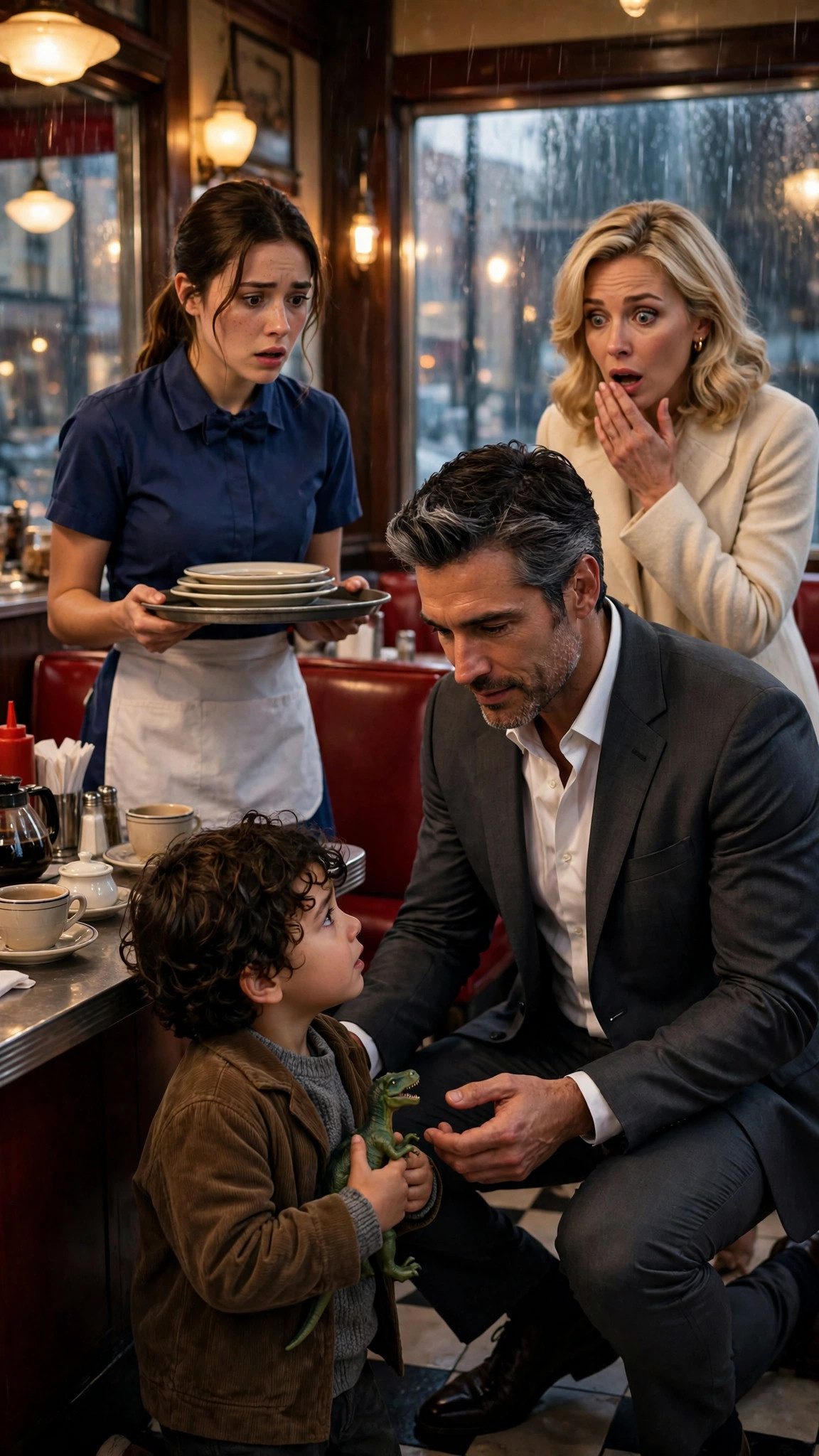
Millbrook was the kind of town where everybody knew everybody else's business and nobody ever asked about it directly.
When I arrived on that cold morning six years ago, with a duffel bag and a bus ticket stub and three hundred dollars in my coat pocket, I thought I would stay a week. A month, at most. Just long enough to figure out what came next. But Millbrook had a way of holding on to people. The rent was cheap. The diner needed a dishwasher. The hardware store below my apartment had a leaky roof and a landlord who fixed things himself and never asked for references. And so a week became a month, and a month became a year, and a year became a life.
Rosie Alvarez hired me on a Tuesday. I remember it clearly because it was the first kind thing that had happened to me in weeks. I walked into the diner with my duffel bag and asked if she needed help, and she looked at me — really looked at me, the way she still does — and said, "You're pregnant."
"Yes," I said. I didn't bother to deny it. I was four months along by then, and my coat didn't hide it anymore.
"And alone," she said. Not a question.
"Yes."
She nodded once, as if that settled something. "You start Thursday. Dishwasher, mornings. Don't be late. And eat something before your shift — you're too thin, and the baby needs you strong."
I started Thursday. I washed dishes until my hands were raw, and I ate the toast Rosie put in front of me without arguing, and at the end of the first week she paid me in cash and said, "You're a hard worker. Hard workers last in this town."
She was right. I lasted. I washed dishes, and then I cleared tables, and then I waited tables, and somewhere along the way I became part of the diner the way the chipped Formica counter and the buzzing neon sign were part of it. The regulars learned my name. Mr. Henderson taught me how to make his coffee — "hot enough to hurt, Sofia, that's the only way." Eddie, the cook, taught me to flip a pancake without a spatula, and laughed every time I dropped one. Rosie taught me everything else: how to smile when you were tired, how to remember that the man in booth four takes two sugars and the woman in booth seven is allergic to onions, how to keep going when going was the hardest thing in the world.
Leo was born in February, in the middle of the worst snowstorm Millbrook had seen in a decade. Rosie drove me to the hospital herself, in her old station wagon, through snow that came up to the hubcaps, holding my hand at every red light and telling me to breathe. "You're doing fine, honey," she said, over and over. "You're doing fine. Just breathe."
When they put Leo in my arms, he was so small I was afraid to move. He had dark curls already, and tiny fists, and eyes that opened and looked straight into mine — grey eyes, storm-cloud eyes, Matthew's eyes. I cried then, and I didn't stop crying for a long time, and Rosie sat beside the bed and held my hand and didn't say a word, because she understood that some tears don't need words.
We named him Leo because he was born in February and the lion is the sign of February, and because I wanted him to be brave. Rosie said it was a good name. "A lion's name," she said. "He'll need it."
The first year was the hardest. Leo cried at night, and I walked him around the small apartment until my feet ached, humming songs my mother used to hum to me. Money was so tight I counted every dollar twice. I worked the morning shift at the diner and the evening shift three nights a week, and Rosie watched Leo in the back office when I couldn't afford the babysitter, and he grew up among the smell of coffee and pie crust, doing his homework on the last stool at the counter, learning to count with sugar packets and to read from the laminated menus.
By the time he was three, Leo knew every regular by name. He knew that Mr. Henderson liked his newspaper folded a certain way. He knew that Eddie would give him a pickle if he asked nicely. He knew that Rosie kept a jar of peppermints behind the register and that she would pretend not to notice when he took one.
And by the time he was four, he started asking questions.
"Mommy," he said one evening, while I was tucking him into bed, "why don't I have a daddy?"
I had rehearsed this moment a hundred times, and it still broke my heart. "Your daddy was a good man," I said carefully, "but he died before you were born. He loved you very much, even though he never got to meet you."
"Was he brave?" Leo asked.
"Very brave," I said.
"Was he strong?"
"Very strong."
Leo thought about this for a moment. "Then why did he die? Brave and strong people don't die."
"Sometimes they do, baby," I said. "Sometimes even the bravest people can't stay."
He accepted this, the way children accept the things they cannot change, and he asked me to tell him a story about his daddy, and so I told him a story — a safe story, about a man who loved the rain and who could make anyone laugh and who would have loved Leo more than anything in the world. It was not a lie, exactly. Matthew did love the rain. He could make me laugh. And I believed, in the deepest part of my heart, that he would have loved Leo more than anything in the world.
Leo turned four in the spring, and Rosie insisted on a party at the diner. She closed the place an hour early, hung streamers over the counter, and Eddie made a cake shaped like a dinosaur, with green frosting and candy eyes, and Leo stared at it as if it were the greatest thing anyone had ever made. There were only eight people there — Rosie, Eddie, Mr. Henderson, two of Leo's friends from preschool and their mothers — but Leo acted as if it were a royal ball. He wore a paper crown Eddie had folded for him, and he blew out the candles in one breath, and he wished for something he would not tell me, because wishes only come true if you keep them secret.
Rosie gave him a picture book about dinosaurs, and she wrote inside the cover, in her careful handwriting: "To Leo, who is braver than a T. rex. Love, Rosie." Leo carried that book everywhere for a month. He read it to Rex at bedtime. He read it to the worms on the playground. He read it to me, from memory, getting most of the words right and inventing the rest.
The winter he turned four, Leo caught a fever that would not break. For three nights I sat beside his bed with a cold cloth, watching the numbers on the thermometer climb and fall, praying the way I had prayed only once before in my life. On the second night, Rosie came to the apartment with soup and medicine and a spare blanket, and she sat with me until two in the morning, holding my hand while Leo tossed and cried out for water.
"You should call his father," Rosie said quietly, in the dark, while Leo slept fitfully between us. "Whatever happened between you, a father should know when his child is sick."
"He's not his father anymore," I whispered. "I made that choice a long time ago."
"Did you?" Rosie asked. "Or did you make it for him?"
I had no answer for her. I had no answer for anyone. I only knew that when Leo's fever finally broke on the third morning, and he opened his eyes and asked for pancakes shaped like volcanoes, I cried with relief — and with something else, something I did not want to name, something that felt like the first crack in a wall I had spent four years building.
But the questions didn't stop. They never stop, with children. "Mommy, did Daddy have eyes like mine?" "Mommy, was Daddy tall?" "Mommy, if Daddy was brave, why didn't he fight the sickness?" And every time, I answered as honestly as I could without telling the truth, and every time, a small piece of my heart broke off, because I was building my son's whole understanding of his father on a story that wasn't true.
The summer Leo turned five, he started kindergarten, and I walked him to school on his first day with his blue backpack and his lunchbox and his hair combed flat with water, and he was so excited he could barely stand still. At the gate, he turned to me and said, "Mommy, will you wait here until I come out?" And I said, "I'll be right here, baby. I promise." And he ran inside, and I stood at the gate for an hour, because I could not make myself leave, because letting him walk into a building full of strangers felt like the hardest thing I had ever done — harder than the bus, harder than the first night in Millbrook, harder than anything.
That night, after he fell asleep, I sat at the kitchen table with my phone in my hand, and I stared at a number I had never deleted. Matthew's old number. I had kept it for five years, the way some people keep a scar — not because they want it, but because it proves something happened. My thumb hovered over the call button for a long time. I imagined his voice. I imagined telling him about Leo — about the volcano pancakes, and Captain the worm, and the dinosaur cake. I imagined him saying "come home."
I did not call. I put the phone down. I went to bed. And I told myself, the way I always did, that I had made the right choice.
The next morning, Leo asked me why my eyes were red, and I told him I had stayed up too late reading, which was almost true — I had stayed up too late reading an old number on a phone screen, over and over, the way you read a sentence in a book you can't quite understand. He accepted it, the way children accept the things adults tell them, and he asked for volcano pancakes, and I made them, and the day went on being ordinary. But something had shifted in me that night, something small and quiet, like a door coming unlatched in the wind. I did not know it yet. I would not know it until the rain started falling on an October afternoon, and the door of Rosie's Diner opened, and everything I had built came face to face with everything I had run from.
But the truth was, I had never stopped wondering. And wondering, I was learning, was its own kind of prison — quieter than running, but just as lonely.
The worst question came on a Sunday in September, a month before the rain and the diner door and everything changed. Leo and I were walking home from the park, and he was carrying a leaf he had found — a big red maple leaf, the kind that looks like a hand — and he said, very quietly, "Mommy, if my daddy died, why do I still miss him? I never even met him."
I stopped walking. I knelt down on the sidewalk and took his small face in my hands, and I said, "Because love doesn't need to meet someone to miss them, baby. Your heart knows him, even if your eyes never did."
Leo nodded, satisfied, and held up his leaf. "I'm going to press this in a book," he said. "So I can keep it forever."
That night, after he fell asleep, I sat by the window of our small apartment and looked out at the quiet street, and I thought about the man I had run from, and I wondered where he was, and whether he ever thought about me, and whether he had moved on, and whether he was happy. I wondered if he had married someone else. I wondered if he had forgotten my name.
I told myself it didn't matter. I told myself that the life I had built in Millbrook was enough — the diner, the small apartment, the boy with the grey eyes who pressed leaves in books and named worms on the playground. I told myself that distance had protected us, and that silence had protected us, and that I had made the right choice.
I believed it. I had believed it for six years.
But the truth was, I had never stopped loving Matthew Vieri. I had only stopped saying his name out loud. And every time Leo asked about his father, every time I saw those grey eyes looking up at me, every time I caught myself listening for a voice I would never hear again, I knew that the life I had built was not a life. It was a hiding place. And hiding places are not meant to last forever.
They are meant to keep you safe until you are strong enough to come home.
I just didn't know, that September night, that home was about to walk through the door of Rosie's Diner on a rainy October afternoon — taller than I remembered, sharper, quieter — and that my five-year-old son would look into his eyes and ask the one question I had prayed he would never ask.
"Mister… why are your eyes just like mine?"
And I would have no answer. Because the answer had never been easy.
The answer was six years of running. Six years of hiding. Six years of telling myself that love meant losing myself, when all along, love had meant something else entirely.
Love had meant coming home.