Matthew Vieri had not believed in ghosts until the morning his wife disappeared.
He woke that morning to an empty bed and a cold house, and for a moment he thought she had simply gone downstairs early to make coffee. Sofia always woke before him. She liked the quiet of the house before the guards changed shifts, before the phones started ringing, before the day became what the day always became. He lay in bed for a moment, listening for the sound of her moving around downstairs, and when he heard nothing, he got up.
He found the note on the kitchen table. He read it three times before the words made sense.
"Matthew, I love you. I have always loved you. But I can't live in this life anymore, and I can't raise a child in it. Don't look for me. I'm sorry. — Sofia."
A child. She was pregnant, and she was gone, and she had left him a note on the kitchen table like a woman leaving a hotel room.
He read the note a fourth time, and then a fifth, and then he put it down very carefully on the table, as if it might break, and he walked to the window and looked out at the garden where they had married, and he did not move for a very long time.
Tony Russo found him there an hour later. Tony had been his father's right hand for thirty years, and Matthew's underboss for six, a broad, grey-haired man with a voice like gravel and hands that had done things Matthew preferred not to think about. Tony took one look at the note on the table and said, "Boss. I'm sorry."
"Find her," Matthew said. His voice sounded very far away, even to himself. "Find her and bring her home."
"I will," Tony said. "I'll put every man we have on it."
And Tony did — or at least, that was what he told Matthew. For a year, Matthew paid for private investigators, for informants, for men who knocked on doors in three states and asked about a young woman with dark hair and brown eyes. For a year, he waited for the phone to ring. For a year, he slept in the guest room because he couldn't bear to sleep in their bed alone.
And then, one morning, Tony came to his office with a second letter.
It was in Sofia's handwriting. Matthew knew her handwriting the way he knew his own name — the neat, slanted letters, the way she crossed her t's, the small loop she made on the letter y. The letter said:
"Matthew, stop looking for me. I meant what I wrote. I never loved you. I married the name, not the man. I have a new life now, and I don't want you in it. Don't send your men. Don't call. Let me go. — Sofia."
Matthew read it twice. Then he folded it very carefully, put it in the top drawer of his desk, and said, "All right."
"Boss—" Tony started.
"All right," Matthew said again, and his voice was so quiet that Tony took a step back. "Stop the search. Pay the investigators. Close it."
"Are you sure?"
"I'm sure," Matthew said. "She doesn't want to be found. I won't chase a woman who doesn't want me."
That night, Matthew went home to the big house on the hill, and he walked through the rooms that still smelled faintly of her — the kitchen where she used to hum while she made coffee, the garden where she used to read in the afternoons, the bedroom where her side of the bed was still empty — and he understood something he had not understood that morning six years ago when he found the note on the kitchen table.
Sofia had not left because she was afraid. She had left because she had never loved him. The white roses, the coffee with one sugar, the way she looked at him as if he were the only steady thing in the world — all of it had been a performance. She had married the name. She had married the money, the house, the power. And when she got tired of it, she had walked out the door and never looked back.
That was what the letter said. That was what he believed.
For six years, he believed it. He buried himself in the family — in the docks, in the trucking routes, in the endless meetings with men who wanted something from him and were afraid to ask for it directly. He became colder. Quieter. The stillness that had always been a part of him hardened into something that made even his own men nervous. His mother, Elena, watched him with worried eyes and said, "Matthew, you are disappearing. I can see you going, day by day, and I don't know how to stop it."
"I'm fine, Mother," he said, the way he always said.
"You are not fine," she said. "You are a ghost in your own house."
She was right. He was a ghost. He moved through the big house like a man haunting a place he no longer lived in. He ate alone. He slept alone. He worked until two in the morning because sleep brought dreams, and dreams brought her face, and her face brought the question he could not answer.
Why? Why had she left? Why had she said she never loved him? What had he done wrong?
He asked himself that question a thousand times, and he never found an answer, because there was no answer in the letter. There was only the handwriting, and the handwriting was hers, and the handwriting did not lie.
Except it did lie. He would not learn that for six years.
In the sixth year, the council came to him. The council was five old men who had served his father and who believed that a family without an heir was a family without a future. They sat in his study, in their dark suits, with their hands folded, and they told him what they had been telling him for two years.
"You need a wife, Matthew," said old Don Ferrante, who was eighty-one and had buried two wives and three sons. "A man in your position cannot be alone. It makes people nervous. It makes them think you are weak."
"I'm not weak," Matthew said.
"No one is saying you are weak," said another, a man named Carlo, who had known Matthew since he was a boy. "But a family needs a future. You need a son. And the Cross family has a daughter."
Vivian Cross. Thirty years old, beautiful, educated, the daughter of Charles Cross, who owned half the real estate on the East Side. A good match, the council said. A strong alliance. A woman who understood the life.
Matthew did not love Vivian Cross. He did not dislike her, either. She was pleasant. She was patient. She understood when he was quiet, and she did not ask him questions he did not want to answer. When she touched his arm, he did not pull away. When she talked about the wedding — a big wedding, four hundred guests, the cathedral — he nodded, the way a man nods when he has agreed to something he does not care about.
His mother hated the idea. "You don't love her," Elena said flatly, the night he told her.
"I don't need to love her," Matthew said. "I need a wife. The council needs a wife. Vivian is a good woman."
"She is a good woman," Elena agreed. "And you will make her miserable, the way you have made yourself miserable for six years, because you are still married to a ghost."
"I am not married to a ghost," Matthew said. "My wife left me. She told me she never loved me. She is gone."
"Then why do you still carry her photograph in your wallet?" Elena asked.
Matthew said nothing. He did not need to say anything. They both knew the answer. He carried the photograph because it was the only thing he had left of her — a small, creased photograph from their wedding day, Sofia in her simple dress, smiling at him the way she used to smile, as if he were the only steady thing in the world.
He carried it for six years. He carried it to meetings, to dinners, to the docks at dawn.
He met Vivian Cross properly at a council dinner in the spring of the sixth year — a long table, twenty guests, crystal glasses, and conversation that never once said what it meant. She sat across from him, in a pale blue dress, and she asked him about the shipping business, and she listened to the answer, and she did not flinch when old Don Ferrante told a joke about a man who had crossed the family and never been seen again. After dinner, she found him on the terrace, alone with a glass of whiskey he had not touched, and she said, "You look like a man who would rather be anywhere else."
"I would," he said honestly.
"So would I," she said, and smiled. "My father arranged this. He thinks a marriage will make us both stronger. I think it will make us both lonelier. But I have learned not to argue with my father."
Matthew looked at her then, really looked at her, and saw a woman not unlike himself — a person who had been handed a life and told to live it, whether she wanted it or not. He felt something close to pity, and something close to respect, and neither of them was love.
"I'll treat you well," he said. "That's the best I can promise."
"That's more than most men in our world promise," Vivian said. "I'll take it."
That night, alone in his study, Matthew took the photograph out of his wallet and set it on the desk in front of him. Sofia, in her simple dress, smiling at him in Elena's garden, the white roses everywhere. He looked at it for a long time, the way a man looks at a door he has locked and lost the key to.
He thought about the letter in the top drawer of his desk — the second letter, the one that said she never loved him. He had read it a hundred times, and every time, the same question came back, the one he could never answer: if she never loved me, why did she stay for six years? Why did she learn my mother's lasagna? Why did she dance with me in the kitchen when no one was looking?
He had no answer. He had never had an answer. And so he put the photograph back in his wallet, and he poured himself a glass of whiskey he did not drink, and he sat in the dark of his study until two in the morning, listening to the silence of a house that had been empty for six years.
He carried it for six years. He carried it to meetings, to dinners, to the docks at dawn. He carried it the way a man carries a wound he has stopped trying to heal.
And then, on a rainy afternoon in October, he carried it to Millbrook.
He had not planned to go to Millbrook. The family was buying a trucking depot there, part of the slow, careful work of making the business legitimate — a project Matthew had started two years ago, because he was tired of the guns and the guards and the men who disappeared. Vivian had insisted on coming with him. "You've been working too hard," she said. "Let me take you to lunch. There's a little diner in town. It will be charming."
It was not charming. It was a low brick building with a striped awning and a buzzing neon sign, and the air smelled of coffee and bacon, and the fluorescent lights hummed over the counter. Matthew did not want to be there. He wanted to be back in New York, in his office, where the world made sense.
And then he saw the boy.
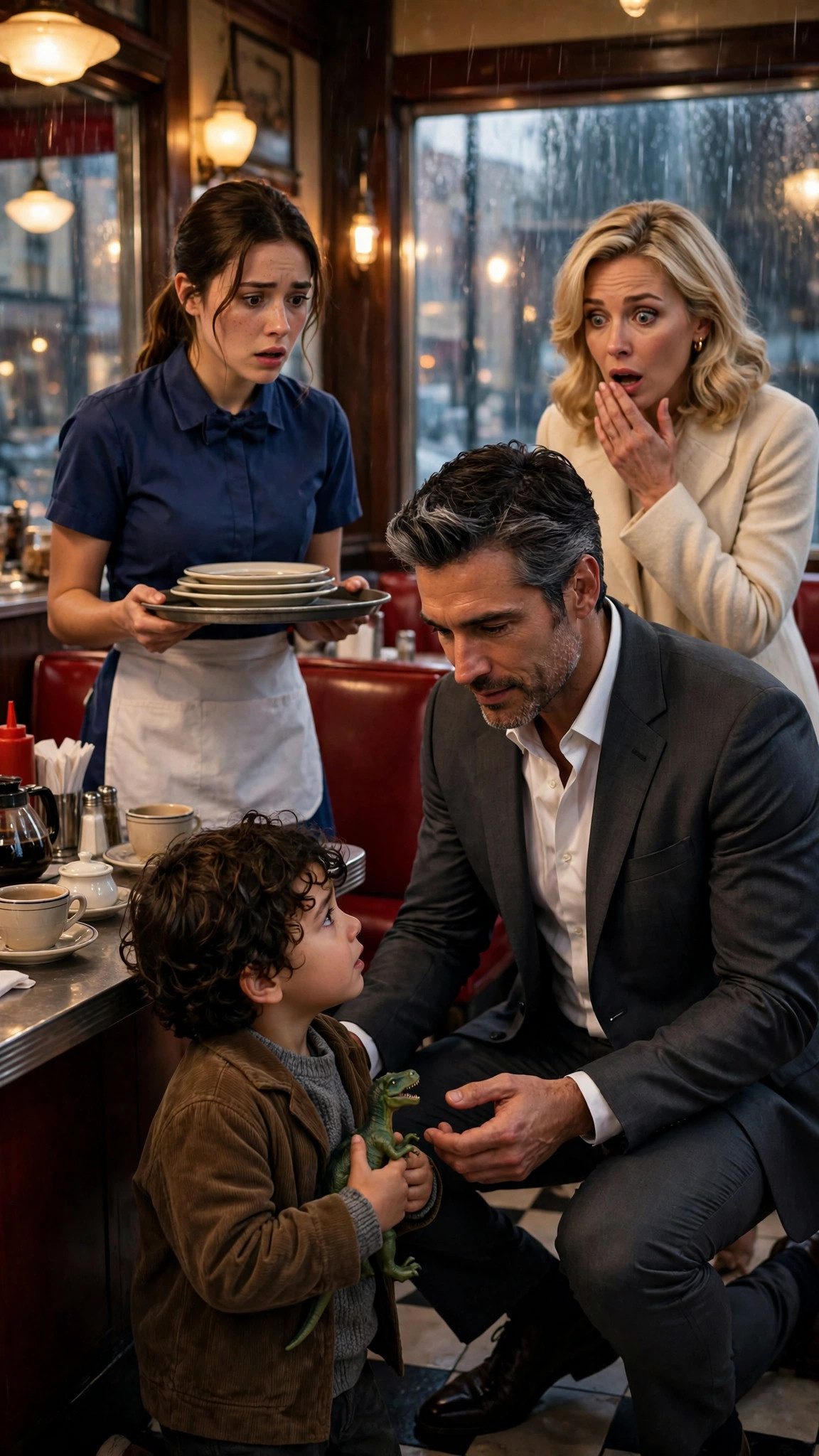
The boy was sitting on the last stool at the counter, doing his homework with a pencil that was missing its eraser, and he looked up when the door opened, the way children do. He had dark curls. He had a small, serious face. And he had eyes the color of storm clouds — grey and deep and exactly like Matthew's own eyes, staring back at him from the face of a child he had never seen before.
Matthew stopped walking. The room went very quiet, or maybe that was only inside his own head. He looked at the boy. And then his gaze moved across the counter, across the booths, and it stopped on the waitress carrying a tray of plates — dark chestnut hair in a low ponytail, warm brown eyes, a navy uniform with a white apron — and his heart stopped beating entirely.
Sofia.
His wife. The ghost he had carried in his wallet for six years. Standing ten feet away, in a diner in a town he had never heard of, carrying plates, alive, real, breathing.
And beside the counter, the little boy with his eyes looked up at him and asked, in a clear, curious voice, "Mister… why are your eyes just like mine?"
Matthew did not answer. He could not answer. He was too busy doing the arithmetic — five years old, six years gone, the letter, the note, the baby she had mentioned in the note on the kitchen table — and the arithmetic added up to something so enormous, so impossible, that for a moment he could not breathe.
A child. She had been pregnant when she left. And the child was here. Five years old. With his eyes. With his hair. With his chin.
His son.
The word hit him like a physical blow, and he took a step forward without thinking, and then Sofia said "Stop," and the whole diner turned, and the boy — his son, his son — stepped forward holding a little green dinosaur and whispered the question that broke six years of silence wide open.
"Are you my daddy?"
And Matthew Vieri, the most feared man in New York, the man who had never once in his life knelt to anyone, dropped to one knee in the middle of a diner in Millbrook, in front of strangers, in front of his fiancée, in front of the entire world, and took his son's small hand in his, and whispered the only honest thing he had said in six years.
"I don't know yet. But if you are mine… then I have been missing the only thing I never knew I wanted."