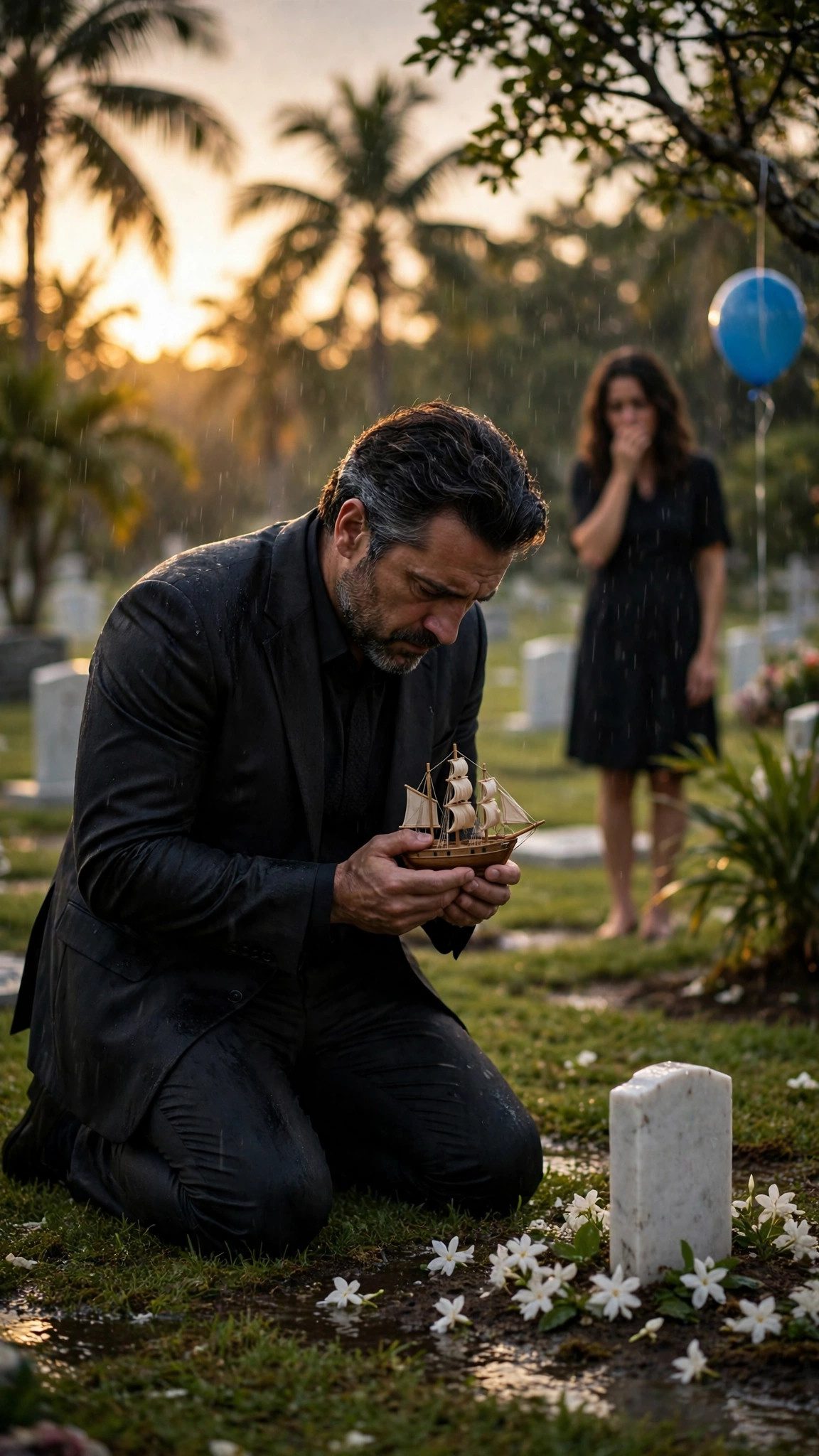
I spent six weeks preparing for Noah's first birthday. Six weeks, because I wanted it to be perfect, and because preparing for it gave me something to do with my hands while my marriage fell apart around me.
I ordered thirty-six balloons in soft blue and white, and I spent an entire afternoon tying them to the backs of chairs, to the banister, to the corners of the living room, until the ceiling looked like a sky that had come indoors to celebrate my son. I baked the cake myself, a little ship with white sails made of frosting, because Noah loved the toy ship his grandmother in Naples had sent him, the one he carried everywhere, even into his bath. I made tiny sandwiches and cut fruit into stars. I hung a banner across the fireplace that said HAPPY FIRST BIRTHDAY NOAH in bright blue letters, and I stood back and looked at it, and I thought, this is what a home is supposed to look like.
The blue shirt arrived the week before, in a box from the boutique on Worth Avenue where Damian bought his own shirts. He had chosen it himself, on one of his rare days home, holding it up against Noah's chest in the nursery, turning him this way and that, frowning in concentration the way he frowned over business contracts.
"This one," he had said. "The blue brings out his eyes. His father's eyes."
I had folded it with such care that I was almost afraid to let anyone else touch it. I laid it out on Noah's bed the night before the party, smoothing it with my hands, and I whispered to my sleeping son, "Your daddy picked this out for you. He loves you, baby. He really does."
I wanted to believe it. I needed to believe it, because if I stopped believing it, I would have to admit that I had married a man who loved his son in photographs but not in person, and I was not ready to admit that yet.
Rosa came early on the morning of the party, her arms full of flowers from her own garden, white jasmine that filled the whole house with sweetness. Rosa had been with our family since before I married Damian. She was sixty-four, small and round, with hands that had rocked three generations of Moretti babies, and she loved Noah like her own grandson. She had been there the day he was born, holding my hand when Damian stepped out to take a phone call, and she had been there every day since, singing to Noah in Spanish while she cooked, teaching him to clap his hands, wiping his chin with a tenderness that made my throat ache.
"Today is a beautiful day, señora," she said, arranging the jasmine in vases. "The little one will be so happy."
"He will," I said. "His father promised he would be here."
Rosa did not say anything. She just looked at me, and in her eyes I saw everything she was too kind to say: that Damian had promised before, and that promises from men like Damian were like smoke, beautiful and impossible to hold.
We spent the morning finishing the cake together, Rosa and I, in the kitchen, with Noah in his high chair watching us, banging a wooden spoon against the tray. The cake was shaped like a little ship, and I had made the sails out of white frosting, but they kept drooping, and Rosa laughed, and she showed me how to prop them up with toothpicks, the way her own mother had taught her when she was a girl in Cuba.
"There," she said, stepping back to admire our work. "A ship fit for a captain."
Noah clapped his hands, and Rosa gave him a tiny cupcake to practice on, a little one with blue frosting, and he put both hands into it immediately, smearing frosting across his face and his hair and the front of his shirt, and Rosa and I laughed until our sides hurt, because he looked so delighted with himself, so proud, as if he had just discovered the greatest joy in the world.
I filmed it, of course. I filmed everything. I held up my phone, and I said, "Noah, show Mommy your cupcake!" and he held up his frosting-covered hands, and he laughed, and I thought, this is the video I will send Damian tonight, and this time, surely, he will understand what he is missing.
Matteo arrived early, before the other guests, carrying a gift so large he could barely fit it through the front door. It was a wooden rocking horse, painted bright red, with a black mane and a golden saddle, and Noah's eyes went wide when he saw it. Matteo set it down in the middle of the living room, and he lifted Noah onto it, and he rocked him gently back and forth, and Noah laughed, that high, delighted laugh that sounded like wind chimes.
"He's going to love this," Matteo said, grinning. "Every boy needs a horse."
"He already loves it," I said. "Thank you, Matteo. You're a wonderful uncle."
Matteo's smile faded a little. He looked at me, and he looked at the empty chair beside the table, the chair I had set for Damian, and he said, quietly, "He'll be here, Claire. I called him this morning. He said he's on his way."
I nodded, and I did not say what I was thinking, which was that Damian had said he was on his way many times before, and that being on your way and being here are two very different things.
My mother arrived next, with a cake of her own, because no grandmother trusts her daughter's baking entirely, and she hugged me, and she looked around the living room, at the balloons and the banner and the little ship cake, and she said, "You've done a beautiful job, sweetheart. Noah is a lucky boy."
"He is," I said, and I meant it, because he had a mother who loved him, and a grandmother who loved him, and an uncle who loved him, and a housekeeper who loved him like her own grandson. He had so much love. The only love he did not have was the one that mattered most, and I could not give it to him, no matter how hard I tried.
My mother helped me dress Noah in his blue shirt, the one Damian had chosen, and she smoothed his dark curls with her fingers, and she said, "He looks just like his father. The same eyes. The same chin."
"He does," I said, and my throat closed, because it was true, and because it was the cruelest thing about all of it: Noah looked like Damian, and sounded like Damian when he laughed, and reached for Damian in his sleep, and Damian was not there to see any of it.
The guests began to arrive at three in the afternoon. Matteo came first, with a gift so large he could barely carry it through the door, a wooden rocking horse painted bright red, and Noah's eyes went wide when he saw it. My mother came, with a cake of her own, because no grandmother trusts her daughter's baking entirely. A few of my friends from the hospital came, nurses I had worked with for years, women who knew how to laugh loudly and hold a baby at the same time. A few of Damian's men came with their wives, standing awkwardly in their suits in my living room, holding glasses of lemonade like they were afraid to break them.
Everyone asked the same question, in different ways. "Where is Damian?" "Is the boss coming?" "When does he get in?"
"He's on his way," I said, again and again, smiling until my face hurt. "He promised. He'll be here."
At four in the afternoon, he was not home. The party was in full swing. Noah was in his high chair, wearing the blue shirt, his face covered in frosting, laughing at the balloons. I kept looking at the door.
At five, still nothing. I went into the kitchen and called his phone. It went to voicemail. I called again. Voicemail.
At six, the guests began to look at each other. My mother took my hand under the table and squeezed it. Matteo went outside to make a call, his face dark, and when he came back in, he would not meet my eyes.
At 7:12, I could not wait any longer. I went into the bedroom, closed the door, and called him.
"Damian, where are you?"
There was a pause, and then his voice, too casual, too smooth. "I'm heading to the airport."
Behind him, I heard music. Laughter. The sound of waves breaking on a shore, slow and rhythmic, a sound that belonged to another world.
Then Sofia's voice, light and unbothered, floating through the line like perfume. "Damian, they're bringing the champagne."
I looked at the empty chair beside mine, the chair I had left for him, with a place set before it and a glass of wine poured and waiting.
"You're not coming," I whispered.
"Claire, something came up."
"No," I said, and my voice was steady now, steady in a way that frightened me, because it was the voice of a woman who had finally stopped hoping. "You chose not to."
I ended the call. I stood in the bedroom for a long time, looking at myself in the mirror, at the woman in the blue dress who had spent six weeks preparing a perfect birthday for a little boy whose father could not be bothered to come home. And then I wiped my eyes, and I fixed my lipstick, and I went back out to the party, because my son was turning one year old, and he deserved a mother who could smile.
We sang Happy Birthday without him. Everyone gathered around the cake, and Noah sat in his high chair, and we sang, and he clapped his tiny hands, and then he put both hands into the cake, right into the frosting, and everyone laughed, and I laughed too, because that is what mothers do. We laugh so our children will not be afraid.
Rosa took the photograph. In it, Noah is laughing, his face covered in cake, his hands in the air. And beside me, there is an empty chair.
By ten o'clock, the guests were gone. Matteo was the last to leave, and he hugged me at the door, hard, and he said, "I'm sorry, Claire. I tried to reach him. I told him he needed to be here."
"I know," I said. "It's not your fault, Matteo. It was never your fault."
He nodded, and he left, and I stood in the doorway for a moment, watching his car disappear down the street, and then I closed the door, and the house was quiet.
Rosa had stayed to help me clean up, and we worked in silence, putting away the dishes, folding the tablecloths, gathering the leftover balloons. When she was ready to go, she kissed Noah's forehead, and she kissed my cheek, and she said, "You are a good mother, señora. The best mother. Don't ever forget that."
"I won't," I whispered, but I was already forgetting, because I was starting to believe that being a good mother was not enough, that no amount of love from me could make up for the love my son was not getting from his father.
I put Noah to bed in his blue shirt. I sat on the edge of his crib for a long time, just watching him breathe, his chest rising and falling, his dark curls damp with sweat, his little hand curled around the edge of his blanket.
At 11:43 P.M., he woke up.
I carried him into the living room, and I placed him on the rug, and he pulled himself upright using the couch, and then a car passed outside, and he turned toward the front door, and his little face lit up, and he said, "Daddy!"
One step. Two steps. Three steps. Then he fell onto the rug.
"Oh my God, Noah! You walked!"
I scooped him into my arms and spun him around, and he laughed, and then he looked over my shoulder, toward the door, and he said it again, softer, like a question.
"Daddy."
I had recorded everything. Video number 1,907. His first three steps. All toward a father who wasn't there.
For the first time in a year, I did not send Damian the video. I stared at the Send button until the screen went dark. Then I turned off my phone, and I carried my son back to his crib, and I lay down beside him on the floor, on the rug where he had taken his first steps, and I cried until I fell asleep.
I dreamed that night, a dream so vivid I woke up believing it was real. In the dream, Damian came home. He walked through the front door, and Noah ran to him, and Damian picked him up and held him high in the air, and Noah laughed, and Damian looked at me, and he said, "I'm sorry, Claire. I'm here now. I'm never leaving again."
I woke up with the sun on my face and Noah stirring in his crib, and for one beautiful, terrible second, I believed the dream was true.
Then I remembered the empty chair. And the phone call. And Sofia's voice saying, "Damian, they're bringing the champagne."
And I got up, and I dressed my son in his blue shirt, because he had developed a mild cough after the party, and I was going to take him to the doctor, and it was going to be an ordinary trip, less than forty minutes, there and back.
It should have been an ordinary trip.
It was the last trip I ever took with my son.
I did not know it then. I know it now, and I will know it for the rest of my life, in every car I ever ride in, on every ordinary morning, whenever I hear brakes scream or glass break in a film. Some moments do not end. They simply wait for you, patiently, forever.