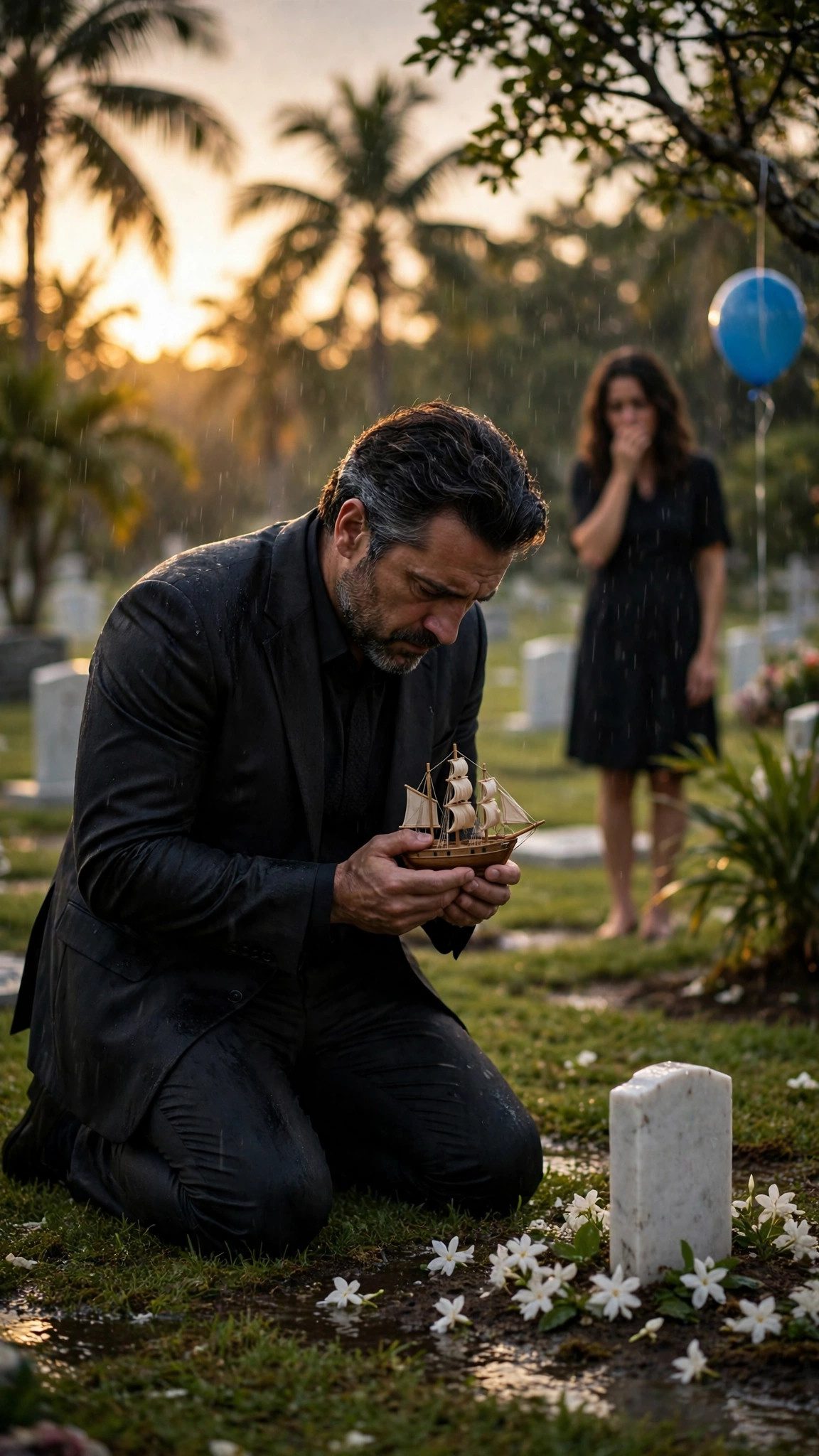
The morning after Noah's birthday began like any other morning. That is the cruelest thing about the worst day of your life: it does not announce itself. The sun comes up the same way. The birds sing the same way. The coffee tastes the same. Nothing warns you.
Noah woke up coughing, a small, dry cough that worried me more than it should have. He had been fine the night before, laughing and clapping, but parties are hard on small children, and I told myself it was nothing, just a little irritation from the excitement and the cake and the late night. Still, I called the pediatrician's office as soon as it opened, and Dr. Alvarez, who had cared for Noah since he was born, told me to bring him in.
"Just to be safe, Claire," she said. "Better to check."
I dressed Noah in his blue shirt, the same blue shirt from the party, because he looked so beautiful in it, and because some foolish, hopeful part of me thought that if Damian saw a photograph of him in it, he might finally understand what he had missed. I packed his diaper bag. I put the toy ship in the car seat beside him, because he never went anywhere without it.
At 9:16, Damian called. I did not answer. At 9:18, he called again. I did not answer. At 9:23, a message appeared on my phone.
"How's my birthday boy?"
I did not answer. I put the phone in my purse, and I carried Noah out to the car, and I buckled him into his seat, and I kissed his forehead, and I said, "We're going to see Dr. Alvarez, baby. Just a quick check, and then we'll come home, and Mommy will make you soup."
He smiled at me, and he held up his toy ship, and he said, "Daddy?"
"No, baby," I said, my throat closing. "Not today. Daddy is away."
He looked out the window, and he did not say it again.
At 10:07 A.M., we left the house. It should have been an ordinary trip. Less than forty minutes. The pediatrician's office was ten minutes away, down streets I had driven a hundred times, past the park where I took Noah to feed the ducks, past the bakery where Rosa bought her bread.
Our car was passing through Coral Gables when it happened.
I remember the sound first. Brakes screaming, tires skidding on asphalt, a horn blaring somewhere behind us. Then a shape, dark and fast, coming from the side street, and our driver, Marco, shouting, "Hold on!" and the world tilting sideways.
Glass shattered. The car spun. Someone yelled my name, or maybe I yelled it myself. I wrapped my arms around Noah, pulling him tight against my chest, shielding his small body with mine, and I felt his heart beating against me, fast and frightened, and I whispered, "Mommy's here, baby. Mommy's here. I've got you."
Then everything disappeared.
I woke up at 1:32 P.M. in a hospital. White ceiling. White walls. The smell of antiseptic and something else, something cold and metallic that I could not name. My head throbbed. My ribs ached with every breath. There was a bandage on my arm, and wires on my chest, and a nurse standing beside my bed with tears in her eyes.
My first words were, "Where's Noah?"
Nobody answered.
I asked again, louder, pulling at the wires, trying to sit up. "Where's my baby?"
A doctor approached my bed. He was a kind man, older, with gray hair and gentle hands, and I could see in his eyes that he had rehearsed this moment a thousand times and still did not know how to do it. I saw his face.
And I knew.
But I kept shaking my head. "No," I said. "No. No. No. Tell me where he is. Bring him to me. Bring my baby to me."
The doctor took my hand, and he said, very quietly, "Mrs. Moretti, I'm so sorry. We did everything we could."
Noah had died at 12:48 P.M.
One day after his first birthday.
The night before, his little hands had been gripping the couch. That morning, they had held my finger in the car. Now mine were empty, and they would stay empty, and no one in the world could ever fill them again.
I do not remember much of the hours that followed. I remember the nurse, a young woman with kind eyes, sitting beside my bed and holding a cup of water to my lips, because my hands were shaking too hard to hold it myself. I remember Dr. Alvarez arriving, still in her white coat from her office, her face white, because she had been expecting us for a check-up, a mild cough, nothing more, and now she was standing in a hospital room telling a mother that her son was gone. She held my hand, and she said, "Claire, I am so sorry. I am so, so sorry," and I could see that she meant it, that she carried it too, that she would carry it for a long time.
I remember Elena arriving. My friend, my attorney, my college roommate, the woman who had held my hand at my father's funeral. She came the moment she heard, and she did not ask me what I needed. She simply sat beside me, and she held my hand, and she waited, because she knew that sometimes the only thing you can do for a person in grief is to sit with them in it.
"He's on his way," Elena said quietly, after a while. "Matteo called him. He's coming home."
"He's too late," I said. My voice sounded strange to my own ears, flat and far away, like it belonged to someone else. "He was too late for the birthday. He's too late for this. He will always be too late now."
Elena did not argue with me. She knew better. She simply said, "What do you want to do, Claire? Whatever you want, I will make it happen."
"I want to leave," I said. "I can't stay here. I can't stay in a place where my son died. I can't be here when Damian arrives, because if I look at his face, I will see the man who chose Saint-Tropez over his son's birthday, and I will never be able to unsee it."
Elena nodded. She spoke to the doctors. She signed the papers. She arranged a car, a small hotel on the other side of the city, a room under a different name, where no one from the Moretti family would think to look for me. And before we left, the nurse brought me a small bag.
Noah's sock. His hospital bracelet. The blue birthday shirt, folded neatly, still smelling faintly of cake. A toy ship with tiny white sails. And my phone.
I held the bag against my chest, and I stood in that hospital room for one last moment, looking at the empty bed where they had laid my son, and I whispered, "Goodbye, baby. Mommy loves you. Mommy will always love you."
Then I typed the note on my phone, with shaking hands, and I left it on the screen for Damian to find.
"The hard drive is at home. Start with the first video."
It was the only thing I could think to say to a man who had missed everything. Start at the beginning. Watch it all. See what you lost. See it the way I saw it, one video at a time, because that is the only way you will ever understand.
Elena drove me to the hotel in silence, and I sat in the passenger seat, holding the small bag, staring out the window at the streets of Miami going by, at the palm trees and the traffic lights and the people walking their dogs, all of them living their ordinary lives, as if the world had not just ended.
That night, in the hotel room, I lay on the bed in my clothes, and I stared at the ceiling, and I thought about Noah, and about the forty-three moments, though I did not know the number yet, and about the year I had spent recording videos for a man who was always somewhere else.
And I made a promise to myself, there in that dark hotel room, holding my son's sock against my cheek.
I would never again teach a child to wait for someone who would not come.
They told me later what had happened. A truck had run a red light and struck our car on the driver's side, spinning us into a concrete barrier. It had not been an accident. The truck had been waiting. The driver had been paid. The route had been sold. But I did not know any of that then. I knew only that my son was gone, and that I had been holding him, and that my arms had not been enough to save him.
Damian learned what happened at 1:41 P.M. He was having lunch with Sofia in Saint-Tropez, on a terrace overlooking the water, the sun on his face, a glass of champagne in his hand, when his younger brother Matteo called.
Matteo told him, in words I will never know, because I was not there, and Matteo has never told me exactly what he said. But I know that Damian left immediately. A helicopter to Nice. His private jet to Miami. For once, his entire empire moved because he desperately wanted to get home, because for once, the most powerful man in Miami was not trying to get somewhere. He was trying to get back.
But he arrived at the hospital at 11:09 P.M., nearly ten hours after our son died.
I was already gone.
I had left the hospital against the doctors' advice, with my attorney, Elena Vasquez, who had come the moment she heard, and who had held my hand while I signed the papers, and who had driven me to a small hotel on the other side of the city, where no one from the Moretti family would think to look for me. I could not stay in that hospital. I could not stay in a place where my son had died. I could not look at Damian's face and see the man who had chosen Saint-Tropez over his son's birthday, and then arrived ten hours too late to say goodbye.
The nurse gave Damian a small bag. Noah's sock. His hospital bracelet. The blue birthday shirt, folded neatly, still smelling faintly of cake. A toy ship with tiny white sails. And my phone.
On the screen was a note I had typed with shaking hands before I left.
"The hard drive is at home. Start with the first video."
Damian reached our mansion close to 2 A.M. The birthday balloons were still hanging from the ceiling, drooping now, their blue faded in the dark. The cake remained in the refrigerator. His chair was still empty.
On the table sat a black hard drive.
NOAH — YEAR ONE.
He connected it to his computer, and there they were. One thousand nine hundred and seven videos. He watched Noah's first laugh. His first tooth. His first fever. His first crawl. Everything he had promised he would not miss.
He watched them all night. He watched them as the sun came up, and he watched them as the light changed in the windows, and he did not eat, and he did not sleep, and he did not answer his phone. Matteo came and stood in the doorway for a long time, watching his brother watch his dead son, and he did not know what to say, because there was nothing to say.
And finally, Damian opened the last file.
1907_FIRST_STEPS_11-43PM.
Noah stood beside the couch. A car passed outside.
"Daddy!"
One step. Two steps. Three steps. Then he fell.
My voice burst through the speakers. "Oh my God, Noah! You walked!"
Damian played it again. And again. And again. Five times. Until he could not press Play anymore, until his hand was shaking so hard he could not hold the mouse.
Then he found my letter beneath the hard drive.
I used to think the worst part was watching you miss our son's childhood.
I was wrong.
The worst part is realizing these 1,907 videos are his entire childhood now.
You can watch his first laugh a thousand times. His first tooth. His first crawl. His first three steps.
But you can never make video number 1,908.
Last night, Noah walked toward the door because he thought you were home.
This morning, he died before you could come home.
Then my final words:
I don't know how to forgive myself for spending an entire year teaching our son to wait for you.
Damian read the letter three times. Then he folded it, very carefully, and put it in his jacket pocket, over his heart. And then he did something he had not done since he was twelve years old, since the day his mother died.
He wept. Not the quiet tears of a man trying to hold himself together, but great, tearing sobs that shook his whole body, that came from somewhere so deep inside him that he did not recognize the sound of his own grief. He wept for his son. He wept for his wife. He wept for the year he had thrown away, one video at a time, for a woman in Saint-Tropez and an alliance in Marseille and an empire that had never once loved him back.
And when the weeping stopped, when there were no more tears left, he stood up, and he looked at the empty chair, and at the drooping balloons, and at the hard drive on the table, and he said, out loud, to the empty room, "I will find out who did this. And then I will find my wife. And I will spend the rest of my life making this right, even if it takes forever."
It was the first promise he had made in a year that he intended to keep.