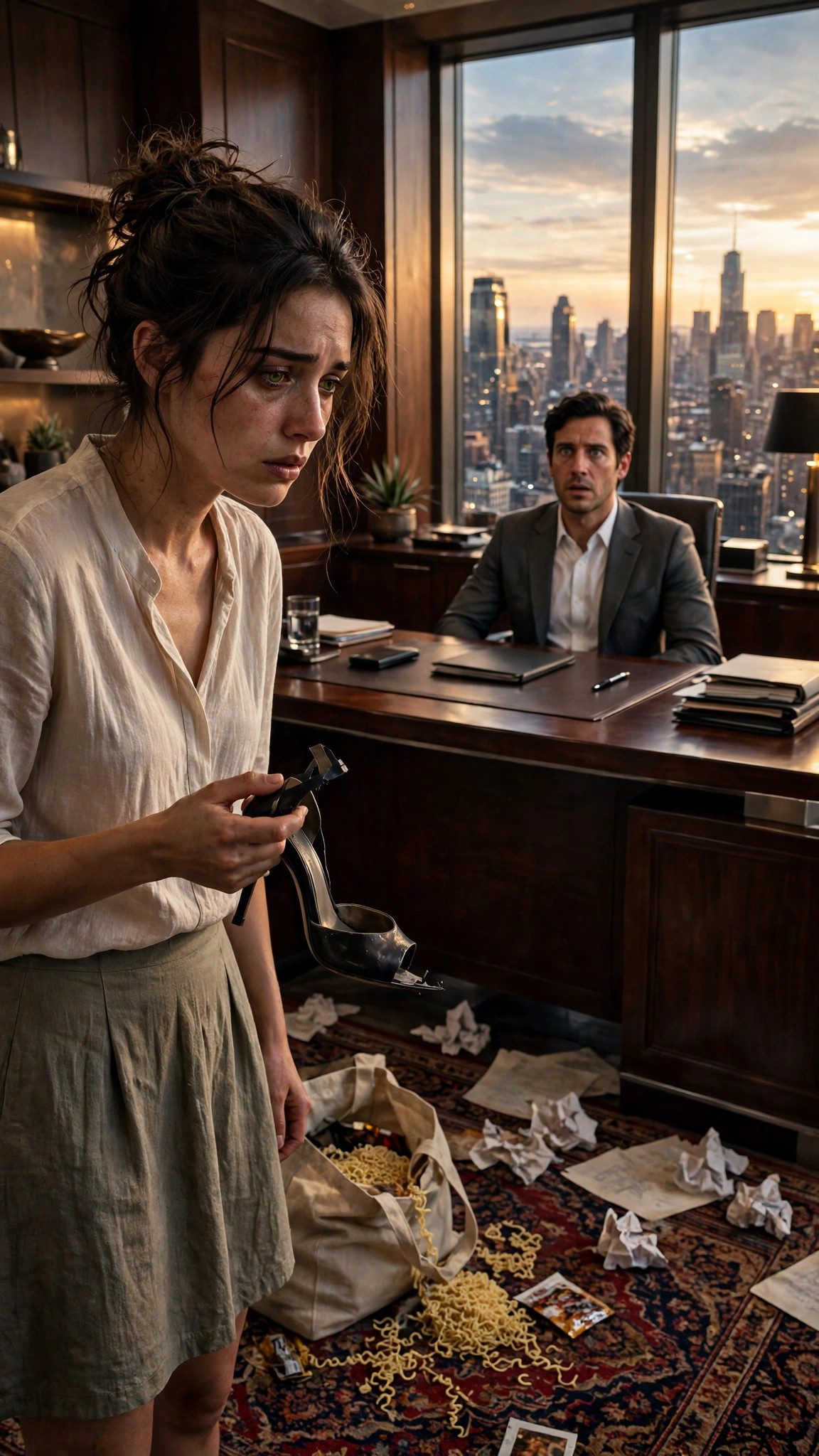
Monday morning, I arrived at Conti Enterprises at 8:47, thirteen minutes early, wearing two matching shoes and carrying a tote bag that did not spill. I had ironed my blouse. I had braided my hair. I had eaten a granola bar on the subway and drunk coffee out of a paper cup, and I had told my mother that I loved her and that I would call her at lunch, and I had walked into the building on Park Avenue like a woman who belonged there.
The receptionist with the perfect hair looked at my shoes and nodded, just once, like a general approving a new recruit. "Your desk is through there," she said, pointing toward a glass-walled office just outside Lorenzo Conti's door. "Your name is on it."
My name was on it. MIA SULLIVAN, in small black letters on a brass plate. I ran my finger over it twice, because it did not feel real, and then I sat down, and I looked at my desk, and I understood, in about four seconds, why seventeen assistants had already been fired.
The desk was a war zone. There were stacks of paper everywhere, some of them leaning, some of them sliding, some of them held together with paper clips that had given up. The filing cabinet from the interview was still there, still exploding. The computer was on, and the inbox had four hundred and twelve unread emails, and the calendar had three meetings double-booked for that morning alone, and someone had written, in black marker, on a sticky note stuck to the monitor: GOOD LUCK.
I took a deep breath. I opened the top drawer. Inside were three pens that did not work, a stapler with no staples, a packet of mints that had gone soft, and a photograph of a young man I did not recognize, face down, like someone had put it there and then changed their mind about looking at it.
I turned the photograph over. The young man in it was about twenty years old, dark-haired, smiling, standing in front of a lake with his arm around a younger Lorenzo Conti, who was not smiling at all, but whose eyes were softer than I had ever seen them. On the back, in faded ink, someone had written: LEONARDO — SUMMER, LAKE COMO.
I put the photograph back, face down, exactly where I had found it. My hands were shaking a little, and I did not know why.
Within three weeks, I understood why everyone else had quit.
Conti Enterprises looked like a legitimate Manhattan corporation, and most of it was. There were accountants and lawyers and a marketing department and a woman named Patricia who ran human resources and had the warm, tired eyes of a person who had seen everything and survived it. But the men who came into Lorenzo's executive office were not accountants. They were dangerous and frightening, and every morning I weathered their suspicious stares and told myself I did not need to get used to everything about them at all. I treated it like an office. That was my whole strategy: treat it like an office, and maybe it would become one.
One afternoon, Frankie Russo stormed toward my desk with blood still dripping from a split lip, his jeans torn and his shirt dirty. Frankie was six foot four and covered in scars, and he had the kind of face that made strangers cross the street, and he was bleeding on my clean desk.
"Seriously?" I snapped.
Frankie froze. He stopped in the middle of the office, one hand pressed to his mouth, staring at me like I had just spoken to him in a language he did not understand.
I handed him tissues. I made him clean the keyboard. I stuck a bandage over his cut, and I told him he would apologize after doing the paperwork, and I pointed at the chair, and he sat down, all six foot four of him, and he filled out the incident form in silence while I went back to my emails.
"You know who I am, right?" he said, after a while, in a low voice.
"You're the man bleeding on my desk," I said. "Fill out the form."
He filled out the form. When he left, he paused at the door and looked back at me, and something in his face had changed, like a door opening a crack.
"You're all right, kid," he said. "The last girl cried."
"I'm not a girl," I said. "I'm twenty-eight, and I'm your boss's assistant, and you owe me a keyboard wipe."
He laughed. It was a short, surprised sound, like he had not expected to laugh, and then he was gone, and I sat at my desk with my heart hammering, and I thought: I am going to die here. Not today, maybe, but someday, in this office, surrounded by dangerous men and paper clips, I am going to die, and my mother will never know why.
I was not particularly good at being a secretary. I forgot toner. I misplaced pens. I repeatedly butchered Italian surnames on the phone, and once I transferred a call from a very important shipping client to the building's maintenance department, and once I sent Lorenzo's lunch order to the wrong floor, and once I called a man named Castellano "Mr. Cast Iron" to his face, which made Frankie laugh so hard he had to sit down.
Somehow, though, I could keep him and his hundreds of businesses on schedule. I could look at a calendar full of chaos and see the pattern in it. I could read a shipping ledger and find the one line that did not belong. I could remember that the man from the docks liked his coffee black and that the lawyer from Boston was allergic to shellfish and that Lorenzo's mother, whoever she was, had a birthday in October, because there was a card in the drawer with her name on it, and nobody ever sent it.
Lorenzo himself was the hardest part. He was not cruel. That surprised me. I had expected cruelty, because cruelty is what people mean when they say "dangerous," but Lorenzo was not cruel. He was cold. He was silent. He was precise. He ate the same lunch every day, at the same time, at his desk, while he worked. He never raised his voice. He never smiled. He worked until nine o'clock every night, and sometimes later, and the light in his office was always the last one on in the building, and sometimes, when I stayed late to finish the filing, I would look through the glass and see him sitting there alone, staring out at the city, and I would think: he is the loneliest person I have ever seen.
He never asked about my mother. He never asked about my life. He never asked me anything at all, except where his papers were and when his meetings were and whether the waterfront contracts had been revised. And I was grateful for that, because my private life was not part of the arrangement, and I had told him so on the first day, and he had respected it, and that was that.
But I noticed things. I noticed that he never drank. Not coffee, not water from a bottle anyone else had opened, not anything, unless he had poured it himself. I noticed that his security men checked his food before he ate it, in a way so casual that most people would not see it, but I saw it, because I saw everything. I noticed that he kept the photograph in his desk drawer, face down, and that sometimes, when he thought no one was watching, he would open the drawer and look at it for a long time.
I noticed that nobody in the building ever said the name Leonardo. Not once. Not in three weeks. I had said it on my first day, by accident, and the whole office had gone still, like a held breath, and I had never said it again, and neither had anyone else.
I should have asked. I should have wondered why. But I was too busy keeping his calendar straight and his filing cabinet from exploding and his dangerous men from bleeding on my desk, and my mother was waiting for me at home, and the insurance company was still denying her claims, and I had no time for mysteries.
Then one Tuesday evening, something changed.
Lorenzo was alone in his office, studying shipping ledgers, when I delivered the revised waterfront contracts. It was 7:40. The outer office was empty. The sun was going down over the city, turning the glass walls gold, and the whole building was quiet in the way only a skyscraper can be quiet, high above the noise.
"Are we finished?" I asked. "I need to reach the pharmacy before it closes."
Instead of dismissing me, Lorenzo stared at my face. He did not look at the contracts. He did not look at his papers. He looked at me, really looked at me, for the first time since the day he had hired me, and his grey eyes were doing something I had never seen them do before.
"Your mother," he said.
Every muscle in my body tightened. My hand closed around the strap of my tote bag. My heart started beating in my throat.
He remembered.
"She has multiple sclerosis," I said, carefully, the way you speak to a wild animal. "It's managed."
"You manage it," he replied quietly.
I grabbed my bag. "You pay me well. I do my job, I deal with your frightening men, and my private life is not part of this arrangement."
Then Lorenzo reached beneath the ledger and placed something on the desk.
A pharmacy receipt.
My mother's name was printed across the top. MARGARET SULLIVAN. And beneath it, the name of her medication, and the amount, and the word PAID, stamped in red.
My blood went cold.
I had never told him where she filled her prescriptions. I had never told him the name of her pharmacy. I had never told him anything at all about my mother, except that she was sick, and yet there it was, on his desk, in his office, with her name on it.
"How did you get that?" I whispered.
Lorenzo didn't answer.
Instead, he slid another document toward me. A single sheet of paper, folded once, heavy and cream-colored, with a seal at the bottom. And the moment I saw the name printed beneath my mother's name, my whole world overturned.
But before that evening, before the pharmacy receipt and the trust document and the name beneath my mother's name, there were three weeks of ordinary days, and the ordinary days were where I learned who Lorenzo Conti really was, and who I was going to have to become to survive him.
The first thing I did was fix the filing cabinet. It took me two days. I emptied every drawer onto the floor, and I sorted the papers into piles, and I threw away three years of dead memos, and I found things that should not have been in a filing cabinet at all: a Christmas card from a shipping company in Genoa, a photograph of a yacht I did not recognize, a dry-cleaning ticket from 2019, and a shipping manifest with a name on it that I would not think about again for weeks, until it mattered more than anything in the world. The name was Castellano. It was written in the margin, in pencil, next to a route number, with a question mark after it. I filed it away and forgot about it, the way you forget about a cloud on a clear day.
The second thing I did was learn the office. Patricia from human resources took me to lunch on my third day, a tired, kind woman with reading glasses on a chain, and she told me, over a salad she did not eat, that seventeen assistants had come before me, and that the longest any of them had lasted was eleven days, and that the shortest had lasted four hours.
"What happened to them?" I asked.
"They cried," Patricia said. "Or they quit. Or Mr. Conti fired them for crying, or for quitting in their heads before they quit in person. He does not tolerate tears, Mia. He does not tolerate weakness. He does not tolerate mistakes. He is not a cruel man, but he is not a patient one, either. The women before you were all very good at being secretaries. They were not good at being brave."
"I'm not brave," I said. "I'm just too tired to cry."
Patricia looked at me for a long moment, and then she smiled, the first real smile I had seen in that building. "That," she said, "might be exactly what he needs."
The third thing I did was learn Lorenzo. Not the legend. Not the billionaire, not the mafia boss, not the man everyone warned me about. The man. He took his coffee black, at exactly 8:15, in a white cup with no handle, because he had broken the handle off a cup once and kept using it anyway, and no one had ever dared to replace it. He read the shipping ledgers himself, every night, with a red pen, circling numbers in a handwriting so precise it looked printed. He never ate lunch with anyone. He never took a personal call. He kept a spare suit in his office closet, and a pair of running shoes under his desk, and a first-aid kit in the top drawer, which I discovered when Frankie bled on my keyboard for the second time, and I went looking for bandages, and I found the kit, and inside it, under the gauze, was a small, worn prayer card, with a saint on it I did not recognize, and a name written on the back in a child's handwriting: Leonardo.
I put the prayer card back, exactly where I had found it, and I did not mention it to anyone. But I thought about it, late at night, when my mother was asleep and the apartment was quiet, and I wondered about the boy in the photograph, and the name on the prayer card, and the way the whole office went still whenever the name came up, and I wondered what kind of grief makes a man keep a prayer card in a first-aid kit and a photograph face down in a drawer.
I also learned the men. Frankie Russo, who bled on my desk and then brought me coffee the next morning, black, no sugar, the way I liked it, without asking how I liked it. Enzo Ricci, who stood by the door and watched everything and said nothing, and who once, when a delivery man raised his voice at me, appeared at my desk in three steps and stood there until the man apologized. The captains from the docks, who called me "Miss Mia" and tipped their caps. The lawyers, who called me "Ms. Sullivan" and never tipped anything. And Dominic Voss, the CFO, who smiled at me with a smile that never reached his eyes, and who asked me, once, in a voice like silk, whether Lorenzo ever talked about his family, and I said no, and he said, "Pity. Families are important," and I thought about that conversation for a long time afterward, and I did not like the way it made me feel.
And every night, I went home to my mother. I made her tea. I counted out her pills. I told her about my day — the filing cabinet, Frankie, the coffee, the prayer card — and she listened, the way she always listened, and she asked me, every night, the same question: "Is he kind to you?"
"He doesn't speak to me," I said, the first night. "He's kind in the way a wall is kind. He doesn't fall on you."
"He hired you," my mother said. "That is a kind of speaking."
By the third week, my answer had changed. "He's not unkind," I said. "He's just — alone. He eats alone. He works alone. He sits in his office after everyone has gone home, and he stares out the window, and I think he is the loneliest person I have ever seen."
"Then be kind to him," my mother said. "Lonely men are dangerous, Mia, but they are not bad. Not all of them. Some of them are just waiting for someone to notice."
I did not know, then, that I had already noticed. I did not know that Lorenzo had noticed me noticing. I did not know that the pharmacy receipt was already on its way, and the trust document was already in his drawer, and the name beneath my mother's name was already waiting for me, on a Tuesday evening, in an office full of gold light, at 7:40, when I asked him if we were finished, and he said, "Your mother," and my whole world overturned.