The name printed beneath my mother's name was Leonardo Conti.
I stared at it until the letters blurred. My hands were shaking. The office had gone very quiet, the way it goes quiet before a storm, and Lorenzo was watching me with those grey eyes, and for the first time since I had met him, he did not look cold. He looked like a man standing at the edge of something he had been avoiding for a very long time.
"What is this?" I asked. My voice sounded far away, like it belonged to someone else.
"A trust document," Lorenzo said. "My father set it up twenty-three years ago. Your mother is the beneficiary."
"My mother doesn't know your father. My mother has never met your father. My mother is a retired nurse from Queens who—"
"She was a nurse at St. Vincent's Hospital," Lorenzo said, and his voice was very quiet, and very steady, the way a man's voice is steady when he is holding something heavy and does not want to drop it. "Twenty-three years ago, my younger brother was dying there. Leukemia. He was fourteen years old. Your mother was his nurse."
The room tilted. I put one hand on the desk to steady myself.
"Leonardo," I whispered.
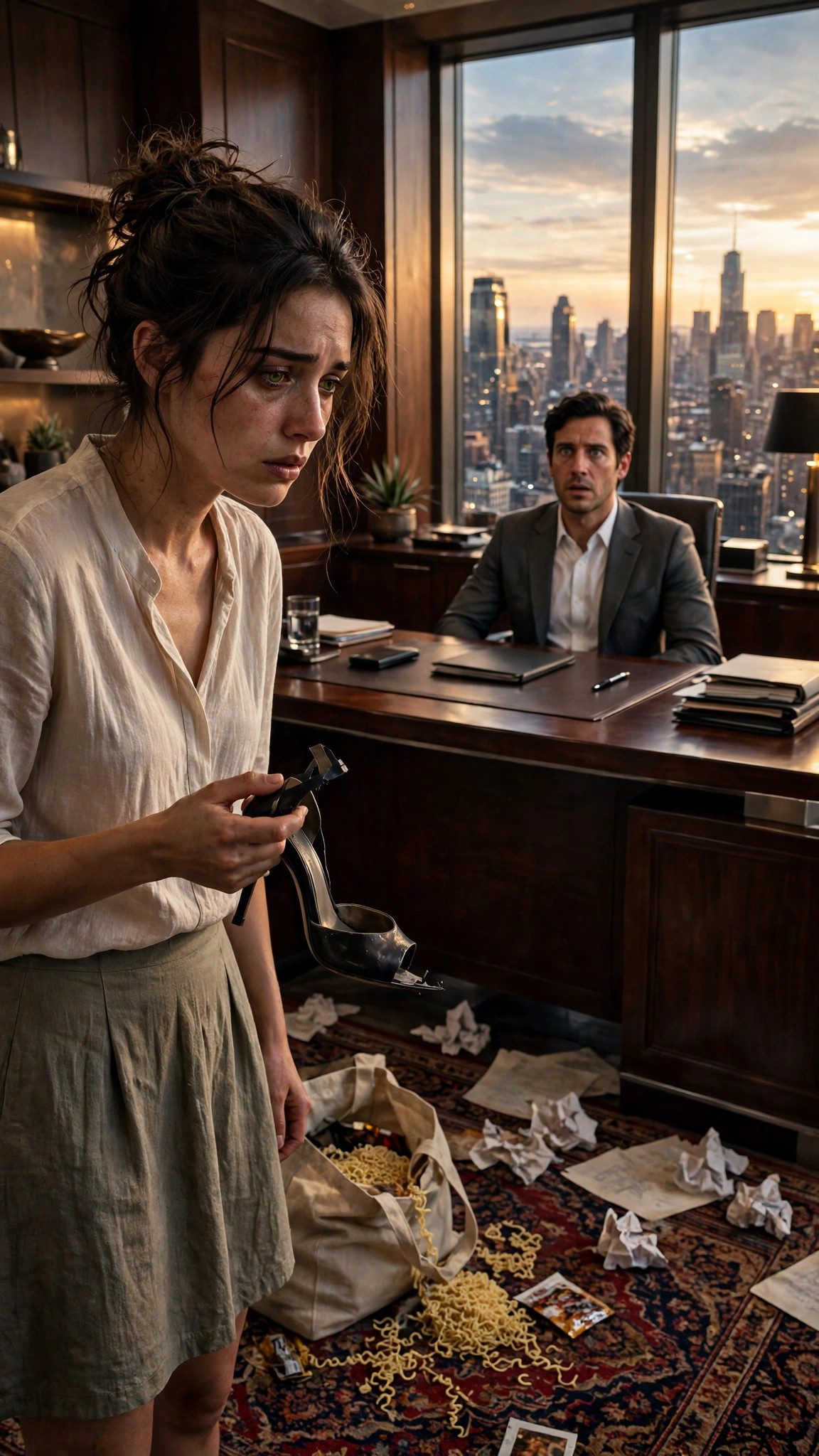
"Leonardo," Lorenzo said. "You called me Leonardo on your first day. Nobody has said his name in this office in eleven years. Not since he died. And then you walked in, with your broken shoe and your tote bag full of medical bills, and you said his name like it was the most natural thing in the world, and I hired you before I had time to think about why."
I looked down at the trust document. There were numbers on it. Large numbers. A monthly stipend. A medical fund. A clause about education. My mother's name, and beneath it, Leonardo Conti, and beneath that, in my father's handwriting — no, in Salvatore Conti's handwriting — a single line: For the woman who stayed with my boy when I could not.
"She stayed with him," Lorenzo said. "For six months. Every night. She held his hand when the treatments hurt. She read to him. She sang to him. My father was in Sicily, trying to hold the family together, and my mother was — my mother was not well, and I was at school, and your mother was the only person in that hospital who never left his side. When he died, my father promised her that her family would never want for anything. He set up the trust. And then — " He stopped. His jaw tightened. "And then we lost track of her. The trust was administered by a law firm. The payments went out. But no one in my family ever spoke to her again. My father died five years ago, and I inherited the trust along with everything else, and I did not think about it. Not until you walked into my office."
"You're lying," I said, but my voice was shaking, and I did not believe it, because the document was real, and the numbers were real, and the name was real, and my mother's name was on it, and I had never seen my mother's name on anything except medical bills and denial letters.
"I am not lying," Lorenzo said. "I had my lawyers verify it the day after you were hired. Your mother is Margaret Sullivan. She was a nurse at St. Vincent's from 1998 to 2011. She was assigned to Leonardo Conti in the spring of 2003. She stayed with him until he died, on October 17th, 2003. She was thirty-five years old. You were five."
I was five. I remembered being five. I remembered a hospital, vaguely, the smell of it, the long corridors, my mother's hand in mine. I remembered her coming home late, night after night, smelling of antiseptic, sitting on the edge of my bed and telling me about a brave boy who liked stories about pirates. I had thought it was just a story. I had never known the boy was real.
"She never told me," I said.
"She would not have," Lorenzo said. "She signed a confidentiality agreement. My father insisted. The Conti family does not advertise its grief."
"And the pharmacy receipt?" I asked. "How did you get the pharmacy receipt?"
"The trust pays for her medication," Lorenzo said. "It has been paying for it for months. Since the day I verified who you were. The insurance company denies the claims, and the trust pays them, quietly, the way my father wanted. Your mother thinks her insurance finally came through. She has no idea."
I stared at him. "You've been paying for my mother's medication for months, and you didn't tell me."
"You told me your private life was not part of the arrangement."
"That was before I knew you were in it!"
He flinched. Just slightly. Just enough for me to see it. Lorenzo Conti, the man who never flinched, flinched, and for a moment he looked almost human, almost young, almost like the boy in the photograph at Lake Como, standing next to his brother, not smiling, but softer.
"I did not know how to tell you," he said. "I did not know how to tell you that I hired you because of your mother, and that I have known who you were since the first day, and that every time you walk into my office, I see her. I see the woman who stayed with my brother. And I see you, and I think — " He stopped again. He looked down at his hands. "I think about what Leonardo would have said, if he had lived. He would have liked you. He liked people who talked back."
Tears were running down my face. I did not remember starting to cry. I wiped them away with the back of my hand, angrily, because I did not cry in offices, and I did not cry in front of dangerous men, and I especially did not cry in front of Lorenzo Conti.
"My mother is dying," I said. "Not today. Not tomorrow. But multiple sclerosis does not get better, Mr. Conti. It gets worse. And I have spent three years watching it get worse, and fighting insurance companies, and working three jobs, and I am so tired, and you have been paying for her medicine, and you did not tell me, and I don't know whether to thank you or to hate you."
"Both," Lorenzo said. "You can do both. I have done both, for eleven years."
I laughed. It came out as a sob, and then as a real laugh, short and startled, and then I was crying again, and Lorenzo Conti, the most dangerous man in New York, stood up from behind his desk, walked around it, and handed me a box of tissues, and then he stood there, awkward and stiff, with his hands in his pockets, while I cried into a tissue in his office, and neither of us said anything at all.
When I finally stopped, I looked at the trust document again. "What happens now?" I asked.
"Now," Lorenzo said, "you go home to your mother. You tell her whatever you want to tell her. The trust is hers. It always was. And tomorrow, you come back to work, and we do not speak of this again, unless you want to."
"And if I want to?"
"Then we speak of it," he said. "And I will tell you about Leonardo. All of it. The parts my father never told anyone. The parts I have never told anyone."
I folded the trust document carefully, the way you fold something precious, and I put it in my tote bag, next to the ramen and the aspirin and the granola bar, and I walked out of his office, past the dangerous men who had all gone home for the night, past the receptionist's empty desk, and into the elevator, and down forty-two floors, and out onto Park Avenue, where the city was lit up and loud and alive, and my whole world had turned over, and I did not know which way was up anymore.
That night, I sat on the edge of my mother's bed, and I held her hand, and I told her everything. I told her about the trust. I told her about Leonardo. I told her about the pharmacy receipt, and the medication, and the man in the charcoal suit who had hired me because of her.
My mother listened in silence, the way she always listened, with her eyes closed and her hand in mine, and when I finished, she was quiet for a very long time.
"I wondered," she said finally, in her thin, careful voice. "All these years, I wondered if anyone remembered. I was just a nurse. I was nobody. But that boy — oh, Mia. That boy was the bravest person I ever knew. He was fourteen years old, and he was dying, and he asked me to read him pirate stories, and he made me promise that I would not cry in front of him, and I kept that promise, and I have been keeping it ever since."
She opened her eyes. They were wet, but she was smiling, the way she smiled on the good days, when the medication was working and the pain was far away.
"He had a brother," she said. "A big brother. He talked about him all the time. He said his big brother was going to be the strongest man in New York someday. He said his big brother was going to protect everyone. Is that him? Is that the man you work for?"
"Yes," I said. "That's him."
My mother squeezed my hand. "Then you be kind to him, Mia. He lost his brother, and he has been carrying it alone for a very long time. Be kind to him. And be careful with him. Men who carry things alone do not know how to put them down."
I kissed her forehead, and I went to bed, and I lay awake until dawn, thinking about a boy I had never met, and a man who had hired me because of my mother, and a name I had said by accident that had turned out not to be an accident at all.
The next morning, I went back to work. And Lorenzo Conti was waiting for me, the way he always was, behind his desk, in his charcoal suit, with his silence and his ledgers and his dangerous men. But something had changed. The air in the office was different. The silence was different. And when he looked up at me, and our eyes met, I saw something in his face that I had never seen before.
He was waiting for me to speak first. And for the first time in my life, I did not know what to say.
That evening, after work, I went home, and I did not sleep. I lay in bed, staring at the ceiling, thinking about a boy I had never met, and a hospital I barely remembered, and a mother who had kept a secret for twenty-three years. The trust document was in my tote bag, and a half-remembered hospital corridor was in my head, and neither of them would let me rest.
The next morning, I asked her about it. I sat on the edge of her bed with two cups of tea, and I said, "Mom. Tell me about St. Vincent's. Tell me about the boy."
My mother was quiet for a long time. She held her tea with both hands, the way she always did, steady and careful, and she looked out the window at the street below, and when she finally spoke, her voice was soft, like a woman opening a door she had kept closed for a very long time.
"His name was Leonardo," she said. "He was fourteen years old. He had dark hair, like his brother, and he laughed at everything, even when he was in pain, especially when he was in pain. The other nurses said he was too much trouble. He rang the bell too often. He asked too many questions. He wanted too many stories. But I liked him. I liked him from the first day, because he looked at me like I was a person, not a uniform, and he said, 'You have kind eyes, nurse. My brother has kind eyes too.'"
She smiled, remembering. "I read to him every night. Pirate stories, mostly. He loved pirates. He said that when he grew up, he was going to sail around the world, and he was going to find an island no one had ever found, and he was going to name it after his brother. And I would say, 'Leonardo, you are supposed to be resting,' and he would say, 'Nurse Margaret, resting is for people who are not dying, and I am dying, so I might as well have a good story.'"
Her voice caught. She put her tea down. "I was there the night he died. October 17th. It was raining. He asked me to hold his hand, and I did, and he said, 'Tell my brother I was brave,' and I said, 'You tell him yourself, when you see him,' and he smiled, and he said, 'I will. I will tell him everything.' And then he went to sleep, and he did not wake up."
I took her hand. It was thin and cold, and it shook a little, and I held it, and I thought about being five years old, and about a hospital corridor, and about my mother's hand in mine, and suddenly, like a door opening, I remembered. I remembered the smell of antiseptic. I remembered a boy in a bed, pale and smiling, waving at me from a doorway. I remembered my mother kneeling beside me, whispering, "That is Leonardo. He is very brave. Say hello." And I remembered saying hello, in my small five-year-old voice, and the boy waving back, and laughing, and saying, "Hello, little one. Your mother is the best nurse in the whole world."
"I met him," I whispered. "Mom, I met him. When I was five. You took me to the hospital, and I saw him, and he waved at me."
My mother nodded, tears running down her face. "You did. Once. I should not have brought you, but there was no one to watch you that day, and he asked to meet you, and he gave you a pirate sticker, and you put it on your forehead, and you wore it all the way home."
I remembered the sticker. A red pirate ship, stuck to my forehead, peeling off in the rain. I had forgotten it for twenty-three years, and now it was back, sharp and clear, like it had happened yesterday.
"And the trust?" I asked. "Did you know about the trust?"
"I knew Mr. Conti — Salvatore — had promised to look after us," my mother said. "He came to the hospital, the day after Leonardo died, and he thanked me, and he said, 'Your family will never want for anything.' I thought he meant it as a kindness, as words. I did not know he had set up a trust. I did not know the payments were real. When the insurance started denying my claims, and the medication kept coming anyway, I thought — I thought perhaps God was looking after me. I did not know it was a Conti."
"And Lorenzo?" I asked. "Did you know about Lorenzo?"
"I knew Leonardo had a big brother," she said. "He talked about him all the time. He said his big brother was going to be the strongest man in New York someday. He said his big brother was going to protect everyone. I never met him. Not until you started working for him. And when you told me his name, and you told me about the office, and the photograph, I wondered. I wondered if it was the same family. And now I know. It is."
She squeezed my hand. "Mia. Listen to me. That man hired you because of me, and because of Leonardo, and that is not an accident. That is a debt, and a promise, and a story that is not finished yet. You go back to work tomorrow, and you look him in the eye, and you speak first. You tell him you know. You tell him you remember the sticker. And you tell him that his brother said hello to a five-year-old girl once, and that she never forgot him, either."
I kissed her forehead. The next day, I went to work, and Lorenzo was waiting for me, behind his desk, in his charcoal suit, with his silence and his ledgers, and I walked into his office, and I stood in front of his desk, and I spoke first.
"I remember the sticker," I said. "The pirate sticker. I was five. You were not there. But I was there. And Leonardo waved at me."
Lorenzo went very still. His hands, resting on the desk, curled slowly into fists, and then uncurled, and he looked up at me, and his grey eyes were wet, and he said, very quietly, "He gave those stickers to everyone. He had a whole book of them. He said pirates were the only people who were truly free."
"Then he was right," I said. "And he was brave. My mother told me. He told her to tell you he was brave."
Lorenzo closed his eyes. For a moment, he did not speak. And when he opened them again, something in his face had changed, like a wall coming down, brick by brick, and he said, "Thank you, Mia. Thank you for telling me that. No one has ever told me that."
And that was the moment everything changed between us. Not the trust document. Not the pharmacy receipt. Not the name beneath my mother's name. That moment. A pirate sticker, and a five-year-old girl, and a boy who waved from a hospital bed, twenty-three years ago, and a man who had been waiting eleven years to hear that his brother was brave.