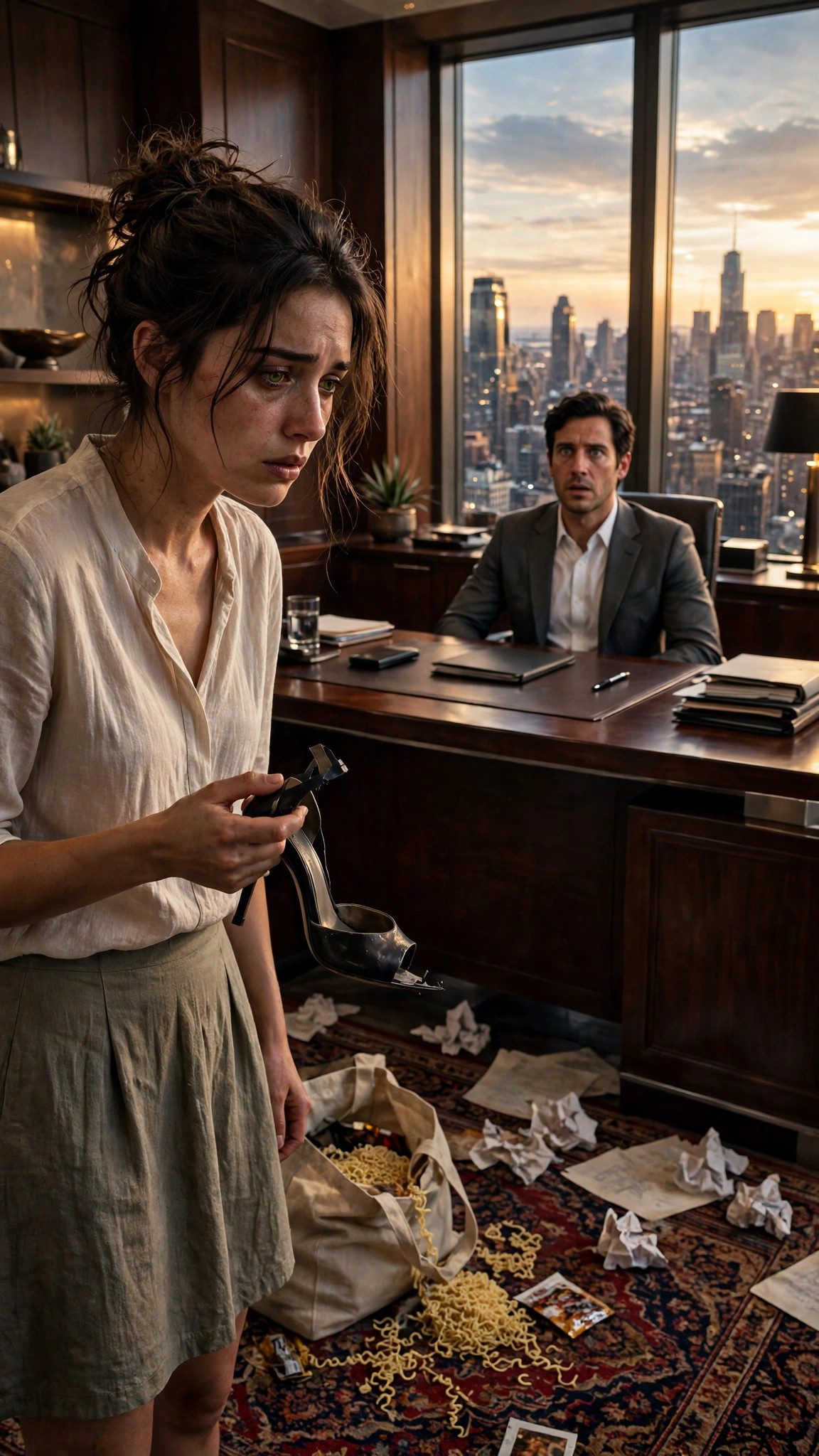
The trouble started with a phone call. It always starts with a phone call.
It was a Wednesday, three weeks after the park, and I was at my desk, sorting the waterfront contracts, when the phone rang. It was Denise, from the insurance company. Except it was not Denise. It was a different woman, with a different voice, and she was calling to tell me that my mother's medication had been denied again, and that the appeal had been rejected, and that there was nothing more they could do.
"But the trust pays for it," I said, confused. "The trust has been paying for it for months."
"There is no trust on file," the woman said. "There is no record of any payment. Your mother's account is in arrears. If payment is not received within thirty days, her prescription will be discontinued."
My blood went cold. I put the phone down. I looked at Lorenzo's office door. I stood up, and I walked in without knocking, which I had never done before, and Lorenzo looked up from his ledgers, and he saw my face, and he said, "What happened?"
"The trust," I said. "The insurance company says there is no trust. They say no payments have been made. They say my mother's account is in arrears."
Lorenzo went very still. It was the stillness of a man who has just understood something terrible. He picked up his phone. He dialed a number. He spoke three words — "My office. Now." — and he put the phone down, and he looked at me, and he said, "Sit down."
I sat down. My hands were shaking. Lorenzo opened his laptop. He pulled up the trust account. He stared at the screen for a long time, and his face did not change, but his hands, resting on the desk, curled slowly into fists.
"The payments stopped six weeks ago," he said. "The law firm that administers the trust reported a — " He stopped. He read the screen again. "A change of beneficiary. Someone filed a change of beneficiary form. The payments were redirected to an account in the Cayman Islands."
"Who would do that?" I asked. "Who even knows about the trust?"
"Three people," Lorenzo said. "Me. My lawyer. And the chief financial officer of this company."
"Dominic Voss," I said. Dominic Voss was the CFO. He was a tall, thin man with silver hair and a smile that never reached his eyes, and I had never liked him, and I had never known why, and now I knew why.
"Dominic Voss," Lorenzo agreed.
The door opened. A man walked in — not Voss, but a man I had never seen before, tall and broad, with a scar across his left eyebrow and a suit that fit him like armor. He looked at me, and then at Lorenzo, and he said, "Boss."
"This is Enzo Ricci," Lorenzo said. "My head of security. Enzo, this is Mia. She is — " He paused. "She is family now. You protect her like family."
Enzo looked at me for a long moment, and then he nodded, once, the way men in Lorenzo's world nod when they have just been given an order they intend to follow to the death.
"Tell me about Voss," Lorenzo said.
Enzo did not hesitate. "Voss has been meeting with Vincent Castellano for four months. Restaurants. Parking garages. A warehouse in Red Hook. Castellano is buying up the waterfront contracts, one by one, and Voss is selling him the schedules. The shipping ledgers. The routes. Everything."
Vincent Castellano. I knew that name. Everyone in New York knew that name. He was the man who ran the other half of the city, the half Lorenzo did not run, and he had been trying to take Lorenzo's half for twenty years, and he had never succeeded, because Lorenzo was smarter, and colder, and better. But now he had a man inside.
"And the insurance company?" I asked.
"Castellano owns it," Enzo said. "Not directly. Through a shell company. Meridian Health Holdings. He bought it two years ago. He has been denying claims for every family connected to us, one by one, squeezing them, waiting for someone to break."
I thought about my mother. I thought about her medication, and her legs, and the way she smiled on the good days, and I thought about a man I had never met sitting in an office somewhere, denying her medicine to hurt Lorenzo Conti, and something in me went very cold and very still, the way Lorenzo went cold and still, and I understood, for the first time, what it felt like to be part of this world.
"What do we do?" I asked.
Lorenzo looked at me. "We?" he said.
"We," I said. "You hired me. You told Enzo I was family. Family does not sit at a desk and file papers while someone tries to kill her mother."
Lorenzo was quiet for a moment. Then he smiled — that small, rusty smile — and he said, "No. Family does not."
That night, I did not go home at seven. I stayed late, and Lorenzo stayed late, and Enzo stayed late, and we sat in Lorenzo's office with the shipping ledgers spread out across the desk, and I did what I did best: I looked at a calendar full of chaos and I found the pattern in it.
It was there. It had been there all along, and I had been looking at it for weeks without seeing it. The waterfront contracts. The shipping schedules. Every time a Conti shipment was delayed, or rerouted, or inspected, it was on a route that Voss had reviewed. Every time a Castellano shipment moved smoothly, it was on a route that Voss had approved. And the insurance denials — I pulled up the list of denied claims, and there they were, one after another, all of them families connected to Conti Enterprises, all of them denied in the same week, all of them by the same adjuster, all of them signed off by the same supervisor.
"His name is Arthur Voss," I said, pointing at the screen. "The supervisor. Same last name as Dominic."
"His brother," Enzo said. "Younger brother. Works at Meridian Health. Castellano put him there."
I looked at Lorenzo. "You have a mole in your office, and a mole in the insurance company, and a rival who has been buying your contracts and denying your people's medicine, and you didn't see it because you were too busy being alone."
"I was too busy being alone," Lorenzo agreed, and he did not sound angry. He sounded almost relieved, like a man who has finally been told the truth by someone who is not afraid of him.
"Then stop being alone," I said. "Let me help. Let Enzo help. Let Frankie help. You have an entire family of dangerous men out there who would die for you, and you have been carrying this by yourself, and that is why Voss got in. That is why Castellano got in. Because you would not let anyone stand next to you."
Lorenzo was silent for a long time. Then he stood up, and he walked to the window, and he looked out at the city, at the lights coming on, at the whole glittering skyline, and he said, "My brother used to say that. He used to say, 'Lorenzo, you cannot carry everything alone. You will break.' And I told him he was wrong. And then he died, and I carried everything alone, and I did not break. But I did not live, either."
He turned back to me. "You are right. I will not be alone anymore. Not in this. Enzo — " He looked at his head of security. "Find out everything Voss has sold. Every route. Every schedule. Every name. I want it all by Friday."
"And Castellano?" Enzo asked.
"Castellano," Lorenzo said, and his voice went cold in the way I had seen it go cold only once before, on the day I met him, "will learn what happens when a man threatens my family."
He looked at me then, and his grey eyes were doing something I had never seen them do before. They were not cold. They were not silent. They were alive.
"And you," he said to me. "You go home. You tell your mother that her medication is paid for, and that it will always be paid for, and that no one will ever deny it again. And tomorrow, you come back, and we finish this. Together."
I went home. I told my mother. She cried, quietly, the way she always cried, and she held my hand, and she said, "Be careful, Mia. Men like Castellano do not lose gracefully."
"I know," I said. "But men like Lorenzo do not lose at all."
She smiled at that, the way she smiled on the good days, and she fell asleep, and I sat beside her in the dark, listening to her breathe, thinking about a mole in an office and a rival across the city and a man who had finally, after eleven years, stopped carrying everything alone.
Tomorrow, I thought. Tomorrow, we finish this.
I had no idea how close Castellano already was, or that Dominic Voss had already made his next move, or that by Friday, the trap would be set, and the bait would be me.
The next morning, Thursday, I came in early, at 7:30, and Enzo was already there, sitting at the conference table with three laptops open and a pot of coffee that smelled like it had been burning since midnight. He looked up when I came in, and he nodded, once, and he said, "Sit. We have work to do."
We worked all day. We went through the insurance records, claim by claim, denial by denial, and the pattern was worse than I had thought. It was not just my mother. It was twenty-three families. Twenty-three families connected to Conti Enterprises — dockworkers, drivers, cooks, cleaners, secretaries — all of them denied, all of them in the same month, all of them by the same adjuster, all of them signed off by Arthur Voss. A dockworker's wife with breast cancer. A driver's son with asthma. A cook's husband with a heart condition. A cleaner's daughter with diabetes. Real people, with real illnesses, and a man I had never met had sat in an office and denied them all, to hurt Lorenzo Conti.
"Read this one," Enzo said, sliding a file across the table. It was a letter, handwritten, from a woman named Rosa Delgado, a cook at one of the Conti restaurants. Her husband had been denied coverage for his heart medication, and she had written to the insurance company, begging them to reconsider, and they had sent her a form letter back, and she had written again, and they had sent another form letter, and the last line of her letter said: Please. He is a good man. He has worked for Mr. Conti for nineteen years. Please do not let him die because of paperwork.
I read it twice. My hands were shaking. I thought about my mother, and about Denise, and about the five hours on the phone, and about the way it feels to beg a stranger for medicine, and I thought about Vincent Castellano, sitting in an office somewhere, signing off on all of it, and I felt something in me go very cold and very still, the way Lorenzo went cold and still.
"We are going to fix this," I said. "All of it. Every family. Every claim. I don't care how long it takes."
"We will," Enzo said. "After Saturday. After Castellano. The FBI is already moving on the insurance company. Agent Reyes has the warrants. But first, we need Voss to walk into the trap, and for that, we need him to believe he is winning."
That afternoon, Lorenzo called me into his office. He was standing at the window, looking out at the city, and when I came in, he did not turn around. He said, "Enzo told me about the families. Twenty-three of them."
"Twenty-three," I said.
"I knew about three," Lorenzo said. "Three families came to me. Three families told me their claims had been denied. I paid for their medication out of my own pocket, quietly, and I thought that was enough. I thought I had fixed it. I did not know there were twenty more. I did not know Castellano had a system. I did not know Voss was feeding him names."
He turned around then, and his face was doing something I had never seen it do before. It was not cold. It was not silent. It was furious — not the loud, shouting kind of fury, but the quiet, contained kind, the kind that is far more frightening, because it does not burn out. It builds.
"My father used to say that a man is only as strong as the people who trust him," Lorenzo said. "I have spent eleven years being strong. I have spent eleven years being alone. And while I was being alone, Castellano was hurting my people, one family at a time, and I did not see it, because I was too busy looking at shipping ledgers."
"You see it now," I said.
"I see it now," he agreed. "Because of you. You found the pattern. You found Voss. You found the families. You walked into my office with a broken heel, and you changed everything, and I am never going to forget that."
He walked over to me, and he took my hands, and he held them, and he said, "Mia. On Saturday, you will be on that dock, and I will be on that dock, and Enzo will be on that dock, and the FBI will be on that dock, and Castellano's men will walk into it, and it will be over. But I need you to promise me something."
"Anything," I said.
"Promise me that if anything goes wrong — if the plan falls apart, if Voss warns them, if Castellano does not come — you run. You do not stay. You do not fight. You run, and you go to your mother, and you do not look back. Promise me."
I looked at him, and I thought about my mother, and about Rosa Delgado, and about twenty-three families, and about a boy named Leonardo who had asked his nurse to tell his brother he was brave, and I said, "I promise to be careful. I promise to stay with Enzo. But I will not promise to run. I am not a woman who runs. I am a woman who stays. Your mother — my mother — stayed. I stay too."
Lorenzo closed his eyes. He took a deep breath. He opened them again, and he said, "Then I will stay with you. Wherever you are on that dock, I will be beside you. That is my promise."
That night, I went home, and I sat with my mother, and I told her about the families, and about Rosa Delgado, and about the plan, and about Saturday, and she listened, the way she always listened, and when I finished, she took my hand, and she said, "Be careful, Mia. And be brave. And remember — men like Castellano do not lose gracefully, but men like Lorenzo do not lose at all."
"I know," I said. "I told you that already."
"I know you did," she said, and she smiled. "I just like hearing it."
I slept badly that night. I dreamed about docks, and floodlights, and men in dark clothes, and a truck, and a crate of medicine with my mother's name on it. I woke up at four in the morning, sweating, and I sat in the dark, listening to my mother breathe, and I thought about Friday, and about the trap, and about the bait, and I thought: tomorrow, it begins. Tomorrow, Voss makes his move. Tomorrow, we find out whether we are the hunters or the hunted.
I did not know, then, that Voss had already made his move. That afternoon, while I was in Lorenzo's office, he had come to my desk. He had opened my top drawer. He had seen the photograph of Lake Como, the copy Lorenzo had given me, sitting on top of my notebook. And he had smiled, his cold smile, and he had taken out his phone, and he had sent a message to a number I would never see, and the message had said four words: She knows about Leonardo.
Castellano did not know about the trap. He did not know about the FBI, or about Enzo, or about the floodlights waiting in the dark at Red Hook. But he knew, now, that I was close to Lorenzo — closer than any assistant had ever been — and that I knew things no outsider was supposed to know. And that made me a target. And it made Saturday night more urgent than ever, because Castellano was not a man who waited. He was a man who struck first, and the shipment at Red Hook was his chance to hurt Lorenzo where it would hurt most: in front of his people, in front of his family, in front of me.
By Friday morning, the trap was set. The bait was me. And Castellano was coming.