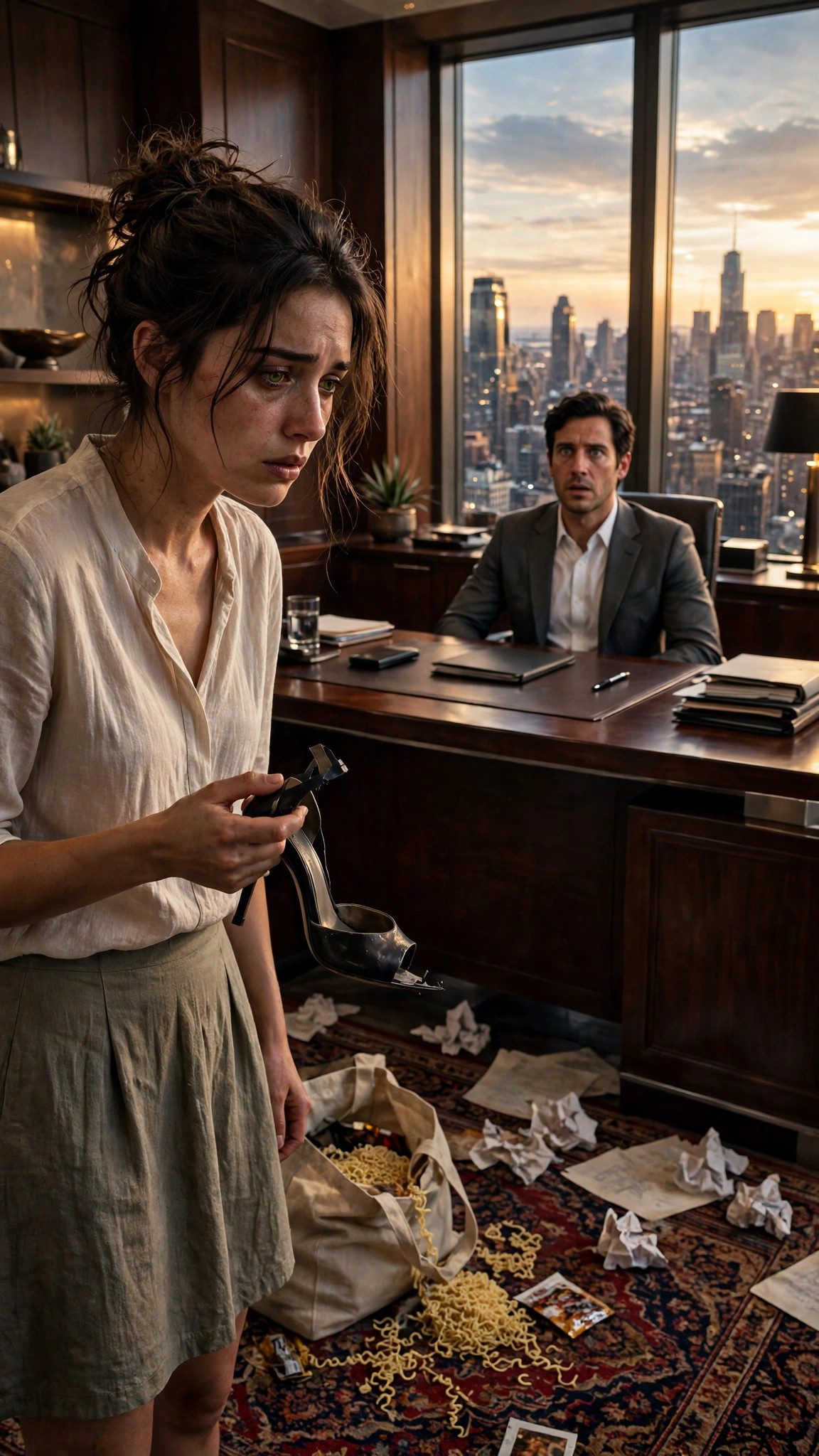
I did not speak first. Not that morning, and not the morning after that. For three days, Lorenzo and I went back to the way things had been: the calendar, the contracts, the filing cabinet, the dangerous men. He did not mention the trust. He did not mention Leonardo. He did not mention my mother. And I did not mention any of it either, because I did not know how to begin, and because some truths are too big to carry into an office on a Monday morning.
But on Thursday, at 6:15 in the evening, when the outer office was empty and the sun was going down and the whole building was quiet, Lorenzo came to my desk. He did not call me into his office. He came to me, and he stood there, in his charcoal suit, with his hands in his pockets, and he said, "Walk with me."
We walked. Out of the office, into the elevator, down forty-two floors, and out onto Park Avenue, where the evening was warm and the city was moving the way it always moves, fast and loud and indifferent. Lorenzo walked beside me without speaking, and I walked beside him without speaking, and we went three blocks before he finally said, "There is a park. Two blocks from here. Leonardo and I used to go there, when we were boys. Before."
"Before what?" I asked.
"Before everything," he said.
We sat on a bench under a plane tree, and the city went on around us, and Lorenzo Conti, the most dangerous man in New York, told me about his brother.
"Leonardo was four years younger than me," he said, staring straight ahead, at the path, at the children on the swings, at nothing at all. "He was the funny one. I was the serious one. Our father used to say that God gave our family one serious son and one laughing son, and that it was a miracle they did not cancel each other out. Leonardo laughed at everything. He laughed when he fell off his bicycle. He laughed when our mother burned the Sunday sauce. He laughed when I told him I was going to be the head of the family someday, and he said, 'Good, then I never have to be serious, because you will do it for both of us.'"
He stopped. His hands were clasped together, tight, knuckles white.
"When he got sick, he was fourteen. Leukemia. The doctors said six months. He lasted six months and eleven days, and he laughed for most of them. He made the nurses laugh. He made the doctors laugh. He made me laugh, and I did not want to laugh, because laughing felt like giving up, and he said, 'Lorenzo, if you don't laugh, I will have to laugh twice as hard, and I am already very tired.'"
I did not say anything. There was nothing to say. I sat beside him on the bench, and I listened, and the city went on around us, and the plane tree moved above us, and the whole world narrowed down to a man telling a story he had never told anyone.
"Your mother was his nurse," Lorenzo said. "She was the only one who never treated him like he was dying. She treated him like he was living. She brought him books. She read to him. She sang to him — terrible songs, he told me, off-key, but he loved them. She held his hand when the treatments hurt, and she never cried in front of him, not once, and he told me that was the bravest thing he had ever seen. He said, 'Lorenzo, when I am gone, you find that nurse, and you take care of her, because she took care of me, and nobody takes care of her.'"
"And your father set up the trust," I said.
"My father set up the trust," Lorenzo agreed. "And then my father died, and I inherited it, and I forgot about it, because I forgot about everything that hurt. I buried it. I buried Leonardo. I buried my mother, who died two years after him, of grief, although the doctors called it something else. I buried my father. I buried everything, and I built this — " He gestured at the city, at the towers, at the whole glittering skyline. "I built all of this, on top of it, so I would never have to look at it again."
"And then I walked into your office," I said.
"And then you walked into my office," he said, "wearing one broken heel, and you called me Leonardo, and for one second — one second — I thought he was alive. I thought my brother had walked back into my life. And then I saw your face, and I saw that you were not him, and I hired you anyway, because I could not let you walk out of that door."
He turned to look at me then, really look at me, and his grey eyes were wet, and I realized, with a shock that went all the way through me, that Lorenzo Conti was crying. Not sobbing. Not breaking down. Just two tears, running down his face, silent and steady, the way rain runs down a window.
"I have not said his name in eleven years," he said. "Not out loud. Not to anyone. I have not let anyone say it. I fired an assistant once for saying it. She read it in a file and she said it, and I fired her on the spot, because I could not bear to hear it. And then you said it, on your first day, by accident, and I did not fire you, and I did not know why, and now I know why. Because you were not saying it by accident. You were saying it because you belong to him. You belong to his story. Your mother stayed with him, and you stayed with your mother, and now you are here, and I am here, and he is gone, and none of it makes sense, and all of it makes sense."
I reached out, slowly, the way you reach out to a wild animal, and I put my hand over his. His hand was cold. It was shaking, just a little, and I held it, and he did not pull away, and we sat there on the bench under the plane tree while the city went on around us, and for the first time since I had met him, Lorenzo Conti did not look like the most dangerous man in New York.
He looked like a man who had lost his brother, and who had been carrying it alone for eleven years, and who was finally, finally, putting it down.
"My mother says you should be kind to me," I said, after a while, "and that I should be careful with you."
"Your mother is a wise woman," Lorenzo said.
"She also says men who carry things alone do not know how to put them down."
"She is right about that too."
We sat there until the sun went down and the streetlights came on, and then Lorenzo walked me to the subway, the way a gentleman walks a lady to the subway, and he stood on the platform with me until my train came, and he said, "Tomorrow. Nine o'clock. Don't be late."
"I won't be late," I said.
"I know," he said, and he smiled. It was a small smile, and it was rusty, like a door that has not been opened in a long time, but it was a smile, and it was the first time I had ever seen him smile, and it changed his whole face.
I rode home to Queens with that smile in my head, and I went up the stairs to our fourth-floor walk-up, and I sat with my mother, and I told her about the park, and the bench, and the plane tree, and the story of the boy who laughed, and my mother listened, and she cried, quietly, the way she always cried, with her eyes closed and her hand in mine.
"He would have liked you," she said, when I finished. "Leonardo. He would have liked you very much. He liked people who talked back."
"That's what Lorenzo said," I told her.
"Then it must be true," she said, and she smiled, and she fell asleep holding my hand, and I sat there in the dark, listening to her breathe, thinking about two brothers, one living and one dead, and a nurse who had stayed, and a daughter who had stayed, and a man who had finally, after eleven years, said his brother's name out loud.
The next morning, I went to work, and Lorenzo was waiting for me, and something had changed between us. The silence was gone. Not all of it — Lorenzo would always be a silent man — but the cold part of it, the part that kept everyone at arm's length, was gone. He looked at me when I came in. He nodded. He said, "Good morning, Mia."
It was the first time he had ever said my name.
"Good morning, Lorenzo," I said.
And Frankie Russo, who was standing by the coffee machine with a bandage on his lip, looked at us, and then looked at the ceiling, and then said, very quietly, to no one in particular, "Well. That's new."
It was new. Everything was new. And I had no idea that, three floors below us, in an office I had never seen, a man named Dominic Voss was already making plans to take it all away from us.
The next morning, the whole office knew. I do not know how they knew — nobody had told anyone, and Lorenzo had not announced anything — but offices are living things, and they feel a change in the air the way animals feel a storm. Frankie Russo brought me coffee, black, no sugar, and he set it on my desk with a ceremony usually reserved for religious objects, and he said, "You look different, kid."
"I look the same," I said.
"You look like a woman who said the right thing to the right man," Frankie said, and he winked, and he went back to his post by the door, and I sat at my desk with my coffee, and I thought about the park, and the bench, and the plane tree, and the way Lorenzo had cried, and the way he had smiled, and I thought: I am in trouble. Not the kind of trouble where you lose your job. The kind of trouble where you lose your heart, and you do not even mind.
At ten o'clock, Lorenzo called me into his office. Not through the intercom. Not through an email. He opened his door, and he stood there, and he said, "Mia. Come in. Close the door."
I closed the door. He was standing by his desk, and he had the drawer open, and in his hand was the photograph — the one I had found on my first day, face down, the young man smiling in front of a lake, with his arm around a younger Lorenzo.
"I want you to have this," he said, and he held it out to me. "Not the original. I had a copy made. The original stays in the drawer. But I want you to have this one. Because you are part of his story now, and his story is part of yours, and I think he would have wanted you to have it."
I took the photograph. It was warm from his hand. The young man in it was laughing, really laughing, with his head thrown back and his eyes squeezed shut, and the younger Lorenzo beside him was looking at him with an expression I had never seen on Lorenzo's face in real life: pure, unguarded love.
"Lake Como," Lorenzo said. "The summer before he got sick. He was thirteen. I was seventeen. Our father had rented a house on the lake, and Leonardo spent the whole summer jumping off the dock, and I spent the whole summer telling him to be careful, and he spent the whole summer ignoring me, and it was the happiest summer of my life."
He sat down, slowly, like a man sitting down after a long walk, and he looked at the photograph in my hands, and he said, "After he died, I could not look at it. For eleven years, I kept it face down in a drawer, and I told myself that was respect, that was grief, that was what a brother does. But it was not respect. It was fear. I was afraid that if I looked at it, I would feel everything I had been refusing to feel, and I would fall apart, and I would never be able to put myself back together."
"And now?" I asked.
"And now," he said, "I look at it every morning. Before you come in. Before the meetings. Before the ledgers. I look at it, and I remember that I had a brother who laughed, and that I loved him, and that loving him did not kill me. It made me who I am. And I think — I think he would want me to stop being afraid."
I put the photograph in my tote bag, carefully, next to my notebook, and I said, "He would want you to eat lunch, too. You haven't eaten lunch with anyone in three weeks, and I have been keeping track."
Lorenzo looked at me for a moment, and then he laughed. It was a short, startled sound, like Frankie's laugh on the day I bandaged his lip, and then it was gone, but it had been there, and I had heard it, and I stored it away in my memory, next to the pirate sticker and the lake and the boy who laughed.
"Tomorrow," he said. "We will have lunch tomorrow. In the office. Together. And you will tell me about your mother, and I will tell you about Leonardo, and we will be — " He stopped. He searched for the word. "We will be normal. For one hour. Just normal."
"One hour," I agreed. "Tomorrow."
We did have lunch the next day. Sandwiches from the deli downstairs, eaten at his desk, with the ledgers pushed to one side and the photograph of Lake Como standing up against a paperweight where we could both see it. I told him about my mother — about the good days and the bad days, about the tea and the pills and the insurance company, about the way she smiled when the medication worked. And he told me about Leonardo — about the pirate stories, and the bicycle, and the time Leonardo had hidden all of Lorenzo's ties and replaced them with scarves, and Lorenzo had worn a scarf to a board meeting and pretended it was on purpose.
It was the best lunch I had ever had. It was also the last normal lunch we would have for a long time, because that afternoon, Dominic Voss came up from the third floor, and he stood in my office doorway, and he smiled his smile that never reached his eyes, and he said, "Miss Sullivan. How lovely to see you. I hear you and Mr. Conti have become quite close."
"Mr. Voss," I said, and I kept my voice steady, and I kept my hands steady, and I thought about the way he had asked me, weeks ago, whether Lorenzo ever talked about his family, and I thought about the prayer card in the first-aid kit, and the photograph in the drawer, and the trust document in my tote bag, and I thought: this man is dangerous. Not the way Frankie is dangerous. Frankie is dangerous like a storm. This man is dangerous like a snake.
"We are colleagues," I said. "That is all."
"Of course," Voss said, and his smile widened, just a little, and his eyes moved past me, toward Lorenzo's closed office door, and then back to me, and he said, "Families are important, Miss Sullivan. Remember that. Families are everything."
He walked away, and I sat at my desk, and my hands were shaking, and I did not know why, except that I did know why, because some part of me, the part that had survived three years of insurance companies and medical bills and a sick mother, could smell trouble the way my mother used to smell rain.
I should have told Lorenzo right then. I should have walked into his office and said, "Voss was here, and he said something strange, and I don't like it." But I did not. I told myself I was being paranoid. I told myself Voss was just a CFO, just a colleague, just a man with a cold smile. I filed the moment away, the way I had filed the shipping manifest with Castellano's name in the margin, and I went back to my emails, and I forgot about it, until the Wednesday the phone rang, and Denise was not Denise, and the trust had no record, and everything I had filed away came back at once, all of it, like a wave.