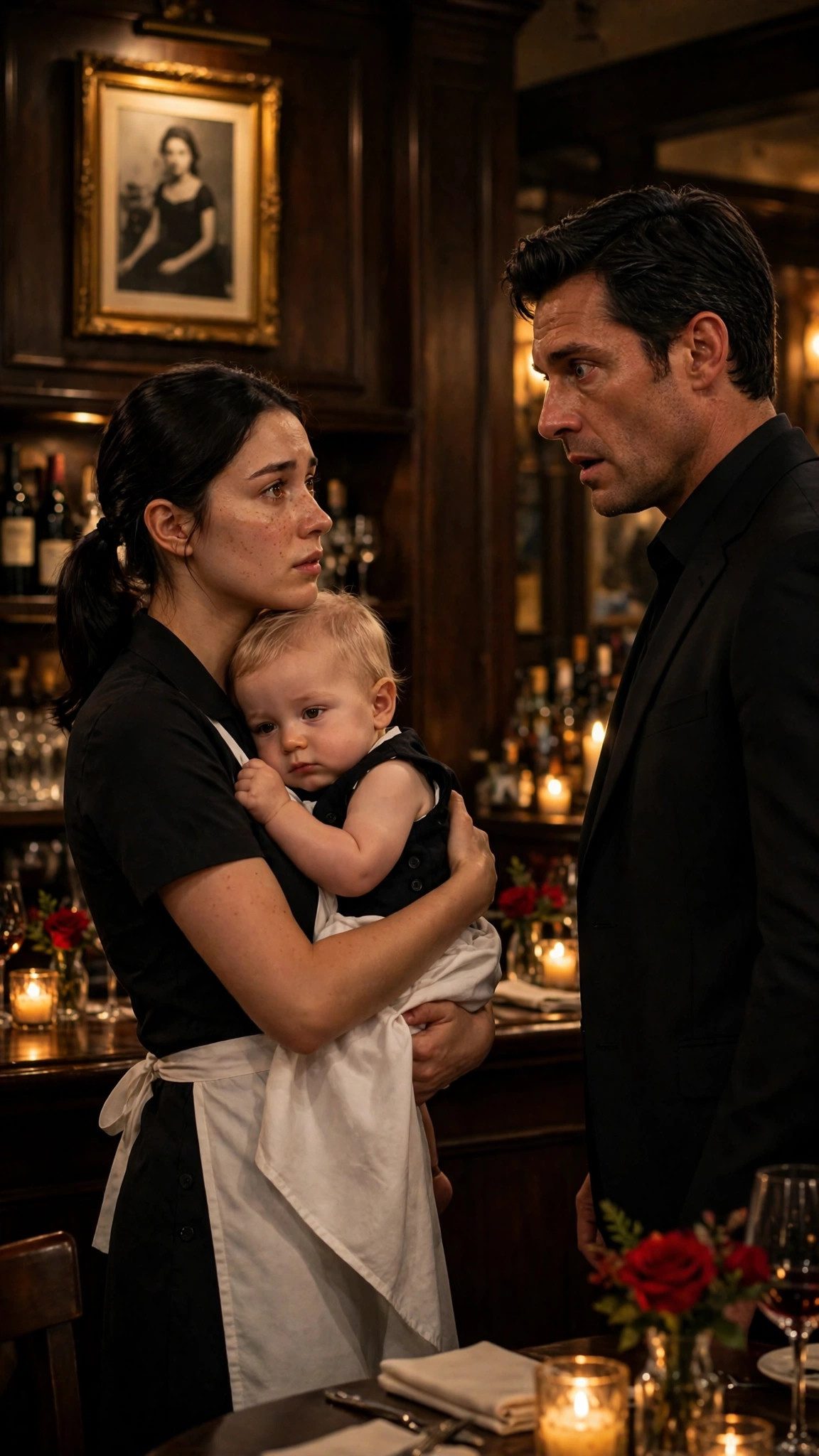
The morning after my mother died, my grandmother Rosa sat me on her lap and sang me a song about a river that never ran dry. I was three years old. I do not remember my mother's face. I do not remember her voice. But I remember that song, because Rosa sang it to me every night until I was old enough to be embarrassed by it, and then she sang it anyway, because Rosa did not care about embarrassed.
"Your mother sang it to you first," she told me once, when I asked where the song came from. "She sang it the night you were born, and she sang it every night after, until she couldn't sing anymore. Now it's mine, and one day it will be yours."
Rosa died two years ago, on a Tuesday in February, in the same small apartment where she had raised me. The landlord painted over the water stains and rented it to someone else before the month was out. I took her photograph, her rosary, and a shoebox of letters she had never let me read, and I moved into a smaller place two streets over, where the radiator never worked and the rent was only slightly less than impossible.
I never opened the shoebox. I told myself I would open it when I was ready. I was never ready.
By the time I was twenty-six, my life had narrowed down to a few simple facts. I worked double shifts at Ristorante Orelio six days a week. I owed four hundred dollars in rent and had one hundred and twelve dollars in the bank. My shoes had holes in them. My brother Marco had stopped calling. And the only person who had ever loved me without conditions was buried in a cemetery on the edge of the city, under a stone that read ROSA VALDEZ, BELOVED GRANDMOTHER, in letters that were already starting to fade.
Marco was four years older than me, and when we were children he had been my whole world. He taught me to ride a bicycle. He walked me to school. He told me stories about our mother, stories Rosa would never tell, because Rosa said the past should stay where it belonged.
But Marco had grown up angry. Angry at our mother for dying. Angry at the world for giving us nothing. Angry at the men in suits who owned the restaurants and the buildings and the streets, while we counted coins for bread. By the time he was twenty, he was running with a crew. By the time he was twenty-five, he had stopped coming to Sunday dinner. By the time Rosa died, he had not called in eleven months, and the number I had for him went straight to a voicemail that was full.
I did not blame him. That was the worst part. I understood him. The world had given us nothing, and Marco had decided to take something for himself. I had decided to work double shifts and hope. Neither of us was winning.
On an ordinary night, a week before everything changed, I came home from the restaurant to find a pink envelope taped to my door. FINAL NOTICE, it said, in capital letters that seemed to shout even in the dim hallway light. Four hundred dollars, due in five days, or the locks would be changed.
I stood in the hallway with that envelope in my hand for a long time. Four hundred dollars. I had one hundred and twelve in the bank and a shift the next day that would pay me sixty, before tips, and tips had been terrible all month because Tony had given the good tables to the new girls, the ones who laughed at his jokes.
The next night at the restaurant, I asked Tony for an extra shift. He looked at me the way he always looked at me, like I was a problem he had inherited and could not get rid of.
"You want more hours, Elina?" he said. "Then smile more. The customers tip girls who smile. You walk around like you're at a funeral."
I wanted to tell him that I had buried my grandmother two years ago and my mother before I could remember her, and that smiling on command was not something I had ever learned how to do. Instead I said, "I'll smile more."
He gave me the Sunday lunch shift, the worst shift in the restaurant, when the dining room filled with families and children who spilled juice on the floor and parents who forgot to tip. I took it anyway. Sixty dollars was sixty dollars.
That Sunday, an old man named Mr. Kowalski came in alone, as he did every Sunday, and ordered the same thing he always ordered: soup, bread, and a glass of red wine. He had been coming to Orelio for thirty years, and he always sat at table four, and he always tipped exactly two dollars, folded neatly under his plate.
"You look tired, child," he said to me that day, as I set his soup down.
"I am tired, Mr. Kowalski," I said, and then I was embarrassed, because I had not meant to say it out loud.
He nodded slowly. "My wife used to say that tired is just the body's way of telling you that you're still fighting. The day you stop being tired is the day you've given up." He pushed the two dollars across the table toward me. "Don't give up, Elina."
I did not give up. I went home that night and counted my money again. One hundred and twelve dollars in the bank. Sixty from the Sunday shift. Two dollars from Mr. Kowalski, folded neatly in my apron pocket. It was not enough. It was never enough. But it was something, and something was better than nothing, and that was the arithmetic my whole life had been built on.
Upstairs, Mrs. Alvarez knocked on my door with a plate of rice and beans, the way she did whenever she cooked too much, which was three times a week.
"You eat," she said, in her firm, no-argument voice. "You are too thin, mija. A girl your age should have meat on her bones."
"Thank you, Mrs. Alvarez," I said, and I ate standing in her doorway, because she would not let me take the plate back to my apartment until it was empty.
"Your grandmother would be proud of you," she said, watching me eat. "She used to tell me, my Elina works so hard, my Elina never complains. She was right. You never complain."
I thought about Rosa then, about the way she had worked in a laundry until her hands were raw, about the way she had come home every night and cooked dinner and helped me with my homework and sang me the river song, and I thought about how she had never complained either.
"I'm trying," I said.
"I know, mija," Mrs. Alvarez said. "I know."
The morning after the night at the restaurant, I stood in front of my bathroom mirror and stared at my own face like I had never seen it before. Dark hair, pulled back in the same low ponytail I had worn since I was sixteen. Brown eyes. A small dimple in my left cheek when I smiled, which was not often.
I thought about the woman in the photograph. Sofia Romano. The wife of Adrian Romano. The mother of that baby.
She had my face. Not a family resemblance. Not a passing similarity. My face, down to the dimple, down to the shape of my eyes. Mr. Orelio had seen it. Adrian Romano had seen it. The whole dining room had seen it, even if they did not understand what they were seeing.
How could a stranger have my face? How could a woman who had died seven months ago look like a waitress who had spent her whole life counting coins?
I thought about Rosa's shoebox, sitting on top of my closet where it had sat for two years, unopened. I thought about the letters inside it, letters Rosa had never let me read. I thought about the things Rosa had never told me about my mother.
My mother had died when I was three. That was the whole story, as far as I had ever known. She had died, and Rosa had raised me, and that was that. Rosa never said how she died. Rosa never said where she was buried. When I asked, Rosa would change the subject, or hum the river song, or tell me to go do my homework.
Standing in front of that mirror, with the white card burning a hole in my apron pocket, I wondered for the first time in my life whether my grandmother had been keeping a secret.
Across the city, in a house on a hill behind iron gates, Adrian Romano was having a morning of his own.
He had not slept. He had not slept properly in seven months, not since the night the phone had rung at two in the morning and a voice he did not recognize had told him there had been an accident, and his wife was gone, and his son, his nine-week-old son, was somehow alive.
Sofia had taken his car that day. His car. She had gone to pick up medicine for the baby, a ten-minute errand, and the bomb underneath the driver's seat had not cared whose errand it was. The police called it a gas leak. Adrian called it what it was. Someone had tried to kill him, and they had killed his wife instead.
For seven months, Matteo had rejected everyone. The nannies came and went, three of them, each one lasting less than a month. His sister Giulia, who loved that baby with her whole heart, could hold him for ten minutes before he screamed. Adrian himself could hold him, but only just, and only when the baby was too tired to fight. The doctors said it was grief. The doctors said a baby who lost his mother that young could carry the loss in his body. The doctors said a lot of things, and none of them helped.
Adrian had tried everything. He had hired the best nannies in the city. He had bought the softest blankets, the warmest bottles, the most expensive toys. He had sat in the nursery at three in the morning, holding his son against his chest, humming the only song he knew, a lullaby Sofia used to sing, and Matteo had cried until his small voice gave out.
And then last night, in a restaurant, a waitress he had never seen before had taken his son, and the baby had gone quiet in her arms like he had finally come home.
Adrian stood at the nursery window that morning and watched Matteo sleep in his crib, his small fist curled around a blanket, his blonde hair damp with sweat. The baby's face was peaceful in a way Adrian had not seen in seven months.
"Who is she?" he asked the empty room.
His sister Giulia came to stand beside him. She had been up all night too. "Her name is Elina Valdez," she said. "Rocco looked into her before dawn. Twenty-six years old. Waitress at Orelio for two years. No criminal record. No family except a brother who runs with the Castellanos. Her grandmother died two years ago. Her mother died when she was three."
Adrian had tried everything. He had hired the best nannies in the city. He had bought the softest blankets, the warmest bottles, the most expensive toys. He had sat in the nursery at three in the morning, holding his son against his chest, humming the only song he knew, a lullaby Sofia used to sing, and Matteo had cried until his small voice gave out.
Three days before the night at the restaurant, Dr. Pierce, the pediatrician, had come to the house for Matteo's nine-month checkup. The doctor was a kind man in his sixties, with gentle hands and a voice that never rose above a murmur, and he had examined Matteo with the careful thoroughness of someone who knew he was looking at more than a medical problem.
"He is healthy," Dr. Pierce had said, putting his stethoscope away. "His weight is fine. His reflexes are fine. There is nothing wrong with his body, Adrian. What he has is grief, and grief does not show up on a chart."
"Then what do I do?" Adrian had asked. He hated asking that question. Adrian Romano did not ask what to do. Adrian Romano told other people what to do. But he had asked it anyway, because his son was crying, and he did not know how to make it stop.
"You wait," Dr. Pierce had said. "You stay close. You let him know you are there. And you find someone he trusts, someone whose voice calms him, someone whose arms feel safe. Sometimes it is not the father. Sometimes it is a grandmother, or an aunt, or a nurse. The baby will choose, Adrian. You cannot choose for him. You can only make sure that when he chooses, the person he chooses is someone good."
Adrian had walked Dr. Pierce to the door in silence. At the door, the doctor had turned back.
"One more thing," he had said. "Sofia used to sing to him, didn't she? In the last weeks?"
"Every night," Adrian had said.
"Then play her voice," Dr. Pierce had said. "If you have recordings, play them. A baby remembers his mother's voice before he remembers anything else. It lives in his body, even when his mind cannot hold it."
Adrian had recordings. He had a phone full of videos Sofia had taken, singing to Matteo in the nursery, her voice soft and warm. He had played them every night for a week. Matteo had listened, his eyes wide, his small body still, and then he had cried harder than ever, as if the sound of his mother's voice had reminded him of everything he had lost.
Adrian had stopped playing them. He had put the phone in a drawer, and he had not taken it out since.
Now, standing at the nursery window with his sister beside him, watching his son sleep peacefully for the first time in seven months, Adrian thought about Dr. Pierce's words. The baby will choose. You cannot choose for him.
Matteo had chosen. He had chosen a waitress in a restaurant, a girl with his dead wife's face and his dead wife's song, and Adrian did not understand it, but he understood this: his son had stopped crying. His son was sleeping. And for the first time in seven months, the house on the hill did not feel like a tomb.
Adrian's jaw tightened. "Her brother runs with the Castellanos."
"Yes," Giulia said. "And before you ask, no, I don't think she's a plant. A plant would not look like Sofia. A plant would not make Matteo stop crying. Whatever she is, brother, she is not a trap."
"She has Sofia's face," Adrian said. It was not a question.
"I know," Giulia said softly. "I saw the photograph too. I stood in that restaurant and looked at that girl holding your son, and for one second I thought—" She stopped. She did not finish the sentence. She did not have to.
Adrian looked down at his sleeping son. "She comes at ten," he said. "I want to know who she is. I want to know why my son chose her. And I want to know why she looks like my wife."
Giulia put a hand on his arm. "Be careful with her, Adrian. She is not one of us. She is a girl who works double shifts and worries about rent. Whatever this is, she did not ask for it."
"I know," Adrian said. And he did know. He knew it the way he had known, last night, that the baby reaching for a stranger was not a coincidence. Something was happening that he did not understand, and Adrian Romano had built his life on understanding everything.
He went downstairs and stood in the doorway of the room that had been Sofia's. He had not touched it in seven months. Her dresses still hung in the closet. Her perfume still sat on the dresser. Her photograph still stood on the nightstand, smiling at a camera that no longer existed.
He picked up the photograph and looked at it for a long time.
Sofia had been twenty-five when the picture was taken. Dark hair. Brown eyes. A small dimple in her left cheek.
The same face as the waitress who had held his son.
"Who are you, Elina Valdez?" he whispered to the empty room. "And what did you do to my son?"
At nine forty-five that morning, I stood outside the iron gates of the house on the hill, wearing my only good dress and the shoes with holes in them, holding the white card in my hand like a ticket I was afraid to use.
The gates opened before I could knock.
A man in a black suit stood on the other side. He was older, with grey at his temples and kind eyes that did not match the gun I could see under his jacket.
"Miss Valdez," he said. "Mr. Romano is expecting you. My name is Rocco. I will take you to him."
I followed him up the long driveway, past gardens that were too perfect to be real, past windows that reflected the morning sun like mirrors, and with every step I took, I felt the life I had known getting smaller behind me.
I did not know it then, but I was walking into the house where my twin sister had lived. I was walking into the nursery where my nephew slept. I was walking into the middle of a war I did not know existed, between a man who had lost everything and a brother who blamed him for it.
All I knew was that a baby had reached for me, and his mother had my face, and nothing in my life would ever be simple again.