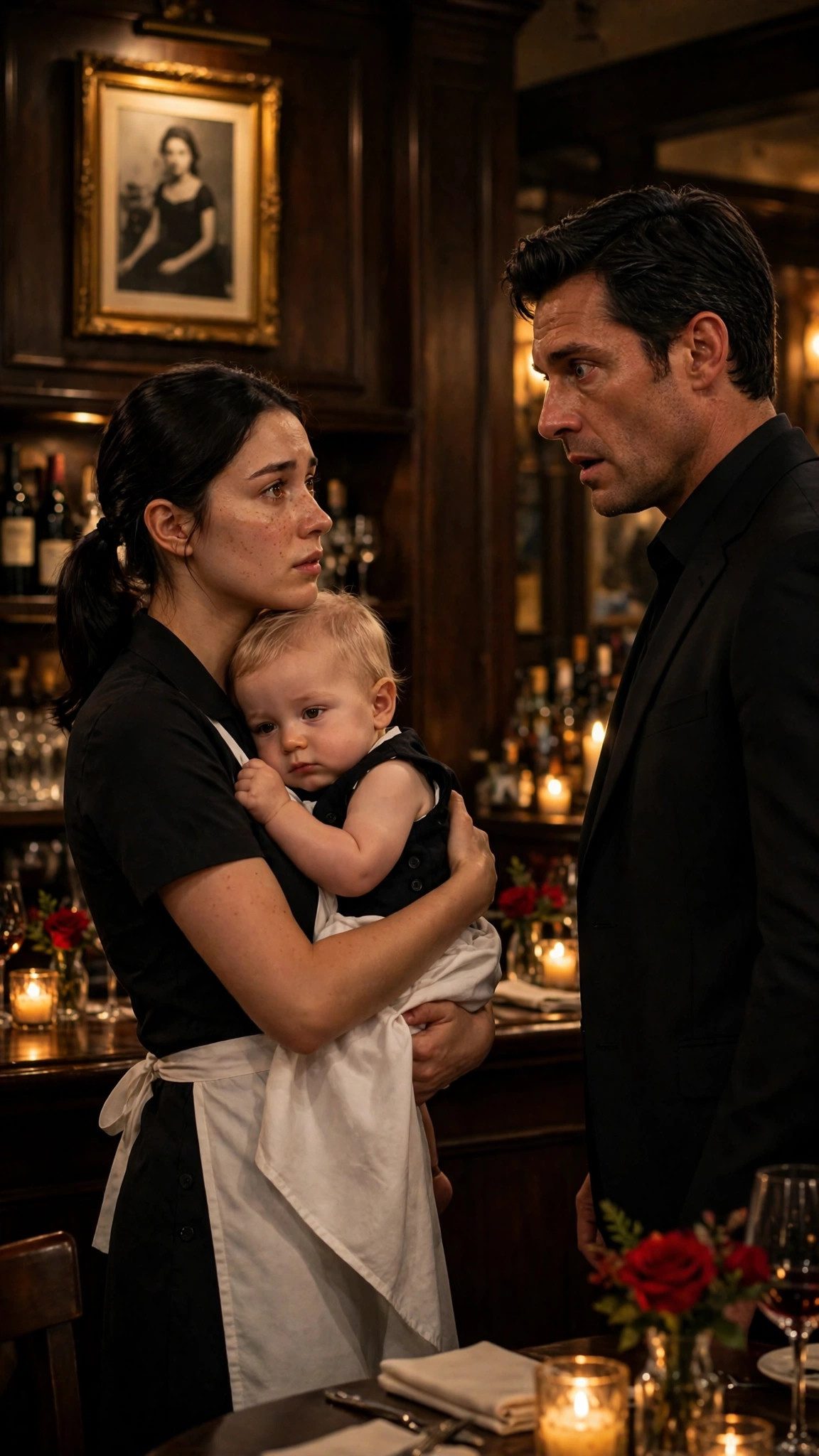
The inside of the house was quiet in a way that felt expensive. Not silent. Quiet the way a church is quiet, or a library. The floors were dark wood, polished until they shone. The windows were taller than I was. Every room we passed looked like it had been arranged by someone who was paid a great deal of money to make sure nothing was ever out of place.
And yet, underneath all of it, the house felt sad. I could feel it in the air, the way you can feel rain coming before the first drop falls. The flowers in the hallway were fresh, but no one had opened the curtains in the front rooms. The furniture was beautiful, and no one sat on it.
Rocco led me up a wide staircase and down a hallway lined with photographs. I tried not to stare, but I could not help it. There was Adrian as a young man, standing next to an older man with the same hard jaw. There was a woman I assumed was his mother. And there, halfway down the hall, was Sofia.
She wore a white dress in that photograph, standing in a garden, laughing at something outside the frame. Her dark hair was loose around her shoulders. The dimple in her left cheek was deep and clear.
My dimple.
I stopped walking. My hand went to my own cheek without thinking.
Rocco stopped too. He did not hurry me. He just stood there, patient, while I looked at the face of a woman who had died seven months ago and who looked exactly like me.
"She was beautiful," I said, because I did not know what else to say.
"She was," Rocco said quietly. "She was the best thing that ever happened to this house. After she died, it was like someone turned the lights off and never turned them back on."
He led me to the nursery at the end of the hall. The door was open, and inside, a woman with dark hair pulled back in a severe bun was standing over the crib, holding a bottle, looking exhausted.
"Giulia," Rocco said. "This is Elina Valdez."
Giulia Romano turned, and I saw the same shock cross her face that I had seen on Adrian's face the night before. She looked at me, and then she looked at the photograph in the hallway, and then she looked at me again, and her hand went to her mouth.
"God help us," she whispered. "You really do look like her."
Matteo was awake in his crib, and the moment he saw me, he made a sound. Not a cry. A small, eager sound, almost like a laugh, and his arms went up.
Giulia's eyes filled with tears. "He never does that," she said. "He never reaches for anyone. Not even me. Not even his father, most days."
I went to the crib before I could talk myself out of it, and I lifted Matteo into my arms. He settled against my chest immediately, his small body going soft and warm, his cheek pressed to my collarbone, his fist curling into my dress the way it had curled into my apron the night before.
And then, without thinking, without planning, I began to hum.
It was the river song. Rosa's song. The song my mother had sung to me the night I was born, the song Rosa had sung to me every night of my childhood. I had not hummed it in years. I had not even thought about it in years. But holding that baby, it came out of me like breathing.
Matteo went still. Then he sighed, the same deep little sigh from the restaurant, and his eyes drifted closed.
Giulia was crying openly now. "That song," she whispered. "Sofia used to sing that song to him. The same song. The same melody. How do you know that song?"
My blood went cold. "My grandmother sang it to me," I said. "She said my mother sang it to me first. I don't know where it came from. I thought it was just ours."
Giulia and Rocco looked at each other, and in that look I saw a whole conversation I was not part of.
Adrian Romano appeared in the doorway. He was dressed in a dark suit, his hair still damp from a shower, and he looked at his son asleep on my chest, and something in his face cracked open.
"You're hired," he said.
"I didn't apply for a job," I said.
"You did last night, when you held my son and he stopped crying for the first time in seven months." He stepped into the room. "I will pay you five thousand dollars a week. You will live here, in the guest room next to the nursery. You will take care of Matteo. That is the job. Those are the terms."
Five thousand dollars a week. I did the math before I could stop myself. That was more than I made in two months at the restaurant. That was rent, and shoes without holes, and food that did not come from a can.
"I can't live here," I said. "I have an apartment. I have a job."
"You have a job that pays you nothing and an apartment with a broken radiator," Adrian said. "Rocco looked into your life this morning. I know about the rent. I know about the double shifts. I am not offering you charity, Miss Valdez. I am offering you a job, because my son needs you, and I do not know why, and I intend to find out."
He looked at Matteo, asleep against me, and his voice dropped. "Do you understand what you are to him? In seven months, no one has been able to do what you did in ten seconds. Not the best nannies in the city. Not his aunt. Not me. You walk into a room, and my son reaches for you like you are the answer to a question he has been asking since the day his mother died."
I wanted to say no. I wanted to walk out of that house and go back to my small cold apartment and my double shifts and my simple life, where the biggest danger was missing rent.
But Matteo's small hand was curled into my dress, and his breathing was slow and even, and I could feel his heartbeat against my chest, steady and trusting.
And somewhere in the back of my mind, a voice that sounded like Rosa whispered, "The river never runs dry, child. It only waits for you to come back to it."
"I'll stay," I heard myself say. "For now. Until we figure out what this is."
Adrian nodded once, like a man closing a deal. "Rocco will show you the guest room. Giulia will show you Matteo's routine. I will be in my office. If you need anything, you ask Rocco."
He turned to leave, and then he stopped. "Miss Valdez," he said, without turning around. "That song you were humming. Where did you learn it?"
"My grandmother," I said. "She said my mother sang it to me."
He was quiet for a long moment. Then he said, "Sofia sang it to Matteo every night. She told me her mother sang it to her. She never knew where it came from. She said it was just a song her family had always known."
He left, and I stood in the nursery holding his son, humming a song that apparently belonged to two families at once, and the walls of the world I thought I knew began to crack.
The first three days passed in a strange, suspended kind of peace. Matteo thrived. He ate. He slept. He laughed for the first time since his mother died, a small bubbling sound that made Giulia cry and made Rocco grin like a boy. I learned his routine. Bottles at seven, eleven, three, and seven. Naps at nine and two. Baths at six. The river song at bedtime, every night, without fail.
On the second morning, Giulia found me in the kitchen at six thirty, warming a bottle and trying to figure out the espresso machine, which was more complicated than anything I had ever operated in the restaurant.
"You don't have to do that," Giulia said, taking the bottle from me and testing it on her wrist with the practiced ease of a woman who had done it a thousand times. "The housekeeper does the mornings. You should sleep."
"I've been up since five," I said. "I'm used to it. At the restaurant, my shift started at six."
Giulia looked at me the way someone looks at a stray dog they have just decided to keep. "Sit," she said, pointing at the kitchen table. "Eat. You look like you haven't had a proper breakfast in years."
She put eggs and toast and fruit in front of me, and coffee that was actually hot, and I ate like I had not eaten in days, because I had not, not really. At the restaurant, I ate standing up between tables. At home, I ate rice and beans from Mrs. Alvarez's plate. I had forgotten what it felt like to sit at a table and eat a meal someone had made for me.
"Tell me about yourself," Giulia said, sitting across from me with her own coffee. "Not the file Rocco put together. You. Who are you, Elina Valdez?"
I told her about Rosa. I told her about the laundry and the river song and the shoebox I had never opened. I told her about Marco, and how he had taught me to ride a bicycle, and how he had disappeared into a world I did not understand. I told her about the rent and the double shifts and Mr. Kowalski's two dollars.
Giulia listened without interrupting, and when I finished, she reached across the table and took my hand.
"Sofia would have liked you," she said. "She liked people who worked hard and didn't complain. She used to say that the best people she knew were the ones who had the least and gave the most. She would have liked you very much."
I did not know what to say to that, so I said nothing, and Giulia squeezed my hand, and we sat there in the morning light, two women who had both lost someone, eating breakfast in a kitchen that was too beautiful to be real.
Later that morning, I took Matteo out to the garden for the first time. The garden was enormous, with roses in every color and a fountain in the middle and a stone bench under an old oak tree. I sat on the bench with Matteo on my lap, and I showed him the roses, and I told him their colors, red and white and pink and yellow, and he reached for a white rose with his small hand, and I let him touch the petals, soft as silk.
Adrian watched us from the terrace. I saw him out of the corner of my eye, standing very still, his hands in his pockets, and I pretended not to notice, because I did not know what to do with a man watching me hold his son in a garden.
But when I looked up again, he was gone, and in his place, Rocco was walking the perimeter of the garden, slow and thorough, the way he had walked the restaurant the night I first saw him.
"Rocco checks the garden every morning," Giulia told me later, when I asked. "He checks the gates. He checks the cameras. He has done it every day since Sofia died. Adrian says it is habit. Rocco says it is his job. Neither of them will admit it is fear."
That afternoon, I found a small room off the nursery that no one had mentioned. It was Sofia's sewing room, or it had been. A basket of yarn sat beside an armchair. A half-finished baby blanket lay folded on the table, blue and white, with one corner still unfinished. A photograph of Sofia and Adrian on their wedding day stood on the shelf, both of them laughing, both of them young, both of them alive.
I stood in that room for a long time, looking at the unfinished blanket, and I thought about how a life could stop in the middle of a stitch, how a woman could leave a blanket half done and a song half sung and a son half raised, and how the people left behind had to find a way to finish what she had started.
I picked up the blanket. The yarn was soft. The stitches were even and careful. I sat down in the armchair, and I looked at the pattern, and I realized I could finish it. Rosa had taught me to knit when I was ten. I had not done it in years, but my hands remembered.
I did not finish it that day. But I took the basket back to my room, and I put it on the nightstand, next to Sofia's letters, and I promised myself I would finish it. For Matteo. For Sofia. For the woman whose face I wore and whose song I sang.
Adrian watched from a distance. He would stand in the nursery doorway in the evenings, silent, watching me hold his son, and I could never tell what he was thinking. Sometimes he asked me questions. Small ones. Where did I grow up? What did my grandmother do? Did I have any other family?
"My brother," I said one evening, when he asked. "Marco. He's older than me. We don't talk much anymore."
"Why not?" Adrian asked.
I hesitated. "He went a different way. He runs with people I don't approve of. The Castellanos." I said the name carefully, watching his face. His expression did not change, but something in his eyes went cold.
"The Castellanos," he repeated.
"My brother blames men like you for everything that went wrong in our lives," I said. "He thinks the world is divided into people who have everything and people who have nothing, and he's decided to take something for himself."
Adrian was quiet for a long time. "And what do you think?" he asked.
"I think the world is more complicated than that," I said. "But I also think my brother is not entirely wrong."
He almost smiled at that. Almost.
That evening, after Matteo was asleep, Rocco knocked on the door of my room. He did not come in. He stood in the hallway, his hands behind his back, and he looked uncomfortable, the way a man looks when he has to deliver news he does not want to deliver.
"Miss Elina," he said. "I need to tell you something. There was a car outside the gates tonight. A black sedan. It sat there for two hours with its lights off. When I went out to check, it drove away."
My stomach tightened. "Is that normal?"
"No," Rocco said. "It is not normal. It has happened three times this week. Always the same car. Always after dark. Mr. Romano knows. He has doubled the men on the gate."
"Who is it?" I asked.
Rocco hesitated. "We don't know yet. But Mr. Romano has enemies, Miss Elina. Men who want what he has. Men who would use anything, or anyone, to get to him." He looked at me directly. "I am telling you this because you live here now, and you take care of the baby, and you should know. If you see anything strange, a car, a man watching the house, anything at all, you come to me. Day or night. Do you understand?"
"I understand," I said.
He nodded and walked away, and I stood in the doorway for a long time, looking down the hallway toward the nursery, listening to Matteo breathe in his sleep, and I thought about the black car, and the men in black suits, and the world I had walked into without understanding it.
I thought about calling Marco. I thought about asking him if he knew anything about a black car. But Marco had not called me in eleven months, and I did not know if he would answer, and I did not know what I would say to him if he did.
So I went back to my room, and I took out Sofia's half-finished blanket, and I knitted until my eyes were too tired to see the stitches, and I tried not to think about the car outside the gates, watching the house where I slept.
On the fourth night, my phone rang. The number was unknown, but I knew the voice immediately.
"Elina." Marco. His voice was rougher than I remembered, older. "I heard you moved into Romano's house."
My heart stopped. "How did you hear that?"
"I hear everything, little sister. That's my job now." He paused. "Do you know who that man is? Do you know what he did to our family?"
"He didn't do anything to our family, Marco. I work for him. I take care of his baby. That's all."
"That's not all, and you know it." His voice dropped. "You look like her, Elina. You look like Sofia. Did he tell you that? Did he tell you she was your sister?"
The room tilted. I sat down hard on the edge of the bed, Matteo asleep in his crib beside me.
"What did you say?" I whispered.
"Sofia Valdez," Marco said. "Your twin sister. Our mother had two girls, not one. Sofia was taken when we were babies. I only found out after she died. I found her letters, Elina. She knew. She found out a month before she died, and she was looking for you. And Romano—" His voice broke. "Romano got her killed. A bomb meant for him. She took his car, and she died, and our sister died because of him, and now you're living in his house, holding his baby, like none of it matters."
"Marco—"
"Listen to me," he said, and now his voice was hard, the voice of a man who had made a decision. "I am going to make him pay. The Castellanos are going to help me. And when it happens, you need to be out of that house. Do you understand me? You need to choose, Elina. Your family, or his."
The line went dead.
I sat in the dark nursery, listening to Matteo breathe, and the world I thought I knew fell apart completely.
My twin sister. I had a twin sister. She had married Adrian Romano. She had died in a bomb meant for him. And my brother was going to kill him for it, with the help of the very people who had ordered the bomb in the first place.
Outside the nursery window, in the dark garden below, a black car sat with its lights off, watching the house.
I did not sleep that night. I sat in the rocking chair beside Matteo's crib, humming the river song, and I waited for morning, and I tried to figure out how a girl who had only ever worried about rent had ended up in the middle of a war.