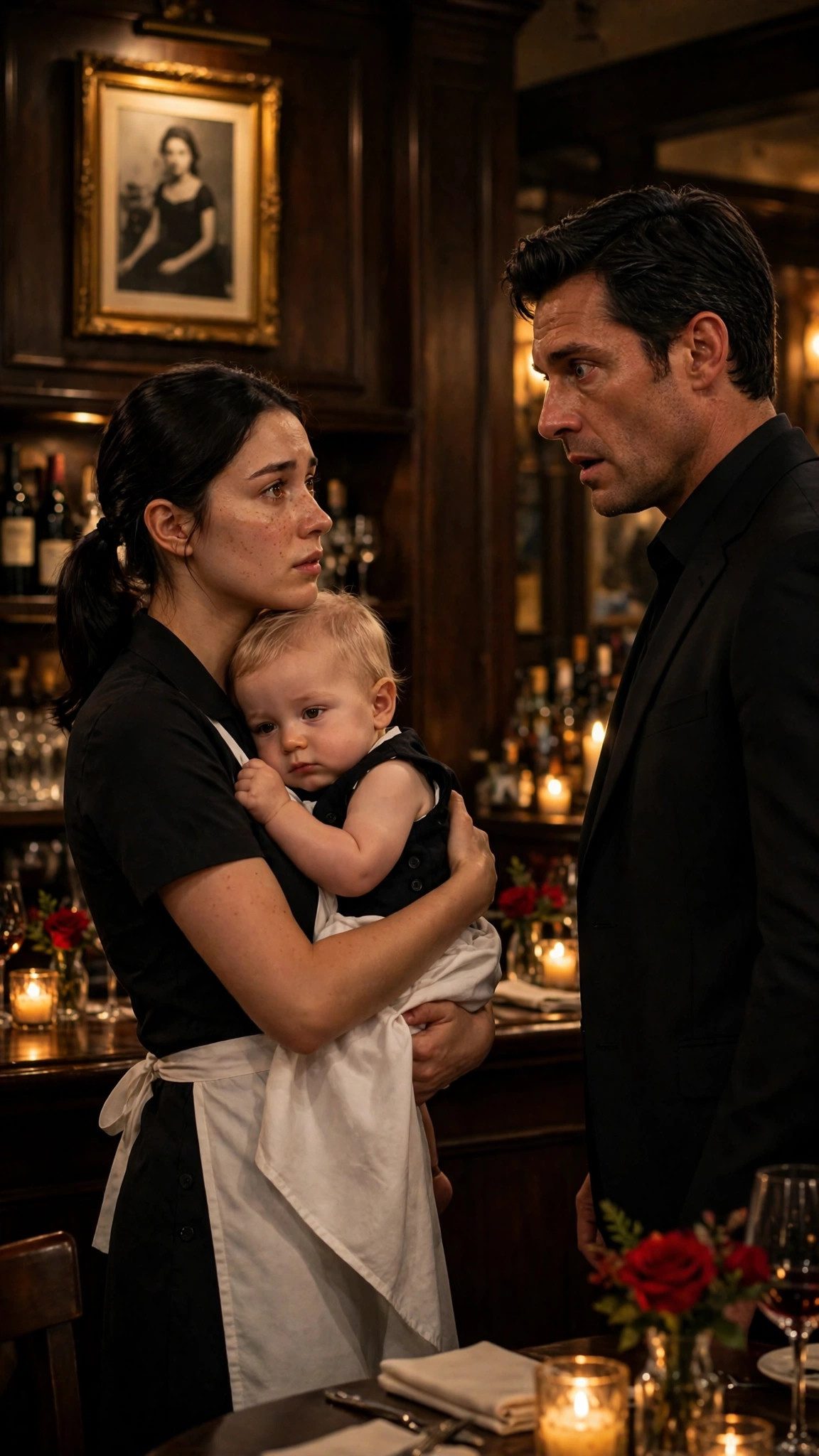
Matteo turned one year old on a Friday in October, and we celebrated his birthday at Ristorante Orelio, in the same dining room where his father had carried him in nine months earlier and he had reached for a stranger with both arms.
Mr. Orelio had closed the restaurant for the night. He had hung white lights from the ceiling and put roses on every table, red roses and white roses, and he had cooked the meal himself, the way he had cooked it forty years ago when he first opened the doors.
There were only a few of us. Giulia and Rocco. Marco, home from six months in a quiet town upstate, thinner and calmer than I had ever seen him, holding a gift wrapped in blue paper. Adrian, in a dark suit, holding Matteo on his hip. And me, in a green dress I had bought with my first real paycheck, my hair loose around my shoulders, a small gold chain around my neck that had belonged to Sofia.
Matteo sat in his high chair at the head of the table, wearing a tiny black vest, just like the one he had worn the first night, and he looked around at all of us with his serious grey eyes, and then he laughed. A real laugh, loud and bubbling, the laugh of a baby who had finally learned that the world was a safe place.
"One year," Giulia said, wiping her eyes. "One year ago, he would not let anyone hold him. Look at him now."
Marco leaned down and held out his hand, and Matteo grabbed his finger, and Marco's face crumpled like he might cry.
"Hey, little man," Marco whispered. "I'm your uncle. I'm sorry it took me so long to come home."
Matteo babbled something that might have been agreement, and Marco laughed through his tears, and I put my hand on my brother's shoulder, and for the first time in years, our family felt whole.
After dinner, after the cake, after Matteo had smashed his small fist into the frosting and gotten it all over his face and his vest and Adrian's suit, Mr. Orelio brought out a guitar.
"Your sister used to sing here," he said to me. "Friday nights. This was her song. The river song. Would you sing it for her son?"
I had not sung in public since I was a child, since Rosa had died and the song had gone quiet inside me. But I took the guitar, and I held it the way Rosa had taught me, and I looked at Matteo, sitting in his father's arms, his eyes already heavy with sleep, and I began to sing.
The river never runs dry. The river carries you home. The river remembers every name, and the river brings you home.
My voice was shaky at first. Then it steadied. Then it filled the room, warm and clear, and I saw Giulia crying, and I saw Rocco smiling, and I saw Marco with his eyes closed, listening like a man hearing a prayer he thought he had forgotten.
And I saw Adrian, watching me, with Matteo asleep against his chest, and his eyes were shining.
When the song ended, the room was silent for a long moment. Then Mr. Orelio began to clap, slowly, and everyone joined in, and Matteo, half asleep, made the deep little sigh I had first heard in that restaurant, the sigh of a baby who had finally found what he was searching for.
Adrian stood up, still holding Matteo, and he walked to where I sat with the guitar.
"Elina Valdez," he said, and his voice carried across the quiet room. "A week ago, I told you I was going to ask you something when the danger was past. The danger is past. So I am asking you now, in front of our family, in the place where your sister used to sing, in front of the son who chose you before any of us understood why."
He shifted Matteo to one arm, and with his free hand, he reached into his pocket and took out a small box. Inside was a ring. A simple gold band with a single diamond, and next to it, set into the gold, a tiny river stone, smooth and grey, the kind of stone you find at the bottom of a river that never runs dry.
"I am not asking you to replace Sofia," he said. "No one could replace her. I am asking you to be yourself. Elina Valdez. Matteo's aunt. My brother's sister. The woman who walked into my life carrying nothing but a tray and a kind heart, and who gave my son back his smile. Will you marry me? Will you be my wife, and Matteo's mother, and the woman who sings the river song in this house for the rest of our lives?"
I looked at the ring. I looked at Matteo, asleep in his father's arms. I looked at Marco, nodding at me through his tears. I looked at Giulia, smiling. I looked at Mr. Orelio, standing behind the bar with his hand over his heart.
And I thought about my sister, in her black dress, laughing in a photograph on the wall. I thought about Rosa, singing to me on the night my mother died. I thought about the river song, and the river that never runs dry, and the long road that had brought me from a cold apartment with a broken radiator to this room, to this table, to this man, to this baby.
"Yes," I said. "Yes, Adrian. Yes."
He slid the ring onto my finger, and it fit perfectly, like it had been waiting for me, and he leaned down and kissed me, gently, in front of everyone, and Matteo, in his sleep, made a small sound of contentment, and the whole room erupted.
We planned the wedding in six weeks, which Giulia said was impossible and then immediately proved was not, by taking charge of everything with the terrifying efficiency of a woman who had organized a hundred charity galas and was not about to be defeated by a wedding.
"You will wear white," Giulia told me, on the first morning of planning, sitting at the kitchen table with a notebook and three different colors of pen. "Sofia wore white, and you will wear white, and it will be beautiful. The church on the hill. Roses, red and white, like the garden. And Matteo will be the ring bearer, and he will wear a tiny black vest, because he is his father's son, and his father wore a black vest at our parents' wedding, and it is a family tradition now, apparently, because I have just decided it is."
I laughed until my sides hurt. "Giulia, I don't need a big wedding. I just need Adrian, and Matteo, and Marco, and you. That's all."
"And that is exactly what you will have," Giulia said, writing something in her notebook. "Plus roses. And a cake. And a dress that will make Adrian Romano forget his own name. Trust me, Elina. I know what I am doing."
She did. On the morning of the wedding, I stood in front of the mirror in Sofia's old room — no, in my room now, the room next to the nursery that had become mine — and I looked at myself in a white dress, with my dark hair loose around my shoulders and Sofia's locket around my neck, and I barely recognized the girl in the mirror.
She did not look like a waitress who worked double shifts and worried about rent. She looked like a woman who had found her family. She looked happy.
Giulia came in to help me with the dress, and she stood behind me, looking at our reflections in the mirror, and she said, very quietly, "You look like her. Not just your face. The way you hold yourself. The way you smile. She would be so happy today, Elina. She would be so happy that you are here."
"She is here," I said. "I can feel her. In this room. In this house. In Matteo. She's here."
Giulia squeezed my shoulders. "Yes," she said. "She is."
Marco walked me down the aisle. He wore a suit that Rocco had helped him pick out, and he had shaved, and he had cut his hair, and he looked like the boy who had taught me to ride a bicycle, all grown up and trying very hard not to cry.
"You look beautiful, little sister," he whispered, as we stood at the back of the church. "Sofia would be so proud of you."
"She would be proud of you too," I said. "Look at you. You came home. You told the truth. You did the right thing, even when it was hard. That's all she ever wanted."
He nodded, and he took my arm, and we walked down the aisle together, past roses and white lights and the faces of everyone we loved, toward a man standing at the altar with our nephew in his arms.
Matteo was the ring bearer, and he took his job very seriously, holding the pillow with both hands and walking down the aisle with the careful concentration of a one-year-old who knew something important was happening, even if he did not know what.
When he reached Adrian, he held up the pillow, and Adrian took the ring, and Matteo clapped his hands, delighted with himself, and the whole church laughed.
The ceremony was short and simple. We said our vows. Adrian promised to love me and protect me and to come home for dinner every night. I promised to love him and Matteo and to sing the river song for as long as I lived. The priest pronounced us husband and wife, and Adrian kissed me, and Matteo, from his place in Giulia's arms, made a loud, happy sound, as if he approved.
After the wedding, we went back to Ristorante Orelio, because where else would we go? Mr. Orelio had prepared a feast, and the whole neighborhood came, and someone put on music, and Adrian danced with me in the middle of the dining room, under the white lights, while Matteo slept in his grandfather's arms — no, in his uncle's arms, in Marco's arms, safe and warm.
That night, after everyone had gone home, Adrian and I stood in the nursery, looking down at Matteo asleep in his crib, his small fist curled around his blanket, his blonde hair damp with sleep.
"He chose you," Adrian whispered. "Before any of us knew why. Before any of us knew who you were. He reached for you, and he never let go."
"He reached for family," I said. "He reached for the other half of his mother. He reached for the song he heard before he was born. Babies know these things, Adrian. They know."
Adrian put his arm around me, and we stood there together, watching our son sleep, and I thought about Sofia, and I thought about Rosa, and I thought about my mother, who had sung the river song to two baby girls on the night they were born, not knowing they would be torn apart, not knowing they would find each other again through a baby who refused to let anyone hold him.
The river never runs dry. The river carries you home. The river remembers every name, and the river brings you home.
I hummed the song softly, and Matteo sighed in his sleep, and Adrian kissed the top of my head, and I knew, with a certainty I had never felt before in my life, that I was home.
Not the apartment with the broken radiator. Not the restaurant where I worked double shifts. Not the small, hard, lonely life I had lived for twenty-six years.
Home. With a husband who loved me. With a son who had chosen me. With a brother who had come home. With a sister watching over us from a photograph on the wall, smiling with my face, singing the same song.
The baby had chosen the mafia boss's enemy.
And the enemy had turned out to be family.
One year later, on a Friday night in October, I stood on the small stage at Ristorante Orelio, holding a guitar, looking out at a dining room full of people I loved. Matteo was two years old now, and he sat at the front table in his tiny black vest, banging a spoon against his plate in time with the music, completely out of rhythm and completely delighted with himself.
Adrian sat beside him, watching me with the same look he had worn on our wedding day, the look of a man who had lost everything and found something better. Marco sat on his other side, home for good now, working at the restaurant, learning to cook from Mr. Orelio, who had taken him under his wing like a son. Giulia sat across the table, holding a glass of wine, smiling at all of us.
I finished Sofia's blanket that spring. The blue and white one she had left half done in her sewing room. I worked on it in the evenings, after Matteo was asleep, sitting in the armchair where she used to sit, and when I sewed the last stitch, I folded it carefully and put it in Matteo's crib, where it belonged.
And on the night of the anniversary of the day Matteo first reached for me, I stood on that stage, and I sang the river song, the song my mother had sung to two baby girls on the night they were born, the song Rosa had sung to me, the song Sofia had sung to her son, the song I now sang to mine.
The river never runs dry. The river carries you home. The river remembers every name, and the river brings you home.
When the song ended, Matteo stood up in his chair, and he held out his arms toward me, and he said, very clearly, in his small, certain voice, "Mama."
The whole room went still. Adrian's eyes filled with tears. Marco put his hand over his heart. Giulia pressed her napkin to her eyes.
I put down the guitar, and I walked to my son, and I lifted him into my arms, and he melted against my chest, the way he had melted against my chest on the first night, in this same room, when he was nine months old and I was a stranger and he reached for me anyway.
"Yes," I whispered into his blonde hair. "I'm here. I'm your mama. I'm here."
And somewhere, I knew, my sister was smiling. Somewhere, Rosa was singing. Somewhere, the river kept running, carrying all of us home, the way it always had, the way it always would.
The End.
THE END