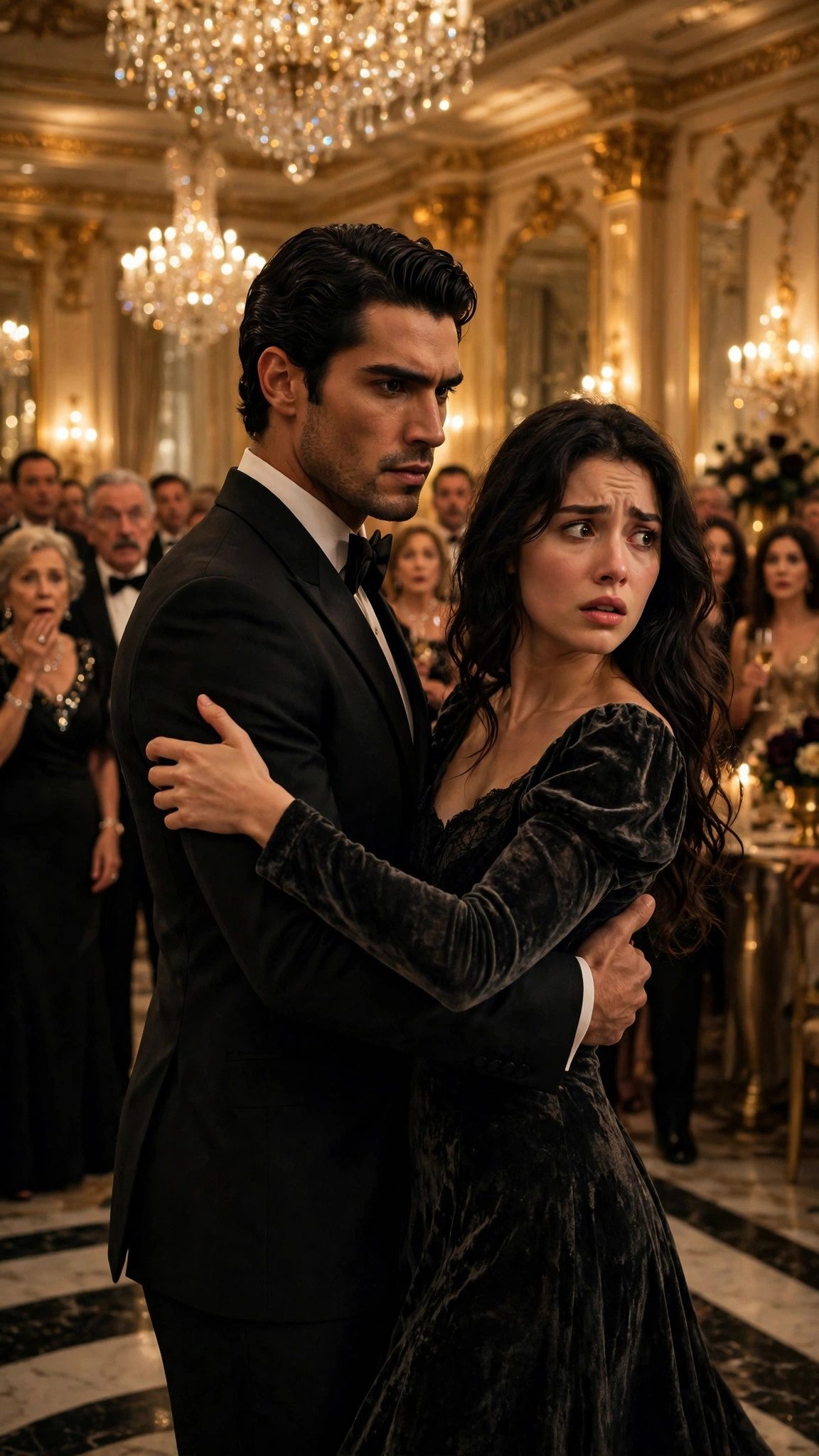
The family council met the next morning in the great hall of the Valenti estate, and I had never seen so many dangerous men in one room in my life.
They sat around a long oak table — twelve men, all in dark suits, all with faces that had seen things I would never see. Lorenzo sat at Carmine's right hand. Rosa sat at the far end, her cane resting against her chair, her eyes sharp as needles. Marco Valenti sat beside his father, his leg stretched out stiffly, his face pale. And Salvatore sat at the opposite end of the table from Carmine, alone, his hands folded in front of him, his white hair gleaming in the winter light.
Carmine stood. He did not raise his voice. He never raised his voice.
"Three years ago," he said, "my uncle tried to take this family from me. He failed. Last night, he tried again. He kidnapped my wife's brother. He threatened my wife. He demanded that she lie to this council and destroy my marriage. She refused."
He looked around the table, meeting every man's eyes, one by one.
"I am not here to ask you to punish my uncle. I am here to show you what he has done, and to let you decide."
Lorenzo stood and laid a folder on the table. Inside were papers — the loan documents from Nico Falco, the ones I had seen in my apartment the morning after the gala, stamped PAID IN FULL. And beneath them, other papers: bank records, showing money moving from Salvatore's accounts to Falco's, month after month, for two years. A ledger, in Falco's own handwriting, listing the loans he had made on Salvatore's orders — not just Liam's, but a dozen others, all young men with sisters, or wives, or mothers Salvatore could use.
"My uncle did not lend Liam Gallagher money because he needed the interest," Carmine said. "He lent it because he needed Josephine. He put her on my piano roster. He waited for me to notice her. He waited for me to need a wife. And when I chose her, he waited for the moment he could use her brother to destroy the marriage. Every step of it was planned. Every step of it was his."
A murmur ran around the table. Marco Valenti stared at the papers, and his face went white.
"Is this true, Father?" he asked.
Salvatore did not answer. He stared at the table, his hands folded, his jaw tight.
"It is true," said a voice from the doorway, and Nico Falco walked into the room, flanked by two of Lorenzo's men, his hands cuffed in front of him. He was smaller than I remembered, and older, and afraid.
"Tell them," Lorenzo said.
Falco swallowed. "Salvatore Valenti paid me to lend money to Liam Gallagher. He told me to make the debt so large the boy could never pay it. He told me to offer the sister the piano job. He said — he said the boss would fall for her, because she was honest, and then the old man would have something to hold over both of them." He looked at the floor. "I'm sorry. I did what I was told. I always did what I was told."
The room was silent. Then Rosa Valenti rose to her feet, leaning on her cane, and she looked at her brother-in-law with eyes full of contempt.
"You used a dead man's children," she said. "Daniel Gallagher tuned my husband's piano for twenty years. He was an honest man. His daughter is an honest woman. And you used them like tools." She turned to the council. "I have known Salvatore Valenti for forty years. I have watched him lie, and steal, and murder, and call it loyalty. I am done watching. I vote to strip him of his standing, his territory, and his name in this family."
One by one, the men around the table raised their hands. Lorenzo. The others. Marco Valenti, his face twisted with shame, raised his hand last, and he did not look at his father.
"Marco," Salvatore said, his voice cracking. "You are my son."
"I am a Valenti," Marco said quietly. "And a Valenti does not use innocent people as weapons. I am sorry, Father. But you did this to yourself."
Carmine nodded. "The council has spoken. Salvatore Valenti is stripped of his standing in this family. His territory passes to Marco. His men will choose: loyalty to this family, or exile with him. He will leave New York tonight, and he will not return. That is the mercy I am showing him. It is more mercy than he showed my wife's brother."
Salvatore rose slowly from his chair. He looked at Carmine, and for a moment, I saw not a monster, but an old man who had spent his whole life reaching for something that was never his.
"You think you have won, nephew," he said. "But a man who marries for a charter will lose everything when the year is up. She will leave you. They always leave."
"She already chose me," Carmine said. "Last night, in your club, with her brother's life in your hands, she chose me. That is more than you have ever had from anyone in your life."
Salvatore said nothing more. He walked out of the great hall with his head high, and his son did not follow him, and the door closed behind him with a sound like the end of a song.
After the council, after the men had gone, after Rosa had kissed my cheek and gone to rest, Carmine found me in the music room. I was sitting at the piano, my hands in my lap, looking out at the snow-covered gardens.
"Are you all right?" he asked.
"I think so," I said. "I keep waiting to wake up. To be back in my apartment, with the cracked mirror, and the debt, and the fear."
He sat down on the bench beside me, and for a while, we said nothing. Then he spoke, quietly, the way a man speaks when he is telling the truth for the first time.
"I need to tell you something, Josephine. About the funeral. About why I chose you."
"I already know," I said. "You heard me play. You remembered."
"That's only part of it." He looked at his hands. "My father died three years ago, and I buried him in that little chapel in Brooklyn, and I stood at his grave and I realized I had never once told him I loved him. I had spent my whole life trying to be strong enough for him, and I never said the words. And then you played Chopin, and for ten minutes, I wasn't the head of a crime family. I was a boy, sitting beside his father on a piano bench, listening to him sing. You gave me that back, Josephine. You gave me ten minutes of my father. I have been trying to repay that debt ever since."
I took his hand. His palm was warm and dry, and his grip was steady, the way it had been on the dance floor.
"You don't owe me anything, Carmine," I said. "You already paid my brother's debt. You already gave Liam a job and a second chance. You don't owe me anything."
"I owe you everything," he said. "And I want to tell you the rest of it. The charter. The trust. All of it was true — I did need a wife before January twentieth. But I could have chosen anyone. I chose you because when I looked at you across that ballroom, I saw a woman who had given up everything for her brother and never once complained. I saw a woman who was braver than every man in that room. I didn't choose you for the charter, Josephine. I chose you because you were the only person in New York I wanted to come home to."
I stared at him, and my throat closed up, and I could not speak for a moment. Then I said, "My birthday is in March. My father used to say that March was the bravest month, because it had to survive the winter to reach the spring."
"What does that mean?" he asked.
"It means," I said, "that I survived the winter, Carmine. And now I want the spring."
He kissed me then, in the music room, with the snow falling outside and the piano silent beside us, and it was not the kiss of a contract or a bargain. It was the kiss of a man and a woman who had chosen each other, not once, but twice — once in front of four hundred people, and once in the dark, with no one watching at all.
That evening, Agent Whitfield came to the estate. She stood at the door with her badge in her hand, and she asked to speak to me alone. Carmine let her in, because he was not afraid of her, and I met her in the library.
"Your uncle-in-law is finished, Ms. Gallagher," she said. "We arrested Nico Falco this morning on gambling charges, and he gave us everything. Salvatore Valenti is going to prison for a very long time. We don't need you anymore."
"Then why are you here?" I asked.
"To ask you one last time," she said. "Will you help us with Carmine?"
I looked at her, and I thought about the man in the music room, and the way he had knelt on his dining room floor, and the way he had walked into a trap to save my brother.
"No," I said. "I won't. And I never will. Goodbye, Agent Whitfield."
She nodded slowly, as if she had expected the answer. "Then take care of yourself, Mrs. Valenti. And take care of him, too. Men like your husband don't usually get a second chance. He's lucky he found you."
After she left, I went back to the music room, and Carmine was still there, sitting at the piano, his fingers resting lightly on the keys.
"Play something for me," he said.
I sat down beside him, and I played the folk tune my father used to play on Sunday mornings, and Carmine listened with his eyes closed, and the snow fell outside, and the house was warm, and for the first time in my life, I was exactly where I belonged.
January twentieth came cold and clear, and it was Carmine's thirty-fifth birthday.
I woke up that morning with a strange feeling in my chest, and it took me a moment to understand what it was. The charter deadline. Today was the day the trust would have passed to Salvatore if Carmine had not married. Today was the day it all became final — the marriage was valid, the trust was secure, and no one could take it from him anymore.
I found him in the library, signing papers with Lorenzo, and when he saw me, he stood up and came to me, and he took my hands.
"Happy birthday," I said.
"Thank you," he said. "I have something for you. Come with me."
He led me to the music room, and I stopped in the doorway, because the room had changed. The grand piano was still there, black and gleaming. But beside it, against the far wall, stood another piano — an old upright, worn and scratched, with keys yellowed by time and a bench that wobbled slightly on one leg.
I knew that piano. I had grown up with it. I had learned to play on it. I had watched my father tune it a hundred times.
"That's my father's piano," I whispered.
"I found it," Carmine said. "After your father died, Liam sold it to a secondhand shop in Queens to pay a gambling debt. I tracked it down. It took my men three weeks. I had it restored — new strings, new hammers, the same worn keys. I didn't want to change anything that mattered."
I walked to the piano on shaking legs and laid my hands on the keys, and they were warm from the sun coming through the window. I pressed one key, and the note rang out, clear and true, and I thought about my father sitting beside me on that wobbling bench, guiding my small hands, telling me to listen, to really listen, because the music was already in the piano, waiting for someone brave enough to let it out.
I sat down and I played. I played the first piece my father ever taught me, a simple melody, clumsy and sweet, and then I played Chopin, and then I played the folk tune, and Carmine stood behind me with his hands on my shoulders, and Rosa came in and sat down in the corner, and Lorenzo stood in the doorway with his arms crossed, and nobody said a word, because there were no words for what that piano meant.
When I finished, Rosa came to me and took my hands in hers. "Your father would be proud of you, child," she said. "He would be so proud."
"Thank you," I whispered to Carmine, and my voice broke. "Thank you for bringing him home."
"I told you," he said. "Family protects family. Your father was family, even if I never met him. He raised the woman I love."
That night, we had a small birthday dinner, just the four of us — Carmine, Rosa, Liam, and me — and Lorenzo stopped by with a bottle of champagne and a toast that made Rosa laugh until she cried. "To the boss," Lorenzo said, raising his glass. "And to the piano girl who tamed him."
"To the family," Carmine said, and he looked at me when he said it, and I knew he meant all of us — Rosa, and Liam, and Lorenzo, and me. A family built not from blood, but from choices. From a waltz, and a ring, and a woman who refused to lie.
After dinner, Carmine and I walked in the gardens, and the snow crunched under our feet, and the stars were out, cold and bright.
"One year," I said. "That's what the contract says. One year, and then I can walk away with two million dollars."
"I know," he said.
"I'm not going to walk away," I said. "I want you to know that now, not in a year. I'm not staying because of the contract. I'm staying because I love you. And because this —" I gestured at the house, at the gardens, at the lights in the windows — "this is home now. You are home now."
He stopped walking, and he turned to me, and in the starlight, his eyes were dark and shining.
"Then I have something to ask you," he said. "Not as a contract. Not as a bargain. As a man who loves you."
"Ask me," I said.
"Not tonight," he said, and he smiled, the dangerous smile I had first seen across the ballroom, softened now into something tender. "Tonight is for walking in the snow. Tomorrow is for asking."
He took my hand, and we walked on through the gardens, and the stars burned overhead, and the house glowed behind us, and I thought about how far I had come — from a faded black dress and a piano in the corner of a ballroom, to this: a home, a family, and a man who had given me back my father's piano and my brother's life and, somehow, my own heart.