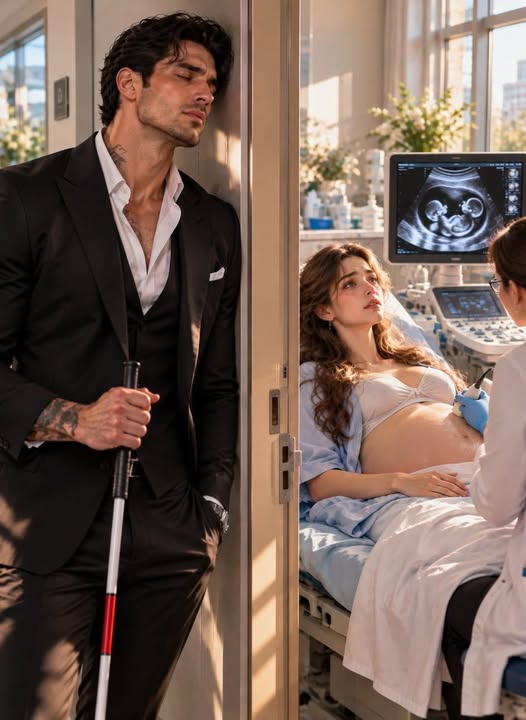
"Not here," Emma said.
Her hand closed around my sleeve — not my arm, my sleeve, the way you take hold of something you are afraid of breaking or being broken by — and she led me down the corridor. I let her. The most powerful man in the Romano family let a woman eleven weeks gone lead him by the sleeve like a child, past the nurses' station — I heard the small, startled hush as we passed — and into what she told me was a small consultation room. The door closed. The air smelled of antiseptic and the faint, warm dust of a room the sun reached.
"The baby is yours," she said, before I could speak. "That's not the secret, Luca. I need you to hear that first, because everything else is going to sound like a lie, and that part is the truth. The baby is yours."
Some knot in my chest loosened — and instantly another tightened in its place. "Then why—"
"Three days before I left, I got my answer from a home test in our bathroom. Two lines. I stood there holding it, and I cried, and then I laughed, because we'd talked about it for two years like it was weather — someday, someday. I was going to tell you that Friday. I had it all planned. The dinner at Aurelio's. The stupid little box I bought to put the test in." Her voice frayed. "That afternoon a courier came to my studio. No name, no return mark. An envelope with a drive inside it, and a printed card. Six words on the card: *Ask him about the succession.*"
"The succession," I repeated. I could feel the room tilt, very slightly, on its axis.
"I told myself it was a threat, or a joke, or one of your enemies trying to rot the house from inside. I told myself to bring it to you." A breath. "And then I listened to it, Luca. I listened to it eleven times."
She took out her phone. I heard the small sounds of her thumb on glass, and then — my voice. My own voice, out of a telephone speaker, flattened and intimate and utterly unmistakable:
*Emma is a liability. If a child comes, it changes nothing. End the arrangement before it complicates the succession.*
The recording ended. The room was very quiet. Somewhere beyond the door a cart went past, wheel squeaking, ordinary as sin.
"Play it again," I said.
She did. *Emma is a liability. If a child comes, it changes nothing. End the arrangement before it complicates the succession.*
Every word of it was mine. The vowels were mine, the cadence was mine, the particular way I clip the end of a sentence when I am done permitting discussion — mine, mine, mine, assembled into sentences I had never spoken, in service of a cruelty I had never thought. I stood in that little room with my dead eyes open and listened to myself order the destruction of my own family, and I understood, with a coldness that went all the way down, that someone had built this thing the way you build a bomb: patiently, and with access.
"Emma." I had to clear my throat. "I have never said those words. Not in that order, not in any order, not about you, not about any child. If you believe one thing I have ever said in your life, believe that I did not know about this baby until eleven minutes ago, standing in a corridor, and that the man on that recording is a puppet made out of my voice by someone who wants us destroyed."
"You think I don't know how it sounds?" she said, and now she was crying in earnest, the words coming apart in her hands. "It's your voice, Luca. I slept beside that voice for four years. I would know it in hell. And they knew about the baby — *if a child comes* — three days, Luca, three days after I found out, before I'd told a soul on this earth, someone knew, and they sent me your voice telling me to end it. What was I supposed to do? Come down to dinner and ask you? If it was true, I'd have been asking the man who ordered it. If I ran, and it was a lie, at least the baby lived. A mother—" She stopped. "I chose the baby. I would choose the baby again. That's what you need to know."
The terrible thing was that I understood her. That was the wound under the wound: in her place, with my child inside her and my voice on that drive, I would have run too. I would have burned the city down behind me to put distance between that voice and my baby.
"Who else knew?" I asked. "About the pregnancy. Think, Emma. Three days. You took a test at home. Who—"
"No one. No one, that's what has kept me awake for nine weeks. I bought the test with cash at a pharmacy in Queens so it wouldn't touch our accounts. I told no one. Not my sister, not Rosa, not God." Her footsteps paced, three steps and back, three steps and back — the room was small. "Unless they were watching the house. Unless someone inside—"
"Stop." I said it gently. I reached out — carefully, the way you move around a bird with a broken wing — and found her hand in the air between us, and she let me hold it. Her pulse was hammering. "Listen to me. Somewhere there is a seam in that recording. There has to be. Voices can be cut, Emma, like film. Men in my world have done worse with less. Give me the drive — give me the chance to find the seam before you decide what I am."
"And if there is no seam?"
"Then you'll have lost nothing. You'll be exactly where you are now, except you'll know." I turned her hand over in mine and laid my palm against the back of it, and I felt her wedding ring — she still wore her ring. Nine weeks gone and she still wore her ring, and the discovery went through me like light through a crack. "You kept the ring," I said, before I could stop myself.
"So did you." Her thumb brushed the band on my finger. "Don't make it mean more than habit, Luca."
"Habit." I almost laughed. "Emma, I don't have habits. I have rituals and I have wars. You're the only habit I ever kept."
She withdrew her hand, slowly, and I let her, because letting her was the whole of my penance and we both knew it.
Before we negotiated, she told me where she had been. Not the address — the shape of it. I think she needed one person on the earth to know what the nine weeks had cost, and I was, by bitter default, the only candidate.
She had rented a room in Astoria under her maiden name, Sullivan, from a widow who asked no questions of women who paid three months in cash and cried quietly. She had money of her own — the proceeds of two paintings she had restored before we met, sitting in an account I had insisted she keep separate in the early days, when I still believed my world might one day require her to run from it. The irony of that prudence was not lost on either of us; I heard her smile when she said it, the tired kind. She worked at a table by the widow's window, restoring a Flemish landscape for a dealer who paid in envelopes, scraping varnish with a scalpel for six hours a day to keep her hands too busy for terror. She ate what the nausea allowed, which at first was little and then, traitorously, everything. She kept the ultrasound appointments at this clinic because Dr. Marsh had been recommended by a college friend who did not know the whole story and had been told none of it. She had a bag packed by the door for nine weeks. She had three routes out of the building rehearsed. She had my number half-dialed a hundred times — a hundred times, Luca, she said, in elevators, at three in the morning, in the pharmacy line with the vitamins in her hand — and a hundred times she had heard my voice on that drive instead, and put the phone away, and chosen the baby over the truth.
"I hated you at night," she said, matter-of-factly, the way you report weather you have survived. "In the day I mostly hated myself. At night it was you. It made it easier. Hating you was a kind of company."
"And now?" I asked.
"Now you've been standing in a hospital corridor for twenty minutes working out how to ask me questions without touching me," she said, "and it's ruining my system."
I laughed — a short, startled sound that hurt coming up — and after a second she laughed too, and for one moment the consultation room held nothing but two people laughing in the ruins, and it was the best sound my ears had been given in nine weeks. It was not forgiveness. It was the ground forgiveness might one day stand on, cleared of rubble, waiting.
In the end, this is what we agreed, standing in a consultation room that smelled of antiseptic, with our child's heartbeat still ringing in my ears: she would not come home. Not yet, not on my word alone. But she would let Marco drive her back to where she was staying — "a room in Astoria, don't ask me to say the address out loud in a clinic, I'm not a fool" — and she would accept one man outside the building, one, whose name she would be given, and she would keep her phone on, and when the analysis of the recording was done, whatever it said, she would sit in a room with me and hear it. It was not trust. It was the shape trust leaves when it leaves a room. I took it like a starving man takes bread.
In the car, Marco driving, Emma beside me in the back in a silence that was almost companionable, she said, very quietly, "Why didn't you look for me? Eleven words and the Don obeys? No one who knows you believes that."
"I looked for you every night," I said. "I stood in the drawing room and listened to the whole house, the way a man listens to weather. Rosa thinks I don't know she cried in the pantry the first week. Your sister called the house twice — I know because the calls stopped when I picked up, both times, because she heard my voice and hated me too much to speak. I could have found you, Emma. I have found men in cities that don't appear on maps. But you'd written *not this time, I mean it*, and you have never in your life said a thing you didn't mean. If I had dragged you home by force, I would have had your body in my house and lost you forever. I chose the only version of the future where you might come back on your own feet." I turned my face toward her voice. "Today you did. One corridor's worth. I'll take it."
She said nothing. But when the car turned onto the expressway, I heard her crying, very quietly, into her hands — and she did not move away when my shoulder brushed hers and stayed there.
Marco dropped her at a corner in Astoria, the way she'd asked — a block from her door, no escort to the step, the guard, a man named Salvo, already in place across the street with a coffee and a newspaper like a piece of street furniture. I sat in the car a long time after she got out, listening to her footsteps go away from me, softer and softer, until the street swallowed them.
"Home, boss?" Marco said.
"Home," I said. "And Marco. Wake Gus Ferro. Tell him the thing he's been waiting six years to be needed for has arrived. And then pull the archive access logs for my office recordings — all of them, back ninety days. Nobody knows. *Nobody*, Marco. Not the council, not the staff."
"Not Dante?" Marco asked, in the neutral tone he uses for landmines.
I listened to the city move around the car — horns, a siren far off, the whole loud living beast of New York — and I thought about the little printed card. *Ask him about the succession.* Whoever made the recording knew my family's pressure points. Knew about the baby before the mother had told a living soul. Knew my voice well enough to carve it.
"Especially not Dante," I said. "Until I know why that hurts to say."