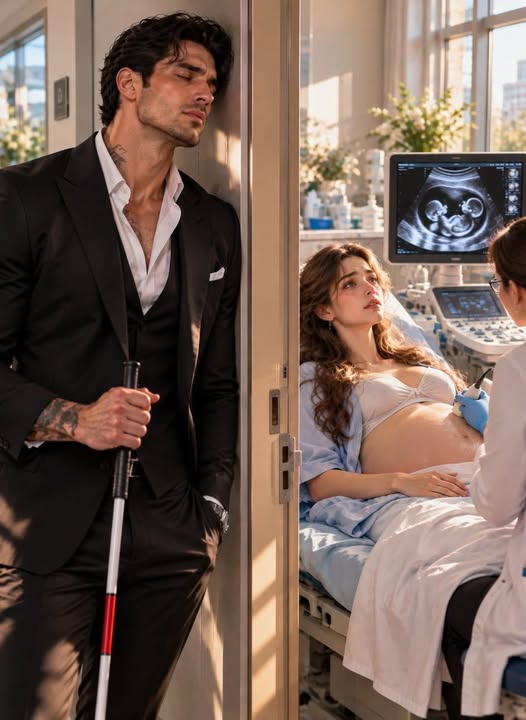
For nine weeks, my house had been a tomb that served dinner.
I knew it by sound, the way I know everything now. I knew the exact hush that fell over the entrance hall when I came down the stairs in the morning, the staff drawing their breath in like congregants in a church. I knew Rosa's footsteps — soft, brisk, a heel that clicked slightly on the marble because she favored her left knee — and I knew the pause she made outside my study door, tray in hand, deciding whether the boss wanted coffee or wanted to be left alone with his ghosts. I knew the tick of the long-case clock in the library, the sigh of the radiators, the muffled thud of the front door when the evening papers came in. I knew the sound of a full house doing its best to be quiet around a man who had too much quiet already.
What I did not hear, in nine weeks, was the piano.
Emma used to play in the mornings, before the house was properly awake — Chopin on the good days, and on the bad ones whatever her hands found first. She played the way she argued: precisely, and with more feeling than she would ever admit to out loud. After she left, the piano stood in the drawing room with its lid down and its keys gathering dust, and I forbade anyone to open it. Some nights I stood in the doorway of that room and listened to the shape of its silence, and I hated myself for it, because a man like me is not supposed to stand in doorways like a dog waiting for a whistle.
My name is Luca Romano. In New York's criminal underworld, men feared me enough to lower their voices when I entered a room — a habit I could hear, every time, the conversation thinning out like water finding a crack. I ran an empire my father built, in a city that eats the weak and invoices the strong. None of that power could bring Emma home. None of it could tell me why she had gone. And I had refused — refused, with a discipline that cost me more than any war I ever fought — to send my men after the woman who had chosen to leave me. She had left a note. Eleven words, in her own hand, left on my desk where Rosa found it and read it to me in a voice that shook: *Don't look for me, Luca. Not this time. I mean it.*
So I didn't. Every night I lay beside an untouched pillow and listened for footsteps that never came, and every morning I got up and was the Don, and counted the cost in a currency nobody could audit.
Blindness had taught me to recognize people by their footsteps, their breathing, the smallest changes in their voices. It had been six years since the world went dark for me — six years since an explosion I still hear in my sleep took my sight. I had rebuilt my life out of sound and memory and other men's fear. I could tell a liar by the half-second his breath snagged before he answered. I could tell which of my men had been drinking by the drag of a shoe. I could hear a room the way other men see one.
But I could not hear Emma, because Emma was gone.
That afternoon I had an appointment of my own, at a private medical clinic on the Upper East Side where my physicians have examined me, quarterly, for six years, and told me, quarterly, in kinder and kinder language, that nothing has changed. Dr. Park was gentle about it. The nerves were what they were. Medicine advances, Mr. Romano. We remain hopeful, Mr. Romano. I thanked him the way I thank everyone who lies to me professionally — politely, and without believing a syllable.
Marco waited by the elevators, as he always did, leaving me the dignity of walking the corridor alone. I prefer it. A white cane in a man's fist marks him, in other men's eyes, as diminished; I have spent six years teaching this city that the cane is the least dangerous thing about me. My cane tapped against the polished marble floor — tap, tap, the small bright sound bouncing off walls I remembered from a sighted life — and I was counting my steps to the elevator bank when a voice stopped my heart.
"Are the measurements where they should be?"
It came through a partially open examination-room door, on my left. A woman's voice, low, and trembling beneath an attempt at calm.
My entire body went rigid.
I know voices the way jewelers know stones. I had heard that voice laugh in my kitchen at midnight, whisper against my shoulder, read me the Sunday papers in the years when reading my own mail was a fresh wound. I had heard it say my name in anger and in tenderness and in the dark.
Emma.
"Everything we're seeing looks appropriate for approximately twelve weeks," a second voice replied — a woman doctor, gentle, practiced. "The baby's heartbeat sounds strong. Would you like to hear it again?"
I should have walked on. I want it understood that I understood that. The door was not mine. The room was not mine. The woman inside it had written me eleven words and vanished out of my life, and every code I lived by said a man does not press his ear to the doors of people who have left him.
I stopped walking anyway.
Then I heard it.
A heartbeat — tiny, rapid, impossibly fast and steady, galloping out of the little speaker like something running toward me through the dark. It filled the corridor. It filled my chest. Something inside me, some load-bearing wall I had been maintaining for nine weeks at enormous expense, cracked clean through.
Twelve weeks, the doctor had said.
Twelve weeks.
Emma had left nine weeks earlier.
I did the arithmetic the way men in my trade do casualty counts — again, and then again, desperate to have misunderstood. Three weeks before she packed a bag and wrote me eleven words, she had conceived our child. While I ate dinner alone in a silent house, while I slept beside an untouched pillow and wondered whether she ever missed me, our baby had been growing inside her. Every lonely night, every unanswered question, every hour I had spent honoring her note and not sending my men into the city to drag her home — all of it suddenly carried a different kind of pain. She had not left me empty-handed. She had left me a father, and taken the knowledge of it with her.
I took two steps toward the examination-room door before I stopped myself.
For all the authority my name commanded, I could not cross that doorway without her permission. I had one rule left that I had not broken in nine weeks, and I was not going to break it in a hospital corridor with a cane in my hand and my heart slamming against my ribs. So I stood there, in the middle of the marble corridor, and I waited — the most feared man in three boroughs, waiting outside a door like a schoolboy, while my child's heartbeat faded behind it and the doctor's voice murmured on.
Minutes passed. A cart rattled somewhere. The elevator chimed, far away, and Marco did not come — he would have heard nothing, seen nothing, and Marco knows when a closed hand means stay back; my whole posture must have been screaming it.
I thought, standing there, of the morning she left — the last morning of the old world, though neither of us knew its name yet.
I had been at the docks before dawn, settling a dispute between two of my captains in the way such disputes get settled, with voices kept low and consequences kept lower. I came home at nine to a house performing normality a half-second too slowly, the way an orchestra performs when the conductor's baton has slipped. Rosa met me in the hall with my coffee and did not say *good morning*, and in six years she has never once forgotten to say good morning. I heard her breathing — too careful — and I heard the paper in her hand before she told me about it.
*There's a note, Luca. On your desk. In her hand.*
Eleven words. Rosa read them twice, because I asked her to, and then she stood in my study doorway holding the tray and crying in the disciplined silence of a woman who has served a family through three wars and two funerals, and I sat behind my father's desk and did the arithmetic of blame the way men like me do everything: by inventory. Had I raised my voice that week? No. Had I been cruel? Not in any way I could find, and I searched like a prosecutor. We had eaten dinner the night before at the small table in the kitchen, the way we did when the house felt too large, and she had laughed at something — I can still hear it — and her foot had found my ankle under the table and stayed there, warm through my sock, while we talked about nothing. A woman does not do that on the eve of an execution. Unless she is saying goodbye in the only language she trusts not to betray her.
By noon I had men in three boroughs standing by for a word I refused to give. By nightfall I had read the note so many times in Rosa's voice that the words had worn smooth, and I understood that searching for her would be the first selfish act of our marriage — the one where I put my terror above her stated will — and that I would not do it. Marco argued, once, in this same study, with the door closed. *Boss. People talk. A don's wife doesn't walk out into the weather. Let me just confirm she's alive.* I told him if he sent so much as a shadow after her, I would know by the sound of his conscience before the man reached the corner. He never raised it again. That is the kind of loyalty money cannot buy and fear cannot counterfeit, and I have never forgotten it.
Nine weeks. Sixty-three nights of counting the house's sounds like a miser counting coins that buy nothing.
And now the examination-room door in front of me was doing the small, final sounds of an appointment ending — the doctor's chair rolling back, water running in a little sink, the snap of a chart closing, and underneath it all, her voice, low, asking one more question, something about *folic* and *again in four weeks* — an ordinary sentence in an ordinary room, the sound of a future being quietly maintained by a woman who believed she was maintaining it alone.
Then, footsteps. Hers. I would know them in a crowd of ten thousand: a short stride, the right foot landing a fraction softer than the left, a rhythm I had listened to across six years of mornings. They came toward the door, unhurried — and stopped, abruptly, on the threshold.
The sharp breath she drew told me she had seen me.
"Emma," I said.
"Luca." A whisper. Barely a word at all.
I had imagined our reunion hundreds of times in nine weeks. Sometimes it ended in anger — my anger, rehearsed and magnificent. Sometimes it ended with her crying in my arms, in the version I permitted myself only after midnight. Never once had I imagined standing outside a doctor's office with my cane in both hands, discovering I was about to become a father.
"Twelve weeks?" I asked, and barely recognized my own voice.
Silence stretched between us, full of everything.
"I heard the doctor," I said.
"I know." Her voice did something complicated. "I heard the cane."
My fingers tightened around the cane until they ached. "Were you ever going to tell me?"
Emma inhaled slowly, and for a moment I thought she might cry — I know the sound of Emma gathering tears; it is one of the sounds I have catalogued most carefully in this world. Instead her footsteps moved closer, brisk suddenly, a woman deciding to walk past her past. Instinctively I shifted toward her — and then forced myself aside, cane and all, making a road of the corridor, unwilling to become one more reason she wanted to run.
But she didn't leave.
She stopped right beside me, close enough that I caught the familiar scent of her perfume — the same one, she had not even changed her perfume — and close enough that I could hear her breathing, fast and shallow, a woman standing at the edge of something.
"Emma," I whispered, and my voice broke on her name like a wave on a rock. "Is that baby mine?"
For several agonizing seconds, she said nothing. The corridor hummed with fluorescent light. Somewhere a phone rang twice and stopped.
Then I heard her trembling breath, followed by words that made my blood run cold.
"Luca… there's something you need to know."