Six years before the gala, on a cold night in November, Dante Moretti almost died outside the Astoria subway station in Queens.
He was twenty-eight years old then, and he had been head of the Moretti family for three years, since his father Salvatore had died of a heart attack in his office on Mulberry Street, and he was still learning what it meant to be the most feared man in New York. He had spent that evening at a sit-down with the Romano family, arguing about the docks, and he had left the meeting alone — no guards, no driver, just him and the cold night air — because he liked to walk sometimes, because walking helped him think, and because he had not yet learned that a man in his position is never really alone, even when he thinks he is.
He was standing on the platform at Astoria, waiting for the train, his hands in the pockets of his coat, watching the lights on the tracks, when he felt a hand on his back.
Not a push. Not yet. Just a hand, flat between his shoulder blades, pressing, testing, waiting for the right moment.
Dante turned. There was a man behind him — a man he had never seen before, with a hard face and tired eyes and a coat that was too thin for November. The man said nothing. He just looked at Dante, and Dante understood in that instant, the way you understand things when your life is about to end, that this man had been paid to kill him, and that the train was coming, and that the hand on his back was about to shove him onto the tracks.
Then another hand caught his arm.
It was a subway maintenance man in a navy uniform, a man in his late fifties with grease under his fingernails and a thermos in his pocket and tired, kind eyes. The man had been sweeping the far end of the platform, and he had seen what was happening, and he had crossed the platform in three long strides and grabbed Dante's arm and pulled him back from the edge, hard, so hard that Dante stumbled and fell against the wall, and the maintenance man stepped between him and the killer and said, in a voice that was steady and unafraid, "Not here. Not on my platform."
The killer hesitated. The train roared into the station, lights blazing, brakes screaming. And in the noise and the light and the rush of people getting on and off, the killer turned and walked away, down the platform, into the crowd, and he was gone.
Dante sat on a bench with his heart hammering in his chest, and the maintenance man sat down beside him, and neither of them spoke for a long time. Finally the maintenance man said, "You all right, son?"
"Yes," Dante said. "Thank you."
"Don't thank me," the maintenance man said. "A man fell. I pulled him back. That's all."
"What's your name?" Dante asked.
The man smiled, a small, tired smile. "Thomas," he said. "Thomas — just Thomas. Now go home, son. And next time, don't stand so close to the edge."
Dante went home that night, and he told no one what had happened — not his underboss, not his consigliere, not his mother. He kept it to himself, the way he kept everything that mattered to himself, and he sent his men to find the maintenance man, quietly, without a name and without a photograph, just a description: a subway worker in his late fifties, navy uniform, grease under his fingernails, a thermos in his pocket, working the Astoria station on a cold night in November.
They never found him. The transit authority had thousands of employees. The night-shift rosters were a mess. The man had given no last name and no address, and Dante had been too shaken to ask for one, and so the man who saved his life became a ghost — a nameless stranger with kind eyes and a navy uniform, a debt Dante Moretti could never repay, a question he carried with him for six years.
He thought about that man more than he would ever admit. He thought about him when he stood at the edge of other platforms. He thought about him when he made decisions about who lived and who died, because Thomas had looked at him — a mafia boss, a killer, a man the whole city feared — and had seen only a man about to fall, and had pulled him back without asking who he was or what he was worth.
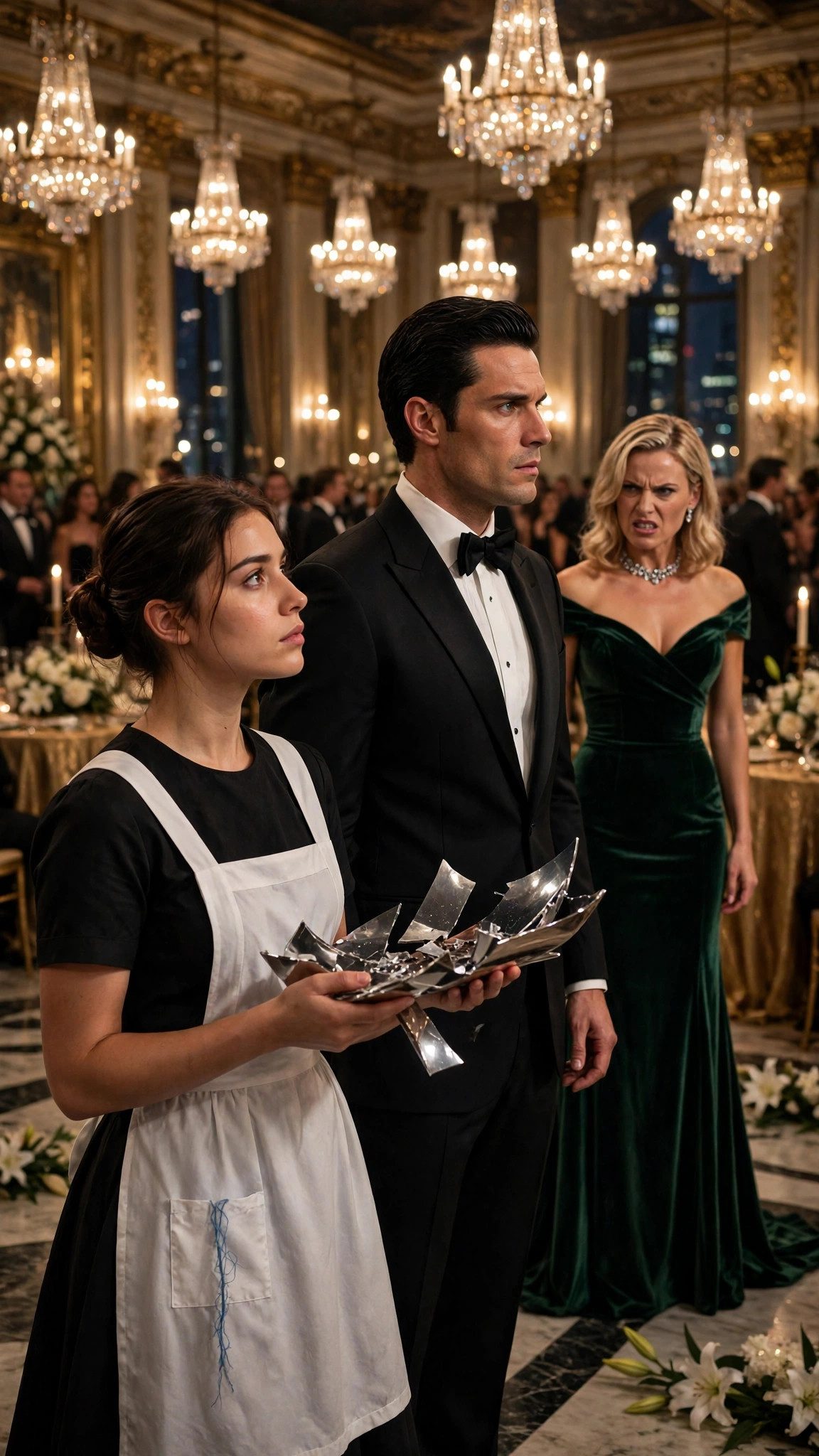
And then, six years later, at his own engagement party, in a ballroom full of chandeliers, Dante Moretti looked down at a maid in a black uniform with a white apron, a plain girl with dark brown hair in a low bun and warm brown eyes, and he saw something that stopped his heart.
A frayed blue thread.
It was sewn into the inside pocket of her apron, just barely visible where the lining had pulled away from the seam — one short length of navy blue thread, the exact shade of a subway maintenance man's uniform, the exact shade he had seen six years ago on a cold platform in Astoria, on the cuff of the jacket of the man who saved his life.
Dante had spent six years looking for a ghost. And the ghost's daughter had just walked into his engagement party carrying a tray.
He didn't know it yet, standing there between Bianca and the maid, with three hundred people watching. He only knew that something about the girl felt familiar, that her face reminded him of someone, that her eyes were the same warm brown as the eyes of the man on the platform, and that when he asked her name and she said "Elena," something in his chest shifted, like a door opening in a house that had been locked for years.
After the gala — after the heel, after the glass, after the wedding was called off and Bianca had stormed out of the ballroom with her father and her diamonds and her fury — Dante stood alone in the empty ballroom with his underboss, Sal Greco, and stared at the broken glass on the head table and thought about Thomas.
"Find her," he said to Sal.
"Who, boss?" Sal asked. Sal was fifty-two years old, built like a wall, with a face that had seen everything and a loyalty to the Moretti family that went back thirty years, to the days when Dante's father was still alive. He had been there the night Dante came home shaking from Astoria. He was the only man alive who knew the whole story.
"The maid," Dante said. "Elena. The girl with the tray. Find out who she is. Where she lives. Who her people are. And do it quietly. No one else needs to know."
"Bianca's going to come after her," Sal said. He didn't ask why. Sal never asked why. "Vittorio too. You called off the wedding in front of three hundred people, boss. The Romanos are going to want blood."
"Let them want it," Dante said. "I just freed myself from a prison where I wasn't allowed to defend anything but a man's ego. I'm not going back in."
Sal nodded slowly. "Her father," he said. "The man on the platform. You think it's her."
"I don't think," Dante said. "I know. I saw the thread, Sal. The blue thread on her apron. It was his uniform. I'd know that shade anywhere. I've been dreaming about it for six years."
Sal was quiet for a long moment. Then he said, "Six years, boss. You've been looking for that man for six years. And now his daughter walks into your engagement party and Bianca Romano tries to kick her like a dog." He shook his head. "There's something in that. Something the old women in my neighborhood would call fate."
"I don't believe in fate," Dante said.
"No," Sal said. "But fate believes in you."
Dante went home that night to his penthouse on the Upper East Side, and he stood at the window looking out over the city, and he thought about Thomas, and about Elena, and about Bianca, and about the wedding that had been a business transaction with a much higher price tag than anyone had told him.
He had known, of course. He had always known. The engagement to Bianca Romano had been arranged by the council — by old men in dark rooms who cared about docks and shipping routes and the balance of power between two families — and Dante had agreed to it because it was his duty, because his father had taught him that a boss puts the family first, because he had believed, for a long time, that his own happiness was a price he had to pay for the empire his father had left him.
But standing in that ballroom, watching Bianca grind her heel into a broken tray while a girl half her size stood shaking in front of her, Dante had understood something he should have understood years ago: the price was too high. The wedding wasn't an alliance. It was a takeover. Vittorio Romano wasn't giving him a daughter. He was buying a son-in-law, and the price was Dante's soul.
And Elena — plain, shaking, brave Elena, who had stood in front of three hundred people and refused to lie about what she saw in a hallway — Elena was the first honest thing Dante Moretti had seen in years.
He thought about her father again, about the hand that had pulled him back from the edge of the platform, about the voice that had said, "Not here. Not on my platform."
Thomas had saved his life. And now, six years later, Dante was going to save Thomas's daughter.
He just didn't know yet how much it was going to cost him.
Dante did not give up looking for Thomas. Not in the first year, when the trail was still warm, and not in the sixth year, when everyone else had forgotten the night ever happened.
He went back to Astoria station twice a year, every year, on the same cold night in November, and he stood on the same platform, and he watched the trains come and go, and he asked the same questions of whoever was working the night shift. He showed them a description, written in his own hand: a maintenance man in his late fifties, navy uniform, grease under his fingernails, a thermos in his pocket, kind eyes, a steady voice.
Most of them shook their heads. A few of them thought they remembered someone — "There was a Thomas, I think, on the night crew, but he retired years ago" — but no one had a last name, and no one had an address, and the transit authority's night-shift rosters from six years ago had been lost in a flood in a basement archive in Brooklyn, and the paper trail was gone, washed away, as if the whole night had never happened.
Once, in the third year, Dante found the station master — an old man named O'Brien, with white hair and a limp, who had worked Astoria for forty years and remembered everything.
"Thomas," O'Brien said, nodding slowly, his eyes going far away. "Yes. Thomas the maintenance man. Good man. Quiet man. He worked the night shift for thirty years, and he never missed a day, and he never complained, not once. He retired — oh, it must be four years ago now, maybe five. Heart trouble, they said. He moved out to Queens with his wife, Rosa. A seamstress, I think."
"Do you have an address?" Dante asked, and his heart was beating so hard he was sure the old man could hear it.
O'Brien shook his head. "I'm sorry, son. I don't. The transit authority doesn't keep addresses for retired men. And Thomas — he was a private man. He didn't leave a forwarding address. He just went home, and that was that."
Dante thanked him, and he left the station, and he stood outside in the cold November air, looking up at the elevated tracks, and he thought about how close he had come — a first name, a wife's name, a neighborhood — and how far away it still was. Queens was a big place. There were a thousand Rosas in Queens. A thousand Thomases. And the man he was looking for was retired, and tired, and private, and he had no reason to want to be found by the most feared mafia boss in New York.
So Dante stopped going to the station. Not because he had given up, but because he had learned something: some debts cannot be repaid by finding the man. Some debts can only be repaid by living the way the man lived — by pulling people back from the edge, by stepping between the strong and the weak, by saying, "Not here. Not on my platform."
He tried. God knows, he tried. But the world he lived in — the world of councils and docks and shipping routes and arranged marriages — did not make it easy to be the man Thomas had been for one night on a platform in Astoria. The world wanted him to be hard. The world wanted him to be feared. The world wanted him to marry Bianca Romano and hand the Romano family the keys to his empire and smile while he did it.
His mother, Caterina Moretti, was the only person who ever told him the truth about it. She was seventy years old, with silver hair and a spine like steel, and she had been married to Salvatore Moretti for forty years, and she had watched her husband trade his happiness for the family, year after year, until there was nothing left of him but the empire.
"Your father made one loveless marriage for the family, Dante," she told him, two weeks before the engagement party, sitting in her garden with a cup of tea going cold in her hands. "Don't make it two. A man can survive many things. He cannot survive waking up every morning next to a woman he does not love, in a life he did not choose. I watched your father do it for forty years. It killed him slowly, like a disease. Don't let it kill you."
"I don't have a choice, Mama," Dante said.
"You always have a choice," she said. "That is the one thing your father never understood. He thought duty meant obedience. It doesn't. Duty means doing what is right, even when it costs you. And marrying a woman you do not love, to please men who do not love you, is not right. It is surrender."
Dante thought about his mother's words for two weeks. He thought about them in his office, and in his car, and at night, standing at the window of his penthouse, looking out over the city. And on the night of the engagement party, standing in a ballroom full of chandeliers, watching Bianca Romano grind her heel into a broken tray while a plain girl in a black uniform stood shaking in front of her, he finally understood what his mother had been trying to tell him.
He had a choice. And he made it.