The next morning, the story was not about a photograph anymore.
It was about me.
A gossip website ran a piece with the headline: "WAITRESS ENDANGERS BABY AT MAFIA BOSS'S RESTAURANT." It said that I had brought my infant daughter to work every night for months, that I had left her alone behind the hostess stand while I served drinks, that I had let the owner of the restaurant — a man with a reputation for violence — hold her unsupervised in a basement office. It quoted an anonymous source, a senior member of staff, who said I was "unfit" and "reckless" and "only interested in the boss's money."
I read it on my phone, sitting on the edge of my bed, with Ellie asleep beside me, and my hands shook so badly I could barely hold the phone. Mrs. Alvarez came in with a tray of tea, and she took one look at my face, and she sat down beside me, and she said, "Do not read it again. It is poison. It is written by a man who has never held a baby in his life."
By noon, a health inspector arrived. He was a thin man with a clipboard and a tired face, and he walked through the restaurant with Grant at his elbow, pointing at things, nodding, writing notes. Grant showed him the alcove behind the hostess stand. He showed him the basement stairs. He showed him the office. He told him, in a low voice that carried just far enough for me to hear, that I had "a history of poor judgment," that I had "brought the child to work against policy," that Mr. Vale had "covered for her because of their relationship."
I stood in the dining room with a tray in my hands, and I listened to a man I had worked beside for three months describe me to a stranger like I was a criminal, and I felt the floor tilt under my feet.
That afternoon, Russo came in person. Anthony Russo was a man in his sixties, silver-haired, with a smile that never reached his eyes, and he sat down at the best table in the dining room, and he ordered the most expensive wine on the menu, and he asked to speak to Mr. Vale. He did not ask. He demanded.
I was serving the next table when I heard his voice, low and pleased, carrying across the room. "Damian. We need to talk about the lease. The landlord is concerned. The landlord has seen the newspapers. A restaurant is no place for a baby, Damian. Everyone knows that. And a man with your reputation, holding a baby — well. People talk."
Mr. Vale did not raise his voice. He never raised his voice. He just looked at Russo, and he said, "Say what you came to say, Anthony. Then leave."
"What I came to say is this," Russo said, and he leaned forward, and he smiled. "Sell me the building. Sell it now, while you still can, before the health department closes you down, before the landlord evicts you, before the newspapers finish what they started. I will give you a fair price. I am a fair man."
"No," Mr. Vale said.
Russo's smile widened. "Then I will take it another way. I have a witness, Damian. A senior member of your staff, who will testify that you have been using this restaurant to conduct an affair with a waitress, and that you have endangered her child, and that you have covered it up. I have a reporter who will print it. I have a lawyer who will file it. You have forty-eight hours."
He stood up. He left a hundred-dollar bill on the table, for a glass of wine he had not finished. He walked out of the dining room, and the whole room watched him go, and nobody said a word.
After Russo left, Grant found me in the kitchen. He was holding his clipboard, and he was smiling, and behind him, Marco the line cook was watching us over the steam, with his tongs in his hand, and his face set like a man deciding whether to step into a fight.
"Well, Lena," Grant said. "Forty-eight hours. That's all he has. And when Russo takes this place, do you know what happens to you? You go back to being nobody. No apartment. No nurse. No contract. Just a waitress with a baby and a bad reputation."
I put down the tray I was holding. I looked at him — really looked at him, for the first time, not as my manager, not as a man with power over me, but as what he was: a small, bitter man who had spent nine years making other people feel small, because it was the only way he knew how to feel big.
"Grant," I said, and my voice was steady, "how much did Russo pay you?"
His smile froze. "What did you say?"
"How much?" I asked. "To lie to a health inspector. To call me unfit. To tell a reporter that Mr. Vale and I were having an affair. How much was it worth to you? Was it worth your job? Because when Mr. Vale finds out — and he will find out, Grant, because men like Russo always leave a trail — you will not have a job here anymore. You will not have a job anywhere in this city. Everyone will know what you did."
Grant's face went white, and then red, and he took a step toward me, and Marco put down his tongs, and he stepped between us, and he said, very quietly, "Grant. Walk away. Now."
Grant looked at Marco. He looked at me. He looked at the other cooks, who had all stopped working, and who were all watching him now, and he seemed to understand, all at once, that the room had changed. He turned around, and he walked out of the kitchen, and nobody said a word until the door had swung shut behind him.
Marco turned to me. He was a big man, with flour on his apron and burns on his forearms from ten years at the line, and he said, "Lena. For what it's worth — we all know. We all know you are a good mother. We all know Grant is a liar. And we all know Mr. Vale would burn this city down before he let anyone hurt that baby. So don't you worry about Russo. You worry about Ellie. We will worry about the rest."
I stood there in the kitchen, with the steam rising around me, and the smell of garlic and lemon in the air, and I thought about the waiters, and the cooks, and Mrs. Alvarez, and Tony, and all the people in this restaurant who had watched me for three months, and who had decided, quietly, that I belonged here. And I thought about Grant, alone in his little kingdom, with his clipboard and his smile, and I understood something I had not understood before: that power is not about who can fire you. Power is about who stands beside you when someone tries.
That night, I went upstairs, and I held Ellie, and I told her about Marco, and about the kitchen, and about the way the cooks had all stopped working to watch Grant walk away. I told her that her father — and I used the word for the first time, out loud, in the dark nursery, to a baby who could not understand it — that her father was a man who had built a restaurant out of grief, and that he was trying, in his own clumsy way, to build a family out of it, too. And I told her that tomorrow, I was going to make him tell me the truth, all of it, no matter what it cost.
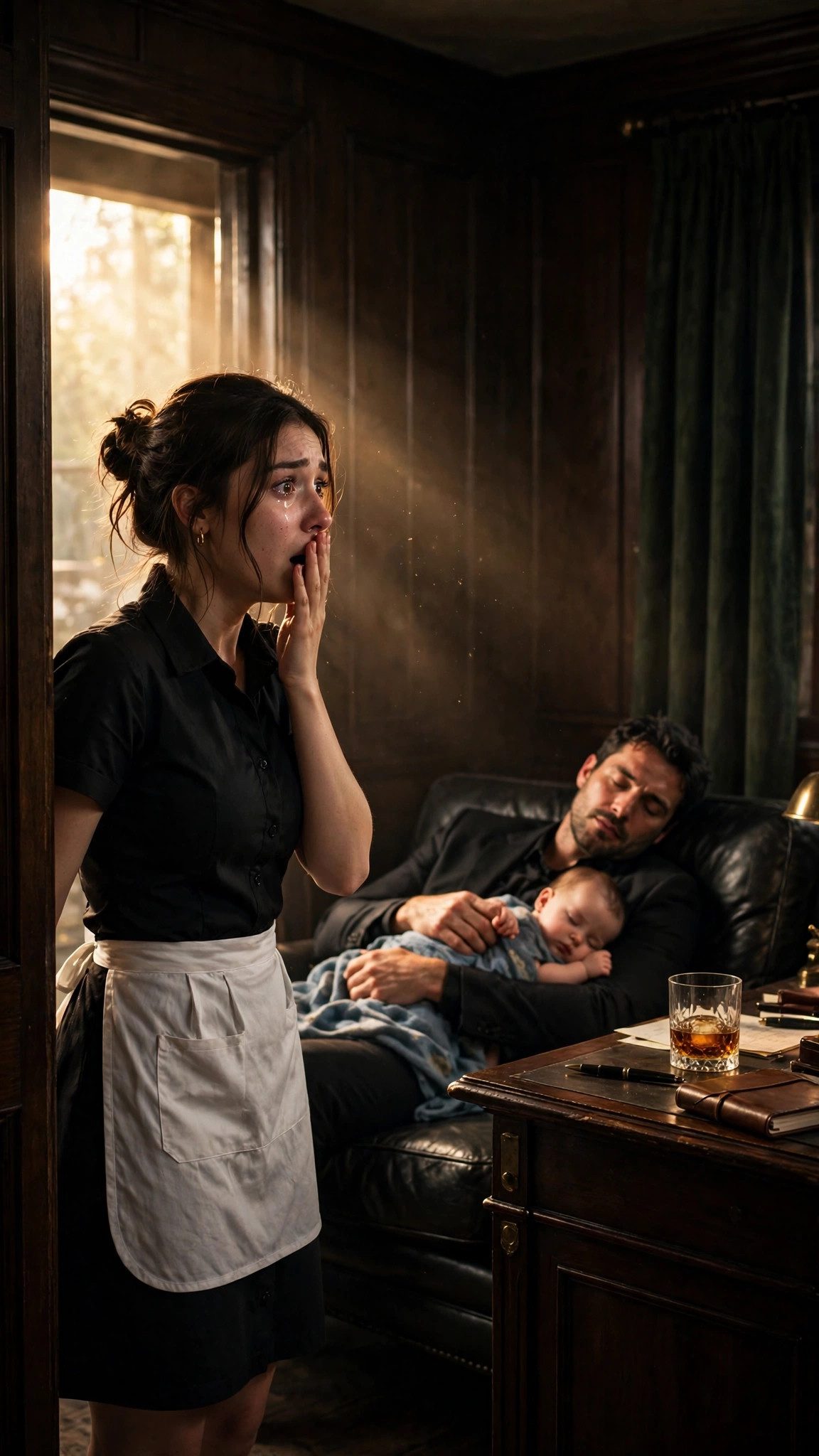
That night, after the last guest had gone, I went to Mr. Vale's office, and I did not knock. I walked in, and I closed the door behind me, and I stood in front of his desk, and I said, "Tell me the truth. All of it. Tonight. No more half answers. No more tomorrow."
He was sitting behind his desk, in the dark, with a glass of whiskey he had not touched. He looked up at me, and his face was gray with exhaustion, and for a moment, he looked like a man who had been carrying something too heavy for too long.
"Lena," he said. "Sit down."
"I don't want to sit down," I said. "I want you to tell me why Anthony Russo thinks he can take your restaurant. I want you to tell me why Grant is lying about me to a health inspector. I want you to tell me why you offered me a contract, and a nursery, and a nurse, and a year of safety, and asked for nothing in return. And I want you to tell me why my daughter has your eyes."
He was quiet for a long time. The clock on the wall ticked. Somewhere upstairs, Ellie made a small sound in her sleep, and Mrs. Alvarez's voice murmured, soft and low, and then it was quiet again.
"Thirteen months ago," he said, finally, "I met a woman on a terrace at the Plaza. She was carrying a tray of champagne. She was wearing a silver locket with a rose engraved on it. She told me her name was Lena, and she told me about a farming town, and a mother who had died, and a coffee tin on top of a refrigerator. I talked to her for an hour, and I had not talked to anyone like that in eleven years, since Sofia died. I kissed her in a hallway behind the kitchens. And then I left, because I did not know how to stay. I did not know her last name. I did not know where to find her. I told myself it was one night, and that one night did not mean anything, and that men like me do not get to keep things like that."
He stopped. He looked at his hands. "Three months ago, a waitress applied for a job at my restaurant. She was wearing the same locket. She had the same voice. She had the same way of smiling when she was nervous. And she had a baby in a carrier, with green eyes — my eyes — and I knew, Lena. I knew the moment I saw her. I knew she was mine. Ours."
My knees gave out. I sat down, hard, in the chair across from his desk, and I put my hands over my face, and I cried — not loud, not dramatic, just tears running down my face while I sat there, shaking, in the dark office of the most feared man in the city.
"Why didn't you tell me?" I whispered. "You knew for three months. You watched me. You offered me a contract. You built a nursery. You hummed lullabies in the hallway. Why didn't you just tell me?"
"Because I was afraid," he said, and his voice broke, just once, on the last word. "Because I knew what I was. A man who lives alone above a restaurant. A man people cross the street to avoid. A man whose name makes waiters go pale. What right did I have to walk up to you and say, 'I am the father of your child, and I have been watching you'? You would have run. You would have taken Ellie and run, and I would not have blamed you. So I did the only thing I knew how to do. I offered you safety. I offered you a contract. I told myself that if I kept you close, and I kept you safe, then someday, when the time was right, I would tell you. And then Ellie disappeared, and you found me asleep with her on my chest, and I knew the time had come, and I still could not say it."
He stood up. He came around the desk. He knelt down in front of my chair, so that his face was level with mine, and he took my hands in his, gently, like he was afraid I would pull away.
"Lena," he said. "There's something about Ellie. She is my daughter. She is our daughter. I have known since the first day. I have loved her since the first day. And I love you. I have loved you since a terrace at the Plaza, thirteen months ago, when you told me about a coffee tin on top of a refrigerator. I can't live without you. I tried. For eleven years, I lived without anyone, and I told myself that was enough, and it was not enough. It was never enough."
I looked at him. I looked at his green eyes, and his tired face, and his hands holding mine, and I thought about the gala, and the locket, and the green eyes, and the contract, and the nursery, and the wooden horse, and the humming in the hallway. And I thought about my mother, and the coffee tin, and the roof that leaked every spring, and the daughter asleep upstairs with silver stars turning above her crib.
"I want a test," I said. "A DNA test. Properly done. With papers. With Andrea present. I need to know, not just believe. Do you understand?"
"I understand," he said. "I will do whatever you ask. I will sign whatever you ask me to sign. I will wait as long as you ask me to wait. But Lena — please don't take her away from me. Please don't disappear. I have already lost one family. I cannot lose another."
I did not answer him. I went upstairs, and I picked up Ellie, and I held her against my chest, and I looked into her green eyes, and I whispered, "Did you know? Did you know all along who he was?"
She did not answer. She just looked at me, and she reached up with her tiny fist, and she touched the silver locket at my throat, and she smiled in her sleep.
And I thought about Grant, and Russo, and the health inspector, and the forty-eight hours, and I understood, finally, what the price of a secret was. It was not money. It was not a restaurant. It was this: three months of silence, and a photograph in a newspaper, and a man who had loved us from a distance because he did not know how to love us up close.
The next morning, I called Andrea. I told her everything. And Andrea, who had been a lawyer for twenty-eight years, and who had seen everything, was quiet for a long time, and then she said, "Lena. We will do the test. We will do it properly. And then we will deal with Grant, and with Russo, and with all of it. But first, you need to decide one thing. Do you love him?"
I looked out the window at the street below, where the reporters had been, and where Tony was now standing, watching the door, like a guard. I thought about the terrace, and the kiss, and the green eyes, and the man who had knelt in front of my chair and said he could not live without me.
"Yes," I said. "I think I do. I think I have since the terrace. I just didn't know his name."