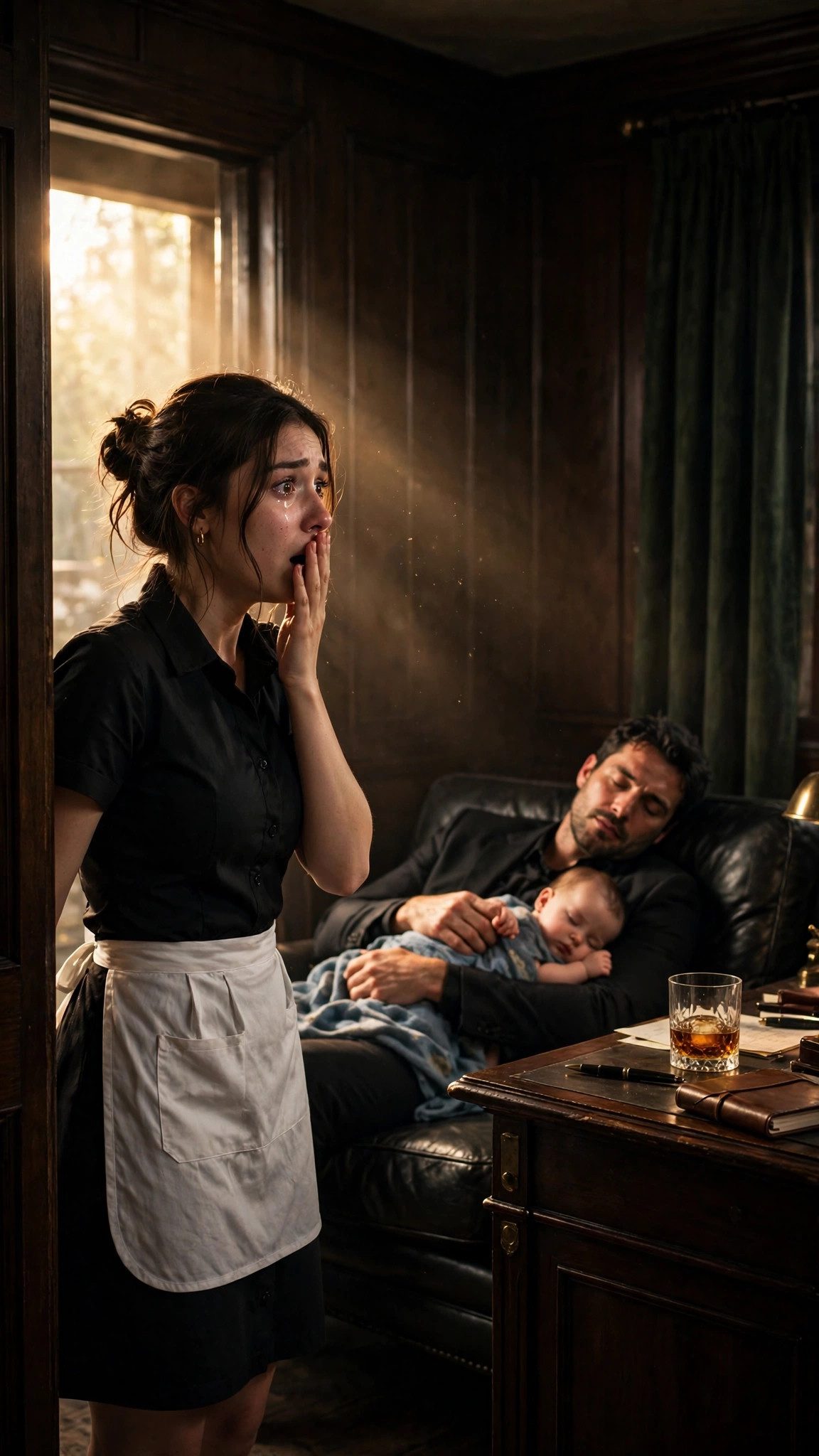
The test was done on a Wednesday, in a small clinic uptown, with Andrea sitting beside me and holding my hand.
The nurse was a kind woman with short gray hair and a voice like warm milk. She swabbed the inside of Ellie's cheek with a cotton stick, gently, while Ellie stared up at her with wide green eyes and did not cry at all. Then she swabbed Mr. Vale's cheek, and he sat very still, with his hands folded in his lap, and he did not look at me, and he did not look at the nurse, and he looked at Ellie the whole time, like she was the only thing in the room.
"That's it," the nurse said. "That's all we need. The results will be ready in five days. We will call you."
Five days. Five days of waiting, and wondering, and lying awake at night listening to Ellie breathe, and thinking about green eyes, and terraces, and lockets, and contracts, and all the things I had believed and all the things I had refused to believe.
Mr. Vale did not come upstairs during those five days. He did not knock on my door. He did not ask me to eat with him, or to sit with him, or to do anything at all. He stayed in his office, or in the dining room, and he worked, and he waited, and I could see the waiting in his face — in the lines around his eyes, in the way his hands shook, just slightly, when he picked up a glass.
Grant, meanwhile, was unraveling. He knew that Russo's forty-eight hours had come and gone, and that the restaurant was still standing, and that Mr. Vale had not sold the building. He knew that the health inspector had found nothing — the kitchen was spotless, the nursery was licensed, Mrs. Alvarez's credentials were impeccable, and the alcove behind the hostess stand had been cleaned out weeks ago, because Ellie had not slept there since the day we moved upstairs. He knew that his lies were falling apart, and he was desperate, and desperate men do desperate things.
On the fourth day, Tony caught him.
Tony had been watching the clinic. Not because Mr. Vale had asked him to — Mr. Vale had not asked him to do anything — but because Tony had worked for the family for twenty years, and he knew what desperate men did, and he knew where they did it. He saw Grant go into the clinic just after closing, carrying a manila envelope, and he saw him talk to the receptionist, and he saw him offer her money, and he saw her refuse, and he saw him try again, with more money, and he saw her pick up the phone to call security.
Tony walked in before security arrived. He took Grant by the arm, gently but firmly, and he walked him out of the clinic, and he drove him to the restaurant, and he brought him to Mr. Vale's office, and he stood him in front of the desk, and he said, "Tell him what you were doing."
Grant told him. He told him everything, because there was nothing left to lie about. He told him that Russo had paid him five thousand dollars to lie to the health inspector, and another five thousand to talk to the reporter, and that he had been promised a manager's job at Russo's restaurant across the street, once Russo owned the building. He told him that he had gone to the clinic to swap the test results — to replace the real envelope with a fake one that said Mr. Vale was not the father — because if the test said no, then Lena would leave, and the contract would be over, and everything would go back to the way it had been, when Grant was the most important man in the restaurant after Mr. Vale.
Mr. Vale listened to all of it without moving. His face did not change. His hands did not shake. When Grant had finished, Mr. Vale stood up, and he walked around his desk, and he stood in front of Grant, and he said, very quietly, "You are fired. You will leave this restaurant now, and you will never come back. If I ever see your name on a reference, if I ever hear that you have done this to another woman, in another restaurant, I will make sure everyone in this city knows what you are. Do you understand?"
Grant nodded. He could not speak. He turned around, and he walked out of the office, and out of the restaurant, and nobody watched him go, because nobody cared anymore.
The next day, the landlord came to the restaurant. He was an old man, eighty years old, with a cane and a hearing aid, and he had owned the building for fifty years. Russo had told him that Casa Vale was a scandal, that the health department was going to close it down, that the newspapers were going to destroy it. He had told him to sell.
Mr. Vale met him in the dining room, and he did not argue, and he did not shout. He showed him the health inspector's report — clean, not a single violation. He showed him Mrs. Alvarez's license, and the nursery's license, and the contract, and the letter from Andrea. He showed him the photograph from the newspaper, and he said, "This is my daughter. Her name is Ellie. She is eight months old. She has my eyes. And this is her mother, Lena, who works in my restaurant, and who is the best waitress I have ever employed. If you want to evict us, you may. But you should know what you are evicting."
The old man looked at the photograph for a long time. Then he looked at me, standing by the bar with Ellie in my arms, and he looked at Mr. Vale, standing beside me, and he said, "I have owned this building for fifty years, Mr. Vale. I have seen restaurants come and go. I have seen owners who cared about money, and owners who cared about food, and owners who cared about nothing at all. I have never seen an owner who cared about a baby. Keep your lease. And tell Russo, from me, that if he ever sets foot in my building again, I will have him removed."
Russo never came back. A week later, his restaurant across the street closed for renovations, and it never reopened, and nobody in the neighborhood was sorry to see it go.
And then, one afternoon, Dora came to see me. She was thinner than I remembered, and her hands shook, and she was wearing a clean coat, and she had been sober for six weeks. She stood in the doorway of the apartment, and she did not come in, and she said, "Lena. I heard what happened. I heard about the bottle. I heard about the night she nearly choked. I have thought about it every day since, and I am sorry. I am so sorry. I was drinking, and I was not watching her, and if anything had happened to her, I would never have forgiven myself. I just wanted you to know that I am getting help, and that I am sorry, and that I will understand if you never want to see me again."
I looked at her for a long time. I thought about the night I had found her door locked, and the television blaring, and the bottle rolling across the floor. I thought about the morning I had carried Ellie home, and sat on the edge of my bed, and thought about the rent. And I thought about the fact that Dora was the reason I had brought Ellie to work that week, and that bringing Ellie to work was the reason Mr. Vale had asked me that cold question, and that cold question was the reason I had given him the lawyer's letter, and the lawyer's letter was the reason he had offered me the contract, and the contract was the reason we were all here now, in this apartment, with a yellow nursery and silver stars.
"I forgive you, Dora," I said. "But I can't hire you again. Not as a babysitter. Not ever. Do you understand?"
"I understand," she said. And then she smiled, a small, sad smile, and she said, "She is beautiful, Lena. She has your eyes. And his, too. Take care of her."
She left. I stood in the doorway for a long time after she had gone, holding Ellie, thinking about the strange, tangled way that lives fit together — how a drunk babysitter and a lost wallet and a photograph in a newspaper could add up to a family, if you were lucky, and if you were brave enough to stay.
That night, Mr. Vale came upstairs. He knocked on my door, and I opened it, and he stood in the hallway with his hands at his sides, and he said, "I fired Grant. Tony caught him at the clinic. He was trying to swap the test results. I wanted you to hear it from me."
I looked at him. I thought about the five thousand dollars, and the reporter, and the health inspector, and the forty-eight hours, and the man who had stood in my kitchen and called me unfit. And I thought about the fact that Mr. Vale had fired him — not quietly, not with a severance package and a handshake, but in front of Tony, with the truth laid out on the table.
"Thank you," I said.
"Don't thank me," he said. "I should have seen it sooner. I should have protected you sooner. I have spent three months watching you, Lena, and I did not see the man standing right next to you, hurting you, every single day. I am sorry."
He turned to go. But I caught his sleeve, and I said, "Wait. Stay. Just for a minute."
He stayed. We sat at my kitchen table, with Ellie asleep in her crib in the next room, and we drank tea, and we did not talk about the test, or about Grant, or about Russo. We talked about Sofia, and the valley, and the restaurant, and my mother, and the coffee tin, and Millbrook, and the roof that leaked every spring. We talked until the tea went cold, and the city went quiet, and the silver stars turned slowly above Ellie's crib.
And then, on the fifth day, the clinic called.
Andrea and I went together, with Ellie in her carrier, and Mr. Vale met us in the waiting room, and we all sat in a small office with white walls and a potted plant, and the doctor — a woman in her forties with kind eyes — opened an envelope, and she read the results out loud.
"The probability of paternity," she said, "is ninety-nine point nine nine percent."
I sat there, holding Ellie's hand, and I did not cry, and I did not laugh, and I did not say anything at all. I just sat there, and I thought about a terrace at the Plaza, thirteen months ago, and a stranger in a black suit, and a kiss in a dark hallway, and a baby with green eyes, and a man who had known the truth for three months and had not known how to say it.
Mr. Vale sat beside me, very still, with his hands folded in his lap, and when the doctor had finished, he looked at me, and he said, "Lena. I know this does not change what I did. I know I should have told you sooner. I know I should have told you the day you applied for the job, the day I saw the locket, the day I saw her eyes. But I need you to know — I have never been happier than I am right now, sitting in this room, hearing a doctor say that my daughter is my daughter. And I have never been more afraid, because I know that now that you know, you might take her, and go, and I would not blame you."
I looked at him. I looked at his green eyes, and his tired face, and his hands, folded in his lap, shaking just slightly. And I thought about everything he had done — the contract, the nursery, the nurse, the wooden horse, the humming in the hallway, the note on the kitchen counter — and I thought about everything he had not done, and I understood, finally, that he was not a monster. He was just a man who had been alone for eleven years, and who had forgotten how to ask for what he wanted.
So I did something I had never done before. I took his hand. I held it in mine, in front of the doctor, in front of Andrea, in front of Ellie, and I said, "I am not going anywhere. But I need you to hear me, Damian. No more contracts. No more silence. No more watching from across the room. If we are going to do this — if we are going to be a family — then we do it honestly, or we do not do it at all. Do you understand?"
"I understand," he said. And then he did something I had never seen him do. He cried. Not loudly. Not dramatically. Just tears, running down his face, while he sat in a white office with a potted plant, holding my hand, and looking at our daughter.
That night, I packed a small bag, and I took Ellie, and I went to stay with Andrea for one night — not because I was leaving, but because I needed one night to think, alone, about what it meant to be a family with a man I had loved since a terrace thirteen months ago, and only just learned the name of.
Andrea made tea. She sat with me on her couch, and she said, "Lena. He is not a perfect man. He is a man who made a terrible mistake, and who tried to fix it in the strangest way possible, and who loves you, and who loves Ellie, and who will spend the rest of his life trying to make up for three months of silence. The question is not whether he is perfect. The question is whether you can forgive him. And whether you want to."
I thought about it all night. I thought about the green eyes, and the locket, and the contract, and the nursery, and the wooden horse. I thought about Sofia, and the valley, and the restaurant, and the man who had built it all out of grief. I thought about Ellie, asleep in the next room, with her tiny fist curled around nothing, and I thought about what kind of life I wanted for her — a life with a father who loved her, or a life without one.
In the morning, I packed the bag, and I took Ellie, and I went home — home to the yellow nursery, and the silver stars, and the apartment above the restaurant, and the man who was waiting for me in the hallway, with his hands at his sides, and his green eyes on my face, and his whole heart in his throat.
"I forgive you," I said. "But no more silence. Ever again. Promise me."
"I promise," he said. And for the first time since I had met him, on a terrace thirteen months ago, he smiled — a real smile, slow and wondering, like a man who had just been given something he thought he had lost forever.