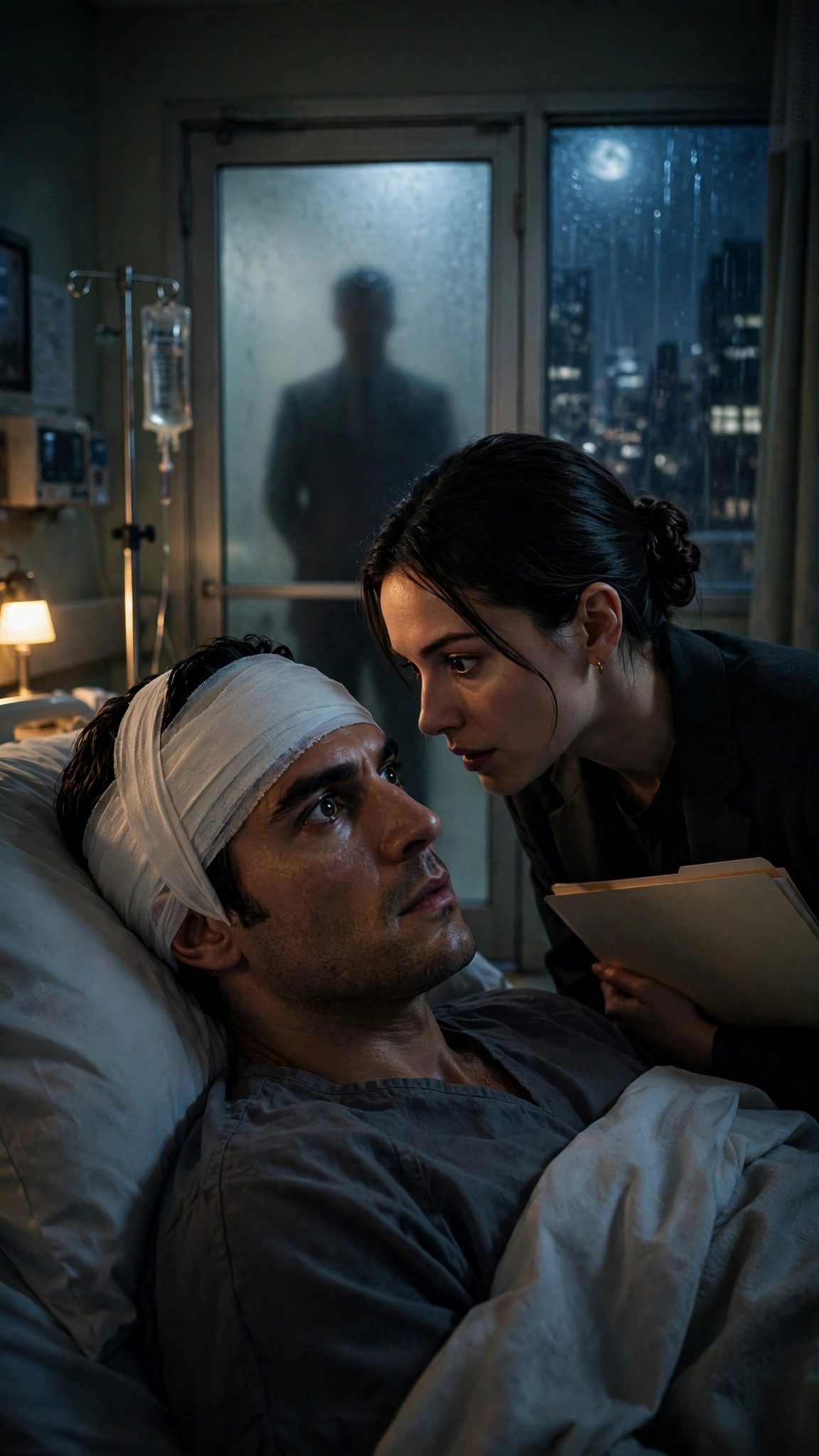
The day before the trap, Emily came to the hospital early, before visiting hours, before the nurses had finished their rounds, before the city outside had fully woken up. She came with the folder, as always, and with a paper bag that smelled of coffee and fresh bread, and she set both down on the table beside my bed, and she sat in the chair, and she looked at me for a long moment without speaking.
"You look better," she said at last.
"I feel better," I said, and I let my voice sound like the voice of a man who was slowly remembering, the way a man sounds when the fog is lifting. "The headaches are less. The doctor says I can go home soon."
"Good," she said. "Because we need to talk, and I do not want to talk about it in a hospital, where anyone can walk in. But there is no other place. So we will talk here, and we will talk quietly, and we will pretend it is about your schedule."
She opened the folder, and she turned it toward me, and inside it was not a schedule. It was her life, written in small precise letters, page after page, the way she had written everything else in that folder: the dates, the times, the phone numbers, the photographs, the proof.
"Before I tell you what I know," she said, "I want you to know who I am. Not your secretary. Not the girl from Queens who files your papers. I want you to know why I stayed, and why I am still here, and why I am going to be here on Thursday, when this ends."
She told me then, quietly, in the white room with the morning light coming through the window, and I listened the way I had listened to nothing else in my life, because for three years this woman had managed my world and I had never once asked her who she was.
Her name was Emily Carter. She was twenty-nine years old. Her mother had cleaned offices at night for thirty years, in buildings owned by men like me, and her father had driven a delivery truck until his back gave out, and she had grown up in a two-bedroom apartment in Queens where the radiators clanked all winter and the rent was always due on the first and always paid on the fifth. She had gone to college on scholarships and loans, and she had graduated with a degree in business, and she had applied to a hundred jobs, and the temp agency had sent her to me.
"I thought you would be like the others," she said. "The men my mother cleaned up after. Men who left their coffee cups on the floor and their secrets on their desks and expected someone else to pick up after them. I thought I would last a month."
She smiled, a small, tired smile.
"But you were different. You said thank you. You learned my name on the first day, and you used it. You asked me about my mother, and you remembered what I told you, and when my mother got sick, you paid the hospital bill without telling me, and you let me believe it was the insurance. I found out later. I found out from the hospital, when I went to pay the rest of it, and they told me it was already paid. In full. By a man who had never met my mother."
She paused, and her voice went quieter, the way a voice goes when it is remembering something that still hurts.
"My mother was in that hospital for three weeks. Pneumonia, and then her heart, and then more pneumonia, the way it goes when a woman has cleaned other people's offices for thirty years and breathed in other people's dust. I sat beside her bed every night after work, and I watched the bills come, and I did the arithmetic, and the arithmetic did not work. The numbers were bigger than my salary. Bigger than my savings. Bigger than everything I had. And then one morning I went to the desk to pay what I could, and the woman behind the desk looked at her computer and said, 'There is nothing to pay. The account is settled.' And I thought she had made a mistake. I thought she had the wrong patient. But she had the right one. My mother. Paid in full. By a man whose name she would not give me, because he had asked her not to."
Emily looked down at her hands, at the folder, at the pages of her own handwriting.
"I stayed because of that. I stayed because you were the first powerful man I had ever met who did not treat power as a reason to be cruel. I stayed because I believed, even then, that a man who pays a cleaning woman's hospital bill in secret is a man worth working for."
She looked up again, and her eyes were steady, and she went on, telling me the rest of it, the part I had never known: her first week in the office, when one of the captains had shouted at her for putting his calls through in the wrong order, and I had come out of my office and told him, in front of everyone, that he would apologize to her or he would not work for me anymore, and he had apologized, and he had never shouted at her again. The night she had stayed late, past midnight, to finish a report I needed for the morning, and I had found her asleep at her desk, and I had left my coat over her shoulders and a note that said, "Go home. It can wait." The morning she had brought me coffee and found me sitting alone in the dark office, the day after my father's birthday, the first birthday since he died, and she had not said anything, and she had not asked anything, and she had simply set the coffee down and left, and that was the morning she had decided, quietly, that she would never leave me, not for any other job, not for any amount of money, because a man who grieves for his father in the dark is a man who is still human, and she had spent her whole life working for men who were not.
She told me, too, about the system she had built for me in those first months, the color-coded schedules and the coded names in the contact book, the way she kept two calendars — one the world could see, and one only she and I knew about — and how, in her second month, she had caught a scheduling conflict that would have put me in the same restaurant, on the same night, as a Castellano lieutenant who had sworn to kill me, and she had moved my meeting without telling me why, and I had never known, until now, that she had saved my life that night, quietly, the way she did everything, without asking for thanks, without even telling me what she had done. She had kept the old calendar, too, with the conflict circled in red ink, and she showed it to me once, years later, and she said, "I kept it so I would never forget that the most important thing I do is not the filing. It is the watching. I watch, Vincent. I always watch."
"And I stayed because, after a while, I realized something else."
She looked up at me, and her eyes were steady, and her voice did not shake.
"I realized that I loved you. Not the way a secretary loves her boss. Not the way a woman loves a name or a title or a bank account. I loved the man who says thank you. I loved the man who remembers my mother's name. I loved the man who sits in a hospital bed with a bullet in his head and pretends to forget, because he would rather be weak for a little while than let a traitor kill anyone else. That is the man I love, Vincent. And I have loved him for a long time, and I have never told him, because I thought it was not my place, and because I thought he would never look at me that way."
She stopped then, and the room was quiet, and the only sound was the monitor counting my heartbeats, which had gone faster, and I could not tell whether it was the wound or the words.
"I am telling you now," she said, "because tomorrow, on Pier Nine, everything changes. Either Sal walks into the trap and the law takes him, or something goes wrong, and I do not want to spend the rest of my life wondering what would have happened if I had said it. So I am saying it. I love you. And I know everything. And I am not going anywhere."
I looked at her for a long time. At the dark hair in its knot. At the hands that had written all those notes. At the eyes that had seen through my lie in less than a minute. And I thought about the three years she had worked for me, and all the times she had been in the room and I had not really seen her, because I had been looking at the men in the room, the captains and the drivers and the lawyers, and not at the woman in the corner with the folder, who knew everything and said nothing.
"Emily," I said, and my voice was my own voice, not the confused voice, not the pretending voice, but the voice I had used before the bullet, the voice of the man who ran the family. "Do you know why I hired you?"
She shook her head.
"Because of the way you filed," I said. "On your first day, you took one look at my office and you reorganized the whole thing, and when I asked you why, you said, 'Because a man who cannot find his own papers cannot find his own enemies.' And I thought, that is the smartest thing anyone has said to me in years. And I kept you, because I knew that a woman who thinks like that is worth more than ten captains."
I reached out, slowly, careful of the IV, and I took her hand. Her hand was warm. It did not tremble. It was steady, the way she was steady, the way she had always been steady, even when the world around her was falling apart.
"I am not going to pretend anymore," I said. "Not with you. Not after this. You know I remember. You know Sal is the traitor. You know what is going to happen on Thursday. So here is what I know, and I am going to tell it to you, because you have earned it, and because it is the truth."
I told her then, in the quiet room with the morning light, the things I had never told anyone: that my father had died and left me the family when I was twenty-nine, and that I had spent nine years trying to make it clean, and that the docks were the last of the old business, and that Sal had run them for thirty years, and that I had planned to take care of him, and that I had not yet told him, and that perhaps, if I had told him sooner, none of this would have happened.
"I was going to give him a share of the legitimate business," I said. "A new position. A way to retire with dignity. I had the papers drawn up. They are in my office safe. I was going to give them to him after the meeting. After the docks went legitimate. I thought I was being generous. I thought I was being kind. I did not know he had already decided to kill me instead."
Emily squeezed my hand. "You were being kind," she said. "And he was being greedy. That is not your fault. A man who sells his boss for money would have sold him for any reason, or for no reason at all. Greed does not need a reason. It only needs an opportunity."
She stood up then, and she picked up the folder, and she held it against her chest, and she looked at me, and she said the last thing she was going to say before Thursday.
"Tomorrow," she said. "Pier Nine. Agent Reyes will be there, and his men will be there, and Marco and Frankie and Leo will be there, and I will be there. And Sal will come, because he thinks he is meeting a man with a briefcase, and instead he is going to meet the law. And when it is over, you are going to walk out of this hospital, and you are going to tell the family the truth, and you are going to be the boss again. And then, Vincent, you are going to take me to dinner. A real dinner. And we are going to talk about what comes next. Not as a boss and a secretary. As a man and a woman who both know everything."
And she smiled, the second smile I had seen from her in three years, and then she was gone, and I was alone in the white room, and the morning light was coming through the window, and the city outside was waking up, and I thought about the woman who had just told me she loved me, and the man who had just told her the truth, and the trap that was waiting on Pier Nine, and I thought about the fact that for the first time in nine years, I was not alone in the fight.
I had Emily. I had Marco. I had Frankie. I had Leo. I had the law.
And on Thursday, I was going to have justice, too.