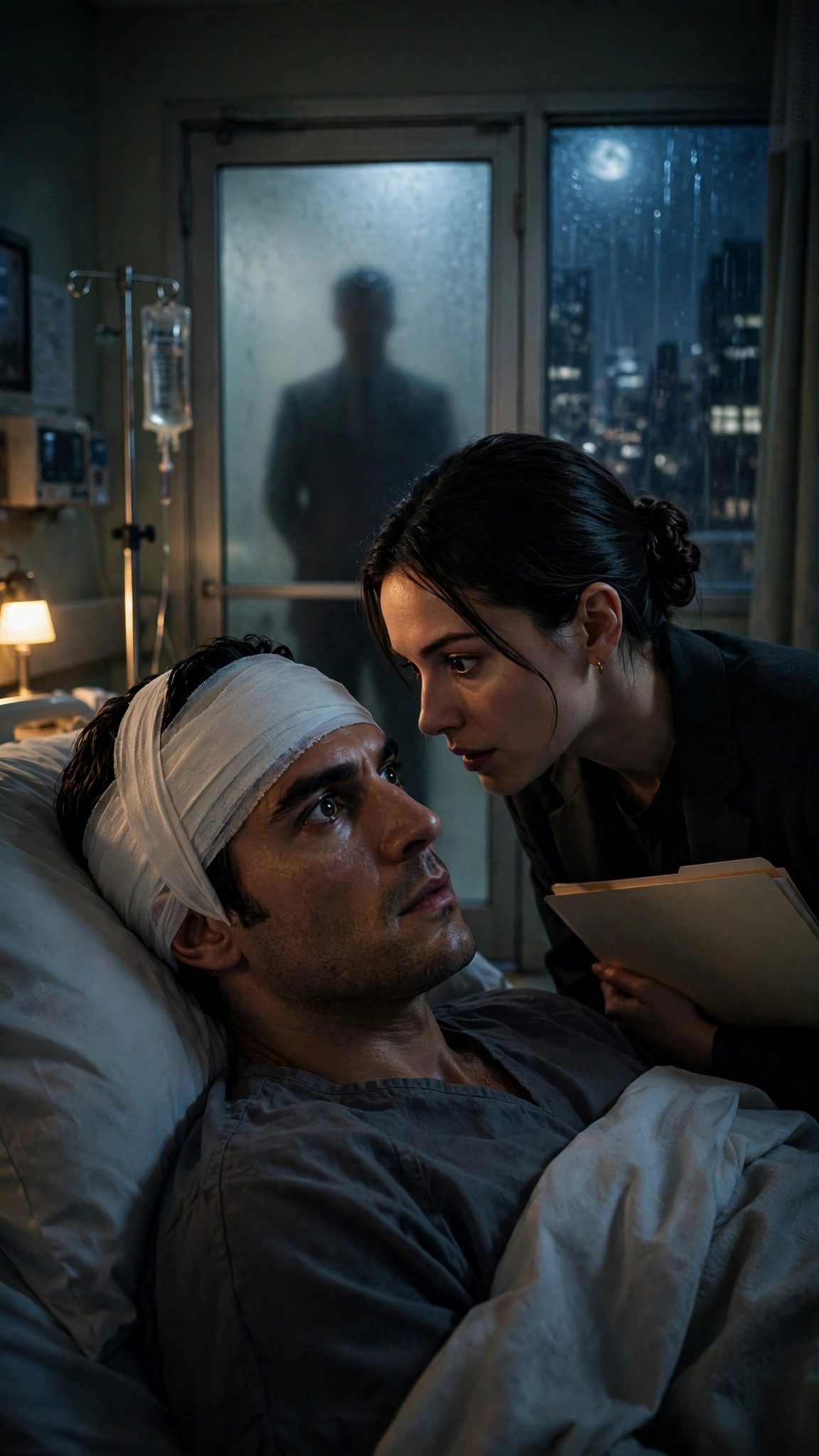
On the third day in the hospital, the doctor brought a specialist to examine me, a neurologist with grey hair and a kind face who asked me questions in a slow, patient voice, the way you speak to a child or a man who has lost his way.
"What is your name?" he asked.
I pretended to think. "Vincent," I said, after a pause that was just long enough to be convincing. "Vincent Moretti. I think."
"Do you know where you are?"
"A hospital," I said. "In Manhattan. I think."
"Do you remember the shooting?"
I looked at the ceiling. I let my eyes go vague. "There was a room," I said. "People talking. Then loud noises. Glass. I remember glass."
The neurologist nodded and wrote something down, and the doctor nodded too, and I could see them both filing me away in their minds under the same label: a man with a fractured skull and a fractured memory, a man who might recover and might not, a man who needed rest and patience and time.
It was perfect. It was also terrifying, because the longer the lie lived, the more real it became, and the more real it became, the more dangerous it was. A boss who cannot remember is a boss who cannot lead, and a family that smells weakness will tear itself apart faster than any enemy ever could. Already, I could feel it happening in the hallways outside my room: captains arriving with questions I could not answer, men I had trusted for years watching me the way men watch a horse with a broken leg, wondering whether it is kinder to put it down.
So I had to move quickly. I had to find the traitor before the family found out the boss was pretending, or before the traitor found out the boss was not.
The plan was simple. It was the oldest trick in the world, and like all old tricks, it worked because it was simple. I would give each of the five a different lie, dressed up as a returning memory, and I would watch to see which lie traveled. The truth stays where it is. The lies do the walking. Whoever carried my lie to Castellano was the man who had sold me in the first place.
I started with Marco, because Marco was the man I trusted most, and because a man you trust most is the man you must test first. If Marco failed the test, I would know the truth was worse than I thought. If he passed, I would know I had at least one man I could stand beside.
It was late in the afternoon when he came to visit, carrying a paper bag with a sandwich in it, the way he always did when he visited someone in a hospital, because Marco believed that food was the answer to every problem, including the ones it could not possibly solve.
"How are you feeling, boss?" he asked.
I rubbed my bandage, the way a confused man rubs the place where it hurts. "There was something," I said, slowly, as if the memory were surfacing through deep water. "A place. A house, I think. On Long Island. A safe house. With a blue door. I think I hid something there. Money, maybe. Or papers. I can't remember what."
Marco frowned. He set the sandwich down. "A safe house on Long Island? With a blue door? Boss, we don't have a safe house on Long Island."
"I know," I said, and I let my voice sound frustrated, the way a man sounds when his own mind will not cooperate. "It doesn't make sense. But I keep seeing it. A blue door. A gravel driveway. A mailbox with no name on it."
He wrote it down in his little notebook, the one he always carried, and he said he would look into it, and he left, and I watched him go, and I thought about the fact that I had just handed my right hand a lie and told him it was a memory.
If Marco was the traitor, Castellano's men would be at a blue-doored house on Long Island within forty-eight hours, searching for money and papers that did not exist. If Marco was loyal, nothing would happen, and the lie would die where I had planted it, in the mind of an honest man.
Next was Frankie. He came in the evening, after his shift, still in his driver's jacket, smelling of rain and gasoline, and he sat in the chair by the bed and looked at me with the same expression he had worn in the restaurant, the expression of a man who had pressed his jacket against a bleeding head and refused to let go.
"Boss," he said. "You look better."
"Frankie," I said, and I pretended to struggle with his name, the way I had struggled with Marco's. "Frankie Gallo. My driver."
"That's right, boss."
"There was something," I said, and I leaned closer, the way a man leans closer when he is telling a secret. "A boat. In Brooklyn. At the marina. I think I keep something on it. A ledger, maybe. With names in it. I keep seeing it. A white boat, with a blue stripe."
Frankie nodded slowly. He did not write it down. Frankie never wrote anything down. He kept everything in his head, the way a driver keeps the city in his head, street by street.
"I'll check the marina, boss," he said. "Don't worry about it. You just rest."
If Frankie was the traitor, Castellano's men would be at a Brooklyn marina within forty-eight hours, looking for a white boat with a blue stripe that did not exist. If he was loyal, nothing would happen.
Leo came the next morning, before the restaurant opened, carrying a container of soup his wife had made, because Leo believed, like Marco, that food was the answer to every problem. He set the soup on the table and sat down, and his hands were shaking, just a little, the way the hands of a man shake when he has seen his friend bleeding on the floor of his own restaurant.
"Vincent," he said. "How are you?"
I looked at him the way a confused man looks at an old friend. "Leo," I said. "Santoro's. The restaurant. The private room."
"That's right," he said, and his voice was thick. "I'm sorry, Vincent. I'm sorry about what happened in my place. I should have had better security. I should have—"
"It wasn't your fault," I said, and I meant it, because it was not his fault, and I wanted him to know that, even through the lie. "But there was something. A key. I keep thinking about a key. To a storage unit, I think. In Queens. Number fourteen. I think there's something in it I need."
Leo nodded, and he wrote the number down on a napkin, the way he wrote down everything important, on whatever paper was nearest.
"I'll go look, Vincent. I'll go today. Don't worry."
If Leo was the traitor, Castellano's men would be at a storage unit in Queens within forty-eight hours, looking for a key that did not exist and a unit that did not exist. If he was loyal, nothing would happen.
That left Sal.
Sal DeLuca came to visit on the fourth day, in the late afternoon, when the light through the window had gone gold and the rain had finally stopped. He came alone, which was unusual for Sal, who was always surrounded by his own men, and he carried a small box of pastries from a bakery in Brooklyn, the way a man carries an offering to a king he is not sure still sits on the throne.
"Vincent," he said, and he sat down in the chair, and he looked at my bandages, and his face did something I could not read. It might have been concern. It might have been calculation. "How are you feeling?"
I let my eyes lose their focus. I let my voice go slow and uncertain.
"There was something," I said. "A meeting. At the docks. Pier Nine. On Thursday. I think I was supposed to meet someone there. Someone important. I keep seeing it. The water. The cranes. A man waiting for me with a briefcase."
Sal went very still. It was a small thing, the stillness, but I had spent nine years reading men, and I knew what stillness meant. Stillness meant a man had just heard something that mattered, and he was deciding what to do with it.
"Pier Nine," he said, slowly. "On Thursday."
"Yes," I said. "I think so. I can't remember who. But it felt important. Like something I had to do. Like something that would change everything."
He nodded, and he wrote it down in his own notebook, a leather one, expensive, the kind of notebook a man carries when he wants the world to know he is important, and he said he would look into it, and he left, and I watched him go, and I thought about the fact that I had just handed the man I suspected most a lie dressed up as a memory, and that if he was the traitor, Castellano's men would be at Pier Nine on Thursday, waiting for a man with a briefcase who did not exist.
And if he was not the traitor, nothing would happen, and I would have to start again.
That night, Emily came back, after visiting hours, when the nurses were changing shifts and the hallway was quiet. She slipped into the room the way she always slipped into rooms, without a sound, and she sat down in the chair, and she opened the folder, and she showed me what she had found.
"Marco did not call anyone about a house on Long Island," she said. "He drove to Long Island himself, yesterday, and he drove up and down the streets for three hours, looking for a blue door. He came back at midnight and told his wife he could not find it. He was looking for your money, Vincent. He was looking for it because he thought you had hidden it and forgotten where. He was trying to protect it for you."
She turned the page. "Frankie did not call anyone about a boat in Brooklyn. He went to the marina himself, last night, and he walked the docks for two hours in the rain, checking every white boat with a blue stripe. There is no such boat. He came home soaking wet and told his brother he could not find it. He was looking for your ledger, Vincent. He was looking for it because he thought it was important to you."
She turned the page again. "Leo did not call anyone about a storage unit in Queens. He drove there this morning, before the restaurant opened, and he tried every key he owns on unit fourteen. It is empty. It has been empty for a year. He stood there for ten minutes, staring at an empty room, and then he went back to his restaurant and cooked lunch for forty people, and he did not tell a soul."
She closed the folder and looked at me, and her eyes were shining, the way the eyes of a woman shine when she has just proved something she already knew.
"Three men," she said. "Three lies. Three men who went looking for things that do not exist, because they thought those things belonged to you, and they wanted to protect them. That is what loyalty looks like, Vincent. It looks like a man driving up and down Long Island in the rain, looking for a blue door that was never there."
She leaned closer, and her voice dropped.
"Sal did not go to Pier Nine. Not yet. But his driver did. His driver went to the docks this morning, and he stood on Pier Nine for twenty minutes, and he took photographs of the cranes and the water and the places where a man could hide. And then he drove back to Brooklyn, and he went into a building on Atlantic Avenue, and he stayed there for an hour. The building belongs to a company owned by Vincent Castellano."
She opened the folder one more time, and she showed me the last page, and on it was a photograph, taken that morning, of a man standing on Pier Nine with a camera, and beside it, in her small precise handwriting, a note.
"Sal DeLuca's driver. Name: Tommy Falco. He has worked for Sal for six years. He was paid in cash yesterday, four thousand dollars, by a man in a black coat, outside the restaurant where Sal eats lunch every day. I have the photograph. I have the time. I have the amount. I have everything."
She closed the folder and stood up, and she looked at me, and she said the thing I had been waiting for her to say since the night she first whispered in my ear.
"Thursday," she said. "Pier Nine. Sal will send Castellano's men to meet a man with a briefcase who does not exist. And when they come, we will be waiting for them. You and me and Marco and Frankie and Leo. And the law."
"The law?" I asked.
"Agent Daniel Reyes," she said. "FBI. He has been building a case against Castellano for two years, and he has been waiting for a witness who could put Castellano's men in the same room as the crime. Sal is that witness, Vincent. Sal is going to walk himself into a trap, and he is going to bring Castellano's men with him, and Agent Reyes is going to be there to meet them. All we have to do is let him."
She picked up the folder and held it against her chest, and she looked at me, and for the first time since I had known her, I saw something in her face that was not precision and was not calm.
It was anger. Quiet, controlled, furious anger, the kind of anger a woman feels when a man she respects has been betrayed by a man he trusted.
"Sal DeLuca sold you for money," she said. "He sold the time and the place, and he took Castellano's cash, and he stood in this hospital and pretended to care about you. I am not going to let him get away with it. And I am not going to let you die pretending to forget. On Thursday, this ends. And on Friday, you are going to stop pretending, and you are going to tell the family the truth, and you are going to be the boss again. Do you understand?"
I looked at her, at the folder, at the photograph of the man on Pier Nine, and I nodded, slowly, because she was right, and because the plan was working, and because the lie that had become a diagnosis was about to become a trap.
"Thursday," I said. "Pier Nine."
"Thursday," she agreed. "Pier Nine. And Vincent — when this is over, when Sal is gone and Castellano is gone, you are going to owe me a dinner. A real one. Not in a hospital. Not in an office. A real dinner, where you are not pretending to be anyone but yourself."
And she smiled, just a little, the first smile I had seen from her in three years, and then she was gone, and I was alone in the white room, and the rain had stopped, and the city outside the window was shining, wet and clean, the way Manhattan shines after a storm, as if nothing had happened at all.
But something had happened. Three men had proved their loyalty in the rain. One man had proved his guilt on a pier. And a woman who knew everything had just told me that on Thursday, the pretending would end, and the truth would finally come out to play.