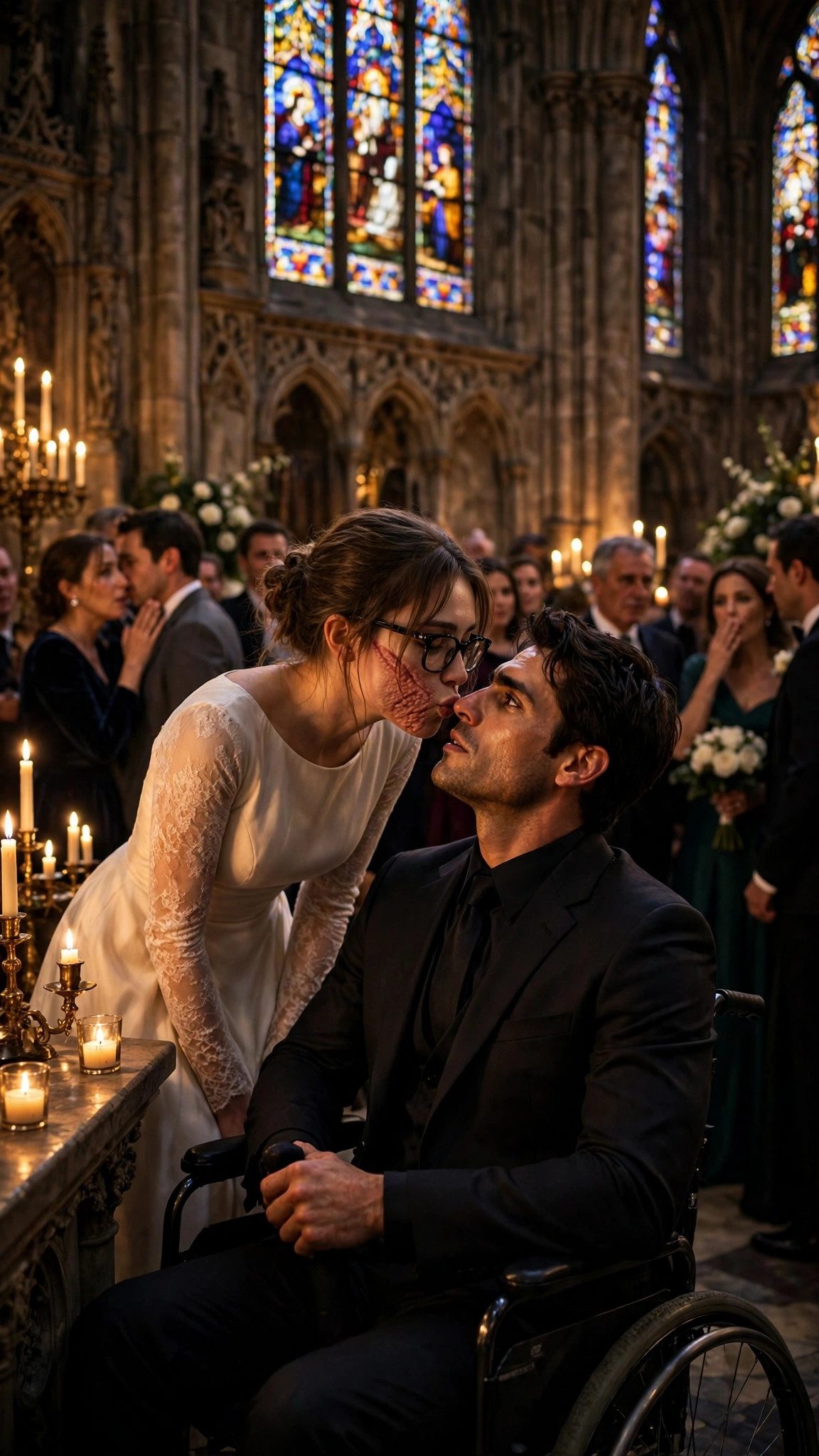
The reception was held at Adrian's estate in Lake Forest, in a ballroom with a ceiling painted like the sky and chandeliers that threw light across the marble floor in patterns like falling stars.
I had never been in a room like that before. I had arranged flowers for rooms like that — I had stood in the back of ballrooms at midnight, in my grey clothes, putting roses into vases while the guests danced — but I had never been the guest. I had never been the bride.
One hundred and twenty people ate and drank and talked in low voices, and I sat beside Adrian at the head table, in my ivory dress, with my bag on the floor beside my chair, and the dark bottle of amaro inside it, heavy as a stone.
Adrian did not eat much. He drank water. He spoke to his men in short sentences, and they bent down to listen, and then they went away again, and I watched them, because I did not know what else to do with my eyes.
There were four of them, mostly. Marco Santini, his driver, a man in his fifties with grey hair and hands that looked like they had done hard work all his life. Two younger men who stood near the doors and did not drink at all. And an older man in a dark suit who sat two tables away and watched everything the way a cat watches a room full of mice — Enzo Falcone, his consigliere, my father had told me once, a man who had been with Adrian since they were both young and hungry.
My father was there, of course, at a table near the front, with Celeste beside him in a red dress that cost more than Ruth's facility charged in a month. Celeste laughed too loudly at something a man said. My father did not laugh at all. He watched Adrian the way a man watches a dog he is not sure is fully trained.
By ten that night, the reception was ending. The band had packed away its instruments. The waiters were clearing the tables. The guests were leaving in their black cars, and the ballroom was growing quiet, and the adhesive beneath my silicone scar had begun to loosen.
It always loosened after ten or eleven hours. The glue was good, but it was not magic, and sweat and heat and time worked against it. I could feel the edge lifting at my temple, a small, tickling pull, like a hangnail, and I kept touching it without thinking, pressing it back down with my fingertip, and hoping no one noticed.
Adrian noticed.
"You keep looking at the time," he said. His voice was low, and it was the first time he had spoken directly to me since the altar.
"I'm tired," I said.
"That isn't why."
My hand went to my temple again, without my permission, and I pressed the edge of the scar back against my skin, and I felt it lift again the moment I let go.
"I need to go upstairs," I said.
He watched me for several seconds. His eyes were dark, almost black, and they did not blink, and I had the feeling again that he was looking straight through me, through the scar and the glasses and the dull hair, at something underneath.
"Your room is at the end of the hall," he said at last. "I'll come up in ten minutes."
My heart nearly stopped.
Ten minutes. Ten minutes to fix my face, to press the scar back down, to make myself ugly again before he saw me. Ten minutes to pour the amaro, or not pour it, to decide what kind of wife I was going to be — the obedient girl my father had made, or someone else, someone I had not been in ten years.
I went upstairs. The bedroom at the end of the hall was large and quiet, with a bed the size of a small boat and windows that looked out over the garden and a bathroom with lights around the mirror that were bright and white and merciless.
I stood beneath those lights and I pressed the edge of the silicone back against my skin. It lifted again. I pressed it harder. It lifted again. The glue had given up. Ten years of glue, and it had chosen tonight to fail.
I was still pressing at my temple, my hands shaking, when I heard the wheels moving outside my door. The soft, steady sound of rubber on carpet, coming closer, and then stopping.
Adrian entered alone. He closed the door behind him. And he locked it.
The click of the lock was the loudest sound I had ever heard.
My hand froze against my fake scar. I could not move. I could not breathe. I stood there in my wedding dress, under the bright bathroom lights, with my face coming apart in my hands, and the most feared man in Chicago looked directly at me and said, in a voice as calm as still water:
"Now tell me why my wife is trying to hold her face together."
I opened my mouth. Nothing came out.
"Take it off," he said.
"What?"
"The scar. The nose. All of it. Take it off."
"How did you—"
"I knew at the altar," he said. "The light in the cathedral was wrong for it. The edge caught the sun when you turned your head. And then tonight, in the ballroom, I watched you touch your temple forty-seven times."
Forty-seven times. He had counted.
"Take it off," he said again. "Or I will take it off for you, and I do not think you would enjoy my version."
My hands were shaking so hard I could barely feel my own skin, but I did as he said. I peeled the scar away from my temple, slowly, the glue pulling at my real skin underneath, and I set it down on the bathroom counter, a limp, flesh-colored thing that looked like a dead jellyfish. Then the nose. Then the jaw. Then the glasses. I stood there in my wedding dress with my real face bare for the first time in front of anyone but Ruth, and I waited for him to laugh, or to look away, or to call me a liar and a fraud and throw me out of his house.
He did none of those things. He looked at me for a long time, and his face did not change, and then he said, very quietly, "You look like Celeste."
"I'm her half-sister," I whispered. "My father never married my mother. He hid me. He made me wear the scar so no one would ask why his unwanted daughter looked like his legitimate one."
"I know," Adrian said.
"You know?"
"I know who you are, Mara Barone. I have known since the morning your father sent word that Celeste had refused me and that her sister would take her place. I know about the silicone. I know about Ruth Delaney and Sunrise Gardens. I know about the nine thousand dollars a month."
My knees went weak. I put my hand on the bathroom counter to hold myself up.
"Then why did you marry me?" I asked. "Why did you let them send me here?"
"Because I wanted to see what your father would do," Adrian said. "And because I wanted to see what you would do."
"What do you mean?"
"I mean," he said, and his voice went colder, "that your sister handed you a bottle of amaro before the ceremony, and told you to pour me a glass before midnight, and told you to drink after me. And I want to know if you were going to do it."
The blood left my face. The bottle was in my bag, downstairs, at the head table. I had not poured it. I had not decided. I had been carrying it around all night like a bomb that had not yet decided whether to go off.
"How do you know about the bottle?" I whispered.
"Because I have had a man watching your sister for three weeks," Adrian said. "Because the bottle was bought from a chemist in Cicero who sells poisons to people who do not ask questions, and my man was standing behind Celeste when she bought it. Because the amaro in that bottle is laced with enough aconite to stop two hearts, and I had it tested before the sun went down."
Aconite. Poison. Enough to stop two hearts. He drinks first. You drink afterward. Don't get it backwards.
Celeste had not given me a wedding gift. She had given me a murder weapon, and she had meant for me to be the second body.
"Were you going to pour it?" Adrian asked.
I looked at him — at his dark eyes, at his broad shoulders, at the wheelchair that everyone in Chicago believed held a broken man — and I told him the truth, because I had spent ten years lying about my face, and I was too tired to lie about anything else.
"I don't know," I said. "I kept thinking about Ruth. If I disobeyed, my father would stop paying for her care. If I obeyed, you would die, and then I would die, and Ruth would be alone anyway. I didn't pour it. I couldn't decide. I'm sorry."
"Say that again," he said.
"What?"
"What you just said."
"I said I'm sorry."
He was quiet for a moment, and something moved across his face, something I could not name, and then he did the last thing in the world I expected him to do.
He laughed. Not a cruel laugh. Not a mocking laugh. A real laugh, rough and surprised, as if something inside him had cracked open.
"Do you know," he said, "that in eleven months, no one in my house has told me the truth about anything? Not my men. Not my lawyer. Not my priest. And you — you walk in here wearing a fake face and carrying a bottle of poison, and you tell me the truth."
He wheeled himself closer to me, and I stood very still, and he reached out and took my hand, and his hand was warm, and his grip was strong, and he said:
"Now I am going to tell you a truth of my own. And it is darker than yours."
Then he put his hands on the armrests of his wheelchair, and he pushed himself up, and he stood.
He stood all the way up, on two legs, tall and steady, in the middle of the bedroom, and he looked down at me, and the wheelchair sat empty behind him like a shed skin.
"I can walk, Mara," Adrian Vitali said. "I have been able to walk for eight months. The bullet never destroyed the nerves in my legs. It grazed the bone and healed. I stayed in the chair because a crippled man is underestimated, and an underestimated man hears things. And what I heard, eleven months ago, was that your father paid a man named Tommy Falco to shoot me."
The room went silent. The lights buzzed. My heart beat so hard I could feel it in my throat.
"Your father shot me," Adrian said, "and then he married his unwanted daughter to me, and sent her into my house with poison, and he thought I was a breathing corpse in a wheelchair who would never see any of it coming."
He took a step toward me, and another, and he did not stumble, and he did not waver, and he was the most dangerous man I had ever seen, standing on two good legs in a bedroom at the end of a hall.
"But I saw it," he said. "I saw all of it. And now, Mara Barone, you have a choice to make. You can help me finish this, or you can go back to your father and tell him everything I just told you. But if you go back to him, Ruth Delaney will not be safe, because I am done playing his game, and when I am done with a man, he does not get to keep his leverage."
I looked at him, standing there, tall and whole and terrifying and honest, and I thought about Ruth, and I thought about the scar lying on the bathroom counter, and I thought about the bottle of poison downstairs, and I thought about ten years of being small.
And I made my choice.
Halfway through the reception, an elderly woman in pearls came to our table, leaning on a cane, and she looked at me for a long moment, and then she said, in a voice like dry leaves:
"You're prettier than they say, dear. Don't let them tell you otherwise."
I stared at her. No one had ever said anything like that to me at a gathering of my father's world. People in that world did not say kind things to ugly girls. They said nothing at all, which was its own kind of cruelty.
"Thank you," I whispered.
"My name is Eleanor Whitmore," she said. "I knew your mother. Not well, but I knew her. She was a lovely woman. She had your eyes."
My heart stopped. "You knew my mother?"
"Briefly, years ago," Mrs. Whitmore said. "She worked in a bakery, I believe. She had a laugh like a bell. Your father never deserved her, and he knows it, which is why he hides you. A man hides what shames him, dear. Remember that."
Then she patted my hand, and she walked away, leaning on her cane, and I sat there with tears in my eyes, and I thought about my mother, laughing like a bell, working in a bakery, and about my father, hiding me for ten years because my face shamed him, and about Mrs. Whitmore, a stranger, who had been kinder to me in thirty seconds than my own family had been in a lifetime.
Adrian watched her go, and then he looked at me, and he said, very quietly, "Eleanor Whitmore is the only honest person in this room besides you."
"How do you know I'm honest?" I asked.
"Because you apologized for existing," he said. "Dishonest people never apologize for anything."
I did not know what to say to that, so I said nothing, and I looked at the chandeliers, and the marble floor, and the guests in their fine clothes, and I thought about the bottle in my bag, and the clock ticking toward midnight, and the choice I had not yet made, and I wished, suddenly and fiercely, that I could be like Mrs. Whitmore — old, and unafraid, and honest, and free.
"Would you like some water?" Adrian asked, and he poured me a glass himself, with his own hands, and he set it in front of me, and I drank it, and it was cold and clean, and for a moment, I felt almost calm.
Almost. The adhesive was still loosening at my temple. The clock was still ticking. And somewhere in the room, my father was watching me, waiting to see what I would do.