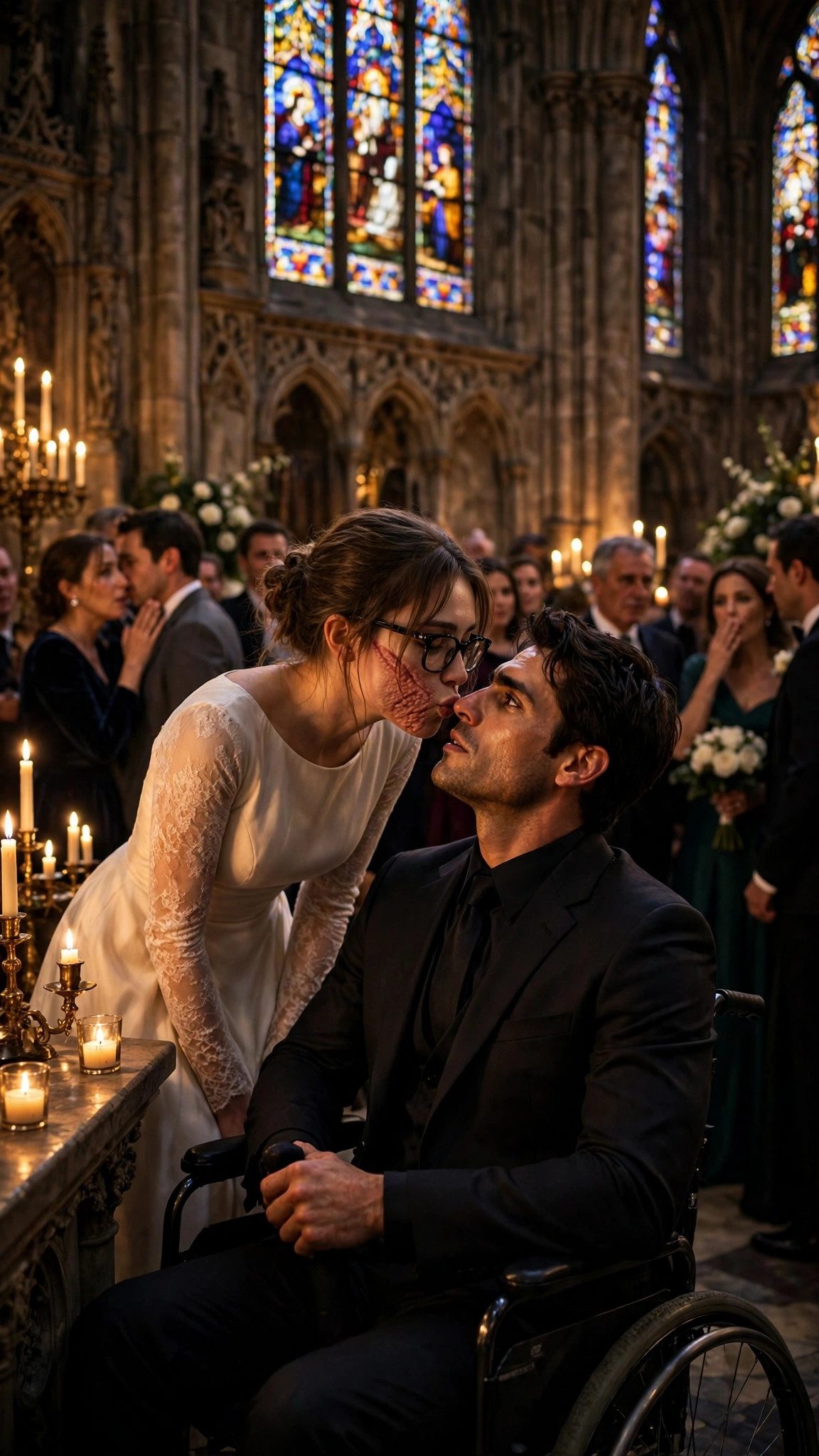
"I'll help you," I said.
The words came out before I had time to be afraid of them, and once they were out, I could not take them back, and I did not want to.
Adrian Vitali looked at me for a long moment, standing on two good legs in the middle of the bedroom, and then he nodded once, the way a man nods when a deal is made, and he sat back down in his wheelchair — not because he needed it, but because the chair was part of the act, and the act was not finished yet.
"Then we need to understand each other," he said. "So listen carefully, Mara, because I am only going to say this once."
He told me everything.
Eleven months ago, on a rainy night in March, Adrian had been driving home from a meeting at the docks when a motorcycle pulled alongside his car and a man fired three shots through the window. One bullet missed. One bullet shattered the side mirror. One bullet struck Adrian in the hip, grazed the bone, and lodged in the seat behind him.
The doctors said it was a miracle. The bullet had missed every nerve, missed the artery, missed everything that mattered by less than an inch. He would walk again in six weeks. He would be fine.
Adrian did not tell anyone that. Not the newspapers. Not the police. Not even most of his own men. He let the story grow — the crippled boss, the destroyed nerves, the breathing corpse in the wheelchair — because a man in a wheelchair is pitied, and a pitied man is underestimated, and an underestimated man hears things that a feared man never hears.
And what he heard, in the months that followed, was very interesting.
His men, thinking he was finished, began to talk more freely. His rivals, thinking he was weak, began to move more boldly. And his enemies, thinking he was helpless, began to make mistakes.
Three months after the shooting, Marco Santini brought him a man named Tommy Falco, a small-time gunman with shaking hands and a mother in a nursing home in Joliet, and Tommy Falco told Adrian everything, because Adrian had offered him something no one else had ever offered him — a way out.
Tommy had been paid fifty thousand dollars to shoot Adrian Vitali. The money had come through three different accounts, but the man who handed him the envelope, in the parking lot of a diner on Cicero Avenue, was an associate of Salvatore Barone. And the instructions had been very clear: do not kill him. Wound him. Cripple him. Make him weak. Make him a man who needs a wheelchair and a wife to take care of him.
"Your father wanted me alive," Adrian said, "but broken. Because a broken man can be managed. A broken man will accept a marriage he does not want, to a bride he has never met, to seal an alliance he cannot refuse. And a broken man will not notice when his new wife starts asking questions about his business, and reporting back to her father, and pouring his drinks."
"That was the plan," I whispered. "Celeste was supposed to marry you. She was supposed to be the spy. When she refused, he sent me instead. And the poison —"
"The poison was the second part of the plan," Adrian said. "If the marriage did not give your father what he wanted, the amaro would finish it. A grieving widow — or in your case, a dead substitute bride — and your father would inherit the alliance, the docks, everything, and no one would ever ask questions, because who poisons a wedding gift?"
I sat down on the edge of the bed, because my legs would not hold me. The room was spinning. Ten years of obedience, ten years of wearing a fake face, and all of it had been leading to this — not just to a marriage, but to a murder, and my father had been willing to use me as the weapon and then throw me away with the body.
"Ruth," I said. "If he finds out I told you —"
"Ruth is safe," Adrian said. "My men moved her three hours ago, before the reception ended. She is in a facility in Evanston, under a different name, with nurses I pay myself. Your father does not know where she is. He will never find her."
I stared at him. "You moved my foster mother?"
"I protect what is mine," Adrian said, and his voice was flat and certain, as if he were stating a fact about the weather. "You are my wife, Mara. That makes Ruth my family. And I protect my family."
Tears came then, hot and sudden, and I did not try to stop them, because I had spent ten years not crying, and I was tired of it. I cried for Ruth, safe in a new facility with nurses Adrian paid for. I cried for my mother, who had laughed at everything and died too young. I cried for the girl I had been at seventeen, standing at a sink washing dishes, while her father looked at her face and decided she was worth more as a lie than as a daughter.
Adrian did not touch me. He did not tell me to stop crying. He waited, the way a man waits for a storm to pass, and when I had wiped my face with the back of my hand, he said:
"There is one more thing you need to know. The darker lie."
I looked at him. "Darker than the poison? Darker than the shooting?"
"Yes," he said. "Because the poison and the shooting were your father's doing. But the darker lie was mine."
He wheeled himself to the window and looked out over the garden, where the lights were still on and the last of the caterers were loading their vans.
"Eleven months ago," he said, "before the shooting, I met your sister. Not Celeste. You."
I frowned. "We've never met. Today was the first time."
"No," Adrian said. "Six years ago, at a flower shop on Division Street, a woman with a scarred face and heavy glasses sold me a dozen white roses for my mother's grave. I remember her because she wrapped them the way my mother used to wrap flowers, with the stems all even and the paper folded twice. And I remember her because when I paid her, she said, 'I'm sorry,' and I said, 'For what?' and she said, 'For existing, mostly.'"
The breath left my body. The flower shop. The white roses. I remembered that day — a tall man in a dark coat, broad shoulders, eyes like winter, buying roses on a Tuesday afternoon, and me apologizing for existing, because that was what I had been trained to do.
"I went back to that shop four times," Adrian said. "I never bought flowers again. I just wanted to see if she was still there. And every time, she was. And every time, she apologized for something that was not her fault. And I thought to myself, that woman has been taught to be small, and whoever taught her that is a coward."
He turned his wheelchair back toward me.
"When your father offered me Celeste, I refused for a year. When he offered me her sister instead, I said yes before he finished the sentence, because I knew exactly who the other girl was. I knew about the scar. I knew it was fake. I have known from the beginning, Mara."
I could not speak. My mouth opened and closed, and nothing came out, and the room seemed very quiet, and the lights seemed very bright.
"You married me on purpose?" I whispered at last.
"I married you because your father thought he was sending me a spy and a poisoner," Adrian said. "And I thought I was rescuing a woman who had been taught to apologize for existing. One of us was right."
He reached out then, and he took my hand again, and his hand was warm, and his grip was steady, and he said:
"Tomorrow, your father is coming to this house for dinner. He thinks he is coming to check on his investment. He thinks his daughter is in my house, reporting back to him, and that the amaro will be poured before midnight, and that by morning, I will be dead and you will be dead and he will own everything. Instead, he is going to walk into a trap, Mara. And you are going to help me spring it."
"How?" I asked.
"By being exactly who you are," Adrian said. "Not the scarred girl. Not the ugly bride. You. Mara Barone, in her real face, sitting at my table, in my house, where your father can see you and understand, at last, that he never owned you at all."
He stood up again then, from the wheelchair, and he walked to the door, and he unlocked it, and he turned back to me.
"Get some sleep," he said. "Tomorrow is going to be a long day. And Mara —"
"Yes?"
"Don't apologize for existing. Not in my house. Not ever again."
Then he walked out of the room, on two good legs, and closed the door behind him, and I stood alone in the bedroom at the end of the hall, in my wedding dress, with my real face bare and my fake scar lying on the bathroom counter, and I thought about the flower shop on Division Street, and the white roses, and the man who had come back four times just to see if I was still there.
And for the first time in ten years, I did not feel small.
I felt like a woman who had a choice. And I had made it.
I took the dark bottle of amaro out of my bag, and I set it on the dressing table, where the light caught the green glass, and I looked at it for a long time. It was not a wedding gift. It was a weapon. And tomorrow, it would become evidence.
Then I washed my face, and I took off the wedding dress, and I put on a plain nightgown, and I lay down in a bed the size of a small boat, in a house that belonged to a man who could walk, and I slept — not well, and not for long, but I slept, because I was tired in a way that went all the way down to my bones, and because for the first time in my life, someone was fighting for me, instead of me fighting alone.
Outside my window, the garden was dark, and the lake was dark, and somewhere in Chicago, my father was sleeping in his big house on Astor Street, dreaming of docks and alliances and a dead son-in-law, and he had no idea that the trap was already closing around him.
Tomorrow, he would find out.
Before he told me about the trap, Adrian showed me the evidence.
He wheeled himself to a desk in the corner of the bedroom, and he opened a drawer, and he took out a folder, and he set it on the bed between us, and he opened it, and inside were photographs, and papers, and a small plastic bag with a piece of paper inside it, sealed and labeled in a neat hand.
"This is the lab report on the amaro," he said, pointing to the first paper. "Aconite. Four milligrams per glass. A lethal dose is two. Your sister bought enough poison to kill a room full of people."
He turned the page. "This is Tommy Falco's statement. Signed. He names your father. He names the amount. He names the diner on Cicero Avenue where the envelope changed hands."
He turned another page. "These are the bank records. Three accounts. All of them lead back to companies your father controls. Fifty thousand dollars, paid in three installments, the last one the day before the shooting."
He held up the plastic bag. "And this is the photograph Marco took, the night Falco was paid. Your father's associate, handing over an envelope, in the parking lot of that diner. The license plate is visible. The time stamp is visible. Everything is visible."
I looked at the folder, at the neat rows of evidence, at the careful, patient work of a man who had spent eleven months building a case against the man who shot him, and I thought about how different Adrian was from what everyone believed. They thought he was a crippled boss, a broken man, a breathing corpse. He was none of those things. He was a hunter, and he had been hunting for eleven months, and he had caught everything.
"Why didn't you go to the police months ago?" I asked.
"Because I wanted all of it," Adrian said. "Not just the shooting. The marriage. The poison. The whole plan, from beginning to end. If I had gone to the police after the shooting, your father would have denied it, and Falco would have disappeared, and the money would have been hidden. But if I waited — if I let him think I was weak, if I let him marry his daughter to me, if I let him send the poison into my house — then I would have everything, and he would have nothing."
"And Celeste?" I asked. "What happens to her?"
"That depends on her," Adrian said. "She bought the poison. She handed it to you. She told you to pour it. That makes her guilty. But she is also your sister, and she is also afraid of your father, and fear makes people do terrible things. If she tells the truth, I will ask Reyes to be kind to her. If she lies, I won't."
"She's cruel," I said. "She's been cruel to me my whole life. But she's not a murderer. Not really. She didn't think it through. She never thinks anything through. She just… reacts."
"Then help her think it through," Adrian said. "Tomorrow, at dinner, when your father is arrested, Celeste is going to be frightened. She is going to look for someone to tell her what to do. Be that person, Mara. Tell her to tell the truth. It may be the first kind thing anyone has ever done for her."
I thought about that, sitting on the edge of the bed, with the folder of evidence between us, and I thought about Celeste, in her red dress, laughing too loudly at the reception, and I thought about the little girl she must have been once, before her father taught her that cruelty was strength, and I felt something I had never felt for my sister before.
Not love. Not yet. But pity. And pity, I was learning, is the beginning of forgiveness.
"All right," I said. "I'll help her. But Adrian — what if my father doesn't come to dinner? What if he suspects something?"
"He'll come," Adrian said, with total certainty. "Men like your father cannot resist checking on their investments. He thinks he owns you. He thinks he owns me. He thinks the poison is already working. He will come to dinner to watch it happen. And when he walks through that door, the trap will close."
He closed the folder, and he put it back in the drawer, and he looked at me, and he said, "Get some sleep, Mara. Tomorrow is going to be a long day."
But I did not sleep right away. I lay in the dark, in the big bed, listening to the house settle around me, and I thought about the folder, and the evidence, and the trap, and the man in the next room who could walk, and the sister who had tried to poison me, and the father who had sold me, and I thought about Ruth, safe in Evanston, and I thought about my mother, laughing like a bell, and I thought about the little bird, following the stars home.
And for the first time in ten years, I fell asleep without the scar on my face, and without fear in my chest, and it felt like flying.