Everyone forgot my thirty-second birthday. My family forgot. My coworkers forgot. Even the people whose celebrations I had spent years making special forgot, and I told myself it was fine, because laughing was easier than admitting how badly it hurt.
My sister Claire had called that afternoon to apologize, which was worse than no call at all. Her husband had a conference. Her son had soccer. Mom's dishwasher was leaking, and somehow my birthday had simply disappeared between everyone else's emergencies. "We'll do brunch next week," she promised, and then she hung up, and I stood in the kitchen of Sable with the phone in my hand and listened to the dinner rush build around me like a tide coming in.
Sable is the kind of restaurant where the lights are always low and the wine costs more than my first car. It sits on a quiet corner in River North, all dark wood and brass and white tablecloths, and I have worked in its kitchen for three years, making desserts for people who will never know my name. I like it that way. Or I did. Tonight I did not like anything at all.
After the dinner rush, when the last dessert had gone out and the dining room had settled into that soft, murmuring hour before close, I stood at my station and stared at the lonely chocolate cupcake I had made from leftover batter. It sat beneath the fluorescent lights without frosting, without a candle, without even a plate. Just a cupcake in a paper wrapper, like an apology nobody had bothered to write.
Theo, one of our line cooks, walked in carrying parsley and spotted it. He is twenty-four, all elbows and enthusiasm, and he has the kind of face that cannot hide a single thought.
"Whose birthday?" he asked.
I should have lied. I should have said it was for a customer, or a joke, or nothing at all. Instead I heard myself say, very quietly, "Mine."
His expression collapsed. "Oh, hell."
"It's fine," I said, with that same practiced laugh I had been using all day. "Everyone forgot my birthday."
"No."
The voice came from beyond the kitchen doors, low enough to make my stomach tighten instantly, and every sound in the kitchen seemed to stop at once. The clatter of pans. The hiss of the stove. Theo's breathing. All of it just stopped.
Adrian Vale rose from his private table.
He is six feet three inches of tailored black suit and cold grey eyes, and half of Chicago seems afraid to discuss him above a whisper. Everyone around the city's restaurants and construction companies and private clubs and old money knows Adrian's name. Our owner personally checks his table whenever he comes in. I usually stay safely in the kitchen, making desserts and quietly adjusting them, because I know Adrian hates anything too sweet.
Tonight he walked straight toward me, leaving three powerful-looking men sitting silently behind him at his table, and I could feel every eye in the dining room turn to follow him.
"You said everyone forgot," he said.
"I was joking," I said.
"No, you weren't."
Heat rushed into my face. I tried to retreat behind work, behind the counter, behind anything, but there was nowhere to go. He stopped on the other side of my station and looked at me the way a man looks at something he has already decided to protect, and then he calmly reminded me that it was ten thirty-eight and my final dessert had gone out twenty minutes earlier.
Then he glanced toward my pathetic cupcake.
"That's your birthday cake?"
"It's technically a cupcake."
"I can see that."
"Then why did you ask?"
The words escaped before common sense could stop them. I felt my stomach drop the second they left my mouth, because you do not talk to Adrian Vale that way. You do not talk to him at all unless he speaks first. Everyone in this city knows that.
Something almost amused flickered across his face. It was gone so fast I might have imagined it. And then he reached inside his jacket, and every muscle in my body froze.
I thought of all the stories I had heard. I thought of the whispers in the dining room and the way grown men went quiet when his name came up. I thought, absurdly, of my father, who used to say that fear makes fools of smart people, and I braced myself for whatever terrifying thing my imagination expected.
He noticed. Of course he noticed. Adrian Vale notices everything.
Instead of a weapon, he pulled out a folded receipt and placed it beside my cupcake. It was from a bakery in Lincoln Park, and beneath the order number, four words were printed in neat black type: Pickup October 17, 10 PM.
"What is this?" I whispered.
"Evidence," he said. "That your statement was inaccurate."
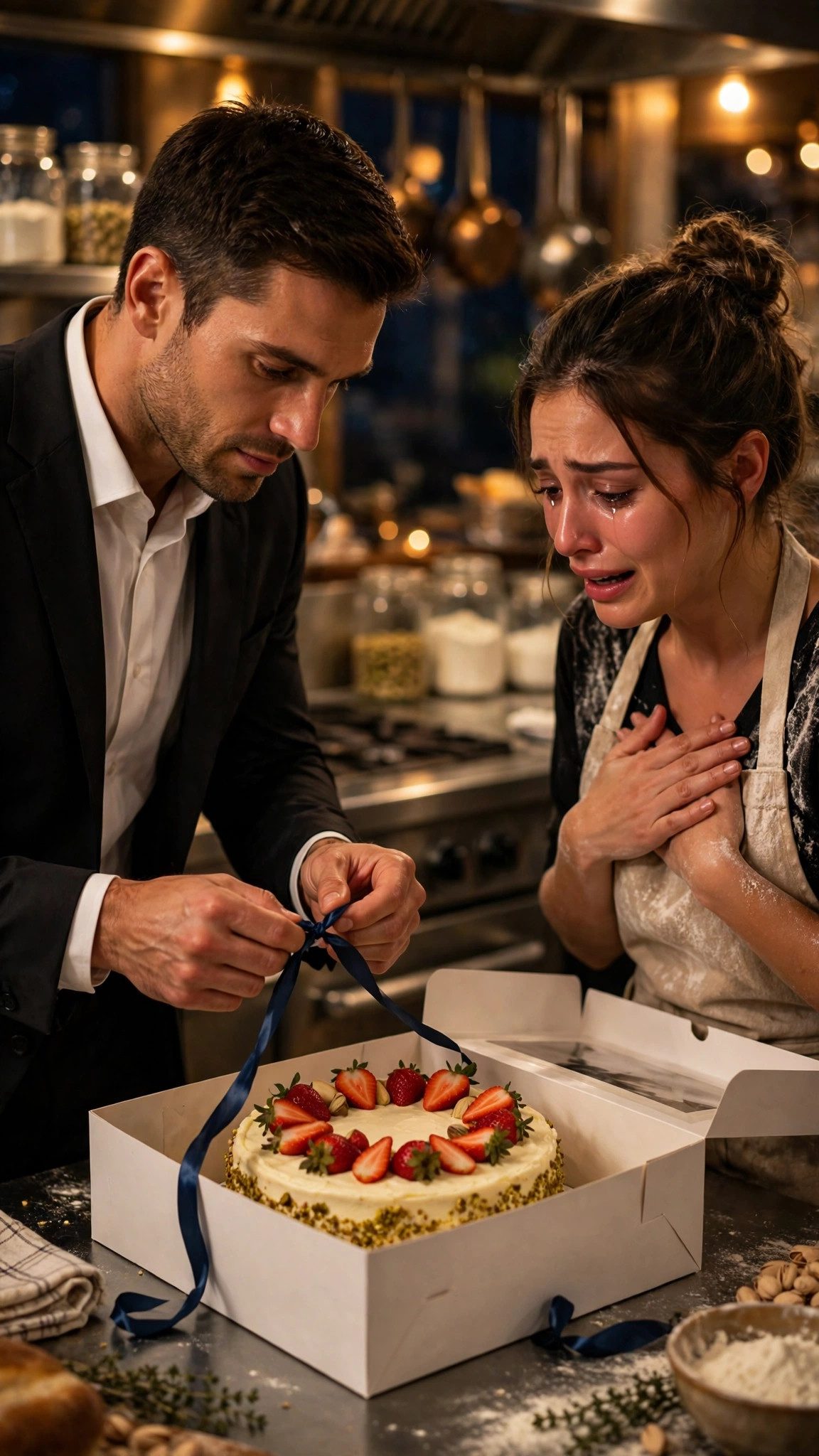
Before I could answer, the back door opened, and Adrian's driver entered carrying a white bakery box tied with dark blue ribbon. He was a broad, quiet man with silver hair and a face that gave away nothing. "Happy birthday, Ms. Bell," he said, and set the box down on my station, and then he disappeared again, as if he had never been there at all.
Adrian untied the ribbon. He lifted the lid with the care of a man handling something sacred.
My breath vanished.
Vanilla buttercream. Fresh strawberries arranged around the edge in crooked circles. Crushed pistachios pressed unevenly along the sides. And one candle beside the number thirty-two, written in chocolate.
It was my father's cake. Exactly.
My father used to bake it every year on my birthday at Bell's Bakery in Milwaukee, back when the world was small and flour-covered and safe. He never measured anything. He arranged the strawberries in crooked circles because he said perfect circles were for people who didn't love you enough to be careless. He pressed the pistachios on with his bare hands. He wrote my age in chocolate with a shaking hand and always got one number wrong, and I always pretended not to notice.
Dad had been dead for four years.
"How?" I whispered. My voice sounded like it belonged to someone else.
Adrian looked at me, and for the first time since he had walked into my kitchen, something in his face softened, just slightly, like a door opening a crack.
He reminded me of a ninety-second conversation from January. I had been complaining that a pistachio dessert reminded me of how my late father used to bake at Bell's Bakery in Milwaukee. I had casually told him about flour-covered Sunday mornings, strawberries arranged in crooked circles, and Dad refusing to measure anything.
I had forgotten that conversation completely. Adrian hadn't.
"You remembered?" I said.
"I remember most things you say."
A chill moved through me, and it had nothing to do with the kitchen's cold air. He began listing things I had done that even I barely remembered. My boss's anniversary cake, the one I stayed three hours late to finish. My sous-chef's baby-shower pastries, the ones I made on my only day off that week. The birthday cake I had made on my day off for a dishwasher's daughter, because he couldn't afford one, and I had delivered it myself in a paper bag so nobody would know.
"How do you know that?" I asked.
"I was here."
"I never saw you."
His eyes held mine, grey and steady and unreadable. "I saw you."
I looked down at the cake, because looking at him was suddenly too much. The strawberries were arranged in crooked circles, exactly the way Dad used to do it, and my throat closed so tight I could barely breathe. I had not seen that cake in four years. I had not tasted it in four years. I had stopped letting myself think about it, because thinking about it meant thinking about the morning my father didn't come downstairs, and the flour still on his hands, and the ambulance that came too late, and the bakery that went quiet in a way a bakery should never go quiet.
"Eat," Adrian said, very quietly, and it wasn't a command. It was something gentler than that, something I didn't have a name for.
My hands were shaking when I reached for the knife. Theo appeared at my elbow with two small plates, the way he always did when I needed something before I asked for it, and I saw that his eyes were wet. Behind the kitchen doors, the dining room had gone completely silent. Even the three men at Adrian's table had stopped talking. One of them, a broad man with a scar through his eyebrow, was watching us with an expression I couldn't read at all.
I cut a slice. The knife went through the buttercream the way it used to go through Dad's cakes, soft and clean, and the smell rose up and hit me all at once. Vanilla. Butter. Strawberries. Pistachio. Sunday mornings in Milwaukee, flour on the floor and Dad singing off-key while the ovens warmed the whole shop, and me on a stool with my chin on the counter, watching his hands like they were doing magic.
I put the fork in my mouth, and for one second I was eight years old again, and my father was alive, and the world was small and safe and sweet.
Then I was thirty-two, standing in a restaurant kitchen in Chicago, crying into a slice of birthday cake in front of the most feared man in the city, and I didn't even care.
"I'm sorry," I said, wiping my eyes with the back of my hand, which only smeared flour across my cheek. "I don't usually cry in front of customers. I don't usually cry at all, actually. I think I forgot how, and then today happened, and then you happened, and now I can't seem to stop."
"You don't have to apologize," Adrian said. "Not to me. Not for this."
He took the second plate Theo offered and cut a slice for himself with the same care he had used to open the box. He ate it slowly, the way a man tastes something he intends to remember, and when he set his fork down, he looked at the cake the way my father used to look at his own work. Like it mattered. Like it was worth doing right.
"It tastes like his," I said. "How does it taste like his? You never met my father."
"I had the recipe," Adrian said.
My head came up. "What recipe? Dad never wrote anything down. He refused. He said recipes were for people who didn't trust their hands."
"He told it to someone once," Adrian said. "A long time ago. Someone who never forgot it, either."
I stared at him. The kitchen was warm and close around us, and the fluorescent lights hummed overhead, and somewhere in the dining room a glass clinked, and I felt like the floor had tilted under my feet. There was a story here. There was a whole hidden history here, running underneath my ordinary life like a river under a frozen lake, and I had been walking on top of it for months without knowing.
"Who?" I asked. "Who did he tell?"
Adrian didn't answer right away. He looked at the cake. He looked at the candle, still standing beside the chocolate thirty-two, unlit. He reached into his jacket again, and this time I didn't flinch, and he took out a small silver lighter and held it out to me.
"Light it," he said. "Make a wish first."
I laughed, and the laugh came out wet and shaky. "I'm thirty-two. I don't think wishes work anymore."
"Try," he said.
So I lit the candle, and I closed my eyes, and I wished for the one thing I had wanted all day without admitting it to anyone. I wished that someone, somewhere, would notice me. Really notice me. Not the cakes I made or the desserts I fixed, but me. And then I blew out the candle, and when I opened my eyes, Adrian Vale was watching me with an expression I had never seen on his face before, and I realized, with a jolt that went all the way down to my knees, that my wish might have already come true months ago, and I had been too busy, too tired, and too used to being invisible to see it.
The last birthday cake my father made me was for my twenty-eighth birthday, four months before he died. I remembered it suddenly, with a clarity that hurt. He had been slower that year, his hands shaking a little as he wrote the twenty-eight in chocolate, and he had gotten the eight backwards, and we had both laughed until our stomachs hurt. "Even the best bakers make mistakes," he had said, wiping his hands on his apron. "The cake doesn't care. The people eating it don't care. Only the baker cares, and the baker should learn to forgive himself." I had not thought about that in years. Standing there in Sable's kitchen, with flour on my cheek and tears on my face and a strange, dangerous man watching me eat my father's cake, I thought about it, and I understood for the first time that my father had not been talking about cakes at all. He had been talking about living. About forgiving yourself for the things you cannot fix, and showing up anyway, and doing the work with the hands you have.
I looked at Adrian, and I wondered what his hands had done. I wondered what he needed forgiving for. I wondered why a man like him would spend months watching a girl in a kitchen, and why he would go to a bakery in Lincoln Park and order a cake from a recipe he had no business knowing, and I understood, all at once, that I was standing at the edge of something I could not see the bottom of, and that stepping forward would change everything.
Suddenly the kitchen felt impossibly quiet. The beautiful cake between us no longer felt like the biggest surprise waiting for me. It felt like the beginning of something much larger, something I did not understand and could not name, and my heart was pounding so hard I was sure he could hear it.
I folded my arms tightly across my chest, as if that could hold me together, and finally asked the question that had begun pounding inside my head.
"Why were you noticing me?"