Ellie turned one year old on a Sunday in October, in the garden behind the restaurant, under a sky so blue it looked painted.
Mrs. Alvarez had made a cake — a small one, just for Ellie, with white frosting and a single candle — and Tony had strung lights in the trees, and Marco had made a special pasta, and the whole staff had come, and Andrea had come, and even the old landlord had come, with his cane and his hearing aid, and he had brought Ellie a tiny silver rattle, and he had said, "For the little girl with the green eyes."
Ellie sat in her high chair in a yellow dress, with frosting on her nose and her hands, and she laughed at the lights, and she reached for the candle, and Mr. Vale — Damian — caught her hand just in time, and he held it, and he said, "Not yet, little one. Not yet."
I stood in the doorway of the garden, watching them, and I thought about how far we had come. A year ago, I had been a waitress with a baby in a carrier, hiding behind a hostess stand, afraid of losing my job. Six months ago, I had been a woman with a contract and a nursery and a man who watched me from across a room and said nothing. And now, I was standing in a garden, watching the father of my child hold her hand away from a candle, and I was home.
Home. It was a word I had not used in a long time. Millbrook had been home, once, when my mother was alive. The room above the laundromat had never been home. The apartment above the restaurant had become home slowly, one night at a time — the yellow nursery, the silver stars, the rocking chair, the smell of Mrs. Alvarez's soup, the sound of Damian humming in the hallway. Home was not a place. Home was the people who waited for you at the end of the day.
After the cake, after the presents, after the landlord had gone home and Tony had taken down the lights, Damian asked me to walk with him. We walked through the garden, past the fountain, past the tables, to the small terrace at the back, where the city glittered beyond the walls, and the air smelled like rain and lilies, and I stopped walking, because I knew that smell. I had smelled it once before, thirteen months ago, on a terrace at the Plaza, on a spring night, when a stranger in a black suit had touched my locket with one fingertip.
"Lena," Damian said, and he turned to face me, and he took both of my hands in his, and he looked at me the way he had looked at me that night — like I was something he had not expected to see, and like he was afraid I might disappear.
"I have done this wrong," he said. "I have done everything wrong, from the beginning. I met you, and I left. I found you, and I watched you. I offered you a contract, when I should have offered you my heart. I built you a nursery, when I should have built you a home. I am not good at this, Lena. I have spent eleven years alone, and I have forgotten how to ask for what I want. So I am going to ask you now, properly, the way I should have asked you thirteen months ago."
He let go of one of my hands. He reached into his pocket. He took out a small box, and he opened it, and inside was a ring — a simple gold band, with a single green stone, the exact color of Ellie's eyes, and the exact color of his.
He got down on one knee. In the garden, under the lights, with the fountain behind him, and the city beyond the walls, and our daughter asleep in her high chair inside, with frosting on her nose.
"Lena Carter," he said. "Will you marry me? Not because of a contract. Not because of a test. Not because of a baby, or a restaurant, or a building. Because I love you. Because I have loved you since a terrace at the Plaza, when you told me about a coffee tin on top of a refrigerator. Because I can't live without you. Because I don't want to live without you. Will you marry me?"
I looked at him. I looked at the ring, and the green stone, and his green eyes, and his tired face, and his hands, shaking just slightly, holding the box open. And I thought about my mother, and the coffee tin, and the roof that leaked every spring, and the daughter asleep inside, and the man who had knelt in front of my chair in his office and said he could not live without me.
"Yes," I said. "Yes, Damian. Yes."
He stood up. He put the ring on my finger. He kissed me, in the garden, under the lights, and it was the kind of kiss that makes the whole world go quiet — the same kind of kiss as thirteen months ago, in a dark hallway behind the kitchens, only this time, there was no elevator waiting, and no goodbye, and no stranger walking away into the night. This time, he stayed.
We were married three months later, in the garden, in the spring, with Ellie as our flower girl, in a white dress with a yellow sash, carrying a basket of rose petals, and throwing them everywhere except down the aisle. Mrs. Alvarez cried. Tony cried. Marco cried, and he blamed it on the onions. Andrea stood beside me, and she held my hand, and she said, "I told you. I told you he was either the kindest man I had ever met, or the strangest. It turns out he was both."
Damian wore a black suit, with a white shirt open at the top button, and when I walked down the aisle toward him, he looked at me the way he had looked at me on the terrace — like I was something he had not expected to see, and like he was afraid I might disappear. And when I reached him, he took my hands, and he said, "You are the most beautiful thing I have ever seen. You were the most beautiful thing I had ever seen thirteen months ago, too. I just didn't know how to tell you."
We said our vows under the lights, in front of the people who had stood beside us — Mrs. Alvarez, and Tony, and Marco, and Andrea, and the old landlord, and all the waiters and cooks who had watched us for months, and who had decided, quietly, that we belonged here. And when the minister said, "You may kiss the bride," Damian kissed me, and Ellie clapped her hands, and everyone cheered, and I thought about my mother, and I thought I could hear her voice, very faintly, saying, "For your future, Lena. For the day you get out of here." And I thought, Mama, I got out. And I found my way home.
The restaurant changed after that, in small ways. We renamed the private dining room after Sofia — not because Damian had forgotten her, but because he had finally learned how to remember her without hurting. We hired a new floor manager, a kind woman named Rosa, who had run a restaurant of her own for twenty years, and who treated the waiters like people. We started a daycare in the basement, in the old office, for the children of the staff, with Mrs. Alvarez in charge, and a yellow room, and a mobile of silver stars. Grant never came back. Russo never came back. Dora sent a card at Christmas, and I sent one back, and that was enough.
And Ellie grew. She grew the way babies grow — fast, and all at once, and then slow, and then fast again. She took her first steps in the garden, toward the fountain, with Damian holding her hands and me holding my breath. She said her first word in the nursery, under the silver stars, and the word was "Dada," and Damian cried, and I cried, and Mrs. Alvarez pretended not to cry, and failed completely.
A month after the wedding, we went to Millbrook. I had not been back since my mother's funeral, and I had not wanted to go back, because Millbrook was the place where the roof leaked, and the coffee tin sat on top of the refrigerator, and my father never came home. But Damian said, "Your mother should meet her granddaughter," and he said it so simply, like it was the most obvious thing in the world, that I did not know how to argue with him.
We drove up in Tony's car, with Ellie asleep in her car seat, and the fields went by, green and gold, and the town came into view — the church, the diner on Route 9, the farm stand, the high school with its forty graduates a year — and I felt my throat close up, because it was smaller than I remembered, and sadder, and more beautiful, all at once.
We went to the churchyard. My mother's stone was simple, gray granite, with her name and her dates, and nothing else. I knelt down in the grass, with Ellie in my arms, and Damian knelt beside me, and I told her — I told my mother, out loud, in the churchyard, with the wind moving through the trees — I told her about the terrace, and the locket, and the green eyes, and the contract, and the nursery, and the man who had knelt in front of my chair and said he could not live without me. I told her that Ellie was hers, too, that she had her grandmother's smile, and her grandmother's stubbornness, and that I wished she could have met her. I told her that the coffee tin was empty now, because I had used the last of it, and that the roof did not matter anymore, because I had found a home with a roof that did not leak, and a man who fixed things before they broke, and a daughter who laughed at silver stars.
Damian put his arm around me. Ellie reached out with her tiny fist, and she touched the stone, and she babbled something in her baby language, and I laughed, and I cried, and Damian held us both, and the wind moved through the trees, and I thought I could hear my mother's voice, very faintly, saying, "Good, Lena. Good. You did it. You got out. And you came back, and you brought them with you, and that is the bravest thing of all."
We stayed in Millbrook for two days. We ate at the diner on Route 9. We bought apples at the farm stand. We walked past the high school, and I told Damian about the art room, and the sketchbook, and the teacher who had told me I had talent, and the day I had decided to leave. And on the second day, before we left, I took the coffee tin — the old tin, dented and faded, that I had carried to the city in a suitcase — and I put it on my mother's stone, and I said, "Thank you, Mama. For the tin. For the locket. For everything. I don't need it anymore. I have my own future now."
We drove back to the city as the sun went down, with Ellie asleep in her car seat, and Damian holding my hand across the seat, and the skyline rising up in front of us, glittering and gold, and I thought about how strange life was — how a girl from a farming town, with a dead mother and a father who never came back, could end up married to the most feared man in the city, with a daughter who had green eyes, and a restaurant, and a garden, and a yellow nursery with silver stars.
The daycare opened the following spring, in the basement, in the old office where it had all begun. We painted the walls yellow. We hung a mobile of silver stars from the ceiling. We hired Mrs. Alvarez to run it, and we hired two more nurses, and we opened it to the children of the staff — the cooks' children, the waiters' children, the dishwashers' children — all of them, free, because Damian said, "No parent should ever have to choose between their job and their child. Not in my restaurant. Not ever again." On the first day, there were six children. By the end of the month, there were twelve. By the end of the year, there were twenty, and the basement was full of laughter, and toys, and small shoes lined up by the door, and the dark-wood office with the black leather couch had become the brightest room in the building.
Ellie loved it. She loved the other children, and the toys, and Mrs. Alvarez, and the silver stars. She loved to sit in the corner with her wooden horse — the little carved horse that Damian had kept in his desk drawer for thirty years, and that he had left outside my door that first week — and she would rock it back and forth, and babble to it, and I would watch her, and I would think about the boy who had once owned that horse, and the man he had become, and the father he was becoming, one day at a time.
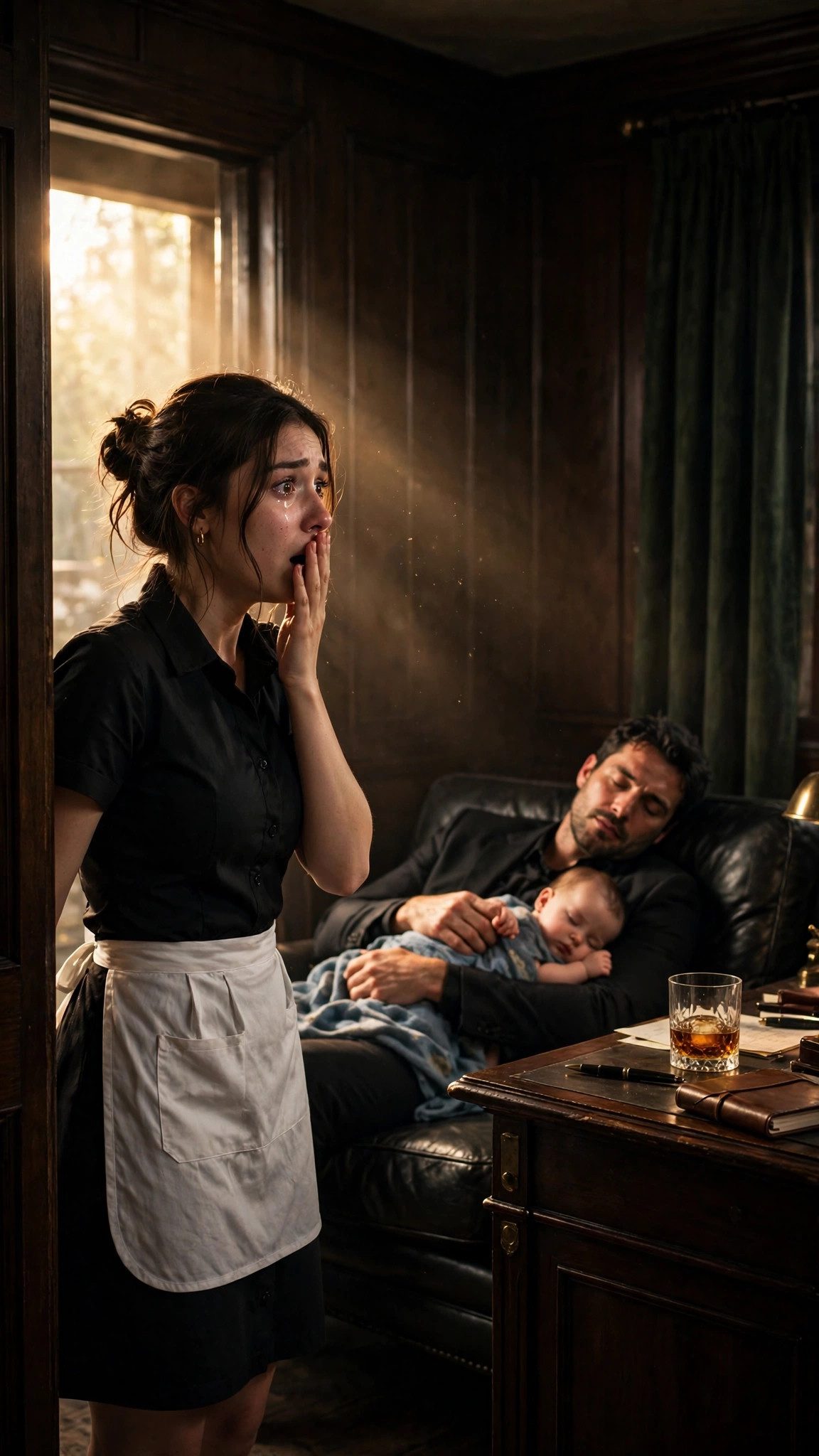
Sometimes, on quiet evenings, after the last guest has gone and the dining room is dark, I go downstairs to the basement office — the dark-wood room with the black leather couch where it all began — and I find Damian there, fast asleep, with Ellie pressed against his chest. Her tiny body rises and falls with his breathing. Her cheek rests on his white shirt. Her tiny fist is curled around his finger. And I stand in the doorway, and I watch them, and I think about the night I found them like that for the first time, and how terrified I was, and how I shouted, "Give me my baby back!"
And now, I do not shout. I just walk in, quietly, and I sit down beside them on the black leather couch, and I lean my head against his shoulder, and I close my eyes, and I listen to them breathe — my husband, and my daughter, asleep together, safe together, home together.
That is the end of the story. Not the end of our story — our story is still going, every day, in a restaurant in Manhattan, with a yellow nursery upstairs, and a garden out back, and a mobile of silver stars turning slowly above a crib. But it is the end of the part where I was afraid. The part where I was alone. The part where I thought that a waitress and a feared man in a black suit could never belong to each other.
We belong to each other. We always did. From a terrace at the Plaza, thirteen months ago, when a stranger touched my locket with one fingertip, and said, "Your mother had good taste." From the night he fell asleep with my daughter on his chest, and I found them, and I understood, finally, what he had been trying to tell me all along.
He had not taken my baby. He had been holding her. He had been holding her like she was the only safe thing in the world. And now, he holds us both. And we hold him. And that is what a family is.
The End.
THE END