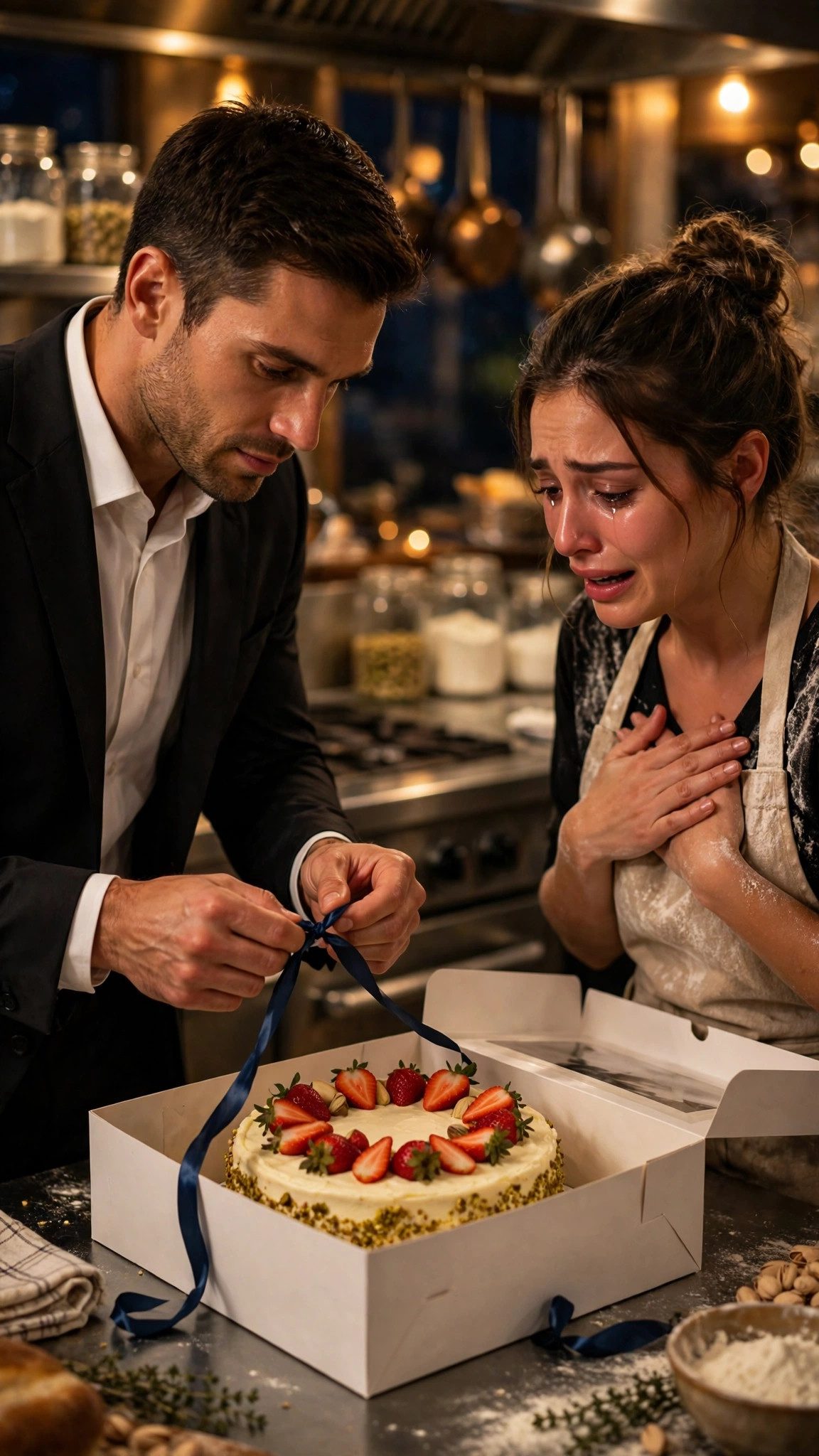
For two weeks after that dinner, my life felt like something out of a dream. Adrian came to Sable every night I worked, and after close, we sat in the kitchen together, and I taught him how to fold butter into dough, and he told me about his mother, and about the family business, and about the weight of a name that opened doors and closed them just as fast. He was patient. He was gentle. He was nothing like the man the city whispered about, and I started to believe, slowly, carefully, that maybe the whispers were only half the story.
Claire called every day. "Are you happy?" she asked, every single time, and every single time I said, "Yes," and every single time I meant it a little more.
I should have known it couldn't last. In Adrian's world, happiness is a target. It always has been. I just didn't know that yet.
It started small. A black car parked across from my apartment, there when I came home, gone when I woke up. A man in a grey coat standing too long outside Sable's back door, smoking, watching the kitchen windows. A wrong-number call at two in the morning, breathing on the other end, and then nothing.
I told myself I was imagining it. I told myself I was being paranoid, that this was what happened when you fell in love with a man like Adrian Vale, that you started seeing threats in every shadow. I didn't tell Adrian. I didn't want to worry him. I didn't want to be the girl who couldn't handle his world.
Then, on a Friday night, I came home from my shift and found a note slipped under my apartment door.
It was a single sheet of white paper, folded once, with four words written on it in neat black type: Pretty cakes burn fast.
My hands went cold. My heart started pounding so hard I could hear it in my ears. I stood in my hallway with the note in my hand, and I looked at my door, and my windows, and the dark stairwell behind me, and I understood, all at once, that someone had been inside my building. Someone had stood outside my door. Someone knew where I lived, and when I came home, and what would frighten me most.
I locked the door. I locked it twice. I checked the windows. I checked the closet. I sat down on the floor with my back against the door, holding the note in both hands, and I called Claire. She answered on the second ring, and I read her the note, and I heard her breath catch.
"Ella, call Adrian," she said. "Call him right now. Don't wait. Don't think about it. Call him."
"I don't want to drag him into this," I said. "I don't want to be the reason—"
"Ella," Claire said, and her voice was sharp in a way I had never heard it before. "Someone threatened you. Someone came to your home. You call the man who loves you, and you let him help you. That's what love is. That's what it's for. Call him. Now."
So I did. I called Adrian. I didn't think about it. I just called him, and he answered on the first ring, and I said, "Someone left a note under my door," and I read it to him, and there was a silence on the other end of the line so complete it felt like the whole city had stopped breathing.
"Don't move," he said. "I'm coming. Silas is already on his way. Do not open the door for anyone but Silas."
Ten minutes later, Silas knocked, three short raps, and when I opened the door, he was standing there with two other men I had never seen, both of them big and quiet and watchful, and they checked my apartment room by room, closet by closet, while I stood in the kitchen with my arms wrapped around myself, shaking.
"He'll be here soon," Silas said, gently, like he was talking to a frightened animal. "You're safe now, Ms. Bell. No one will touch you. Not while we're here."
Adrian arrived twenty minutes later. He walked into my apartment, and he looked at the note, and he looked at me, and I saw something in his face I had never seen before. Not anger. Something colder than anger. Something that made the whole room feel smaller.
"Victor Kessler," he said, and the name fell into the room like a stone into still water. "He runs the docks on the south side. He has wanted my territory for years. He found out about you, and he thinks you are a weakness he can use."
"A weakness," I repeated. My voice sounded very far away. "I'm a weakness."
"You are not a weakness," Adrian said, and he took my face in his hands, very gently, and made me look at him. "You are the best thing in my life. Kessler doesn't understand that. Men like him only understand leverage. They think if they frighten you, they frighten me. They are wrong. But they will try, and I need you to be careful, and I need you to let me protect you."
"I don't want protection," I said. "I want a normal life. I want to go to work and come home and not have men checking my closets."
"I know," he said. "I know. And I'm sorry. I am so sorry, Ella. This is my world. This is what it costs to be near me."
For three days, I lived like a prisoner in my own life. Silas drove me to work. A man I didn't know stood outside Sable's back door all night. Another one sat in a car across the street from my apartment. I tried to work. I tried to be normal. But every time a customer raised their voice, I jumped. Every time the kitchen doors swung open, my heart stopped. I started dreaming about fire, about cakes burning in ovens, about my father's bakery going up in smoke, and I woke up sweating, night after night, with Adrian's arms around me, holding me, whispering that I was safe.
The worst part was the grocery store. On the second day, I needed milk and eggs, and Silas insisted on coming with me, and he walked three steps behind me the whole time, quiet and watchful, and I could feel everyone in the store staring at us. An old woman in the produce aisle looked at Silas, and then at me, and then at Silas again, and I could see her thinking, and I wanted to disappear. I wanted to be the girl in the kitchen again, invisible, unimportant, nobody's weakness and nobody's target. I bought the milk and the eggs, and I went home, and I sat at my kitchen table and cried, because I was afraid, and because I was angry at being afraid, and because I didn't know how to live in a world where buying milk required a bodyguard.
Carmen found me crying in the walk-in the next morning, sitting on a crate of butter with my face in my hands. She didn't ask what was wrong. She just sat down next to me, and she put her arm around me, and she waited until I stopped shaking.
"You know what your problem is?" she said, when I finally looked up. "You think being brave means not being scared. It doesn't. Being brave means being scared and showing up anyway. I have worked in kitchens for twenty-four years, honey. I have been scared plenty of times. Scared of the chef. Scared of the rush. Scared of losing my job. And I showed up every single day, because the work needed doing, and because I needed the work."
"I'm scared all the time now," I whispered. "I can't sleep. I can't think. Every shadow looks like a threat."
"Then be scared," Carmen said. "Be scared and bake the cake anyway. That's what your father would have told you. That's what any good baker would tell you. The oven doesn't care if your hands shake. It only cares that you put the cake in."
I went back to my station, and I baked. I baked all day, furiously, like the work could save me, and for a few hours, it almost did. The kitchen was warm, and the ovens were humming, and the smell of butter and sugar filled the air, and I could almost pretend that everything was normal. But every time the back door opened, my head came up, and every time Silas's shadow crossed the kitchen windows, my heart stopped, and I knew, with a sinking certainty, that pretending wasn't going to be enough.
On the fourth night, Kessler came to Sable himself.
It was after close. The dining room was empty. The kitchen was clean. Carmen and Theo had gone home, and I was alone at my station, wiping down the counters, when the front door opened, and three men walked in.
The man in front was tall and thin, with slicked-back grey hair and a smile that didn't reach his eyes. He wore an expensive suit, and a gold watch, and he moved through my restaurant like he owned it.
"Ms. Bell," he said. "What a pleasure. I've heard so much about your cakes."
My hands went still on the counter. "We're closed," I said.
"Oh, I know," Kessler said. "I just wanted to introduce myself. I'm Victor Kessler. A friend of Adrian's. Or perhaps I should say, a colleague." He smiled wider. "I hear he has become very fond of you. Fond enough to bring you a birthday cake, I understand. How sweet. How. . . domestic."
Behind him, his two men spread out, one by the door, one by the bar, and I understood, with a clarity that turned my blood to ice, that I was alone in a dark restaurant with three dangerous men, and that no one was coming to help me, and that this was the world Adrian lived in, every single day, and I had been a fool to think I could live in it too.
"What do you want?" I asked.
"Nothing much," Kessler said. "Just to deliver a message. Tell Adrian that the docks are mine now. Tell him that his little pastry chef is very pretty, and it would be a shame if something happened to her. Tell him that men who have something to lose are men who can be beaten." He leaned forward, just slightly, and his voice dropped. "And tell him that pretty cakes burn fast."
The kitchen doors swung open behind me, and Adrian walked in.
He didn't run. He didn't shout. He just walked in, calm and unhurried, with Silas and two more men behind him, and the whole room seemed to tilt toward him, the way iron filings tilt toward a magnet.
"Victor," Adrian said, very quietly. "You are in my restaurant, threatening my woman, after close, without an invitation. You have ten seconds to explain why I shouldn't have my men carry you out of here in pieces."
Kessler's smile faltered, just slightly. "Adrian. I was just saying hello."
"You left a note under her door," Adrian said. "You had your men follow her home. You came into her place of work, after hours, to frighten her." He took one step forward, and Kessler took one step back, and I saw, with a sudden, sickening clarity, that Victor Kessler, for all his expensive suits and his gold watch, was afraid of Adrian Vale. Genuinely, deeply afraid.
"I don't want a war, Adrian," Kessler said. "I want the docks. That's all. We can make a deal."
"There is no deal," Adrian said. "There will never be a deal. You will leave this restaurant, and you will never come near Ella Bell again. You will never speak her name. You will never send your men to her home. If you do, if I hear so much as a whisper that you have thought about her, I will come for everything you have. Your docks. Your men. Your money. All of it. Do you understand me?"
Kessler looked at him for a long moment, and then he nodded, once, and he turned and walked out, and his men followed him, and the door closed behind them, and the restaurant went silent.
Adrian turned to me. His face was white. His hands were shaking, just slightly, and I realized that he had been afraid too. Afraid for me. Afraid of what could have happened if he had been five minutes later.
I looked past him, at Silas, standing by the door with his hand still inside his jacket, and at the two men behind Adrian, both of them big and quiet and watchful. One of them was the broad man with the scar through his eyebrow, the same man who had watched us from table twelve on the night of my birthday, and I saw, with a sudden clarity, that these men would have done anything Adrian asked them to do. They would have stood in front of a bullet for him. And now, because he loved me, they would have stood in front of one for me too. I didn't know whether that made me feel safer or more afraid. Both, I think. Safer, because I was protected. More afraid, because I understood, finally, what protection cost in his world, and who paid for it.
"Are you all right?" he asked.
I looked at him. I looked at Silas, standing by the door with his hand inside his jacket. I looked at the dark restaurant, and the empty tables, and the kitchen where I had spent three years making desserts for people who would never know my name. And I understood, finally and completely, what it meant to love a man like Adrian Vale. It meant living in a world where men like Victor Kessler walked into your restaurant after close and threatened you, and where the only thing standing between you and them was the man you loved.
"I can't live in your world," I whispered. "I can't. I'm sorry. I love you, Adrian, but I can't live like this."
I took off my apron. I set it down on the counter, very carefully, like it was the last thing I would ever do in that kitchen. And then I walked out of Sable, into the cold Chicago night, and I didn't look back.