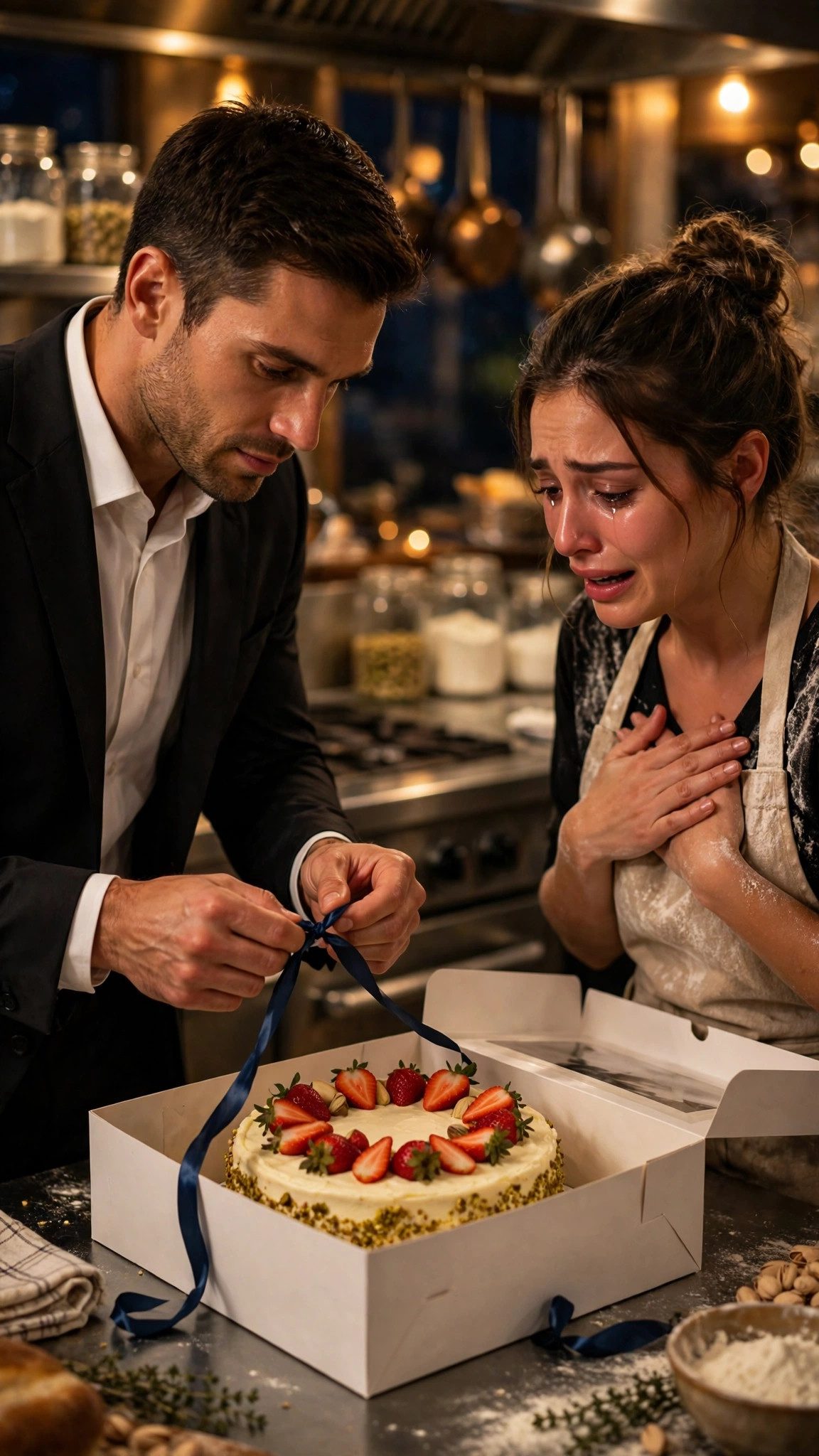
I didn't go back to Sable for three days. I called in sick, which I had never done before, not once in three years, and Mr. Cross was so surprised he didn't even argue. I stayed in my apartment above the laundromat, and I didn't answer Adrian's calls, and I didn't answer Silas's texts, and I sat at my kitchen table and stared at the white bakery box in my refrigerator, which was now empty except for crumbs, and I tried to figure out how to go back to being the girl I had been before my thirty-second birthday.
On the second day, I tried to bake. I don't know why. Maybe I thought the work would save me, the way it always had. I pulled out the flour and the butter and the sugar, and I tried to make my father's cake, from memory, the way he used to make it. Vanilla buttercream. Strawberries. Pistachios. I didn't measure anything, because Dad never measured anything, and I told myself that was the point.
It came out wrong. The buttercream was too thin. The strawberries slid off. The pistachios clumped together in wet patches. I stood at my kitchen counter, staring at the ruined cake, and I started to cry, because it wasn't just a cake. It was proof. Proof that I couldn't do it without him. Proof that my father was really gone, and that the bakery was really gone, and that the girl who used to arrange strawberries in crooked circles on a stool in Milwaukee was gone too.
My phone rang. It was my mother.
"Ella?" she said. "Claire told me what happened. Are you all right?"
"No," I said, and my voice cracked. "Mom, I'm not all right. I tried to make Dad's cake, and it came out wrong, and I don't know how to fix it, and I don't know how to fix any of this."
There was a long silence on the other end of the line. Then my mother said, very gently, "Oh, honey. Your father ruined that cake a hundred times before he got it right. The first time he made it for your birthday, when you were five, the whole thing slid off the plate and onto the floor. He just scooped it up, put it back on the plate, and said, 'Well, now it's rustic.' You laughed so hard you nearly fell off your stool."
I wiped my eyes. "I don't remember that."
"You were five," Mom said. "You don't remember the failures. You only remember the good ones. That's how memory works. But your father failed plenty, Ella. He just never let a failure stop him. He would scrape it off the floor, put it back on the plate, and try again. That's what bakers do. That's what your father did. And that's what you do, too. You just forgot."
I looked at the ruined cake on my counter. The thin buttercream. The sliding strawberries. The clumped pistachios. And I thought about my father, scooping a cake off the floor and calling it rustic, and I thought about Adrian, who had spent twenty years trying to be worthy of a kindness, and I thought about myself, sitting in my pajamas, hiding from a man I loved because I was afraid.
"Mom," I said, "what would Dad say? About Adrian? About all of this?"
Mom was quiet for a moment. Then she said, "Your father would say that a man is measured by what he remembers, and by what he does when no one is watching. And he would say that the man who brought you your birthday cake, the man who remembered a conversation you forgot, is a man who remembers. And he would say, 'Ella, don't be afraid of being loved. Being loved is the bravest thing there is.'"
I sat there with the phone against my ear, and I cried, and my mother waited, patient as she had always been, until I stopped.
"Thank you, Mom," I whispered.
"Come home soon," she said. "The dishwasher is leaking again, and I need someone to fix it."
I laughed, wet and shaky, and I promised I would come home soon, and after we hung up, I stood at my kitchen counter and I looked at the ruined cake, and I scraped it off the plate, and I started over. This time, I measured the buttercream. This time, I chilled the strawberries first. This time, I pressed the pistachios on one at a time, slowly, carefully, the way Dad had taught me when I was twelve and my hands were finally steady enough to do it right.
This time, it came out perfect. Not because I wasn't afraid. Because I was afraid, and I did it anyway.
The problem was that I couldn't remember how to be her. That girl had been invisible, and she had been safe, and she had been lonely, and I had spent three years telling myself that was enough. Now I knew what it felt like to be seen, and I knew what it felt like to be loved, and I knew what it cost, and I didn't know if I was brave enough to pay it.
On the third day, Claire came to Chicago.
She let herself in with the spare key I had given her years ago, and she found me sitting at the kitchen table in my pajamas, unwashed hair, cold coffee, and she didn't say a word. She just put her bag down, took off her coat, and started cleaning my kitchen. She washed the dishes. She wiped the counters. She threw out the dead flowers on the windowsill. And when the kitchen was clean, she sat down across from me and said, "Talk."
So I talked. I told her about the note. I told her about the black car. I told her about Kessler walking into Sable after close, and about Adrian walking in behind him, and about the way the whole room had tilted. I told her about the fear, and the shaking, and the way I had taken off my apron and walked out into the cold night and not looked back.
"I love him," I said, when I finished. "I love him, Claire. And I left him. And I don't know if I did the right thing or the worst thing I have ever done."
Claire was quiet for a long moment. Then she reached across the table and took my hand, and she said, "Do you remember what Dad used to say? About how a man is measured?"
"A man is measured by what he remembers," I said. "And by what he does when no one is watching."
"That's what he said to Adrian," Claire said. "But do you remember what he used to say to us? To you and me, when we were girls and we were scared of something?"
I shook my head. I couldn't remember. My head was too full of Kessler and notes and black cars.
"He used to say, 'Being brave doesn't mean not being afraid, girls. It means being afraid and doing it anyway. The cake doesn't care if your hands shake. It only cares that you put it in the oven.'" She squeezed my hand. "Ella, you are afraid. Of course you're afraid. A man threatened you in your own restaurant. Anyone would be afraid. But being afraid doesn't mean you have to run. It means you have to decide what you're afraid of losing more. Your safety, or him."
"I don't want to lose either," I whispered.
"I know," Claire said. "But you can't have both, not the way you want them. Not a perfectly safe life and a man like Adrian. You have to choose. And whatever you choose, I'll stand behind you. But choose, Ella. Don't just sit here in your pajamas and let the choice make itself."
That night, after Claire left, I sat at my kitchen table for a long time, thinking about my father. I thought about the morning he didn't come downstairs. I thought about the bakery going quiet. I thought about the developer tearing the sign down. I thought about all the things I had lost because I was too afraid, or too tired, or too careful to fight for them. And I thought about Adrian, who had spent twenty years trying to be worthy of a kindness he had received when he was seventeen, and who had never once asked me for anything except the chance to be near me.
I picked up my phone. I stared at Adrian's number for a long time. And then, before I could talk myself out of it, I called him.
He answered on the first ring. "Ella."
"Can we talk?" I asked. "Not at Sable. Not at a restaurant. Somewhere quiet. Just us."
"Yes," he said. "Anywhere. Anytime. Tell me where."
I told him to come to my apartment. An hour later, he knocked, three short raps, and when I opened the door, he was standing there alone. No Silas. No men. Just Adrian Vale in a black coat, holding a small paper bag, looking tired in a way I had never seen him look tired before.
"I brought you something," he said, and held out the bag. Inside was a single chocolate cupcake, unfrosted, on a paper plate. "From the bakery on the corner. It's not much. But I wanted you to have something that was just yours. No occasion. No reason. Just because."
I took the bag, and my throat closed, because it was the smallest, kindest thing anyone had done for me in days, and it was from the most feared man in Chicago.
"Come in," I said.
He came in, and we sat at my kitchen table, and for a long time, neither of us said anything. Then he said, "I have been thinking about what you said. About not being able to live in my world. And you are right. My world is dangerous. It will always be dangerous. I cannot make it safe. I have tried, for years, and I cannot. But I can do something else."
He reached into his coat, and my heart stopped, because the last time he had reached into his coat, he had pulled out a receipt and changed my life. This time, he pulled out a folded document, and he set it on the table between us, and he slid it toward me.
"What is this?" I asked.
"The deed," he said, "to the building on the corner in Milwaukee. Bell's Bakery. I bought it three months ago, when I heard the developer was going to sell it. It has been sitting empty. I didn't know what to do with it. Now I do." He looked at me, grey eyes steady. "It's yours, Ella. Your name is on the deed. No strings. No conditions. No price. If you want to reopen the bakery, it's yours. If you want to sell it, it's yours. If you want to burn it down, it's yours. I am not giving it to you so you will stay with me. I am giving it to you because it was your father's, and it should have been yours all along, and I was wrong to hold onto it."
I stared at the deed. I stared at the words "Ella Bell" printed in neat black type. I stared at the address of the corner in Milwaukee where the morning light came in low and gold, and I felt something inside me break open, something that had been closed for four years, since the morning my father didn't come downstairs.
"You bought my father's bakery," I whispered.
"I bought a building," he said. "You are the one who can make it a bakery again."
I looked at him. I looked at the deed. I looked at the chocolate cupcake on the paper plate. And I understood, all at once, what my father had meant. A man is measured by what he remembers, and by what he does when no one is watching. But he is also measured by what he does when it costs him something. Adrian had just given away the one thing he could have used to keep me. He had given me my father's bakery, with no strings, knowing I might take it and walk away and never come back. He had given me a choice. A real choice. The first real choice anyone had given me in years.
"I don't want the bakery," I said, and his face went very still. "Not like this. Not as a gift I didn't ask for, from a man I'm afraid of." I pushed the deed back across the table toward him. "But I want you, Adrian. I want you, and I want your world, and I want to be brave enough to live in it. I just need you to promise me something."
"Anything," he said.
"Promise me that I get to choose," I said. "Promise me that I get to decide when I stay and when I go. Promise me that you will never lie to me about the danger, and that you will never keep me in the dark to protect me. Promise me that we do this together, or not at all."
He took my hand across the table, and he held it, very gently, like it was something breakable, and he said, "I promise."
"And the bakery?" I said. "We'll reopen it together. On my terms. I run it. I decide. You can fix the roof."
He almost smiled. It was the closest I had ever seen him come to one. "I can fix the roof," he said.
I leaned across the table, and I kissed him. Not a promise. Not almost a kiss. A real kiss, in my small kitchen above the laundromat, with the radiators clanging and the deed to my father's bakery sitting on the table between us, and it tasted like chocolate and rain and the beginning of everything.
When we broke apart, he rested his forehead against mine, and he said, very quietly, "Thank you for choosing me."
"Thank you for letting me choose," I said.