Noelle Grace Vale was born on the third of December, in the first snow of winter, at St. Catherine's Hospital in Chicago, in the very ward where her mother had once been a nurse.
Elena had chosen the name months earlier, in San Diego, sitting on the beach at sunset. Noelle, for Christmas, for the night her father had discovered he was going to be a father. Grace, for Elena's mother, who had taught her daughter that courage was not the absence of fear but the decision to love anyway.
The labor lasted eleven hours. Marcus did not leave her side for a single minute of it. He held her hand. He wiped her forehead. He whispered to her, "You are the bravest person I have ever known," and when the doctor said, "One more push," he leaned down and kissed her hair, and said, "You can do this. I know you can."
And then, suddenly, there was a cry, thin and fierce and furious, and the nurse laid a small, red, perfect baby girl on Elena's chest, and the whole world went quiet, and then it filled up with light.
"Hello, Noelle," Elena whispered, tears running down her face. "Hello, my darling. I'm your mama. I've been waiting for you."
Marcus leaned over them, and his hands were shaking, and he touched his daughter's tiny fingers with one fingertip, and the baby curled her hand around it, and held on.
"She has your eyes," he said, his voice breaking. "Elena, she has your eyes."
Dr. Reyes, who had delivered the baby herself, stood at the foot of the bed, smiling through her own tears. "She is perfect," she said. "Seven pounds, four ounces. Strong lungs. A very determined young lady."
That night, in the quiet of the hospital room, Marcus sat in the chair beside Elena's bed, holding his daughter in his arms, and he looked down at her small face, and he whispered to her, "I didn't know, Noelle. I didn't know you were coming. Your mother tried to tell me, and I was too afraid to listen. But I am here now. And I will be here for every day of your life. I promise you that."
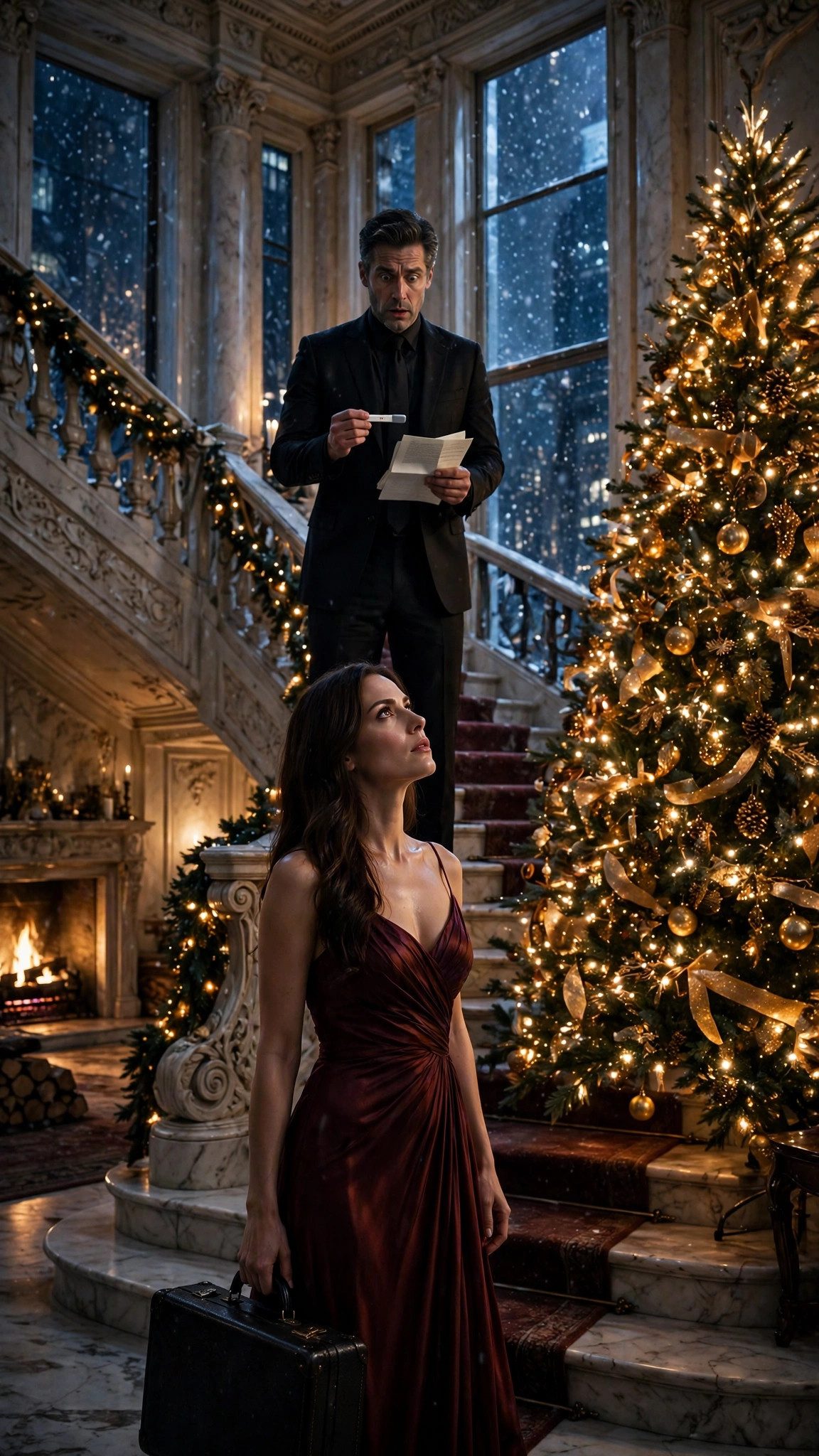
Elena watched them from the bed, her husband and her daughter, bathed in the soft light of the hospital room, and she thought about the Christmas Eve, one year earlier, when she had signed divorce papers and placed a pregnancy test on top of them, and walked down a grand staircase toward a life without this man.
She had been so sure, that night, that love had ended. She had been so sure that the silence had won.
She had been wrong. Love had not ended. It had been waiting, in the dark, for someone brave enough to speak the truth out loud.
The first weeks at home were a blur of sleepless nights and tiny feedings and the smell of baby powder and the sound of Noelle's breathing in the nursery, in the room beside theirs, exactly as Marcus had promised.
He was there for all of it. He changed diapers, badly at first, and then better. He walked the floor at three in the morning, singing lullabies in Italian, his deep voice low and warm. He read to her from the children's books Elena loved, doing all the voices. He took her to the garden in her stroller, and he showed her the white roses, and he told her, "These are your mother's roses, Noelle. Your mother planted them. She makes everything beautiful."
Elena watched him, and her heart healed a little more every day.
Her father, Thomas Carter, came from Columbus for Christmas, and he held his granddaughter in his arms, and he looked at Marcus, and he said, "You kept your promise, son. You did not disappoint her."
"I try every day, sir," Marcus said. "I will try every day for the rest of my life."
On Christmas Eve, one year after the night Elena had signed the divorce papers, Marcus did something she did not expect.
He took her downstairs, to the great hall, where the fifteen-foot tree stood, decorated again, this time by both of them, together, with Noelle asleep in her bassinet beside them. The ornaments Elena had hung alone, a year earlier, were still there. But now there were new ones, too: a tiny silver rattle, a small white stocking with the name Noelle stitched on it in gold thread, and a star at the top of the tree that Marcus had hung himself, standing on a ladder, while Elena held it steady.
"Do you remember this tree?" he asked.
"I remember," Elena said.
"Last year, you decorated it alone," he said. "This year, we decorated it together. Next year, Noelle will help us. And the year after that, and the year after that. That is my promise to you, Elena. That you will never decorate this tree alone again."
And then he went down on one knee, in front of the tree, in front of the fire, in front of their sleeping daughter, and he took her hands in his, and he said, "Elena Carter Vale. A year ago, I almost lost you, because I was too afraid to tell you the truth. Tonight, I want to tell you the truth, all of it, in front of God and this tree and our daughter. I love you. I have always loved you. I will always love you. And I want to spend the rest of my life proving it to you, every single day. Will you renew your vows with me? Will you marry me again, here, tonight, in our home, with our daughter as our witness?"
Elena looked at him, kneeling in front of her, his grey eyes wet, his hands shaking, and she thought about the man who had stood in the rain, and the man who had burned the sauce, and the man who had cried in his study, and the man who had given away a territory and fired his own men and flown to San Diego with no guards and asked her to come home.
And she said, "Yes. Yes, Marcus. I will marry you again."
There was no cathedral. There was no crowd. There was only the two of them, and their daughter, and Rocco Bellini standing quietly in the doorway as a witness, and Dr. Reyes, who had come for Christmas dinner and stayed for the ceremony, and Elena's father, who stood beside her and gave her away all over again, with tears in his eyes.
Marcus had hired a violinist, a young woman who played in the corner of the great hall, and the music rose up through the mansion like light, and Elena walked down the grand staircase in a simple white dress, holding a bouquet of white roses from her garden, and Marcus waited for her at the bottom, and when she reached him, he took her hands, and he said, "You are the most beautiful thing I have ever seen."
They spoke their vows again, slowly, looking into each other's eyes. Not the grand, formal vows of their first wedding, but simple words, honest words, words they had written themselves.
"I promise to tell you the truth," Marcus said. "Always. Even when it is frightening. Especially when it is frightening."
"I promise to listen," Elena said. "And to tell you when I am hurting, instead of waiting in silence."
"I promise to be present," Marcus said. "For you, and for our daughter, every day, in every way that matters."
"I promise to let you," Elena said. "And to build this life with you, one day at a time."
And then he kissed her, in front of the tree, in front of the fire, in front of their family, and Noelle woke up in her bassinet and made a small, happy sound, as if she approved.
After the ceremony, after the dinner, after the toasts, after Rocco had raised his glass and said, "To the Vale family," in a voice that was rough with emotion, Elena found a package on the table in the drawing room. It was wrapped in plain brown paper, with no card, and inside was a hand-knitted blanket, soft and white, with tiny roses stitched along the edge.
There was a letter with it, in Vivian Vale's precise handwriting.
"Dear Elena," it read. "I was wrong. I have been wrong for a long time. I believed that strength meant never bending, and that love was a weakness to be managed. I see now that I was afraid, and that my fear made me cruel. I am sorry for what I said to you, and for what I did. I do not ask for forgiveness. I only ask that you let me meet my granddaughter, once, if you are willing. I would like to hold her, and to tell her that her grandmother loves her. With respect, Vivian."
Elena read the letter twice. Then she showed it to Marcus.
"What do you want to do?" he asked.
Elena thought about it for a long time. She thought about the woman who had called her furniture, and who had offered her two million dollars to disappear, and who had nearly gotten her killed on Michigan Avenue. And she thought about the woman who had knitted a blanket with her own hands, and who had written a letter that said, I was wrong.
"She can come for Christmas lunch," Elena said. "Once. Supervised. She can hold Noelle, and she can tell her she loves her. And if she is kind, and if she respects us, then we will see. But she will never live in this house again. And she will never speak to me that way again. Those are my terms."
"Those are good terms," Marcus said, and he kissed her forehead. "You are a better person than I am, Elena. You always have been."
Vivian came for Christmas lunch, two days later. She was quiet. She was careful. She held Noelle in her arms, and tears ran down her face, and she whispered to the baby, "Hello, my darling. I am your grandmother. I have been waiting to meet you."
And Elena watched her, and she thought about forgiveness, and about how it was not a single moment, but a long road, and about how she was walking that road now, one step at a time, with her husband beside her and her daughter in her arms.
Noelle's first Christmas morning arrived with snow falling over Lake Shore Drive, soft and silent, just as it had fallen a year earlier, on the night her mother had signed divorce papers and placed a pregnancy test on top of them.
Elena woke early, before the sun, and she went downstairs in her robe, and she stood in the great hall, looking at the fifteen-foot tree. It glittered in the dark, the lights reflecting off the ornaments, and the stockings hung in a row above the fireplace: one for Marcus, one for Elena, and one small white one, with the name Noelle stitched on it in gold thread.
Marcus came downstairs behind her, carrying Noelle in his arms, the baby wrapped in the hand-knitted blanket Vivian had sent, and he stood beside his wife, and together they watched the tree, and the snow falling outside the windows, and the fire burning low in the fireplace.
"Do you remember last Christmas?" he asked quietly.
"I remember," Elena said.
"Last Christmas, you were leaving," he said. "This Christmas, you are here. And she is here. And I am here. And I want you to know that I think about that night every single day. I think about how close I came to losing everything. And I think about how lucky I am that you gave me one week."
"You earned more than a week," Elena said. "You earned a lifetime. Don't waste it."
"I won't," he said. "I promise you, Elena. I won't."
They sat by the fire, with Noelle between them, and they opened the presents slowly, one at a time, the way Elena's mother had always insisted presents should be opened, and Marcus gave Elena a silver bracelet, to match the one he had bought her on the Amalfi Coast, and Elena gave Marcus a framed photograph of the three of them, taken on the beach in San Diego, and Marcus held it for a long time, and he said, "This is my favorite thing in the whole house."
Later, after breakfast, after Elena's father had called from Columbus to wish them a merry Christmas, after Rocco had stopped by with a gift for Noelle and tears in his eyes, Elena took her daughter into the garden, bundled up against the cold, and she showed her the white roses, sleeping under the snow.
"These are your roses, Noelle," she said. "Your mama planted them. And one day, when you are bigger, I will teach you how to tend them. Because roses are like love, my darling. They need attention, and honesty, and patience. And if you give them those things, they will bloom, even in the coldest winter."
Noelle gurgled, and reached for a snowflake, and Elena laughed, and Marcus came out into the garden, and he put his arms around both of them, and the three of them stood there together, in the snow, in the garden, in the home they had built together, one honest day at a time.
That night, after the guests had gone, after the house was quiet, Marcus carried Noelle upstairs to the nursery, and he laid her in her crib, and he stood over her for a long moment, watching her sleep, and then he came back to the bedroom, and he found Elena standing at the window, looking out at the snow falling over Lake Shore Drive.
He came up behind her, and he put his arms around her, and he rested his chin on her shoulder, and together they watched the snow drift past the lights along the lake, soft and silent and beautiful.
"Merry Christmas, Mrs. Vale," he said.
"Merry Christmas, Daddy," she said, and she turned in his arms, and she kissed him, and outside the window, the snow kept falling, and inside the mansion, the tree glittered, and the fire burned low, and the house was full of love, and it was, at last, a home.
And that, she thought, was the best Christmas gift of all. Not the bracelet. Not the photograph. Not the house, or the roses, or the tree.
The gift was this: a family, built not on fear, but on truth. A husband who stayed. A daughter who laughed. And a future, bright and open, stretching out before them like the snow-covered garden, waiting to be walked together, one step at a time, for the rest of their lives.
She had been a nurse. She had been a wife. She had been furniture in a mansion. She had been a woman walking away with three suitcases and a secret.
Now she was a mother. Now she was a wife again, on her own terms. Now she was Elena Carter Vale, standing in her own garden, holding her daughter, loved by a man who had finally learned how to love her out loud.
The End.
THE END