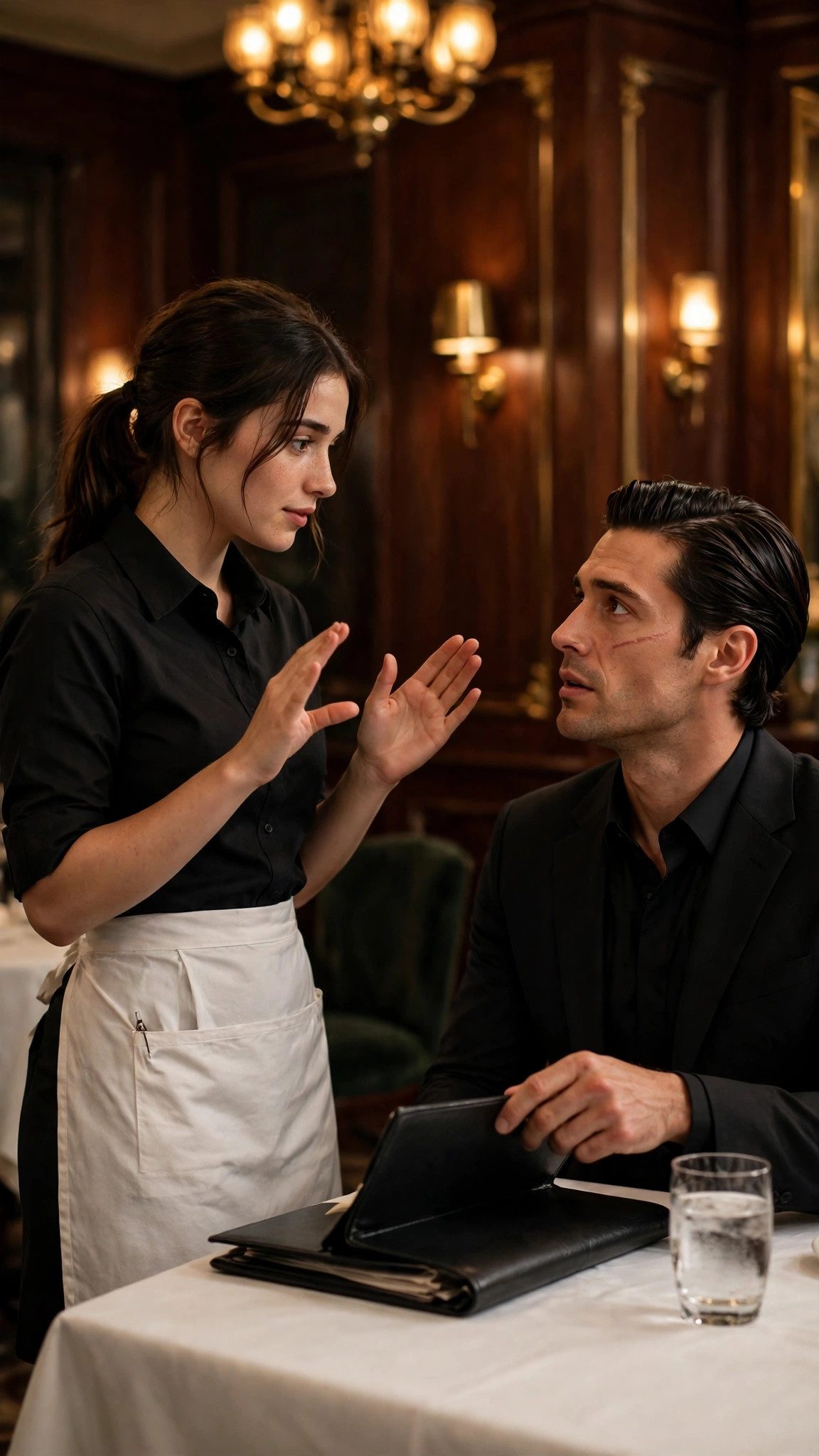
The joke was supposed to end with me humiliated in front of the most feared man in Chicago. Instead, ten minutes after my coworkers shoved me into his private dining room alone, their laughter stopped, and Salvatore Marquetti looked past me at the service door like he had just decided someone was going to pay.
I hadn't even understood what I'd done yet. All I knew was that Brett's face had gone white behind the little glass window. And Salvatore had seen him.
"Private room. He's all yours." Those were the exact words Brett had used when he handed me the order ticket earlier that night. His smile should have warned me. Actually, it did. Brett only smiled like that when somebody else was about to become the evening's entertainment.
Two waitresses standing near the bar immediately turned away, shoulders shaking with suppressed laughter.
"What?" I asked.
Brett leaned closer. "Nothing, Tessa." Then he tapped the ticket against my shoulder. "Just make sure you give our guest your famous personality."
More laughter. I stared at him. Something was wrong. I had worked at Bellini House long enough to recognize a setup. At twenty-seven, I had spent four years carrying crystal glasses and thousand-dollar bottles between people who rarely looked directly at me. I knew which customers wanted silence, which wanted attention, and which treated servers like furniture. I also knew my coworkers thought I was strange. I didn't stay after shifts. I didn't flirt for better tips. I didn't spend breaks dissecting customers' marriages or comparing who had received the biggest phone number that week. When my shift ended, I left. Every Wednesday, I went straight to a small community center across town. Nobody at work knew why. And I preferred it that way.
My younger brother had lost most of his hearing after a childhood illness. I still remembered the first time I realized how lonely silence could make someone feel. We had been teenagers. A relative had told a joke at Thanksgiving. Everyone laughed. My brother smiled too, a second late, because he had learned to copy the people around him when he didn't understand what had been said. That smile destroyed me. So I learned American Sign Language. At first, badly. Then obsessively. I learned because I never wanted my brother to sit in a room full of people he loved and feel alone again.
Brett knew none of that. To him, I was simply the quiet waitress who never joined the group. And apparently, tonight, that made me useful.
"Who's in the private room?" I asked.
The giggling stopped for half a second. Then one of the women whispered, "You seriously don't know?"
Brett folded his arms. "Salvatore Marquetti."
My stomach tightened. Even I knew that name. Everybody in Chicago did. Thirty-three years old. Old money, depending on which rumor you believed. Dirty money, according to another. A scar along one cheek. A collection of businesses with menacingly clean paperwork. And a reputation that made even wealthy customers lower their voices. Some said he controlled half the West Side. Others said he had destroyed men for less than disrespect. I had no idea which stories were true. But I knew what people did when Salvatore Marquetti entered Bellini House. They noticed. They stopped laughing so loudly. Managers suddenly appeared. Nobody made mistakes.
Except tonight, apparently, Brett wanted me to make one.
"He's difficult," another waitress murmured.
Brett smirked. "That's one word for it."
"What’s that supposed to mean?" He shrugged. "He ignores staff. Doesn't answer questions. Sends things back. Makes people stand there like idiots."
The waitress beside him covered her mouth, already smiling. That was when I understood. They weren't sending me in because they trusted me. They were sending me in because they wanted to watch him humiliate me.
I looked at Brett. "You could assign someone else."
His eyebrows rose. "Scared?"
There it was. The trap inside the trap. If I refused, they would laugh. If I went in and failed, they would laugh harder. So I picked up the tray.
"I'm working, Brett."
His grin widened. "Good luck."
I pushed through the private dining room door. The noise of the restaurant disappeared almost instantly. The room was elegant in that expensive, suffocating way rich places sometimes were — dark wood, polished brass, white linen, low golden light spilling from a chandelier overhead. And Salvatore Marquetti sat alone at the table. Black suit. Black shirt. No tie. Dark hair swept back. A faint scar cutting along one cheek. He wasn't looking at me. He was reading something inside a leather folder, one hand resting beside an untouched glass of water.
I walked closer. "Good evening, Mr. Marquetti."
Nothing.
I waited. "Sir?"
Still nothing. My pulse quickened. So Brett had been telling the truth. Salvatore really did ignore people. At least, that was what I thought.
I placed his plate carefully on the table. "Tonight's special is—"
A violent crash exploded from the corridor behind me. Someone had dropped a tray. Glass shattered. Silverware struck tile. Several voices gasped. I flinched so hard my shoulder tightened. Salvatore didn't move. Not even slightly. His eyes remained on the folder.
And suddenly, every strange detail rearranged itself inside my head. The unanswered greeting. The silence. The reports that he ignored servers. The way he hadn't reacted to the tray.
He wasn't ignoring me.
I stopped breathing for a second. Then I looked at his face differently. There was no arrogance there. No mockery. No satisfaction from making me uncomfortable. He simply hadn't heard me.
My heart pounded. Behind me, through the narrow window in the service door, I caught movement. A face disappeared. Brett. Watching. Waiting for me to fail.
I turned back toward Salvatore. For one second, I considered doing what any other server might have done — place the food down, walk away, and let the misunderstanding continue. Instead, I stepped into his line of sight.
Salvatore looked up. His expression was guarded. Impatient, perhaps. But mostly confused.
I raised my hands. His entire face changed.
"Hi. My name is Tessa. I'll be taking care of you tonight. What can I get for you?"
His eyes dropped instantly to my fingers. Then lifted to my face. For the first time since I entered the room, Salvatore Marquetti looked completely unprepared. His hand slowly left the leather folder. Then he signed back.
"You know sign language?"
I smiled before I could stop myself. Not because he was powerful. Not because I wanted a tip. Because I recognized that look. I had seen it on my brother's face the first time somebody outside our family signed directly to him. Surprise first. Then relief. Then that tiny hesitation people get when they're afraid the moment might disappear.
"My brother is deaf," I signed. "I learned because I never wanted him to feel isolated."
Salvatore went completely still. The intimidating man from every whispered rumor vanished for half a second. Something softer appeared underneath. He studied me. Not my uniform. Not the tray. Me.
Then something happened I absolutely had not expected. Salvatore Marquetti smiled. Not the polite smile wealthy customers gave servers before dismissing them. A real one. Small. Almost careful. It transformed his face.
And behind the service door, I heard the faintest sound. A chair scraping. I glanced toward the window. Three coworkers were crammed behind it now. The waitress who had laughed earlier wasn't smiling anymore. Brett stood closest to the glass. His mouth was slightly open.
Salvatore followed my gaze. The smile disappeared. His eyes narrowed. I immediately regretted looking.
He turned his attention back to me. "Are they watching us?"
My stomach dropped. I hesitated. That hesitation was answer enough. His jaw tightened. I tried to soften it.
"They were curious."
Salvatore's eyes flicked toward the door again. "Curious?"
I swallowed. I could have lied. Maybe I should have. But years of watching people treat my brother differently had made me hate the kind of silence that protected cruelty. So I signed carefully.
"They thought you would humiliate me."
Salvatore stared at me. The room seemed to become quieter. For several seconds, he did absolutely nothing. Then his gaze shifted to the service door. Brett was still visible through the glass. Salvatore saw him. And Brett knew it. His face drained of color.
Salvatore slowly turned back toward me. His hands moved with controlled precision.
"Tell whoever is watching us that they are no longer welcome here."
I froze. I wasn't sure I understood. "Here?"
His eyes never left mine. "Here."
A chill ran down my arms. This had stopped being a joke. I turned toward the service door. Brett disappeared from the window. Then I heard hurried footsteps outside. For one hopeful second, I thought he was simply running back to the kitchen. Then the handle moved. The door swung open.
Three large men in dark suits stepped into the private dining room. Nobody spoke. One positioned himself near the doorway. Another looked toward Salvatore. The third looked directly at me. Behind them stood Brett, pale and motionless.
And that was when I realized the prank my coworkers had arranged to humiliate me had just become something none of us were prepared for.
Salvatore raised one hand. The three men stopped instantly. Then he looked at Brett. And whatever Brett saw in Salvatore Marquetti's expression made him stop breathing.
The silence in that room was so complete I could hear my own heartbeat. Brett tried to speak. His mouth opened, but no sound came out, and I understood in that moment that fear can steal a voice the same way it steals everything else. One of the big men took a single step forward, and Brett flinched backward into the doorframe, his tray clattering to the floor behind him.
Salvatore's hands moved again, slow and deliberate, and this time he signed to me alone, his eyes never leaving Brett's face.
"Watch," he signed. "So you understand what I do to people who laugh at the deaf."
My stomach turned. I had spent years watching my brother be treated like a joke, and I had promised myself I would never stand by while someone was punished for cruelty in a way that made me cruel too. But before I could sign a single word, Salvatore's gaze came back to me, and something in it stopped me cold. It was not rage. It was a question.
He was waiting. For me.
"Please," I signed, my fingers shaking. "Don't hurt him. He is stupid, not evil. Firing him is enough."
The three men looked at their boss. Salvatore studied my hands for a long moment, and then, to my amazement, he nodded once, a short, sharp movement, as if my words had been an order he had decided to obey.
He turned to Brett and spoke aloud for the first time since I had entered the room. His voice was low and rough, the voice of a man who rarely used it, and every syllable landed like a door closing.
"You are finished at Bellini House. You will not work in this city again. If I hear your name in connection with my business, or with hers, I will not be this generous a second time."
Brett nodded so fast his chin nearly hit his chest. He backed out of the room without another word, and the two waitresses who had laughed with him vanished from the window like smoke.
The three men left as quietly as they had come, closing the door behind them, and suddenly it was only the two of us again, the chandelier humming above the white linen, the untouched plate of food going cold between us.
Salvatore looked at me for a long time. Then he signed, "Sit down."
"I can't," I signed back. "I'm working."
"You are working," he agreed, and a ghost of that careful smile touched his mouth again. "You are working for me now. Every night. This room. No one else serves me. Do you understand?"
I understood that my life had just changed in the space of ten minutes, and I had no idea whether that was a rescue or a trap of a different kind. But I understood something else, too. For the first time in four years at Bellini House, someone had looked at me and seen a person, not furniture.
"Yes," I signed. "I understand."
"Good." He picked up his fork at last. "Then tell me about your brother."
So I told him. I told him about Noah, about the meningitis that stole his hearing when he was nine, about the long year after when he stopped speaking almost entirely because he could not hear his own voice anymore. I told him about the Thanksgiving joke and the smile that came a second too late, and how that smile had rearranged my whole life. I told him about the community center on Wednesdays, where I taught sign language to parents who were terrified their children would grow up lonely, and how Noah sometimes came with me and helped the youngest ones, patient in a way only someone who had lived it could be.
Salvatore listened the way almost no hearing person ever had. He did not look away. He did not check his phone. He did not interrupt to tell me about someone he knew who had once met a deaf person. He watched my hands the way other men watched a woman's face, and when I finished, he was quiet for a long time, turning his water glass slowly between his fingers.
"Your brother is lucky," he signed at last. "Most people never get someone who learns their language."
"He would say the same about you," I signed back, and immediately wondered if I had gone too far. But Salvatore only nodded, as if I had said something obvious.
He ate slowly after that, and I served him the way I would have served anyone, except that every word between us traveled through our hands, and the room felt less like a private dining room and more like the only honest room in the whole restaurant. When he finally stood to leave, he took a black card from his jacket and set it on the table beside his plate.
"Tomorrow," he signed. "Seven o'clock. Same room. Ask for me at the door, and no one will stop you."
Then he walked out, and I stood alone among the white linen and the low golden light, holding a tray I had forgotten I was carrying, with my heart beating so hard I was certain the whole restaurant could hear it.
I did not sleep that night. I lay in my small apartment above the laundromat on Milwaukee Avenue and stared at the ceiling, replaying every second of the evening, and every time I reached the moment when his face changed — the moment he realized I could speak his language — I felt the same strange lift in my chest. It was not fear. I knew fear well. It was something I had not felt in a very long time, something dangerously close to hope.
The next morning, the restaurant was already different. The manager, Mr. Delgado, called me into his office before my shift and closed the door, which he had never done in four years.
"Brett is gone," he said, not looking at me. "Candace and Priya too. Mr. Marquetti's people delivered a letter this morning. I don't know what happened in that room last night, Tessa, and I don't want to know. But from now on, the private dining room is yours whenever he is here. No one else touches it. Those are his instructions, not mine."
I nodded, because there was nothing else to do. But as I walked back out onto the floor, past the tables I had served for four years, past the bar where my coworkers had laughed at me the night before, I understood something that would shape everything that came after.
Salvatore Marquetti had not saved me. He had chosen me. And in his world, being chosen was the most dangerous thing that could happen to a person.
I went to work anyway. I had never been good at walking away from dangerous things. My brother had taught me that silence was the most dangerous thing of all.