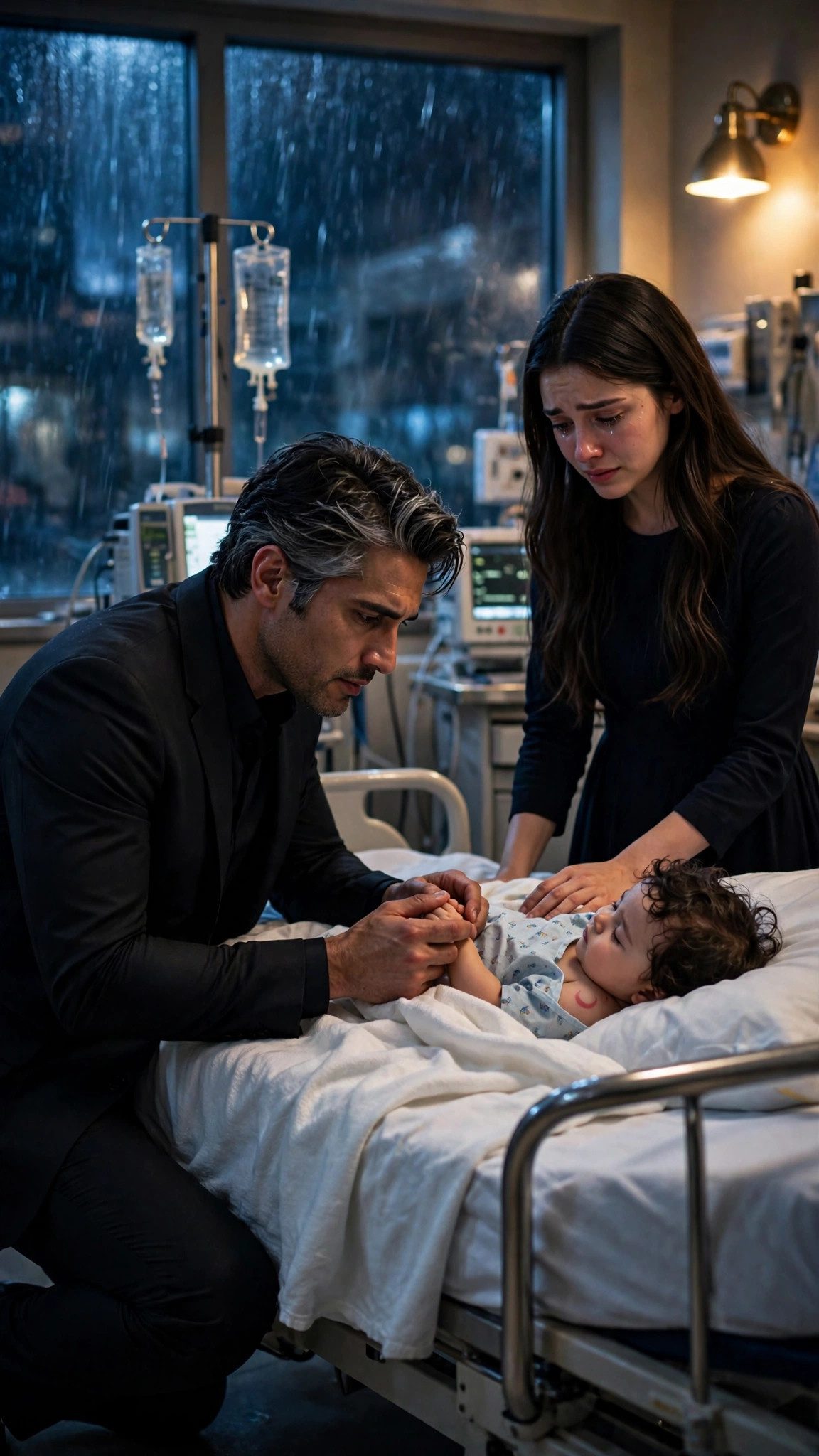
The first time Boston's most feared billionaire mafia boss saw the son I had hidden from him for fourteen months, he didn't shout, threaten me, or reach for a weapon.
He stopped smiling. Straightened. And reached for the boy's hand.
When my son laughed and held him back, Dante Russo's hands shook for the first time in his life. He whispered in Italian. And my name was not on his lips at all. It was my son's.
"Noah," he said, very quietly, like a man saying a prayer he did not quite believe. "Noah."
I was twenty-six years old, and my name was Mariah Cole, and I had spent fourteen months being very good at not being found. I had quit my teaching job. I had stopped returning calls from the only friends I had left. I had rented a nine-hundred-dollar-a-month apartment in Dorchester with a radiator that clanked and a window that looked out on a brick wall, because I did not tell the family I had a child, and I did not tell the child's father either.
And then, on one rainy evening in November, my son barely touched his supper, and his forehead was hot under my palm, and by nine o'clock his temperature was a hundred and four, and there was a red fever rising on his skin, and I did what any mother would do. I wrapped him in his blue blanket and I ran for the hospital, and I did not know that the most dangerous man in Boston was sitting in the same emergency room, three chairs down from the triage desk, waiting for news about his own mother.
I did not know. I swear to God, I did not know.
Noah was fourteen months old, with dark curly hair and ambitious eyes, the kind of eyes that looked at the world like it owed him an explanation. Most days were calm. Most days he woke up laughing and fell asleep with his fist curled around my finger, and most days I could almost believe we were safe. That night was not most days. That night his small body burned in my arms, and his breathing came fast and shallow, and when I pressed my lips to his forehead to check him again, he opened his eyes and looked at me, and he said, in his clear little voice, "Mama."
"Mama's here," I told him. "Mama's right here. We're going to make it better."
The waiting room at Mass General was full of the rain and the sick and the frightened, and the fluorescent lights buzzed overhead, and a television in the corner played the news with the sound turned down. I had Noah on my lap, and I was rocking him, and I was trying not to cry, because mothers are not supposed to cry in waiting rooms, because if you cry in a waiting room then everyone knows you are afraid, and I was afraid.
That was when I felt someone watching us.
I looked up, and the whole room seemed to go quiet, the way a room goes quiet when a storm is about to break. A man was standing by the vending machines, tall and broad-shouldered, in a black suit that cost more than six months of my rent, with dark hair going silver at the temples and eyes the color of a winter sea. He was looking at my son.
He was looking at Noah the way a man looks at something he has lost and never expected to see again.
"Mariah," he said.
I had not heard my name in his voice for fourteen months, and it hit me like a door slamming shut. My arms tightened around Noah. My heart hammered so hard I was sure the triage nurse could hear it.
"Dante," I said.
He came closer, slowly, the way you approach a wild animal, with his hands where I could see them. He stopped a foot away from us, and he looked down at Noah, and Noah, my brave, foolish, beautiful boy, reached up with his small hand and caught Dante Russo's little finger and held on.
Dante froze. His whole body went still. And then his hand began to shake. I watched it happen. I watched the most feared man in Boston stand in a hospital waiting room with his hand shaking like a leaf, because my fourteen-month-old son was holding his finger and laughing.
"Buongiorno, piccolo," Dante whispered in Italian, his voice rough. "Hello, little one."
Noah laughed again, and kicked his feet, and reached for Dante's face with his other hand. And Dante, very gently, as if the boy were made of glass, turned Noah's tiny shoulder just enough to look at the birthmark there. A faint red crescent moon, shaped like a small curved smile, on the soft skin above his shoulder blade.
Dante looked up and stared at me as if he had just seen a ghost.
That is when I realized that Noah was not just my son. He was a Russo. And Dante Russo had the same mark on his own shoulder. I knew it because I had seen it once, fourteen months and nine days ago, in the dark of a hotel room I had never meant to enter, on the shoulder of a man I had never meant to touch.
"Dante," I said, and my voice came out thin and shaking. "Please. Not here. He's sick. He has a fever. Please."
"How old is he?" Dante asked. His voice was very calm. Too calm. The kind of calm that comes before an earthquake.
"Fourteen months," I said.
"Fourteen months," he repeated. He did the arithmetic in his head, the way I had done it a hundred times in the dark of my little apartment. His eyes never left Noah's face. "And the mark. He has the mark."
"It doesn't mean anything," I said, and even I could hear how much of a lie it was.
"It means everything," Dante said. He looked at me then, really looked at me, and I saw fourteen months of questions in his eyes. "Mariah. Why did you run?"
Because I had been told to. Because a man in a black car had come to my classroom door with an envelope full of money and a message that was not a message but a warning. Because I had believed, for fourteen months, that the father of my child did not want us. Because I had been twenty-five years old and pregnant and terrified, and the only thing I had known for certain was that I would rather raise my son in a nine-hundred-dollar apartment with a clanking radiator than let him grow up as a bargaining chip in a family that settled its arguments with guns.
But I did not say any of that in the waiting room. I said, "He needs a doctor, Dante. Whatever you want to say to me, say it after they bring his fever down."
A nurse came then, a tired woman with kind eyes, and took Noah's temperature, and frowned, and took us back through the double doors before I could argue. Dante followed. Nobody stopped him. Nobody in that hospital was going to stop Dante Russo from going where he wanted to go.
In the little curtained bay, they put Noah on the bed, and they gave him medicine, and they put a cool cloth on his forehead, and I sat beside him and held his hand and sang the song my mother used to sing to me when I was small and sick, the one about the moon over the harbor. Dante stood at the foot of the bed, with his arms crossed, watching every move the nurses made, and I could feel his eyes on me, patient and relentless as the tide.
"Your mother is gone," he said quietly, when the nurse had stepped away. "I heard. I'm sorry."
"She's been gone a dozen months," I said. My mother had died the winter before Noah was born, and I had buried her in the same small cemetery where my father lay, and I had cried until there was nothing left to cry. "She never got to meet him."
"She would have loved him," Dante said. It was a strange thing for him to say. It was a kind thing. I had not expected kindness from him.
"How did you find me?" I asked.
"I didn't," he said. "My mother fell this afternoon. Rosa Russo. She slipped on the wet steps at the house in the North End and broke her wrist. I brought her here. I've been sitting in that waiting room for three hours, Mariah, and then you walked in with my son."
"Your son," I whispered. The words felt too big for my mouth.
"My son," he said, and his voice broke on the second word, just a little, just enough that I heard it. "Fourteen months. You kept him from me for fourteen months, and I want to know why. But not here. Not while he's burning up. First we make him well. Then you tell me everything. Do you understand me?"
I nodded, because there was nothing else to do. Noah's fever was coming down, slowly, and his eyes were fluttering closed, and his small hand was still curled around my finger, and Dante Russo was standing at the foot of his bed like a man who had just found something he thought he had lost forever.
Fourteen months earlier, I had been a schoolteacher. I taught second grade at a public elementary school in South Boston, and my life was small and ordinary and entirely mine. I graded spelling tests at my kitchen table. I bought my clothes on sale and mended them myself when they tore. I called my best friend on Sundays. I had a sketchbook, a chipped blue mug, and a mother who had been gone for eleven years when I met Dante, and who still spoke to me in my head whenever I was about to do something stupid.
My mother had run a small bookstore in the North End, Cole's Books, a narrow little shop with a bell over the door and shelves that went all the way to the ceiling. I grew up in that shop, doing my homework behind the counter while my mother recommended novels to old ladies and argued about poetry with the fishermen. When she died, the shop died with her. I sold what was left to pay her debts, and I kept one thing: a first edition of a book of poems she loved, with her handwriting in the margin. "For Mariah," she had written. "The moon is always there, even when you can't see it."
That was the last thing she ever gave me. I carried it with me everywhere.
I met Dante Russo on a Thursday night in October, at a charity gala for the Boston Public Library, in a ballroom full of chandeliers and people in black tie. I was there because my school had been invited, and my principal had asked me to come, and I had borrowed a dress from my best friend and done my hair myself, and I felt like a sparrow that had flown into a room full of peacocks. Dante was there because he had written the largest check of the evening, and everyone in the room knew his name, and everyone in the room was a little bit afraid of him.
He found me hiding by the dessert table, eating a lemon tart and pretending to read the program.
"You look like you'd rather be anywhere else," he said.
"So do you," I said, before I could stop myself.
He laughed. It was a real laugh, surprised and warm, and it changed his whole face. "I'm Dante Russo," he said.
"I know who you are," I said. "Everyone knows who you are."
"And you are?"
"Mariah Cole. I teach second grade. I am very good at making seven-year-olds sit still, which is a skill no amount of money can buy."
He smiled at that, a slow smile, and he asked me to dance, and I said yes, because my mother had always told me to say yes to a dance, and because the band was playing something slow and sad, and because for one evening I wanted to be a woman in a borrowed dress dancing with a beautiful, dangerous man instead of a tired teacher with spelling tests waiting at home.
We danced. We talked. He told me about his mother, Rosa, who made sauce on Sundays and still told him to eat his vegetables. I told him about my students, and about my mother's bookstore, and about the moon poem. He walked me to my car at the end of the night, and he kissed my hand, very properly, like a man from another century, and he asked if he could see me again.
I said yes. I should have said no. I know that now. But I said yes, and we had dinner the next week, and the week after that, and one night, three weeks after the gala, I went back to his hotel room with him, because he looked at me the way no one had ever looked at me, like I was the only real thing in a room full of glass.
It was one night. One night, and then he went to New York on business, and then a man in a black car came to my classroom door with an envelope, and everything changed.
The man said his name was Marcus Hale, and he said he worked for Dante Russo, and he said Mr. Russo wanted me to understand that what had happened between us was a mistake, and that he was a busy man with a family and a business, and that it would be best for everyone if I disappeared quietly. The envelope held fifty thousand dollars. "For your trouble," Marcus Hale said, with a smile that did not reach his eyes. "He'll come find you if you don't go. And you don't want him to come find you."
I did not take the money. I threw the envelope back at him, and I told him to tell his boss that I did not want his money and I did not want him. And then I went home, and I cried, and two weeks later I found out I was pregnant, and I understood that I had a choice to make.
I chose my son. I chose to keep him, and to hide him, and to raise him where no one could use him. I quit my teaching job. I stopped returning calls. I rented the apartment in Dorchester. I told no one. The only person who knew was Mrs. Darrow, an old widow from Beacon Hill whose grandchildren I had once tutored, who found me crying in a grocery store one afternoon and took me home and made me tea and said, "Child, you need a roof and a friend, and I have both."
Mrs. Darrow became Noah's grandmother in every way that mattered. She watched him while I worked nights cleaning offices downtown. She taught me how to make his bottles and how to sing him to sleep. She was the one who told me, on the night Noah was born, holding his tiny hand in hers, "He'll come find you one day, Mariah. A father always does. And when he does, you tell him the truth, all of it, and you let him choose what kind of man he wants to be."
I thought she was wrong. I thought Dante Russo would never come find us, because Dante Russo had sent a man with an envelope to make us disappear.
But Mrs. Darrow was right. He did come find us. Not because he was looking. Because my son got sick on a rainy night, and I carried him into the same emergency room where Dante Russo was waiting for news about his mother, and the whole careful world I had built for fourteen months came apart in the time it took a small boy to reach for a stranger's finger.
In the curtained bay, Noah's breathing slowed and steadied, and his fever broke, and he slept. The nurse came and went. Dante did not move from the foot of the bed.
"When he wakes up," Dante said quietly, "I'm going to take you both home. To my house. To the North End. You will stay there, where I can keep you safe, until we sort this out. Is that clear?"
"I have an apartment," I said.
"You have a nine-hundred-dollar apartment with a broken radiator and a window that looks at a brick wall," Dante said. "I know. I've known for three hours. My people are very thorough, Mariah. Don't argue with me about this. Not tonight. Tonight, my son is sick, and I am going to sit in this chair, and I am going to watch him breathe, and tomorrow we are going to talk."
I wanted to argue. I wanted to tell him he had no right to give me orders. But Noah was sleeping, and his fever was down, and for the first time in fourteen months I was not alone in a hospital waiting room at midnight, and I was so tired, so impossibly tired, that I just nodded.
"All right," I said. "Tomorrow."
Dante pulled a chair up beside the bed, on the other side from me, and he sat down, and he took Noah's other small hand in his, very gently, and he looked at our son, and he whispered something in Italian that I did not understand.
"What did you say?" I asked.
"I said, 'I have been waiting for you for fourteen months, and I did not even know it,'" Dante said. He did not look up. "Go to sleep, Mariah. I'll watch him."
And because I was exhausted, and because my son was safe, and because the most feared man in Boston was sitting beside his bed holding his hand like it was the most precious thing in the world, I closed my eyes.
It was the first night in fourteen months that I slept without dreaming of running.