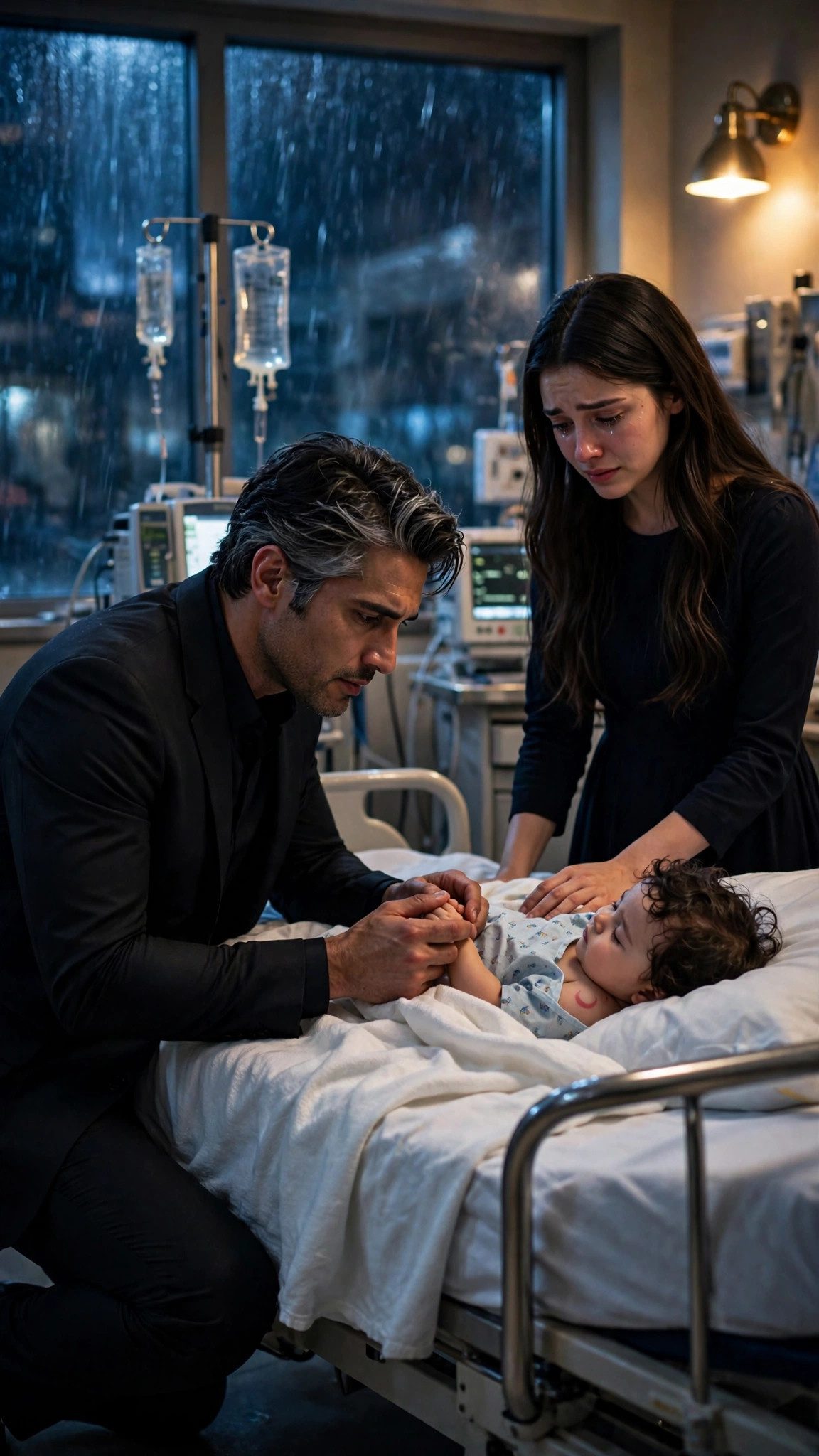
I woke up in the hospital to the sound of my son laughing.
It was a small, hiccuping laugh, the kind Noah made when something surprised him, and for one confused second I thought I was in my own apartment, in my own bed, with the radiator clanking and the morning light coming through the cracked window. Then I opened my eyes and saw the white ceiling and the IV pole and the curtain, and I remembered where I was, and who was sitting across from me.
Dante Russo was still there. He was holding Noah up on the bed, and Noah was patting his face with both hands, delighted, and Dante was smiling. Not the cold smile I had seen in photographs, not the smile of a man who owned half of Boston. A real smile. A father's smile.
"Good morning," Dante said, when he saw me awake. "The doctor says his fever is gone. It was a virus. He needs rest and fluids, and he can go home today."
"Home," I said. My home. My nine-hundred-dollar apartment with the clanking radiator.
"My home," Dante corrected, gently. "The North End. I have a doctor coming to the house. Rosa is already there — my mother came home last night with a cast on her wrist, and she has been asking about you since six this morning. She wants to meet her grandson."
I sat up slowly. My neck was stiff from sleeping in the chair. "Dante, I need to think about this."
"You've had fourteen months to think," he said. "I've had one night, and I've already decided. Noah is my son. You are his mother. You are both coming home with me. We will sort out the rest later."
It was not a request. But it was not a threat, either. It was the voice of a man who had made up his mind, and I was too tired to fight him, and Noah was laughing, and the truth was that I had been tired for fourteen months, and some part of me — the part I had buried under rent receipts and night shifts and fear — was relieved.
I thought about the night the radiator broke, in the middle of January, when the temperature outside was nine degrees and Noah was six months old. I had wrapped him in every blanket we owned, and I had held him against my chest all night, and I had whispered to him, over and over, "It's all right, baby. Mama's here. Mama will keep you warm." And in the morning, Mrs. Darrow had come with a space heater and a pot of soup, and she had stayed with us until the landlord finally sent someone to fix it, three days later. That was the night I understood what it meant to be a mother. It meant that there was no problem too big, no night too cold, no fear too large, as long as your child was breathing in your arms.
I thought about Noah's first word, too. It was "Mama," said on a Tuesday morning in March, while I was changing his diaper on the kitchen table, and I had cried so hard that Mrs. Darrow, who was visiting, had to finish the diaper for me. "He said it," I kept saying, over and over, like a fool. "He said Mama. He said my name." And Mrs. Darrow had just smiled and said, "Of course he did, child. You are his whole world."
Those were the moments that had kept me going. Not the money. Not the fear. The moments. And now, sitting in a hospital with the father of my child, I wondered if there could be more moments like that — better ones, safer ones — if I stopped running.
"All right," I said. "But I need to go to my apartment first. Noah's things are there. His clothes. His blanket. My mother's book."
"I'll send a car," Dante said. "We'll stop on the way."
The apartment in Dorchester looked even smaller in the daylight, with Dante Russo standing in the middle of it. He filled the whole room. He looked at the secondhand crib, and the stack of diapers on the kitchen counter, and the single hot plate, and the window that looked out on a brick wall, and his face did not change, but his hands curled into fists at his sides.
"You lived here," he said. It was not a question.
"It was what I could afford," I said, and I busied myself packing Noah's bag so I would not have to look at him. "The rent is nine hundred a month. The heat works most of the time. Mrs. Darrow lives three blocks away, and she watched Noah while I worked nights."
"Worked nights doing what?"
"Cleaning offices downtown. Ten o'clock to four. I made fourteen dollars an hour. It paid the rent and the diapers and the food, and Mrs. Darrow never took a cent for watching him, no matter how many times I tried to pay her."
Dante was quiet for a long moment. Then he said, "Fourteen dollars an hour. And you never once called me."
"You sent a man with an envelope, Dante. You sent Marcus Hale to my classroom with fifty thousand dollars and a message that I should disappear. What was I supposed to do? Call you and ask for more?"
"I never sent Marcus Hale to your classroom," Dante said. His voice was very quiet. "I never gave that order. I never knew you were pregnant. I never knew Noah existed until last night, when my son reached for my finger in a hospital waiting room."
I stopped packing. The bag slipped from my hands. "What?"
"Marcus Hale has worked for my family for nine years," Dante said. "He is my head of security. He is also, I am beginning to suspect, a man who has been selling my family's secrets for a very long time. Last night, after you fell asleep, I made some calls. Marcus told my people that you left Boston of your own accord. He told them you wanted nothing to do with me. He never told me you were pregnant. He never told me there was a child."
"Why would he do that?" I whispered.
"That," Dante said, "is what I intend to find out."
We drove to the North End in silence, Noah asleep in his car seat, and I watched the city go by through the tinted windows. I had not been to the North End in over a year. It was where my mother had kept her bookstore, where I had grown up doing my homework behind the counter, where Dante's family had lived for three generations. The streets were narrow and old, and the smell of bread and coffee drifted out of the bakeries, and for a moment I was seven years old again, sitting on a stool in Cole's Books, watching my mother shelve novels and argue about poetry with the fishermen.
Cole's Books was gone now. I had sold the lease to pay my mother's debts, and a coffee shop stood in its place. I looked away as we passed it.
Dante's house was a tall brick townhouse on a quiet street, with black shutters and a brass knocker in the shape of a lion's head. Inside, it was warm and dark and beautiful, all polished wood and old paintings and the smell of my mother-in-law's sauce — no, not my mother-in-law. Dante's mother. Rosa Russo.
Rosa was sitting in the living room in a wingback chair, her wrist in a white cast, a blanket over her knees, and when she saw us come in with Noah, she stood up so fast the blanket fell to the floor.
"Oh," she said, and her hands flew to her mouth. "Oh, my God. Dante. He looks just like you did. He looks just like you did when you were his age."
She came to us slowly, and she looked at Noah, sleeping in my arms, and then she looked at me, and her eyes filled with tears.
"You must be Mariah," she said. "My son told me about you this morning. He told me everything. Come here, child. Let me see my grandson."
I let her take Noah, gently, and she held him against her good shoulder and rocked him, and she whispered something in Italian, and Noah slept on, trusting, the way babies do when they know they are safe.
"Fourteen months," Rosa said softly, looking at me. "You kept him safe for fourteen months, all alone. That is not a small thing, Mariah. That is everything."
I had not cried in the hospital. I had not cried in the apartment. But I cried then, standing in Dante Russo's living room, while his mother held my son and called me child, and Dante stood behind me with his hand hovering near my back, not quite touching me, as if he were afraid I might break.
"Come," Rosa said, wiping her own eyes. "You need food and rest. There is a room upstairs, next to the nursery. Dante had it made up this morning. Go. I will watch the baby."
I did not argue. I went upstairs, and I found a beautiful room with a soft bed and clean sheets, and a nursery next door with a crib and a rocking chair and a mobile of little silver moons, and I lay down on the bed fully clothed, and I slept for six hours, the longest sleep I had had in fourteen months.
When I woke up, it was dark outside, and there was a tray on the table beside the bed: soup, bread, a glass of water, and a note in a strong, slanted hand. "Eat. Then come downstairs. We need to talk. — D."
I ate the soup. It was the best thing I had tasted in a year. Then I washed my face, and I changed into the clean clothes someone had laid out for me, and I went downstairs to find Dante waiting in his study, with two glasses of wine on the desk and a file folder open in front of him.
"Sit down," he said. "I want to tell you what I found out today."
I sat. He poured the wine. He did not drink his.
"Marcus Hale has been taking money from Vincent Castellano for two years," Dante said. "Fifty thousand dollars, in cash, every month, delivered through a shell company called Bellini Holdings. In exchange, Marcus has been giving Castellano my schedules, my routes, and my plans. He told Castellano about the charity gala the night I met you. He told Castellano when I went to New York. And when you became pregnant, Marcus saw an opportunity. If Castellano knew I had an heir, the boy would become a target. But if the boy simply disappeared — if you disappeared, quietly, with no one the wiser — then Castellano would have nothing to use against me, and Marcus could keep collecting his fifty thousand a month without anyone asking questions."
"So he lied to me," I said. "He told me you ordered me gone."
"He lied to you, and he lied to me," Dante said. "He told me you left because you wanted nothing to do with me. He told me you took the money. I believed him, Mariah. I am not proud of that, but it is true. I believed him because it was easier than believing that the woman I had spent three weeks falling in love with had walked away without a word."
"You were falling in love with me?" I asked, and my voice came out small.
"I was," Dante said. "I am a man who has spent his whole life being careful about who he trusts. I trusted you in three weeks, Mariah. I trusted you with things I had never told anyone. And then you were gone, and Marcus told me you had taken fifty thousand dollars to go, and I told myself that was the answer. That you were like everyone else. That I had been a fool."
"I never took the money," I said. "I threw it back at him. I would have thrown it back at you, too, if you had come yourself."
"I know that now," Dante said. "And I am sorry. I am sorry I did not come to you myself. I am sorry I sent a man to do what I should have done face to face. And I am sorry that my son spent fourteen months in a nine-hundred-dollar apartment while I sat in this house believing a lie."
He opened the file folder. Inside were photographs. My apartment building. The grocery store where Mrs. Darrow had found me. The office building where I cleaned at night. A photograph of me carrying Noah in a sling, taken from across the street. A photograph of Noah in his stroller outside Mrs. Darrow's house.
"Marcus had you followed," Dante said. "He knew where you were the whole time. He knew about Noah. He was waiting, Mariah. He was waiting for the right moment to sell the boy to Castellano."
My blood went cold. "Sell him?"
"Castellano has no heir," Dante said. "His own son died ten years ago. A Russo heir — my son — would be the most valuable bargaining chip in Boston. Marcus was going to hand Noah to Castellano's men, and Castellano was going to use him to force me to hand over the docks, the routes, everything my father built. That was the plan. That is why Marcus kept you close and kept me blind."
"And now?" I asked. "What happens now?"
"Now," Dante said, "Marcus Hale is in a room downstairs, and he is going to tell me everything he knows, or he is going to spend the rest of his life regretting that he didn't. And Castellano is going to learn that no one touches my son. No one touches you. Not ever again."
He stood up and came around the desk, and he knelt in front of my chair, so that we were eye to eye, and he took my hands in his.
"Mariah," he said. "I am not asking you to forgive me tonight. I am not asking you to love me. I am asking you to stay here, in this house, where I can keep you safe, while I end this. And when it is over, when Castellano is finished and Marcus is finished, I am going to ask you to stay for a different reason. But tonight, I am only asking you to stay because my son needs his mother, and his mother needs a roof that does not leak, and a bed that does not hurt her back, and a life that does not make her afraid."
I looked at his hands holding mine. They were the same hands that had shaken in the hospital waiting room when our son held his finger. They were steady now. They were warm.
"All right," I said. "I'll stay. For Noah."
"For Noah," Dante agreed. But we both knew it was not only for Noah. It had never been only for Noah. Not since the night at the library gala, when a schoolteacher in a borrowed dress had made the most feared man in Boston laugh.
That night, I went to sleep in the beautiful room upstairs, with Noah sleeping in the nursery next door, and Rosa Russo humming in the kitchen below, and Dante Russo standing guard downstairs like a man who had finally found the thing he had been missing without knowing it.
It was the second night in a row that I slept without dreaming of running.