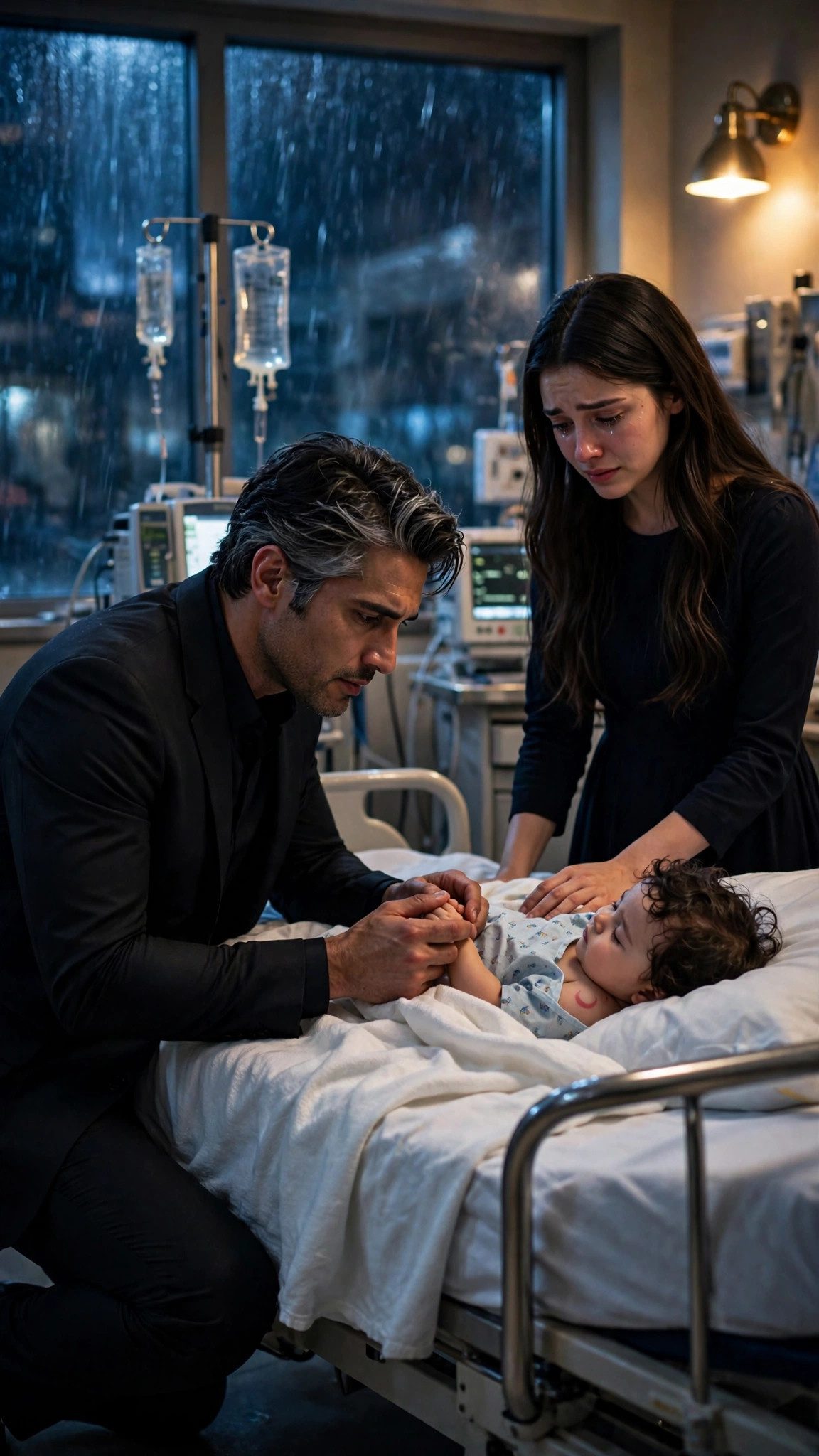
It happened on a Thursday, three weeks after the night in the hospital, on the first warm evening of December, when the Christmas lights were going up on Hanover Street and the whole North End smelled like roasted chestnuts and rain.
Noah had a follow-up appointment at the hospital that afternoon, to check that the fever was fully gone. Dante insisted on coming with us. He insisted on driving. He insisted on bringing two men, and he insisted that I sit in the back with Noah, and I thought he was being overprotective, and I told him so, and he just smiled and said, "Humor me."
The appointment went well. The doctor said Noah was perfectly healthy, that his lungs were clear, that his fever was gone for good. On the way home, we stopped at a bakery, and Dante bought Noah a tiny cannoli, and Noah smeared cream all over his face, and Dante laughed so hard that people in the bakery turned to stare, and for one perfect afternoon, we were just a family. Not a mafia boss and a schoolteacher and a hidden child. Just a family, eating pastries on a Thursday afternoon.
We got home at five o'clock. Rosa was in the kitchen, making sauce. Mrs. Darrow was in the living room, knitting a blanket for Noah. The house smelled like garlic and tomatoes and safety.
At six o'clock, the lights went out.
It was not a storm. There was no wind, no thunder. The whole street went dark at once, and then the house went dark, and then I heard the back door splinter.
"Mariah," Dante said, very calmly, from the other side of the room. "Take Noah upstairs. Lock the nursery door. Do not come out until I come for you. Do you understand me?"
I did not argue. I grabbed Noah from his play mat and I ran. Behind me, I heard shouting, and the sound of furniture falling, and a gunshot, and Rosa screaming my name, and Mrs. Darrow's voice, steady and clear, saying, "Go, child. Go."
I ran up the stairs with Noah clutched to my chest, and I locked the nursery door, and I pushed the heavy dresser in front of it, and I sat on the floor with Noah in my lap, and I sang to him, very quietly, the song about the moon over the harbor, while downstairs, the men who had come to take my son fought with the men who had sworn to protect him.
Noah looked up at me with his big, dark eyes, and he put his small hand on my cheek, and he said, "Mama."
"Mama's here," I whispered. "Mama's right here. Nothing is going to happen to you. I promise."
Downstairs, there was another gunshot. Then another. Then silence. A long, terrible silence. And then footsteps on the stairs. Slow, heavy footsteps, coming up, one at a time.
I held Noah tighter. I looked around the nursery for something, anything, to defend him with. There was nothing. There was a lamp. There was a rocking chair. There was a mobile of little silver moons turning slowly over the crib.
The footsteps stopped outside the door. There was a knock. Three knocks, slow and deliberate.
"Mariah," Dante's voice said. "It's me. It's over. Open the door."
I opened the door, and Dante was standing there, covered in dust, with a cut over his eye and blood on his shirt, and behind him, at the bottom of the stairs, I could see his men holding two strangers face-down on the floor, and Rosa standing in the kitchen doorway with a rolling pin in her hand, and Mrs. Darrow sitting calmly in her chair, still knitting, as if nothing had happened at all.
"Who were they?" I asked.
"Castellano's men," Dante said. "Eddie Krol and Danny Cole. Krol is the one who shot me — no, not me. He shot at me, fourteen months ago, on Pier Nine. No, that's not right either." He shook his head, like a man trying to clear it. "Krol is Castellano's best gunman. He came for Noah. He cut the power to the whole street. He and Cole came through the back door. They had a car waiting two blocks away."
"And now?" I asked.
"And now they're going to tell Agent Reyes everything they know," Dante said, "or they're going to spend the rest of their lives in a cell, thinking about what they did tonight. And Castellano —" He stopped. His jaw tightened. "Castellano just made his last mistake."
He took Noah from my arms, gently, and he held him up, and he looked at our son, and Noah reached out and patted his father's bloody cheek, and Dante closed his eyes.
"Did you see that?" he whispered to me. "He's not afraid. My son is not afraid of anything. Not the dark. Not the noise. Not them. He's a Russo, Mariah. He's a Russo all the way down to his bones."
Later that night, after the police had come and gone, after Agent Reyes had taken Krol and Cole away in handcuffs, after Rosa had bandaged Dante's cut and Mrs. Darrow had made tea for everyone, Dante and I sat in the nursery, watching Noah sleep, and Dante told me the rest of it.
"Castellano called me tonight," he said. "After his men were arrested. He called my private number, the one only five people in the world have. And he said, 'Dante, give me the boy, and I'll give you the docks, the routes, everything. I'll walk away. I'll retire. All I want is the boy.'"
"What did you say?" I asked.
"I said, 'Vincent, you lost your son ten years ago, and I am sorry for that. But my son is not yours to take, and he never will be. And if you ever come near my family again, I will end you myself, with my own hands, and I will not lose a minute of sleep over it.' And then I hung up on him."
He looked at me, and his eyes were dark and tired, but there was something else in them, too. Something I had never seen before. Peace.
"Reyes has enough now," Dante said. "The Darrow papers. Marcus's testimony. Tommy's bank records. Krol and Cole. We have enough to put Castellano away for life, and to put his whole organization away with him. Reyes is going to move tomorrow morning, before Castellano can run. And when it's over, Mariah, when it's really over, I'm going to do something I've been thinking about for a long time."
"What?" I asked.
"I'm going to shut it all down," he said. "The routes. The docks. The gambling. All of it. I'm going to take the family businesses legitimate, the way my father always wanted to, before Castellano got his hooks into us. I'm going to turn the warehouses into storage and the docks into a shipping company, a real one, with real books and real taxes. And I'm going to do it for Noah. So that when he grows up, he never has to sit in a dark house listening to gunshots downstairs. So that he never has to be afraid."
I took his hand. "And what about us?" I asked. "What happens to us, when it's over?"
He looked at me, and he smiled, and it was the same smile he had given me at the library gala, fourteen months and a lifetime ago.
"That's up to you," he said. "But I hope you'll stay. I hope you'll stay, and I'll hope you'll let me be Noah's father, not just his protector. And maybe, one day, if you can forgive me for everything that happened, you'll let me be something more."
I did not answer him that night. I did not need to. I leaned my head on his shoulder, and we sat together in the dark nursery, listening to our son breathe, and I thought about the crescent moon on his shoulder, and the moon over the harbor, and my mother's words, and I knew that the war was almost over.
The next morning, Rosa told me what had happened downstairs while I was locked in the nursery. She told it the way she told everything: plainly, without drama, while making breakfast, as if armed men breaking into her house were an ordinary inconvenience, like a leaky faucet.
"They came through the back door," she said, cracking eggs into a bowl. "Two of them. Big men. One had a gun. I was in the kitchen, and I heard the glass break, and I picked up my rolling pin — the heavy one, your grandfather's — and I stood behind the door, and when the first one came through, I hit him on the head. Hard. He fell down, and his friend tried to grab me, and that is when Dante's men came in from the front, and there was shouting, and then there were the gunshots, and then it was over."
"Rosa," I said, staring at her. "You hit an armed man with a rolling pin?"
"He was in my house," Rosa said simply. "No one comes into my house and takes my grandson. Not while I am alive to stop them. Besides, the rolling pin is very heavy. It was my mother's. She used it to make pasta for forty years, and I have used it to make pasta for fifty. It is a good rolling pin."
Mrs. Darrow arrived an hour later, with more shortbread and a complete lack of surprise. "I heard the sirens," she said, settling into her chair. "I knew it would happen sooner or later. Castellano is a desperate man, and desperate men do desperate things. But he has played his last card now, Mariah. He has shown his hand. And Dante has shown his."
She took Noah from me and bounced him on her knee, and Noah laughed, and she smiled at him, and then she looked at me, and her voice went serious.
"Child," she said, "I want you to know something. Harold used to say that there are two kinds of men in this world: men who run toward danger, and men who run away from it. Dante runs toward it. That is why he is alive, and that is why his father died. But you — you are the reason he will survive this. Because you give him something to run toward, instead of something to run away from. Do you understand me?"
"I think so," I said.
"Good," Mrs. Darrow said. "Then stop worrying about Castellano, and start thinking about what comes next. Because what comes next is the hard part. Not the fighting. The building. Anyone can fight a war, Mariah. It takes a much stronger person to build a peace."
That afternoon, Dante's men swept the whole house, room by room, checking every window and every door, and a locksmith came and changed all the locks, and an electrician came and fixed the power, and by evening, the house was whole again, except for the back door, which would need a new frame, and the vase in the hallway, which Rosa had knocked over in the commotion and which no one mourned, because it had been ugly.
The next morning, two police detectives came to the house to take my statement. They were kind and patient, and they asked me to tell them everything, from the beginning: the gala, the envelope, the fourteen months, the hospital, the night they came through the back door. I told them all of it, and when I finished, the older detective, a woman with gray hair and tired eyes, put down her pen and said, "Miss Cole, I have been doing this job for twenty-five years, and I have never met a mother as brave as you. You kept your son alive, alone, for fourteen months, against men who would have done anything to find him. That is not luck. That is love."
After they left, Dante apologized to Rosa. He stood in the kitchen, with his hands in his pockets, looking at the floor like a boy who had broken a window, and he said, "Mama, I am sorry I brought this into your house. I am sorry you had to pick up a rolling pin and fight men with guns in your own kitchen."
Rosa looked at him for a long moment, and then she walked over to him, and she put her good hand on his cheek, the way mothers do, and she said, "Dante, my son, I have lived in this house for fifty years, and I have seen men come and go, and I have buried a husband, and I have watched my son grow up to be a man I am proud of. Do not apologize to me for protecting your family. That is what this house is for. That is what a home is for. Now go and make sure your wife and your son are all right, and let me finish the sauce."
Noah slept through the whole night after the attack, for the first time in weeks, as if he knew the danger had passed, and I lay awake beside his crib, listening to him breathe, and I thought about the detective's words, and about Rosa's rolling pin, and about the way Dante had stood in the doorway of the nursery, covered in dust and blood, and said, "It's over," and I understood something I had not understood before. Bravery is not the absence of fear. Bravery is holding your child through the fear, and singing to him anyway, and trusting that the people who love you will come for you when you need them most.
I held Noah a little tighter that night, and I thought about what Mrs. Darrow had said, about building a peace, and I thought about the bookstore, and the foundation, and the garden, and the life we were going to build when all of this was over, and for the first time, I let myself believe it was really going to happen.
But Castellano had one more move left. And it was the most desperate move of all.