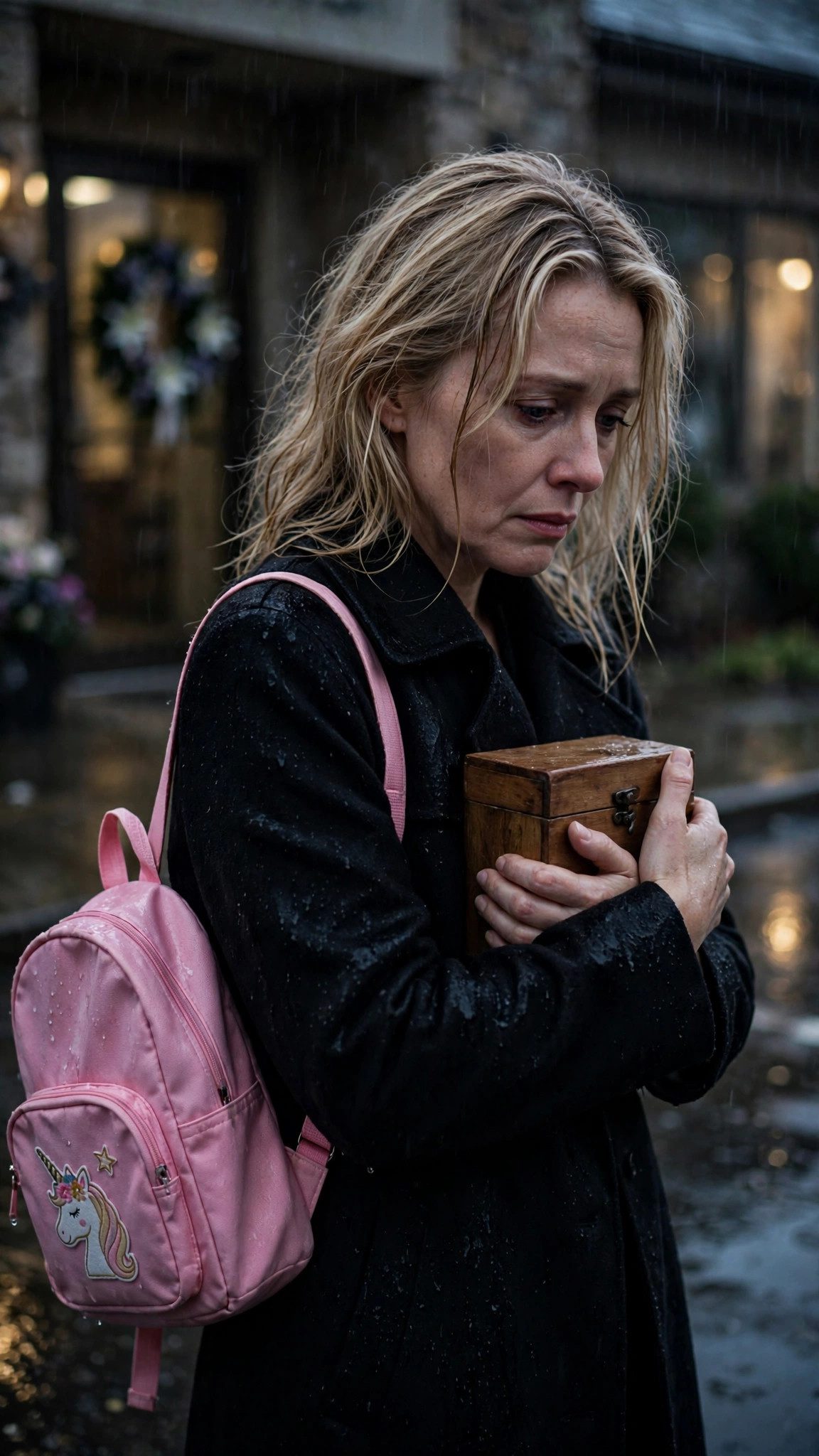
The morning Sophie died was ordinary. That is the part I cannot forgive. It should have been extraordinary. The sky should have been dark. The birds should have stopped singing. There should have been some sign, some warning, some crack in the world that told me to hold my daughter tighter and never let her go.
Instead, the sun came up over Chicago the way it always did, pale and gold through the kitchen window. Sophie came downstairs in her school uniform, her blonde hair in two braids I had done too tightly, and she complained about it the way she always did, and I loosened them the way I always did, and she ate her toast with strawberry jam and got it on her chin, and I wiped it off with my thumb, and she laughed.
"Mama," she said, "can we make the apple pie today? The one with the crisscross top?"
"After school," I said. "You help me with the apples, and I will teach you the crisscross."
"Promise?"
"I promise."
Adrian came downstairs then, already dressed in his suit, his phone in his hand. He kissed Sophie on the top of her head and said, "Be good at school, princess. Daddy has a busy day." He kissed me on the cheek, and his cheek was smooth, and his cologne was the one I had given him for Christmas, and everything was normal, and nothing was normal, and I did not know it yet.
At three o'clock I went to pick Sophie up from school. Her teacher, Mrs. Alvarez, told me Sophie had drawn a picture of our family that day — me, Adrian, Sophie, and a dog we did not have, because Sophie had decided we needed a dog and had already named him Biscuit. Mrs. Alvarez laughed when she told me. "She is a wonderful girl, Mrs. DeLuca. She has such a light in her."
We drove home. Sophie talked the whole way about Biscuit the imaginary dog and about a girl in her class named Lily who had shared her crayons. I listened the way mothers listen, half with my ears and half with my heart, and I thought about the apples waiting in the kitchen and the dough resting in the refrigerator.
At home, Sophie changed out of her uniform and into jeans and a yellow shirt, and she climbed onto the stool beside me and watched me peel apples. She asked if she could taste one. I gave her a slice, and she crunched it loudly, and juice ran down her chin, and she laughed, and I laughed, and for one perfect moment the world was exactly as it should be.
Then Adrian called. I remember the sound of his voice on the phone. He said, "Claire, I am going to take Sophie for a drive. There is a place up in the mountains I want to show her. The leaves are turning. She will love it."
I said, "But the pie—"
"The pie will wait," he said. "This will not. The light is perfect right now."
Sophie heard him. She was already pulling on her shoes, already excited, because her father so rarely took her anywhere alone, and a drive up the mountain sounded like an adventure. I helped her into her pink jacket. I zipped it up. I kissed her forehead and said, "Be good for Daddy. Stay in your seatbelt."
"I will, Mama," she said. "Save me the biggest piece of pie."
"I will," I said. "I promise."
Those were the last words I ever said to my daughter.
I watched from the front door as Adrian's black SUV pulled away from the curb. Sophie waved at me through the back window, her small hand flat against the glass, and I waved back, and I went inside, and I started peeling the rest of the apples.
The hospital called at 4:12.
I have gone over those hours a thousand times since, trying to understand what really happened on that mountain road. The police report said Adrian was driving too fast on a curve. It said the SUV left the road and struck a tree. It said Sophie died of internal injuries before the ambulance arrived. It said Adrian survived with cuts and bruises. It said nothing about Vivian Cole, because the police report had been written by men who owed Adrian DeLuca favors, and in Chicago, favors are worth more than truth.
But here is what I know now. Adrian was not taking Sophie to see the leaves. He was taking Vivian Cole to O'Hare Airport. They were going to disappear together for a weekend — a secret trip, a stolen few days in a hotel in Miami, where no one knew them. And he had taken our seven-year-old daughter along so that no one would ask questions. A man driving his little girl to the mountains looks like a father. A man driving his mistress to the airport looks like exactly what he is.
Vivian was in the passenger seat. Sophie was in the back, in her seatbelt, exactly as I had told her to be. Adrian was driving too fast because he was late for a flight, because Vivian had made him late, because they had spent too long saying goodbye to each other in the apartment on Wacker Drive. On a curve he had driven a hundred times, he took it too fast, and the SUV left the road, and the tree was there, and my daughter was gone.
They told me Adrian held her. They told me he held her in his arms while she died, covered in blood, telling her he loved her. I do not know if that is true. I want it to be true, because if it is true, then at least in her last moments she was held by someone who loved her. But I also know that Adrian is a man who knows how to perform grief, and I do not know where the performance ends and the truth begins.
The funeral was three days later. It was a small service, because Sophie was small, and because I could not bear a large one. The coffin was white. It was so small. I kept looking at it and thinking, this cannot be right, this cannot be my daughter, my daughter is seven years old and she has a loose tooth and she wants an apple pie. But it was right. It was my daughter. And the world had not stopped turning, and the sun had not stopped shining, and that was the cruelest thing of all.
Adrian sat beside the coffin with his head in his hands. People came up to him and touched his shoulder and said, "I am so sorry." He nodded. He thanked them. He played the grieving father so well that I almost believed him, and then I saw the nurse from St. Anthony's standing in the hallway, watching me, and she came over and said, "Mrs. DeLuca, I thought you should know. Your husband was not alone in that car."
She told me about Vivian Cole. She told me about the passenger seat. She told me about the airport. She told me everything, in a low voice, in a hallway, while my daughter lay in a white coffin twenty feet away, and I felt something inside me go very still and very cold.
I did not confront Adrian at the funeral. I did not scream. I did not throw anything. I stood beside my daughter's coffin and I listened to the priest talk about angels, and I thought about the apples still sitting in a bowl in my kitchen, and about the dough still resting in the refrigerator, and about the promise I had made — save me the biggest piece of pie — and I understood that I would never make that pie, and that the woman I had been that morning, peeling apples in the sunlight, was dead too.
That night, after everyone had gone, after Adrian had fallen asleep in the armchair with a glass of whiskey in his hand, I went upstairs. I took a suitcase from the closet. I packed clothes. I packed money from the drawer where I kept the household cash. I packed a photograph of Sophie, the one from her sixth birthday, where she is on her pink bicycle with the basket, laughing so hard her eyes are squeezed shut.
And then I went to the small wooden box on the dresser. The funeral home had given it to me that afternoon. Sophie's ashes. My daughter, seven years old, reduced to a box I could hold in one hand. I picked it up. I held it against my chest. I whispered, "Come on, baby. Mama is taking you home."
I took the unicorn backpack from beside the door. I walked out of the house on Astor Street. I did not look back.
I drove north. I drove through the night, past the city limits, past the suburbs, past the cornfields, until the road was empty and the sky was full of stars, and I pulled over at a rest stop and I cried for the first time since the hospital called. I cried until my throat was raw and my hands were shaking, and then I wiped my face and I drove on, because crying would not bring her back, and only the truth could do anything now.
Within days, Adrian was tearing Chicago apart trying to find me. His men knocked on doors. His lawyers called my mother — my poor mother, who knew nothing, who cried on the phone and said, "Claire, where are you? Please come home." His money bought eyes on every street, in every hotel, in every train station. But I was gone. I had rented a small cabin under a false name, paid in cash, in a town so small it did not have a traffic light. And I intended to stay gone, because I had one thing left in this world that was mine, and it was the truth about what had happened to my daughter, and I was going to find all of it, every last piece of it, before Adrian DeLuca ever found me.
I did not know then that the truth would lead me to a dead woman in her own home, and to a man on the edge of a cliff, and to a confession I never expected to make. I only knew that my daughter was dead, and that her father had used her as cover, and that I would not rest until every person responsible had answered for it.
Sophie had deserved better. She had deserved a father who loved her more than his secrets. She had deserved a life. And since I could not give her back her life, I would give her justice. That was the only promise I had left to keep.
I have tried, many times, to imagine what those last minutes were like for Sophie. I have tried not to imagine them, too. Both are impossible. So I imagine them anyway, because a mother cannot help it.
She was in the back seat, in her seatbelt, exactly as I had told her to be. She was probably singing. She liked to sing in the car, made-up songs about dogs and unicorns and the trees going by. She was probably looking out the window at the mountains, at the leaves turning red and gold, and she was probably happy, because her father had taken her on an adventure, and adventures were her favorite thing in the world.
Adrian was driving too fast. I know this because the police report said so, and because Frank later told me the skid marks told their own story. He was rushing because Vivian had a flight to catch, because they had spent too long in the apartment on Wacker Drive, because they had lost track of time the way lovers do. He took the curve too fast. The SUV left the road. The tree was there — a great oak, older than the road itself, older than Adrian, older than all of us — and the car struck it at speed, and the world turned to noise and glass and metal.
Vivian was in the passenger seat. She survived with a broken arm and cuts on her face. She was pulled from the car by a passing driver, a trucker named Joe, who stopped because he saw the smoke. Joe told the police later that Adrian was already out of the car, holding Sophie, screaming her name, and that there was blood everywhere, and that he had never seen anything like it in his life.
The ambulance took twenty-three minutes to arrive. Twenty-three minutes. I have counted them, over and over, the way you count the minutes of a life. Twenty-three minutes is a long time when your daughter is dying in your arms. It is no time at all when you are sitting in a kitchen peeling apples and waiting for your family to come home.
Adrian held her for all twenty-three minutes. He held her and told her he loved her, and he told her Daddy was there, and he told her to stay, to stay with him, to not go. And she went anyway. She went quietly, the way she had lived — without fuss, without complaint, with her hand in her father's hand.
When the paramedics arrived, they took her from him. They worked on her in the back of the ambulance. They did everything they could. But Sophie was already gone, and no one could bring her back, not the paramedics, not the doctors at St. Anthony's, not her mother, who was still sitting in a kitchen in Chicago, peeling apples, believing that the world was safe.
I think about Joe the trucker sometimes. I think about how he stopped, how he pulled Vivian from the car, how he held Adrian's hand while the ambulance came. He was a stranger. He owed us nothing. And he stopped. That is the thing I hold on to, on the worst nights — that in a world where a father can use his daughter as cover for an affair, a stranger can still stop on a mountain road and try to help. There is still good in the world. Sophie believed that. She believed it with her whole heart. And I am trying, every day, to believe it too.