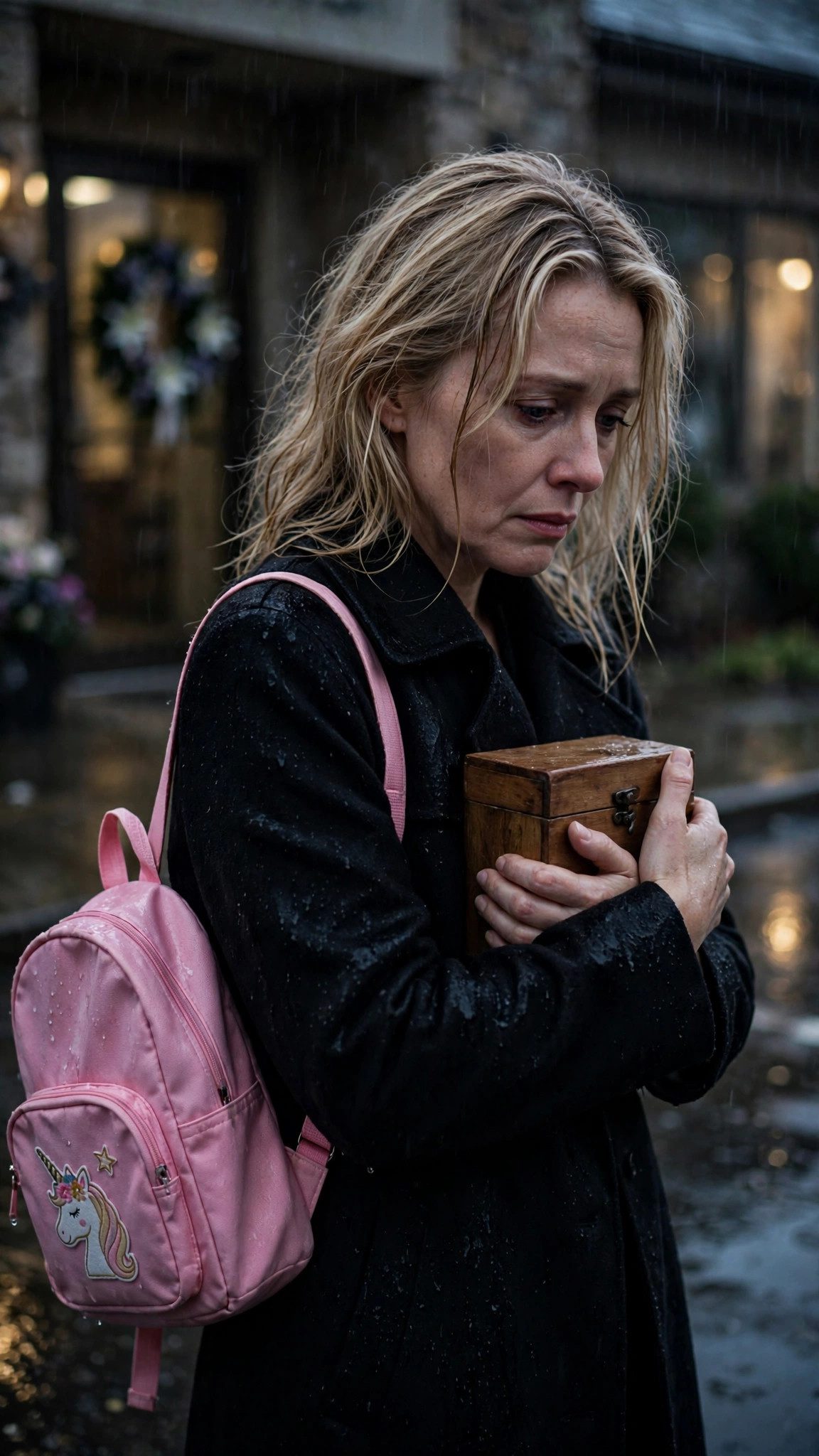
The cabin was at the end of a dirt road in a town called Cedar Falls, Wisconsin, and it had a leaking roof and a wood stove and a view of a lake so still it looked like glass. I paid for a month in cash. The old woman who owned it asked no questions. She looked at my face — at the grief written all over it — and she said, "You will be safe here, dear. Nobody comes to Cedar Falls unless they mean to."
I put Sophie's ashes on the windowsill, where the morning light could reach them. I put the unicorn backpack on a chair. I put the photograph of Sophie on her pink bicycle on the small table beside the bed. And then I sat down, and I did not know what to do next, because grief is not a task you can finish. It is a room you live in. You learn where the furniture is. You learn to move around in the dark.
For two weeks, I did almost nothing. I walked by the lake. I cooked soup I did not eat. I slept in fits, waking at 4:12 every morning — the exact time the hospital had called — with my heart pounding and Sophie's name on my lips. I wrote in a notebook, pages and pages of questions. Who was Vivian Cole, really? How long had the affair been going on? Who else knew? And the question underneath all the others, the one I was afraid to ask: was the crash really an accident?
Because something about it did not sit right. Adrian was a careful driver. I had ridden with him a hundred times, and he was always in control, always measured, always aware. A man like that does not simply lose control on a curve he has driven a hundred times. Unless he was distracted. Unless he was rushing. Unless something was wrong with the car.
I did not have answers. But I had a phone, and I had time, and I had nothing left to lose. So I began to make calls. I called the nurse from St. Anthony's. I called a mechanic I had known since childhood, a man named Frank who had fixed my father's bus for thirty years. I called the funeral home. I called anyone who might know anything, and I wrote down everything they said.
Frank was the one who changed everything. He said, "Claire, if you want to know whether that crash was an accident, you need to see the car. Cars tell the truth. People lie. Cars do not." He said the SUV had been towed to an impound lot on the south side of Chicago, and that it would be auctioned off in a month, and that if I wanted to look at it, I had to do it soon.
I was not ready to go back to Chicago. Adrian's men were still looking for me. But Frank said he had a friend who worked at the impound lot, a man who owed him a favor, and that the friend could take photographs. "Brake lines, steering, tires," Frank said. "That is where the truth lives."
I said yes. I sent Frank the money for the photographs by mail, in cash, wrapped in a birthday card so no one would ask questions. And then I waited.
It was during that waiting that the phone rang at 1:28 in the morning.
I froze for a few seconds, then stood. The cabin was dark. The lake was black outside the window. The phone — a cheap prepaid phone I had bought with cash — showed a number I did not recognize. I almost did not answer it. But something made me pick it up, and a voice I had never heard said, "Mrs. DeLuca? This is Detective Marcus Hale, Chicago Police. I am sorry to call at this hour. I need to ask you about Vivian Cole."
My heart sank. "What about her?"
"She is dead, Mrs. DeLuca. She was found strangled in her own home tonight."
I sat down. I do not remember sitting down, but I must have, because the next thing I knew I was on the floor with my back against the wall, and the detective was still talking, and the words were coming to me from very far away.
"Vivian Cole is dead," I said, my voice hollow. "Is it the hospital administrator?"
"No," he said.
"Is it the police?"
"No."
"Why did you want me to lie, Vivian?" I whispered, and I did not know I had said it aloud until the detective asked me to repeat myself, and I could not, because I did not know what I meant. I was scared. I was confused. The room was spinning.
Detective Hale was patient. He told me that Vivian Cole had been found by a neighbor, strangled, in her apartment on Wacker Drive — the apartment Adrian had paid for. There were no signs of forced entry. Her phone was missing. Her lipstick was smudged. There was a single photograph on the floor beside her, a photograph of her and Adrian at a restaurant, and someone had torn it in half.
"Do you know where your husband is tonight, Mrs. DeLuca?" he asked.
"I have not seen my husband in two weeks," I said. "I left him. I am not in Chicago."
"Where are you?"
"I cannot tell you that."
There was a long pause. Then Detective Hale said something I did not expect. He said, "Mrs. DeLuca, I believe you. And I think you should know something. I have read the police report on your daughter's accident. I have read it three times. And I do not believe it was an accident."
I closed my eyes. "What do you mean?"
"I mean the report is too clean," he said. "No skid marks. No mention of the brake condition. No toxicology on the driver. It reads like a report that was written before the crash happened. Like someone already knew what it was supposed to say."
I felt something cold run down my spine. "Who wrote it?"
"A sergeant named Doyle," he said. "Doyle has been on Adrian DeLuca's payroll for six years. I have been building a file on him for two."
"Why are you telling me this?"
"Because I think your daughter's death and Vivian Cole's death are connected," he said. "And because I think you are the only person in this city who wants the truth more than she wants to be safe. Am I wrong?"
I thought about Sophie. I thought about the apples in the kitchen. I thought about the promise I had made — save me the biggest piece of pie — and I said, "You are not wrong, Detective. Tell me what you need."
He told me he needed me to stay hidden. He told me he needed me to let him work. He told me that Adrian DeLuca was tearing Chicago apart looking for me, and that the safest thing I could do was stay exactly where I was and let the police do their job. But he also told me something else, something that made my hands stop shaking.
"Mrs. DeLuca," he said, "Vivian Cole was not the only person in that car who was supposed to die. I think someone wanted her dead. And I think your daughter died because she was in the wrong seat at the wrong time. I am going to prove it. But I need time."
After he hung up, I sat in the dark for a long time. I looked at Sophie's ashes on the windowsill, silver in the moonlight, and I whispered, "Did you hear that, baby? Someone wanted Vivian dead. Not you. Never you. You were just there. You were just a little girl in the back seat, and someone wanted your father's mistress dead, and you paid for it."
I did not sleep that night. I sat by the window and watched the lake, and I thought about the woman in the morgue — Vivian Cole, thirty-one years old, strangled in her own home, her lipstick smudged, a torn photograph on the floor — and I thought about the man who had done it, and I knew, with a certainty that frightened me, that I was going to find him.
Because Vivian Cole was dead. And Sophie was dead. And someone had arranged for at least one of those deaths. And I was the only person left who was willing to find out who.
My days in the cabin fell into a rhythm. I woke at dawn and made coffee on the wood stove. I walked by the lake, where the mist rose off the water like breath. I ate what I could — bread, soup, eggs from the old woman who owned the cabin and kept chickens behind the shed. In the afternoons I sat by the window with my notebook and wrote down everything I knew, and everything I did not know, and all the questions in between.
The old woman's name was Ruth. She was seventy-nine, with white hair in a braid and hands like tree roots, and she came by every few days with eggs or bread or a jar of jam. She never asked me why I was there. She never asked me about the small wooden box on the windowsill. But one afternoon she sat down at my table, looked at the notebook full of questions, and said, "You are looking for something, dear."
"Yes," I said.
"Is it a person?"
"It is the truth."
She nodded, as if that were the most ordinary thing in the world. "The truth is a hard thing to find," she said. "It hides. It runs. But it leaves tracks, if you know how to look." She tapped the notebook with one gnarled finger. "Keep writing, dear. Write it all down. The truth likes to be written down. It makes it harder for people to pretend it is not there."
I took her advice. I wrote down the nurse's name. I wrote down Frank's phone number. I wrote down everything Detective Hale told me. I wrote down the name Vivian Cole, and the name Nicholas Cole, and the name Adrian DeLuca, and I drew lines between them, the way a detective draws lines on a board, until the picture began to make sense.
I also wrote letters I never sent. I wrote a letter to my mother, telling her I was safe, telling her I loved her, telling her I would come home when it was over. I wrote a letter to Sophie, telling her about the lake, and about Ruth, and about the mist on the water in the morning, and about how I missed her so much it felt like my chest had been cut open. I wrote a letter to Adrian, telling him everything I thought of him, and then I burned it in the wood stove, because some letters are only meant to be written, not sent.
At night, I dreamed about Sophie. In the dreams, she was always laughing. She was on her pink bicycle, riding up and down Astor Street, and the sun was shining, and her hair was flying behind her like a flag. I would wake up with tears on my face and her name on my lips, and I would go to the window and look at the lake, and I would whisper, "I am still here, baby. Mama is still here. And I am going to finish this. I promise."
The lake was my church. The cabin was my chapel. And the truth was my prayer. Every morning, I said it to myself like a vow: I will find out what happened to my daughter. I will find out who did this. And I will make them answer for it. No matter how long it takes. No matter what it costs me. I will finish this.
The phone call from Detective Hale was not the only call I received in those weeks. Frank called me twice more. The first time, he told me he had spoken to the trucker, Joe, the man who had pulled Vivian from the car. Joe had remembered something new. He had remembered that when he arrived at the crash, Adrian was not only holding Sophie — he was also shouting into his phone. "He was shouting at someone," Joe said. "He kept saying, 'Do not come here. Do not come here. Stay away.' I thought he was talking to the ambulance. But now I think he was talking to someone else. I think he was talking to the police. I think he was telling them not to come, or to come slowly, or to come the way he wanted them to come."
The second time Frank called, he told me about the garage. "Claire," he said, "I went to Nicholas Cole's garage. I pretended I needed an oil change. And while I was waiting, I looked around. And I saw something. On the wall, behind the counter, there was a photograph. It was a photograph of Vivian, from their wedding day. And someone had drawn a line across her face with a black marker. A single line, right across her eyes. That is not the photograph of a man who loves his wife. That is the photograph of a man who has already decided to kill her."
I wrote all of this down in my notebook. I drew more lines between the names. Nicholas to Vivian. Vivian to Adrian. Adrian to Doyle. Doyle to the crash. The crash to Sophie. And Sophie to me. And me to the truth. The picture was getting clearer, and the clearer it got, the colder I felt, because I could see now that my daughter had not died in an accident. She had died in a web. A web spun by three men, each pulling a different thread, and my little girl had walked straight into the center of it.
I also began to think about Adrian differently. I had always thought of him as the villain of this story — the husband who cheated, the father who used his daughter as cover. And he was. But he was not the only villain. Nicholas was a villain too. And Doyle. And the tow truck driver. And the impound lot manager. And every man who had taken Adrian's money and looked the other way. There were so many villains. And there was only one victim who mattered to me: a seven-year-old girl in the back seat of an SUV, in her seatbelt, singing a made-up song about dogs and unicorns, who never had a chance.
I went to bed that night with my notebook open on the table, and I dreamed about the web. In the dream, the web was made of brake lines, black and shining, and Sophie was caught in the middle of it, and I was trying to cut her free with a pair of scissors, but the scissors were too small, and the web was too strong, and I woke up crying, and Ruth was standing in the doorway with a cup of tea, and she said, "You are dreaming about her again, dear." And I said, "Yes." And she said, "That is good. Dreaming means you are still fighting. When you stop dreaming, that is when you have given up. And you have not given up. I can see it in your eyes."