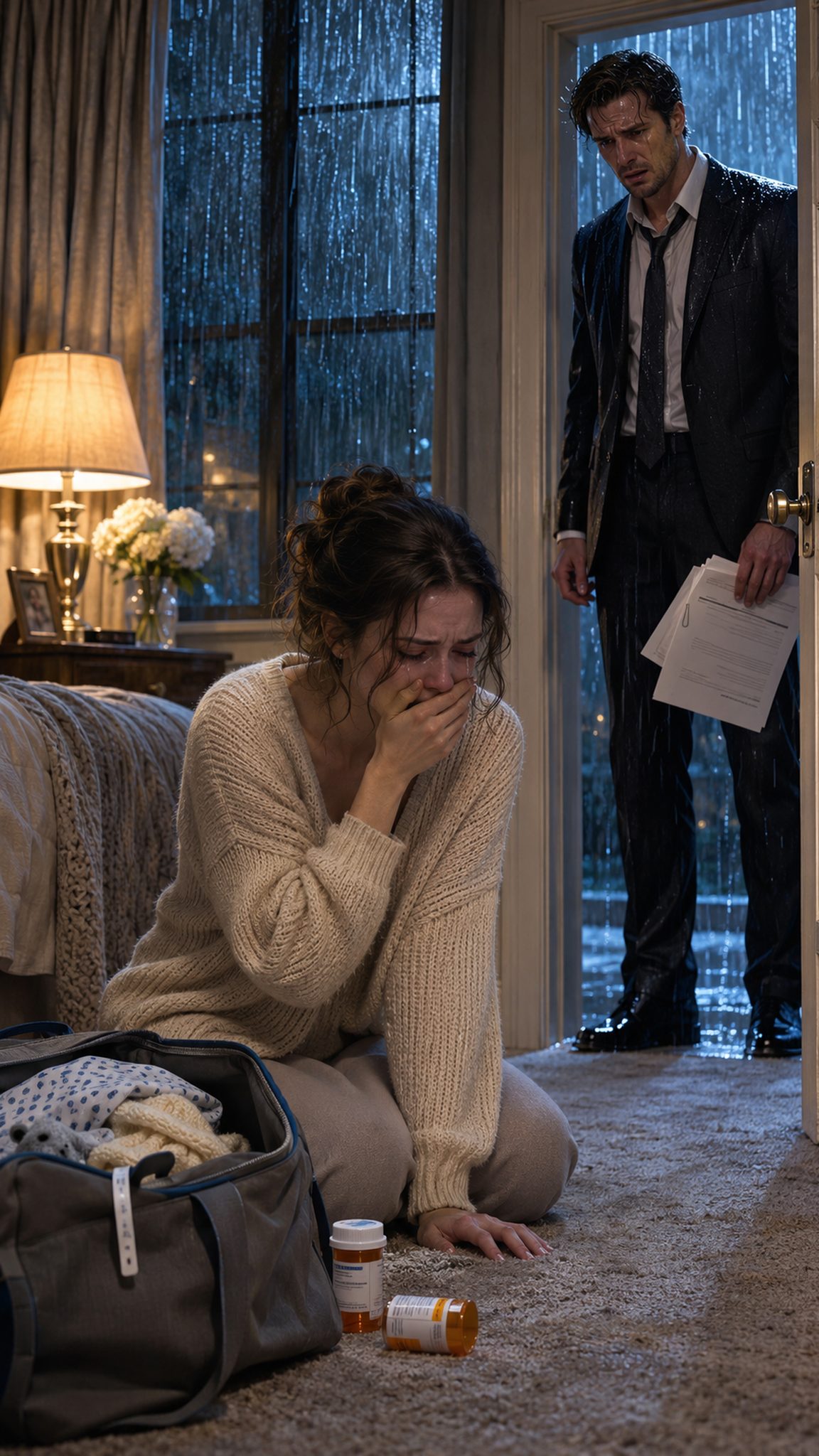
The morning after the crisis, Claire woke to the sound of rain beginning again.
For a moment she did not remember where she was. Then she saw the familiar curtains, the glass of water on the bedside table, and the folder of medical instructions beside it. The previous day's events returned in fragments: the treatment room, the sudden dizziness, the nurses moving quickly, Adrian waiting outside, and the doctor explaining that the infusion would remain stopped until the team understood what had happened.
She shifted beneath the blanket. Her body felt heavy, as though even sleep had not quite restored her.
Adrian was in the chair near the window. He had fallen asleep there, still wearing the shirt he had put on the previous morning. A book lay closed on his lap.
"Adrian."
He woke immediately. "What's wrong?"
"Nothing. I was just saying your name."
He sat forward. "Are you uncomfortable? Do you need water?"
"Water, please."
He handed her the glass and waited while she drank.
"Did you sleep at all?" she asked.
"Some."
"That chair looks terrible."
"It isn't the worst place I've slept."
"That isn't a recommendation."
A faint smile crossed his face. "I'll remember that."
Claire set the glass down. She was glad he was there, but the relief came with a small, unfamiliar caution. She did not yet know how to accept his presence without wondering whether it would last.
Adrian seemed to sense that she needed quiet. He did not fill the room with promises. He asked whether she wanted breakfast, and when she said she was not ready, he told her he would be in the kitchen if she needed him.
The doctor had instructed her to take the day slowly and follow the discharge plan. The next treatment decision would depend on the review of the reaction and the results of further assessment. Nothing had been declared resolved. Claire knew that. She also knew she could not measure recovery by whether she felt better every morning.
She took out her own notebook and wrote down three questions for the treatment team.
Adrian noticed when he returned with tea.
"Are those for the doctor?"
"Yes. I want to ask what they think caused the reaction, what they need to check before the next appointment, and whether the plan might change."
"Would you like me to add anything?"
"Not yet. I'll ask my questions first."
"All right."
He placed the tea beside her and returned to his chair.
That small exchange mattered more than he knew. He had offered help without taking the notebook from her. Claire could keep ownership of her care and still allow him to be present.
Over the next several days, recovery came in uneven pieces. Claire could move around the house for short periods, but fatigue returned quickly. She sometimes woke feeling almost normal and then found herself needing to rest before lunch. On other days, even a shower left her exhausted.
Adrian learned not to interpret every improvement as a permanent change.
He stopped asking, "Are you better today?" as though she could give him a simple yes or no. Instead, he asked what kind of day it was and whether she wanted company. If she said she needed rest, he let her rest. If she wanted to sit in the garden, he made sure the path was clear and then walked beside her without setting the pace.
Claire continued to manage her medication and appointments. She kept the folder in the bedside drawer, arranged her own questions, and spoke directly with the treatment team. Adrian had the routine instructions she had agreed to share, but he did not read through her private notes or contact her doctors without her permission.
The distinction was deliberate.
One afternoon, she found him in the study with a stack of documents arranged across the desk.
"Are you changing another procedure?" she asked.
"Yes. This one is about how I run the businesses."
"That sounds ambitious."
"It needs to be."
He moved a chair toward her. She chose to remain standing by the door.
"I've been looking at how many decisions still come directly to me," he said. "Too many. The freight operations have managers who can make ordinary decisions. The construction companies have directors. The clubs have general managers. I've made myself the point every problem eventually reaches."
"Because you like control?"
"Because I thought it was safer."
"And now?"
"Now I understand that making myself the only person who can decide something is another way of making everyone wait."
Claire considered that. "What are you changing?"
"Each operation will have a clear decision-maker and a deputy. The managers will have written authority within agreed limits. Serious safety issues and legal emergencies still come to me, but ordinary matters won't. There will also be a defined family emergency channel that bypasses the normal office screening."
"That sounds sensible."
"It should have been sensible before."
She glanced at the papers. "Will you really let them make decisions?"
"I'll have to."
"That may be harder than writing the policy."
"I know."
He showed her the new structure. Each business had an assigned lead and backup. The office would maintain a live escalation list, and urgent family messages would be routed through more than one person. If Adrian was in a meeting, the message would still be delivered. If he could not answer, the designated backup would confirm receipt and tell the sender what would happen next.
The procedure also protected the employees. No one would be expected to decide whether a family medical issue was important enough to interrupt a senior manager. The person receiving the message would record it, pass it on, and confirm that it had reached someone with authority.
Claire read the summary.
"You've made this about more than us."
"I should have."
"Good. Then perhaps something useful can come from what happened."
Adrian looked at her. "That's what I hope."
She handed the papers back. "I don't want to approve your business system. That's your responsibility."
"I wasn't asking you to."
"I know. I just wanted to be clear."
He nodded. "You should be."
That evening, Adrian called a meeting with the senior managers. Daniel attended only for the legal and governance portions, not as the person screening Adrian's personal communications. The managers were given their new decision limits and the family emergency procedure. Adrian told them directly that he had created a culture in which staff feared interrupting him.
"I made it clear that I disliked being disturbed," he said. "Some of you responded by trying to protect my attention. In doing so, the office failed to pass on urgent messages from my wife. That failure involved several people, but it began with an instruction I did not define properly and a management culture I allowed to develop."
No one spoke.
"From today, no employee is to decide that a medical or urgent family message can wait because I am busy. You are not expected to judge the seriousness of a diagnosis. You are expected to pass the message on, confirm that it has been received, and follow the escalation procedure if I do not answer."
One manager raised a hand. "What if you're in a meeting with a client and cannot take the call?"
"Then the designated deputy contacts me through the emergency channel. If I still cannot respond, the deputy confirms the next step with the sender. The message does not disappear into a queue."
"And if the sender is a family member?"
"The same process applies. No one gets to decide that a family member is less important than a client."
Adrian paused.
"I also want the policy available to employees for their own family emergencies. No one should be afraid that asking to leave for a hospital visit will be treated as a lack of commitment. We will manage coverage properly. That is what management is for."
The managers acknowledged the instruction. Adrian asked them to test the system rather than simply sign a form. He wanted to know where it failed before anyone depended on it.
After the meeting, Daniel remained behind.
"The revised procedures are ready," he said. "The audit report has been added to the governance record. Martin's warning and access restrictions are documented. The assistant's retraining is complete, and the receptionist has been briefed on the new confirmation process."
"What about the staff who weren't involved?"
"They've received the procedure and a chance to ask questions. Some were worried they would be blamed for not knowing what was happening."
"Tell them they won't be blamed for a process they weren't authorized to control. But if anyone sees a message being mishandled now, they have to report it."
"I'll make that clear."
Adrian looked at Daniel. "I also want to address how I treated the office. I made people afraid to bring me anything I might consider inconvenient. That was not a reasonable way to lead."
Daniel nodded. "People learned to anticipate your reaction."
"Yes. I taught them that."
"Some of us also made choices that were our responsibility."
"And those choices remain on the record. I am not removing accountability. But I won't pretend the culture came from nowhere."
Daniel closed his folder. "Understood."
Adrian stood. "Your role is clear now. You handle legal matters. You do not screen family communications, and you do not decide what Claire needs to hear from me."
"I understand."
"Good. Then let's do the work properly."
Daniel left with the final documents.
The divorce papers remained in Adrian's study.
He had not forgotten them. They had been the reason he came home that stormy Thursday, hidden inside his jacket, certain that he could end the marriage in less than ten minutes. Since then, they had sat in a locked drawer beneath the legal files.
He took them out that night.
The pages looked different now. The language was still neat, the clauses still formal, and the signature lines still blank. He remembered how confidently he had carried them into the house. He had thought the decision was already made and that Claire's signature was the only thing left to obtain.
He had been ready to leave without asking why she had become so distant.
Now he understood that the distance had been built one missed call at a time.
Adrian called Daniel.
"I want the divorce filing withdrawn before anything is submitted."
"Nothing was filed. The documents remain drafts."
"Then close the matter formally. Record that I am withdrawing the instruction and that no filing is authorized."
"I'll prepare the confirmation."
"And the papers?"
"Would you like me to collect them?"
"No. I'll destroy my copies. Keep the legal record that the draft was withdrawn, but don't circulate the documents."
"Understood."
Adrian ended the call. He took the papers to the study's shredder and fed each page through it. The machine pulled the documents away in narrow strips. He watched until the last page had disappeared.
It did not repair the marriage. It did not erase the night he had brought them home. But it ended the action he had once been so certain he wanted to take.
When Claire came downstairs the next morning, she found him making coffee.
"You're up early," she said.
"I had something to finish."
She noticed the empty space on the desk where the legal envelope had sometimes been visible.
"What happened to the divorce papers?"
"I withdrew the instruction. Nothing had been filed. The draft has been formally closed, and I destroyed my copies."
Claire stood still.
"Why?"
"Because I don't want to end our marriage. But I know that saying that doesn't make the damage disappear."
She looked at him for a long moment. "You brought them here because you had already decided."
"Yes."
"And now you've changed your mind."
"Yes."
"That doesn't mean I can forget what it felt like to see you standing in the doorway with them."
"I know."
"I thought you had come home to tell me I was no longer worth the trouble. Then you saw the hospital bag."
Adrian lowered his eyes. "I was wrong to make the decision without understanding what was happening between us."
"You were wrong to stop asking."
"Yes."
Claire moved to the counter and poured herself tea. "I'm glad the papers are gone. But I don't want you to think that withdrawing them is the same as choosing me every day."
"I don't."
"Good."
She carried her cup to the table. Adrian did not ask her to promise anything in return.
The next medical review was scheduled for the following week. Claire prepared for it as she always did, making a list of symptoms, dates, and questions. She wanted to understand the reaction during the infusion and whether the treatment could be adjusted safely. Adrian offered to drive her, and she accepted.
At the appointment, the doctor reviewed the incident and the available results. He explained that the team could not yet determine every factor that had contributed to the reaction. They would consider the timing, Claire's symptoms, and the relevant test information before deciding on the next approach. The doctor discussed possible adjustments and the importance of monitoring if treatment resumed.
Claire asked several detailed questions. She wanted to know what alternatives existed, what risks needed to be considered, and whether the next session could be scheduled with additional observation.
The doctor answered carefully. He did not promise that the same treatment would work or that a different approach would be easier. He explained what the team knew and what remained uncertain.
Adrian listened without trying to hurry the discussion.
At the end, Claire said she wanted time to review the information before making a decision. The doctor agreed and arranged a follow-up discussion.
In the car, Adrian asked, "Do you want to talk about the options?"
"Not yet. I need to read everything first."
"All right."
"I may ask you what you think after that."
"I'll be ready."
"But the decision is mine."
"Of course."
Claire looked at him. "Thank you for saying that without looking disappointed."
He considered it. "I'm not disappointed. I want you to have the information and make the decision you can live with."
She turned toward the window. "That helps."
The weeks that followed were not dramatic. They were difficult in quieter ways.
Claire had mornings when she could prepare breakfast and walk through the garden. She had other mornings when her body seemed to have no energy to spare. Her doctors continued to monitor the disease and discuss the treatment plan. There was no sudden cure, no single appointment that settled everything. Progress came in small signs, and setbacks remained possible.
Adrian began to understand that consistency was not a grand gesture. It was a series of ordinary choices repeated when no one was watching.
He kept his phone available during family appointments. He told Claire when he would be away and when he expected to return. If a meeting ran late, he sent a message rather than leaving her to wonder. When she asked to be alone, he respected it. When she asked him to come with her, he went.
One afternoon, Claire had a follow-up call with the treatment coordinator. She took it in the sitting room, with her notebook open. Adrian was in the next room reviewing a contract. When she finished, she called him.
"Can you come here?"
He set down the contract and joined her.
"They're offering two possible dates for the next review," she said. "I want the earlier one, but I need to check how I feel after this week."
"Would you like me to keep both dates free?"
"Could you keep the morning open? I'll confirm after I speak to the nurse again."
"Yes."
She made a note. "I don't need you to call them. I'll confirm it myself."
"All right."
She looked up. "You didn't offer to take over."
"You told me you wanted to handle it."
"Yes."
He sat opposite her. "I am trying to hear what you actually ask for."
Claire smiled faintly. "That is new."
"I know."
A few days later, Adrian's new emergency-message system was tested during a routine management exercise. A designated deputy sent a test alert while Adrian was in a meeting. The message reached him through the emergency channel, and the backup contact confirmed receipt. The test showed that the process worked without requiring the office assistant to decide whether it was important.
Adrian reviewed the result and asked the team to repeat the test with a different shift. He wanted the system to work at night and on weekends too.
When he told Claire, she said, "You seem determined to make sure nobody has to go through what I did."
"I am."
"Then make sure it works for people who don't have your name."
"It will."
She nodded. "That matters."
Later, Adrian visited the office manager and assistant separately. He did not ask them to apologize to Claire or seek her forgiveness. He told them the corrective actions remained in place and that the purpose of the review was to improve the process, not to humiliate them.
The assistant admitted that she had been frightened of making a mistake.
"I thought if I passed the message through and you were angry, I would be blamed for interrupting you," she said.
Adrian listened.
"You should never have been put in that position," he replied. "But you also had a duty to recognize that a medical message needed to be escalated. The new procedure gives you a clear path. If someone pressures you to ignore it, report that."
She nodded.
The office manager said he had believed he was protecting Adrian's schedule.
"You were protecting a schedule at the expense of the reason the schedule existed," Adrian told him. "The business is supposed to support people's lives, not consume them."
He did not remove the formal warning. He did not pretend the failure had been harmless. But he also made sure the staff had the training and authority needed to do their jobs properly.
Daniel continued in his legal role under the revised arrangement. His performance review included the failure to pass on Claire's messages and the inappropriate removal of the calendar appointment. He was required to follow the new communication policy and had no further authority over family calls.
The office slowly adjusted.
At home, the changes were less visible but more important.
Adrian began leaving work at a reasonable hour on the days Claire had appointments. He learned to delegate decisions that did not require him. He stopped taking business calls at the dinner table. If a true emergency arose, he explained what it was and how long he needed rather than disappearing without a word.
Claire did not praise every change. Sometimes she was too tired to notice. Sometimes she reminded him that a promise was not the same as a habit.
One evening, he arrived later than he had said he would. A construction issue had required a decision, and the meeting had taken longer than expected. He had sent a message before the original time, explaining the delay and telling her who was handling the remaining work.
When he came home, Claire was reading on the sofa.
"I'm sorry I'm late," he said.
"I saw your message."
"I should have been back earlier."
"You couldn't control the meeting. You did tell me."
He sat in the chair opposite her. "Did it upset you?"
"A little. I was tired and had been hoping we'd eat together. But I wasn't left wondering where you were."
He accepted that distinction. "I'll make sure we plan another evening."
"Don't make it a grand occasion. Just come home."
"I can do that."
She returned to her book. He did not press her to reassure him.
The next day, he came home when he said he would. They ate a simple dinner and talked about a book Claire had been reading. It was not a dramatic reconciliation. It was one evening in which his actions matched his words.
A week later, Claire had a difficult day and told him she did not want company. Adrian went to the study, but he left the door open and told her he would be nearby. When she later asked him to sit with her, he closed his work and came at once.
She rested her head against the sofa cushion.
"I used to think asking you to stay meant I was asking too much," she said.
Adrian looked at her. "You weren't."
"I know that now in my head. It takes longer for the rest of me to believe it."
"I understand."
"Sometimes I still want to arrange everything myself."
"You can."
"Sometimes I want help."
"You can ask."
She looked at him. "And sometimes I won't know which one I want until the day comes."
"Then we'll decide that day."
Claire was quiet for a moment.
"That's a better answer than promising you'll always know."
He smiled slightly. "I'm learning not to pretend I know things I don't."
She reached for his hand. He took it gently.
The following medical review brought cautious news. The doctor said some of Claire's recent observations were encouraging, but the disease still required monitoring and the treatment plan remained under review. The team would consider the next step after the additional information had been assessed. Claire was pleased that there had been no repeat of the previous crisis, but she understood that one stable period did not guarantee the next.
On the drive home, she looked at the folder on her lap.
"I think I want to proceed with the adjusted plan they discussed," she said. "But I want the doctor to explain the monitoring again before I confirm."
"That sounds reasonable."
"I'll call tomorrow."
"Would you like me to be there for the call?"
"Yes. But I want to ask the questions."
"I'll listen."
She glanced at him. "You have become very good at that word."
"Listening?"
"Yes."
"I had a lot of practice ignoring it."
Claire gave a small laugh. It was not the old ease between them, but it was real.
At home, Adrian brought in the folder and placed it where she asked. Then he made dinner while Claire rested. She joined him later and helped set the table. When she grew tired, she sat down and let him finish.
After dinner, they stood by the kitchen window. The evening was clear, and the wet garden reflected the porch lights.
"Do you remember the night you came home with the papers?" Claire asked.
"Every part of it."
"I remember the rain. The bag. The bottles on the carpet. I remember seeing you in the doorway and thinking you had finally come home to end things."
"I remember reading the card."
"I didn't want you to see it."
"Why?"
"Because I didn't want you to know how far away I had let you become. I thought it would make me look weak."
Adrian turned toward her. "It didn't."
"I know. But I was ashamed. I had written your name on so many forms before that. Then I had to write those four words because I couldn't trust that a call would reach you."
He nodded.
"I don't want that card to be the last thing you remember about us," she said.
"Neither do I."
"But I don't know what should replace it yet."
"We don't have to decide tonight."
She looked at him. "No. We don't."
They stood quietly.
The divorce papers were gone. The office procedures had changed. The people responsible had been held accountable, and Adrian had begun changing the way he worked. Claire was still managing a serious illness, and the next stage of treatment remained uncertain. Their marriage had not returned to what it had been before the long silence.
It was becoming something else, slowly and carefully.
A few mornings later, Claire woke before Adrian and found him asleep beside her. He had asked whether she wanted him in the room the night before, and she had said yes. He had not assumed.
She watched him for a moment, then reached for the glass of water on the bedside table. The movement woke him.
"Do you need anything?" he asked.
"No. I have it."
He settled back.
After a moment, she said, "I have another appointment next week."
"I'll keep the morning open."
"I'll confirm the time after I speak to the nurse."
"All right."
"And I want to drive myself if I feel well enough."
"Then you can."
She turned toward him. "You won't be offended?"
"No. I want you to be able to choose."
Claire nodded and rested her head against the pillow.
For a long time, she had believed that needing help meant surrendering independence. Now she was beginning to understand that the two could exist together, provided the choice remained hers. Adrian was learning that loving her did not mean controlling every risk or solving every uncertainty. It meant being reachable, being honest, and remaining present even when he could do nothing more than sit beside her.
The road ahead was still long.
But when Claire thought about the next appointment, she no longer imagined herself automatically walking into the hospital alone. She could choose to go by herself. She could choose to ask Adrian to come. Either way, the choice would belong to her.
And when she asked him to stay, he would have to keep showing her that he meant it.
For now, that was enough to keep moving forward.