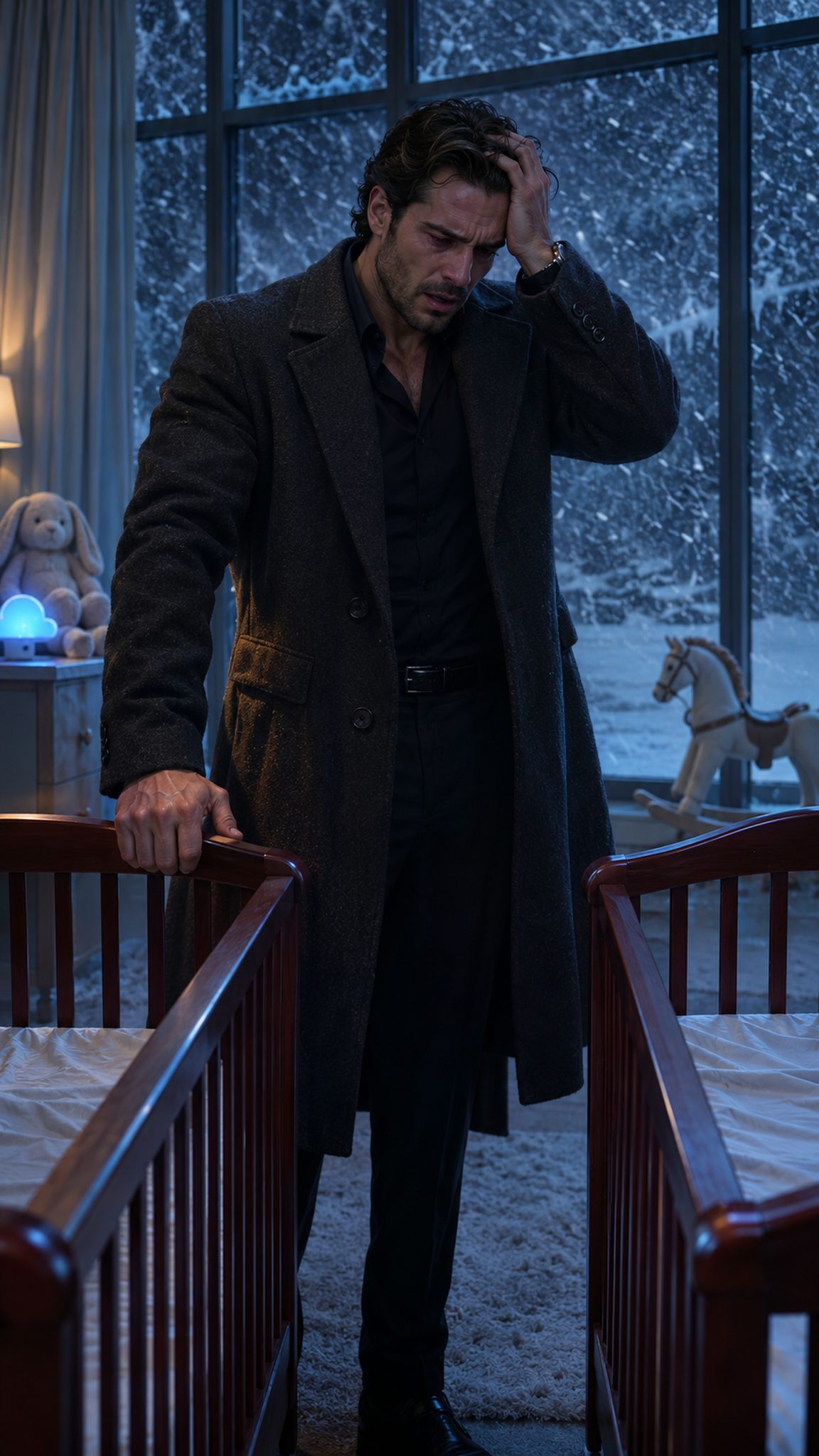
My hand stayed on the crib rail. The thought had barely settled when the scent reached me again.
Cherry blossom.
It was faint beneath the wool and the cold air that had followed me in, but now that I had named it, I could not mistake it. It clung to the collar of my charcoal coat. I caught it on my wrist when I lifted my hand toward my face. It was on my skin, in the fibers, in the space between the man I had been that night and the husband Nora had waited for.
Sylvia.
I closed my eyes, and the nursery seemed to fall away without my moving an inch.
The first time I noticed the lotion, I had been standing in the private lounge above a restaurant on the river. Sylvia had come to discuss a business arrangement connected to one of the companies I controlled. She was polished, composed, and careful with her words. She wore a pale blouse and a perfume that was almost too light to identify. When she reached across the table to pass me a folder, the scent of cherry blossom followed her hand.
I remembered it because it was different from the heavy fragrances worn by people who wanted to be noticed. It was delicate. It lingered without announcing itself.
At the time, I had no reason to give the detail importance.
That was what I told myself later, when the scent became familiar. I told myself that the first meeting had been business, that the second had been a conversation, that the third had happened because we were already in the same building. I arranged the memories into separate boxes, each one harmless when viewed alone. I never asked why I kept making room for another meeting.
Sylvia knew how to listen. She did not ask me to explain the parts of my work I could not discuss. She did not tell me that I came home too late. She did not ask whether the twins had slept or whether Nora had managed to rest. When I spoke about pressure, she called it responsibility. When I spoke about rivals, she called me decisive. She admired the qualities that made me difficult to live with.
I mistook admiration for understanding.
The first time she touched my arm, it was brief. We were standing near the elevator after a meeting, and she said something about how much everyone depended on me. Her fingers rested against my sleeve for a moment. I could have stepped away. I could have thanked her and ended the conversation.
Instead, I let the moment remain.
That was how it began: not with a grand declaration or a sudden loss of control, but with small choices I could excuse before I made them. I stayed after a meeting. I answered a message that had no business reason behind it. I accepted a drink. I let a conversation move from work to private things. I began to anticipate seeing her.
Each step was small enough to deny.
Together, they became an affair.
I had spent years telling men that the first compromise was the one that mattered. I knew how a person crossed a line: first by standing close to it, then by pretending the line had moved. I had used that knowledge when judging other people. I had not applied it to myself.
The first time Sylvia kissed me, I knew exactly what I was doing.
There was no confusion. No misunderstanding. No moment in which I could honestly say I had been swept along by something beyond my control. I could have stopped. I chose not to.
Afterward, I sat alone in my car and looked at my phone. Nora had sent a message asking whether I would be home for the evening feeding. She had added that Leo had been unsettled and Mia had not slept well.
I read the message twice.
Then I typed that an urgent meeting had come up.
I did not tell her where I was. I did not tell her who I had been with. I did not say that the meeting was over and I was sitting outside a hotel with Sylvia's scent on my coat.
I sent the lie.
Nora answered with one word.
“Okay.”
I stared at it for a long time. I had expected a question. I had expected her to ask when I would be home or whether I could come back after the meeting. Instead, she accepted the answer without asking for more.
I should have understood what that meant.
I told myself she was tired. I told myself she had the staff to help. I told myself that the twins had settled and that she wanted me to focus on work. I converted her silence into permission because permission was easier to live with than disappointment.
The next time I saw Sylvia, I did not pretend the first kiss had been an accident. We spoke about it. She asked whether I regretted it.
I said I regretted the complications.
Even then, I had chosen a phrase that kept the truth at a distance. I did not say I regretted betraying Nora. I did not say I was ashamed. I did not say I would end it.
Sylvia looked at me as if she understood the answer.
“Then don't make it complicated,” she said.
I should have walked away.
Instead, I let her make the betrayal sound simple.
The urgent meetings multiplied. Some were real, but I used the real ones to hide the false ones. I learned which explanations Nora was least likely to challenge. A meeting with counsel. A problem at a warehouse. A late call with a partner. A security issue that could not wait until morning.
The words came easily because I had used them for years. My life was full of urgent matters. That made the lies harder to distinguish from the truth, especially for someone who wanted to believe me.
I began keeping a second rhythm to my evenings. I would leave the penthouse after telling Nora that I had to handle something. I would meet Sylvia. I would return with my tie loosened and my answers prepared. Sometimes the scent of cherry blossom was still on my coat. Sometimes I had showered or changed before coming home. Sometimes I believed the cold air would cover it.
I never considered that Nora might know the scent as well as I did.
The memory that hurt most came from the kitchen.
I had come downstairs just after midnight. The penthouse lights were low. Nora stood barefoot beside the island, wearing one of her nursing sweaters. Mia rested against her chest, bundled in a soft blanket. The baby had been awake for some time. Nora's hair was tied back loosely, and there were shadows beneath her eyes.
She looked at me when I entered.
“Are you going out again?” she asked.
I glanced at my phone, though there was no new message.
“I have an urgent meeting.”
Nora lowered her eyes to Mia. The baby made a small sound and moved her cheek against her mother's chest.
“It's after midnight,” Nora said.
“I know what time it is.”
“I didn't say you didn't.”
There was no accusation in her voice. That made it worse, though I did not understand why then.
I picked up my keys from the counter. “It shouldn't take long.”
Nora shifted Mia carefully. “Leo has been crying on and off. I think he's uncomfortable.”
“Have you asked the nurse?”
“She gave us instructions. I'm following them.”
“Then what do you need me to do?”
She looked at me. For one second, I thought she might ask me to stay. She might have asked me to take Mia, to sit with Leo, to let her sleep for an hour. She might have asked me to choose the room over the meeting.
Instead, she said, “Nothing. Go.”
I heard the words and accepted them.
I did not notice the way her shoulders had fallen. I did not notice that she had stopped looking at my face. I did not notice that her fingers had tightened around the blanket.
I walked out.
Now I could see the scene from the other side. Nora had been standing barefoot on cold marble with our daughter against her chest. She had been exhausted, frightened, and alone. She had asked one question, and I had answered with another lie. She had not needed to know where I was going. The scent on my coat had already told her.
I lowered my face toward my sleeve. Cherry blossom. It was still there.
How many times had she smelled it before I came close enough to kiss her? How many times had she noticed it on the collar when I hung up my coat? Had she recognized it on my skin when I leaned over the crib? Had she watched me touch the twins after being with Sylvia and wondered whether I even understood what I was bringing into their home?
I wanted to believe she had not known. That would have made the silence easier to explain. But the signs were everywhere, and I had been the only person determined not to read them.
She stopped asking when I would be home.
At first, I had thought it was a relief. The questions had once irritated me. I had treated them as demands on a schedule I controlled. When she stopped asking, I told myself she had become more understanding.
She stopped asking whether I would join her for dinner. She stopped leaving a plate covered on the counter. She stopped sending messages about the time she expected me. When I came in late, she no longer looked up from the nursery chair to ask whether the meeting had gone well.
Sometimes she said hello. Sometimes she did not.
I noticed the change but interpreted it as adjustment. I told myself she had settled into motherhood, that her attention was on the twins, that the early weeks had made her quieter. I never asked whether she had stopped expecting anything from me.
There had been a morning when I complained about the crying. I had come home after a night with Sylvia and wanted sleep. Leo had begun crying before I had taken off my coat. Nora was trying to soothe him while Mia stirred in the other crib.
“Can someone get him to stop?” I had said.
Nora looked at me. “He's a baby, Victor.”
“I know he's a baby. I'm saying I haven't slept.”
“Neither have I.”
I remember the irritation that rose in me. I remember thinking she was making a point instead of solving the problem. I remember saying that I had responsibilities outside the house and could not function if every night became like this.
She had looked at me for several seconds.
Then she turned back to Leo.
She did not argue. She did not remind me that she had been awake too. She did not ask me to take him. She simply continued rocking our son while I went to the bedroom.
I had thought I was being patient by not raising my voice.
I had not understood that I was leaving her alone with the very thing we were supposed to face together.
There were other signs. Nora began keeping her phone close. She took calls in another room. She stopped telling me small things about her day. When I asked whether she was all right, she said she was tired. I accepted that answer because it did not require me to change anything.
Once, I found her looking at the family photographs on the shelf in the living room. She was holding Mia, who had fallen asleep against her shoulder. The photograph showed us at the hospital, the twins still tiny, Nora smiling with tears in her eyes and my hand resting on her shoulder.
“What are you looking at?” I asked.
“Nothing.”
“You look sad.”
She looked down at Mia. “I'm just remembering.”
I could have sat beside her. I could have asked what she remembered. I could have listened if she told me that the hospital had frightened her, that the babies' early arrival still lived in her thoughts, that she had needed me to be present when the fear came back at night.
Instead, I glanced at the time.
“I have to get ready,” I said.
She nodded.
That was all.
I remembered another evening when I returned and found the kitchen spotless. The bottles had been cleaned and arranged. The formula container was closed. The medicine pouch had been checked and placed in its proper spot. Nora sat at the table with a notebook open, recording the twins' feedings.
I asked why she was still awake.
“I need to finish the notes.”
“Can't the staff do that?”
“They don't know every detail.”
“You should let them help more.”
She looked at me, and I saw something I had not seen before. Not anger. Not even surprise. It was the exhausted recognition that I had missed the point again.
“They help,” she said. “But they're not their parents.”
I had no answer. I could have offered to take over the next feeding. I could have asked her to show me the notes. I could have sat down and learned.
Instead, I said I had a call.
I had not even checked whether it was from Sylvia.
It was.
The memory made my stomach tighten. I could still see the screen lighting up in my hand, Sylvia's name appearing, and Nora looking down at the notebook as if she had not seen it. I had stepped away to answer. I had told myself that the call would be brief.
When I returned, Nora was no longer at the table. The notebook remained open. Beside the last entry, she had written the time and the amount Leo had taken. Her handwriting was neat, even though she must have been exhausted.
I had closed the notebook without reading it.
Now I wished I could read every line.
The scent of cherry blossom seemed stronger in the nursery, though perhaps I was only breathing more deeply. I touched the collar of my coat and remembered Sylvia's hand smoothing the wool after she had leaned close to me. I remembered her saying that she liked the way I smelled when I came in from the cold. I remembered letting her stand close enough that the lotion transferred to my skin.
I had brought that scent home.
Not once. Not accidentally. I had brought it home because I had decided the truth could be hidden beneath a clean shirt, a different route, or a practiced explanation.
I thought of Nora sleeping upright in the nursery chair. I thought of her watching the twins while I complained about being disturbed. I thought of the empty place in the bedroom wardrobe where her winter coats had hung. She had packed those coats because she knew the storm was coming, or because she knew she might have to face one.
She had taken the practical boots. The nursing sweaters. The two overnight bags. The passports for herself and the babies. The diapers, formula, and insulated medicine pouch. She had taken Mia's rabbit.
She had left the fifty thousand dollars.
The pattern was unmistakable. She had not fled in confusion. She had chosen what mattered and left what did not. She had taken the things that allowed her to care for Leo and Mia without depending on me. She had not taken the cash because she did not want the money to become another chain between us.
I could not know every thought that had passed through her mind. I could not know whether she had cried while packing or whether she had waited until the last possible moment. I could not know whether she had looked back at the nursery before closing the door.
But I knew she had smelled Sylvia on me.
I knew she had heard the lies.
And I knew that when she stopped asking when I would be home, it was not because she had stopped caring. It was because she had learned that asking changed nothing.
I moved my hand along the crib rail until my fingers reached the corner. The polished wood was cold. I had spent years believing that the people closest to me understood the demands of my position. I had expected Nora to understand that my time was not entirely mine. I had expected her to accept the risks, the absences, and the lies that came with my name.
I had never asked what she was sacrificing to make that acceptance possible.
The clock made a small mechanical sound. I looked at it but did not let myself count the minutes. The present was still the nursery, the snow, the empty cribs, and the scent that had followed me home.
I thought about Sylvia again. I could have blamed her. It would have been easy to say she had pursued me, that she knew I was married, that she had enjoyed the attention of a powerful man. Some of those things might even have been true.
None of them changed what I had done.
I was the one who had made vows to Nora. I was the one who had promised to come home. I was the one who had stood in the kitchen and lied while she held our daughter. I was the one who had complained about our premature babies crying when they needed comfort. I was the one who had chosen an affair and then carried its scent into the room where my children slept.
Sylvia had not made me betray my family.
I had done that myself.
The realization did not arrive as a dramatic revelation. It settled slowly, with the weight of something that had been obvious for a long time. I had wanted to believe Nora left because she was overwhelmed, because the storm frightened her, because motherhood had become too much, because she had misunderstood my absences.
Those explanations would have made her departure a problem I could solve.
The truth was harder. She had left because she understood exactly what was happening and no longer believed I would stop.
I looked at the two empty cribs. Leo's sheet still held the faint indentation. Mia's rabbit was gone. The blue nightlight softened the edges of the room, but it could not soften what I had finally understood.
The cherry-blossom scent was not evidence of a careless mistake. It was the trace of a choice I had repeated until Nora could recognize it without asking.
I had made her live beside a lie and expected her to keep the house warm around it.
I had made her carry our children through their most fragile weeks while I carried another woman's scent home.
I had made her ask for less and less until she asked for nothing.
The storm pressed against the windows. The nursery remained still. I did not move toward the door. I did not reach for my phone. There would be time for decisions, but not yet. I had to stand in the room long enough to understand that this was not a mystery created by someone else's cruelty.
It was the consequence of mine.
The clock's minute hand edged closer to the next mark. I kept my palm on the crib rail and my eyes on the empty spaces where my children should have been. The next minute had not arrived. The search had not begun.
I could hear the faint hum of the house beneath the storm. I could smell cherry blossom on my skin.
And just before the clock could turn to 5:11, I finally stopped looking for an excuse.