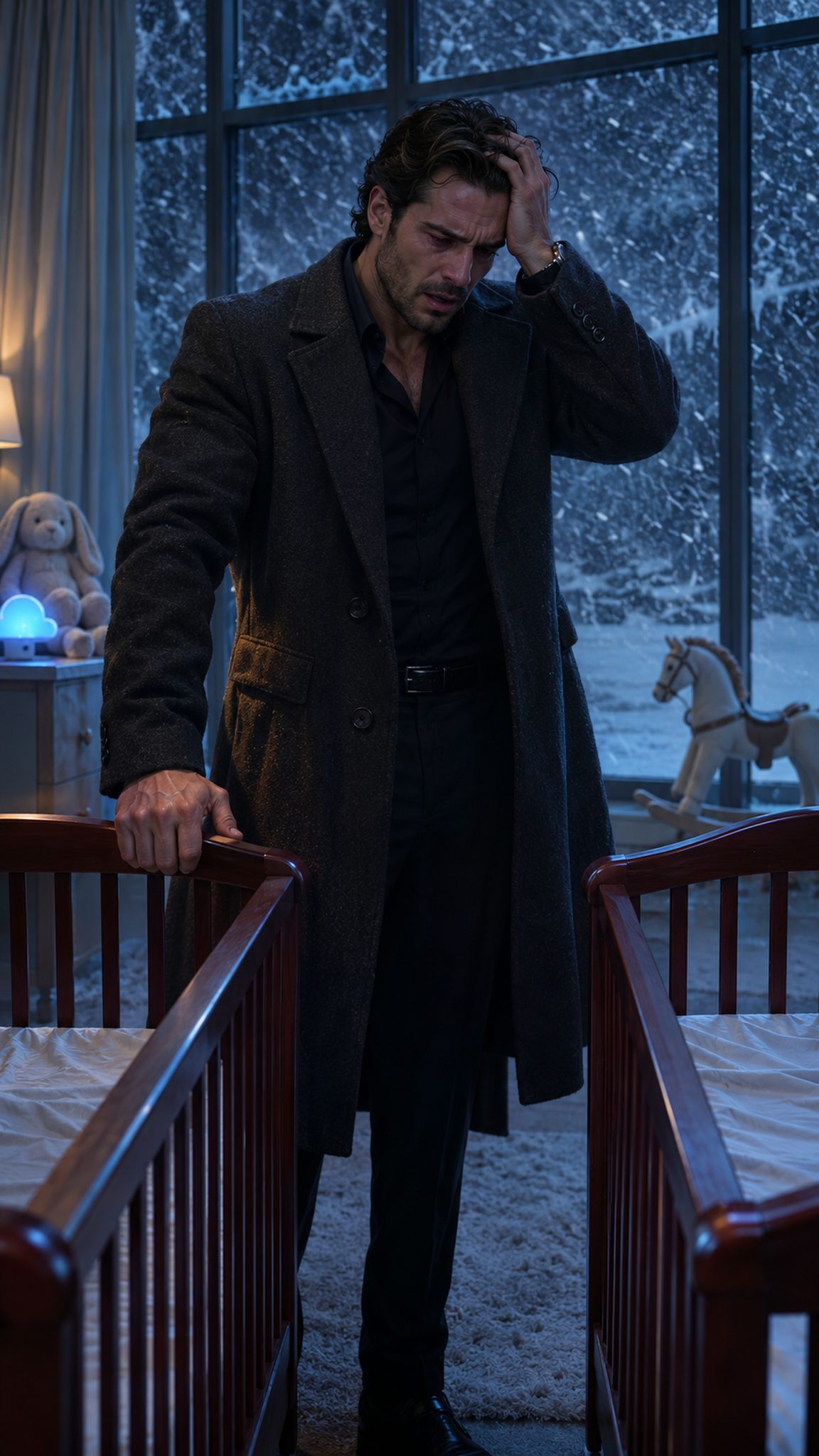
By the second morning, the storm had begun to loosen its grip on Chicago, but the city still looked buried beneath a dirty white silence. Roads were narrowed by plowed snow. Side streets remained blocked. The river moved beneath a skin of gray ice, and every vehicle that passed the penthouse windows left a trail of slush behind it.
I had not slept.
My men had searched hospitals, shelters, transit stations, pharmacies, and the places Nora might have chosen because they were warm and public. They had checked every camera we could lawfully access and every vehicle connected to my businesses. We had found fragments of her departure and nothing after it.
I had stopped calling her missing. The word made her sound like an object misplaced by someone careless. Nora had taken our children and left deliberately. She had made herself difficult to find because she did not want me to find her.
That truth did not make me stop searching. It changed what I believed I had the right to do.
At eight in the morning, my security chief entered the study with a report.
“We have a problem at the south freight terminal,” he said.
I looked up from the map spread across my desk. “What kind?”
“Domenico Varga's people have moved into two of the loading yards. They're holding a shipment and demanding a meeting.”
“Then tell them the shipment is not theirs.”
“We did. They say they'll keep it until you come personally.”
Domenico had been testing my organization for months. He was patient, ambitious, and convinced that my attention had been divided by the babies. He had mistaken my absences for weakness and my silence for an invitation. Normally, I would have answered him before breakfast.
“Send Carlo,” I said.
My chief hesitated. “Varga specifically asked for you.”
“He can ask for the moon. He'll get Carlo.”
“He's threatening to take the western contracts if we don't respond.”
I looked at the report. The western contracts represented years of work and a great deal of money. Losing them would weaken our position with several partners. Varga knew that. He was choosing the moment carefully.
“Tell Carlo to secure the legal records and protect the workers. No confrontation. No one gets hurt.”
“And if Varga refuses?”
“Then the shipment stays where it is until we resolve it.”
My chief watched me. “You would usually handle this yourself.”
“I have something more important.”
He glanced at the empty chair near the window, then back at me. “The search?”
“The search.”
He left without arguing.
I knew what my decision would cost. Men who had built their careers around my attention would wonder why I was allowing a rival to occupy ground that belonged to us. Partners would question whether I still had the appetite to defend the organization. Varga would tell the city that Victor Rinaldi had become distracted by a woman who had walked away.
For once, I did not care what story he told.
I had spent years making sure no one could take anything from me. Nora had not been taken. She had left. There was no rival to punish for that, no enemy to threaten until she came home. The only person who had driven her away was standing in my study.
Me.
At ten, I went to see Sylvia.
I did not call ahead. I did not send a driver to announce me. I drove to the office where she worked and asked reception to tell her I needed to speak with her privately. The receptionist looked surprised, then made the call.
Sylvia appeared a few minutes later in the doorway of the conference room. She wore a dark skirt and a pale blouse. Her hair was neat, and the familiar cherry-blossom fragrance reached me before she sat down.
For one disorienting second, I was back in the nights I had spent telling myself that this scent meant escape.
Then I remembered Nora's empty side of the bed.
“Victor,” Sylvia said. “I didn't expect you.”
“Sit down.”
She closed the door. “Is something wrong?”
“Yes.”
Her expression changed. She placed her folder on the table but did not open it.
“Is it the situation with your wife?”
I looked at her. “You know she's gone?”
“I heard you were looking for her.”
“Then you know why I'm here.”
Sylvia sat slowly. “I thought you might call.”
“I should have called sooner. I should have ended this before it began.”
She looked away for a moment. “Is that what this is?”
“Yes.”
The word sounded final in the room.
She folded her hands. “You told me things were difficult at home.”
“They were.”
“You said you and Nora barely spoke.”
“We spoke about the children. We spoke about the house. We spoke about everything I was willing to discuss.”
Sylvia's eyes returned to mine. “You made it sound as if your marriage was already over.”
“It wasn't.”
“You said you were lonely.”
“I was. That doesn't excuse what I did.”
She leaned back. “So now she's left, and you want to make me the reason.”
“No. I made you part of the reason. I made choices. I lied to Nora. I lied to myself. I came here because I won't continue lying to you.”
The room was quiet. Through the glass wall, employees moved between desks, carrying coffee and folders, unaware that a marriage and an affair were being reduced to plain sentences a few feet away.
Sylvia studied me. “Do you love her?”
I did not answer immediately. Not because I was uncertain, but because I had used the word love too carelessly. I had said it when asking Nora to marry me. I had said it when she told me she was pregnant. I had said it in the hospital while our premature twins lay in their beds. I had said it without understanding that love was not a possession I could claim while behaving as if my promises had no cost.
“Yes,” I said. “I love Nora.”
“And me?”
“I wanted what you gave me. Attention without responsibility. A place where I didn't have to answer for the rest of my life. I let you believe that meant something more.”
Sylvia's face tightened. “You don't get to decide what it meant to me.”
“You're right. I don't.”
She looked down at her hands. “I didn't force you to come to me.”
“No. I chose to come. I chose to keep coming. I chose to call those nights urgent meetings. I chose to walk into my home with your perfume on my coat. Those choices were mine.”
“Don't call it perfume. It's lotion.”
“I know what it is.”
She looked up sharply.
“Cherry blossom,” I said. “I can smell it on my coat even now when I remember those nights.”
Sylvia's expression shifted. “Did Nora find out?”
“She knew.”
“How?”
“She didn't need to catch us. She watched me leave. She smelled it. She saw the lies. She stopped asking when I would be home because she already knew I wouldn't tell her the truth.”
Sylvia was silent.
I continued before I could retreat into excuses. “She was standing in the kitchen with Mia against her chest, asking me to take Leo for five minutes. I told her I had an urgent meeting. I came here. That is what I did. I left my wife alone with two premature babies because I wanted to spend time with you.”
“You're making it sound cruel.”
“It was cruel.”
“I never asked you to abandon your children.”
“You didn't have to. I did that myself.”
She stood and walked to the window. For a moment, I saw the woman I had spent months seeking out: composed, observant, able to make a crowded room feel private. I had mistaken that ease for understanding. Perhaps she had believed my version of the marriage. Perhaps she had known it was incomplete and chosen not to ask.
When she turned back, her eyes were bright but her voice was controlled.
“Was any of it real?”
“I won't pretend it was nothing. But I won't use that to justify continuing it.”
She stared at me. “So that's it?”
“Yes. No more meetings. No private messages. No visits. You will not contact me outside legitimate work matters, and I will arrange for someone else to handle your position so you don't have to report to me.”
“You're firing me?”
“I'm removing the conflict. You'll receive the compensation due under your contract. You can choose whether to stay with the company under a different manager or leave. I won't punish you for my decisions.”
She stared at me. “You think money makes this clean?”
“No. It only makes the employment part fair.”
“And if I call you?”
“I won't answer.”
Her jaw tightened. “You sound very certain.”
“I have been uncertain for too long.”
She picked up her folder. “I hope you find her.”
I stood. “So do I.”
At the door, she spoke again.
“Victor.”
I turned.
“You should know that when you talked about Nora, you never sounded like a man who had stopped loving his wife. You sounded like a man who expected her to keep waiting.”
I held her gaze. “I did.”
“And now?”
“Now I know she doesn't owe me another minute.”
She left.
Outside, the air was bitter. I stood beside the car and breathed until the cold cleared the scent of the office from my head. I did not feel relieved. Ending the affair did not undo it. It did not return Nora to the penthouse or put Leo and Mia back in their cribs. It did not erase the nights I had spent with Sylvia while my wife waited alone.
It was simply the first honest thing I had done in months.
My phone rang before I reached the driver's door. Carlo was calling from the freight terminal.
“Varga's men have blocked the south gate,” he said. “They've brought more people.”
“Any injuries?”
“Not yet.”
“Keep the workers inside. Get the police liaison involved if they threaten anyone. No one draws a weapon.”
“He wants you here.”
“I know.”
“He says he'll take the western contracts and the warehouse leases by tonight.”
I looked across the street. A woman was pushing a stroller through the snow, one hand shielding the child from the wind. I watched until she reached the corner.
“Let him make the announcement,” I said.
Carlo was quiet. “Boss, if we let him take those yards, he'll think he can take more.”
“Then we'll deal with the contracts through lawyers. Protect the workers. Protect the records. Do not start a war over a loading yard.”
“You're giving him ground.”
“I'm choosing where I stand.”
I ended the call.
The threat did not disappear. Varga had money, men, and friends in places where a delayed signature could become a serious problem. If I ignored him, he would use the opportunity. If I retaliated, I could recover the yards quickly, but the response would draw my people into a fight that might spread across the city.
For years, I would have chosen the fight.
I would have treated the challenge as an insult and made an example of the man who delivered it. I would have called it protecting the organization. I would have told myself that power had to be defended every time someone tested it.
But I had spent two days searching for my children while snow covered the roads. I had imagined Leo's medicine pouch getting cold and Mia waking in a strange place. I had imagined Nora trying to keep both babies warm with no help from me. The thought of returning to the old life, of choosing revenge over the chance to find them, felt suddenly obscene.
I drove to the terminal anyway, but I went alone.
Carlo met me inside the administration building. Through the windows, I could see Varga's men near the loading area. They were standing in groups, wearing dark coats, their faces turned toward the gates.
“You shouldn't have come without security,” Carlo said.
“I have security outside.”
“Not enough.”
“I'm not here to fight.”
He looked at me as if I had spoken in another language.
Domenico Varga entered a few minutes later. He was broad, silver-haired, and dressed in a coat that probably cost more than the monthly wages of the men standing outside. He smiled when he saw me.
“Victor. I wondered if the family emergency would keep you home.”
“Say what you came to say.”
He glanced at Carlo. “Still impatient.”
“Talk.”
Varga placed a folder on the table. “The western contracts are vulnerable. Your people have been distracted. Your partners are asking questions. I can take the yards, the leases, and the distribution agreements before the week is over.”
“You can try.”
“I already have.”
“Then you'll discover that contracts don't change hands because you make noise at a gate.”
He smiled. “You used to be quicker to answer an insult.”
“I used to waste more time proving I could.”
Varga's smile faded. “People are saying your wife walked out with your children. People are saying you can't find her.”
I felt my hands tighten, but I kept them on the table.
“Leave my family out of this.”
“Your family is the reason we're here.”
“No. You're here because you think I won't defend my business interests while I'm looking for them.”
“Will you?”
I looked at the folder. “I'll defend them through the law. I'll protect the workers. I won't turn this into a street war because you think my attention is elsewhere.”
Varga leaned forward. “You think restraint makes you look strong?”
“I don't care how it makes me look.”
“You're losing your grip.”
“Maybe.”
The answer surprised him. It surprised Carlo too.
Varga straightened. “You admit it?”
“I admit that there are things more important than keeping every man in this city afraid of me.”
He laughed once. “That's not the Victor Rinaldi I know.”
“Then you haven't been paying attention.”
I left the folder unopened.
Varga stepped toward the door. “When you decide to act like yourself again, call me.”
“I am acting like myself. I'm just done pretending fear is the same thing as respect.”
He walked out. Carlo followed him with his eyes, then turned to me.
“What happens now?”
“We document every threat. We protect the workers. Our lawyers challenge any attempt to seize the contracts. If he damages property, we pursue him through the courts.”
“And if he sends men after you?”
“Then we protect ourselves. But we don't go looking for a fight.”
Carlo shook his head. “Your father would never have allowed this.”
“My father isn't raising my children.”
The words came out harder than I intended. Carlo looked away.
I returned to the SUV and called my security chief. “I need someone who knows Nora and isn't connected to my organization.”
“Who?”
I thought of the clinic. I thought of the people Nora had helped long before she married me, the families she remembered, the volunteers who knew her as a woman who carried blankets through the rain. I thought of the coordinator who had thanked her while I stood in the doorway.
“Find the coordinator at the North Side clinic,” I said. “The one Nora volunteered with before we married. Her name is Margaret Ellis.”
“We can bring her in.”
“No. Don't bring her anywhere. Ask whether she'll speak to me. Make it clear she can refuse.”
My chief hesitated. “You want to contact someone from her past?”
“I want to ask someone she trusts whether Nora has somewhere safe to go. I don't want an address. I don't want anyone followed. I want to know whether the children have what they need.”
“I'll make the call.”
“Not through a threat. Not through a favor she can't refuse.”
“Understood.”
An hour later, Margaret agreed to meet me at the clinic.
I arrived without my men. The snow had slowed, but the sidewalks were still slick. The clinic looked smaller than I remembered. A few people sat in the waiting room, and the same television played quietly in the corner. The smell of disinfectant and old coffee brought back the first day I had met Nora.
Margaret was waiting near the office door. She was older than I remembered, with silver hair and a careful expression.
“Victor,” she said.
“Thank you for seeing me.”
“I'm not sure I should have.”
“I understand.”
She led me into a small office and closed the door. There were folders on the desk and a framed photograph of volunteers standing outside the clinic. Nora was in the front row, holding a box of blankets and smiling at the camera.
I looked at the photograph longer than I intended.
Margaret noticed. “She was good here.”
“I know.”
“Do you?”
I sat down. “I'm trying to.”
She remained standing. “Why are you looking for her?”
“My wife left with our twins.”
“I heard.”
“They were born prematurely. They need their medicine and regular care. I want to know they're safe.”
Margaret's expression did not soften. “Does Nora know you're asking me?”
“No.”
“Then why should I tell you anything?”
“Because I am worried about the children.”
“And Nora?”
I looked at the photograph again. “I'm worried about her too.”
Margaret folded her arms. “You have a great many people who can find someone. Why come here?”
“Because she trusted you before she knew me.”
“That doesn't mean I should help you find her.”
“I know.”
“Do you know why she left?”
The question was direct. I could have said that she was overwhelmed, that the storm frightened her, that we had been arguing. I could have described the empty cribs and the missing passports as though they were the cause rather than the result.
Instead, I told her the truth.
“I had an affair. I lied about it. I kept leaving her alone with the babies. I complained when they cried. I made promises and broke them. She knew.”
Margaret's eyes stayed on mine.
“Did you tell her?”
“No.”
“Then how do you know she knew?”
“Because I came home smelling of another woman. Because I used the same excuse too many times. Because she stopped asking where I was. Because she looked at me as if she had already heard the answer.”
Margaret pulled out the chair opposite me and sat down.
“Nora never told me the details,” she said. “She didn't like discussing private matters.”
“Did she contact you?”
Margaret looked toward the office door. “I'm not going to give you her location.”
“I didn't ask for it.”
“You came here because you hope I will.”
“I came because I need to know whether she has help.”
Margaret studied me for a long moment. “She asked me something before she left.”
My heart began to pound. “What?”
“She asked whether the clinic knew of any places where a mother could stay temporarily with two infants. Somewhere warm, somewhere quiet, somewhere she could manage without having to explain her whole life.”
I leaned forward. “When?”
“Before the storm.”
“How long before?”
“I'm not going to give you a date that could help you track her.”
I sat back. The answer confirmed what I had already suspected. Nora had prepared. She had asked for help from someone who knew her, not from the people who knew me.
“Are the babies safe?” I asked.
Margaret's expression softened slightly. “She was very careful. She asked about medical access, transport, and what supplies she should bring. She knew exactly what the twins needed.”
“Did she have enough medicine?”
“She brought what she needed for the immediate period.”
I closed my eyes briefly. The medicine pouch had been taken. Nora had planned for it.
“Does she have somewhere warm?”
“I believe so.”
“Can you tell her I won't send anyone?”
“I can tell her what you said. I won't promise she will believe you.”
“I don't expect her to.”
Margaret leaned forward. “Victor, listen to me. Nora didn't leave because she wanted to punish you. She left because she needed to make a decision for herself and those babies. She has spent a long time carrying more than one person should carry.”
“I know.”
“No. You are beginning to know. That isn't the same thing.”
I looked down at my hands.
“She doesn't need you to arrive with a convoy and announce that everything will be different,” Margaret continued. “She needs room to decide what she wants. If you truly care about her, don't turn her attempt to find safety into another thing she has to defend.”
“I won't.”
“You have said that before?”
“Yes.”
“Then understand why she may not believe you.”
I nodded.
Margaret stood and walked to the desk. She picked up a small card with the clinic's contact information and placed it in front of me.
“I will pass along one message,” she said. “No more. You can write it here, and I will decide whether it is appropriate to give her.”
I took the card but did not write immediately.
“What should I say?”
“Something that doesn't ask her to make you feel better.”
I looked at the photograph of Nora again. In it, she was standing outside the clinic with a box of blankets. She had been that woman before she became my wife, before the penthouse, before the guards and the money and the promises I had broken.
I wrote slowly.
I'm sorry I made home a place you had to leave. I won't send anyone after you. Please use the clinic if you or the twins need anything. You don't owe me a reply.
I handed the card to Margaret.
She read it and folded it once. “I'll see what I can do.”
“Thank you.”
“Don't thank me yet.”
I stood. At the door, I stopped.
“Margaret, if the babies need medical care, please make sure they get it. Whatever the cost, I'll pay.”
“I'll make sure they get care. But don't use money as a way to reach Nora.”
“I won't.”
She opened the door. “Then let that be the first promise you keep.”
I left the clinic without an address, without a phone number, and without a guarantee that Nora would read my message. But I had something I had not possessed that morning: confirmation that she had asked for help before the storm, that she had considered the twins' needs, and that someone she trusted believed she had found somewhere warm.
It was not enough. It was a lead, and it had come from trust rather than fear.
My phone rang as I reached the SUV. Carlo was calling again.
“Varga has made his move,” he said. “He's announcing that he controls the western yards. Two partners are asking whether they should suspend their agreements.”
I looked at the clinic entrance. A volunteer was helping an elderly woman through the door.
“Tell the partners our legal team will contact them. Protect the remaining operations. Don't retaliate.”
“Boss, this is going to cost us.”
“I know.”
“How much?”
“Whatever it costs.”
He was quiet. “And the search?”
“Continue checking hospitals and public places, but no one follows Margaret. No one watches the clinic. No one approaches Nora if they see her.”
“You're giving up the lead?”
“No. I'm refusing to turn it into a trap.”
I ended the call.
For the first time, I could see the price of finding Nora clearly. It was not simply money or the western contracts. It was the power to make people obey, the power I had spent my life accumulating. I could use that power to narrow her world until she had nowhere to go. I could frighten the people who helped her. I could make every shelter, clinic, and hospital feel unsafe.
I could probably find her faster that way.
And if I did, she might disappear again.
I stood in the snow with Margaret's words in my mind. Nora needed room to decide what she wanted. She did not owe me a reply. She did not owe me forgiveness. She did not owe me a return to the penthouse because I had finally become frightened of losing her.
I had chosen her once when I asked her to marry me. Then I had chosen my power, my convenience, and my appetite over her every day afterward.
This time, choosing her meant accepting that I might not get her back.
I got into the SUV and looked at the phone on the passenger seat. No message had arrived. No new location had appeared. The storm was easing, but the city remained cold.
I started the engine.
I would keep looking for Leo and Mia's safety. I would make sure the medical bills were covered without using them as leverage. I would end the affair completely, remove Sylvia from any position where our lives could overlap, and face the consequences of what I had done. I would not send men to drag Nora home. I would not threaten the people she trusted. I would not make revenge my answer to the fear of losing my family.
The first real lead had come from a woman Nora trusted, and it had not given me the right to know where she was.
It had given me a chance to become someone she might one day choose to speak to.
For now, that would have to be enough.