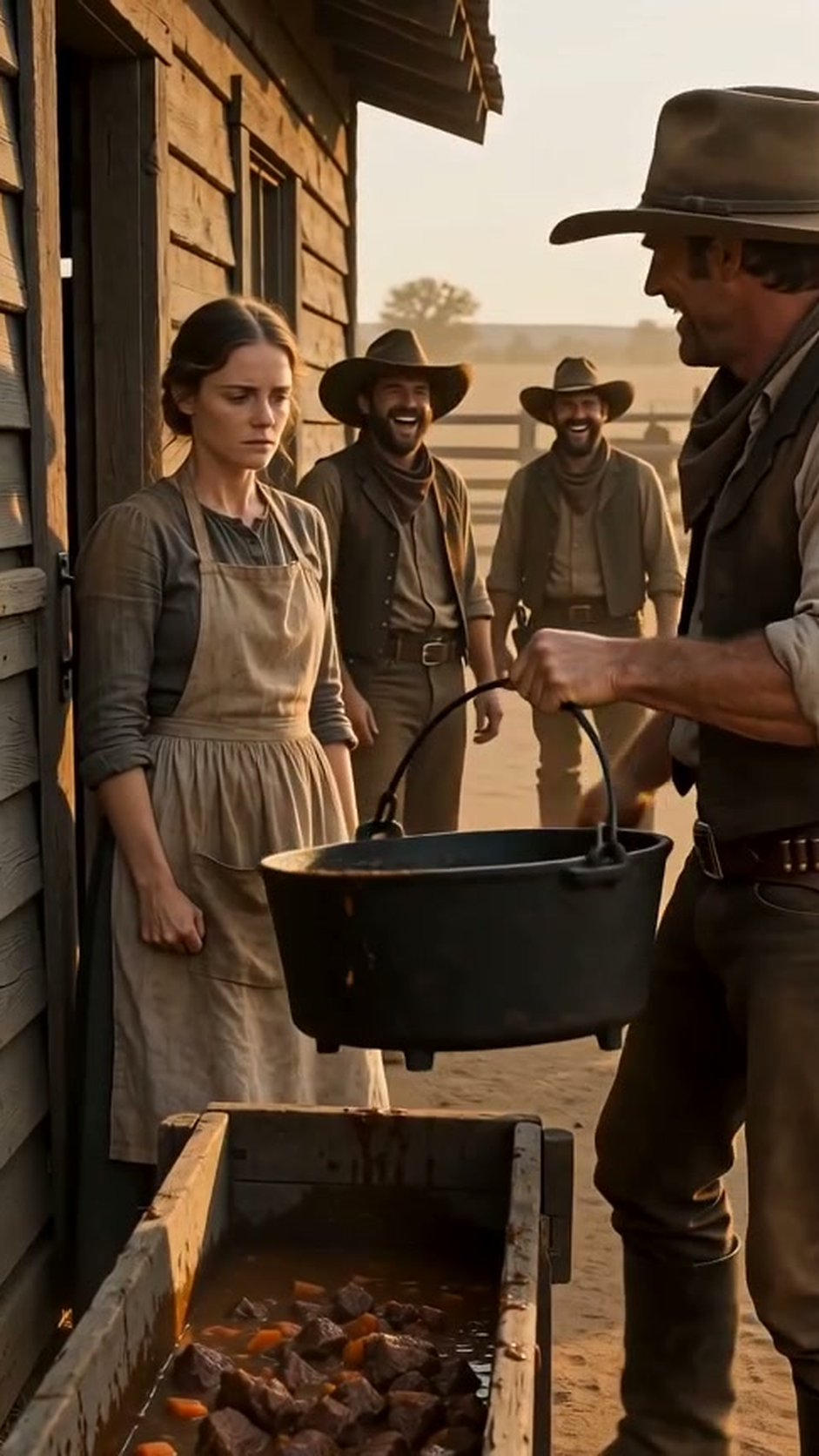
The stew took all day, and Bertha knew what she was doing with every hour of it.
She chose the beef herself that morning from what was left of the spring house side, and she cut it big — a stew for men, not a soup for invalids — and she browned it in batches in her mother's pot until the whole cookhouse smelled like the inside of a promise. Potatoes. Carrots. Onions sweet as apples. A handful of her mother's dried thyme, from the bundle that hung by the stove, the last of what Martha Platt had dried the autumn before she died. Bertha stood over the pot at four o'clock with the spoon in her hand and the steam in her face, and she tasted, and she salted, and she tasted again, and it was right. It was her mother's stew. Thirty men were going to eat like kings at six o'clock, and whatever game Buck Thorp was playing with shortages and regretful smiles, he could not argue with a full table and thirty full men — could not stand in an office in June and call a cook a failure with the taste of that stew still on the crew's tongues.
She set the table at five. Plate, cup, fork, thirty times. She put the bread out. She put the coffee on.
At six o'clock the crew came in out of the yard with the day's dust on them, and Buck came in with them, and he did not sit down.
He walked the length of the table like a man inspecting a fence he intends to tear out. He looked at the plates. He looked at the bread. He lifted the lid of the pot where it sat on the stove, and the steam rose around his face, and the men at the table watched him and watched the steam, and Bertha watched his jaw work once, slow, because the stew was good and he could smell that it was good and everyone in the room could smell it.
"Bertha," he said, almost gently, "bring that pot out to the yard."
"Mr. Thorp—"
"Now." He raised his voice just enough to make it an order in front of witnesses. "There's something the boys ought to see."
She should have refused. She knew later she should have refused, should have made him carry it himself, should have said the word no loud enough to be remembered. But he was the foreman and she was the cook three weeks hired, and thirty men were watching, and refusal in front of the crew would be its own kind of defeat — so she took up her mother's pot with a towel in each hand and carried thirty men's supper out into the yard, and the crew followed, and Buck walked ahead of her to the hog trough by the corral fence, and waited.
"Set it down," he said.
And when she had, he took hold of it himself, with both hands, and tipped it, and poured her whole day — her mother's stew — into the trough for the hogs, slow, so everybody got a good long look.
"Boys aren't eating this," he said.
What he told them, when the pot was empty and the laughing had started — the laughing began with two men, the ones who always began it, and spread the way fire spreads through dry grass, because laughing was easy and riding to town was fun and not laughing, in front of Buck, was a decision a man had to make on purpose — what he told them was a story about a hog. A hog that had died that morning in the pen by the creek, died bloated and wrong, and hadn't he seen the cook's slop bucket by that pen, and hadn't the hogs been fed off her scraps, and what kind of cook feeds stock offal that kills a hog and then serves the same pot to men?
It was a lie. Bertha knew it was a lie the way you know your own name — her scraps went to the hogs the same as her mother's had for fifteen years, and no hog had died, and Buck knew no hog had died. But a lie told by the foreman, in the yard, with a laugh already running through the crew like a current, is not a thing you can argue with. Arguments need listeners, and the listeners were saddling up.
"Try again tomorrow," Buck said, and held her the empty pot.
Bertha took it. She did not cry. She had decided about crying the day she buried her mother: it was a thing she did in private or not at all, and Buck Thorp was not private enough for her tears.
She stood in the yard and watched them ride for town, thirty men and the dust and the laughter going away down the Dryfork road, and then she carried the pot inside and washed it in water so hot it scalded her hands pink, and she didn't feel the scald until much later, which told her something about where her mind had gone.
—
Lonnie Pruitt stayed behind.
He was seventeen, the youngest hand on the crew, stringy as a fence wire and assigned that week to the remuda and the light work because he'd turned his wrist under a falling saddle. A sprained wrist was Buck's excuse for leaving him; Bertha suspected the real reason was that Lonnie was the one man in the yard who hadn't laughed, and Buck's punishments were as quiet as his other methods.
He came into the cookhouse while she was wiping down the table — thirty clean plates in a row, thirty suppers' worth of pride gone to the hogs — and he stood twisting his hat, and what he said first was, "That hog story was a stone lie, Miss Bertha. Ain't no hog died. I fed 'em this morning myself."
"I know," she said. "Thank you for saying it out loud. You're the first."
"I ain't the only one knows it." He glanced at the door. "There's men out there know your cooking from your mama's time, and Gus Henley knows, and Andrew—" He stopped, and the hat took another twist, and Bertha saw that the boy was carrying something heavier than a sprained wrist.
"Lonnie. Whatever it is, I'd rather hear it from you than learn it the way I've been learning things."
He swallowed. "It was last month, before you come. I rode in with the supply wagon and I was behind the Gilded Steer — that's Lester Oler's saloon — putting up the team where the wagon yard is, and Mr. Thorp and Mr. Oler come out the back door, and they didn't see me on account of the wagon. And Mr. Oler says — " The hat twisted. "He says, 'That's twelve men at the hotel table and eighteen at mine, Thorp, and a fine week for both of us.' And Mr. Thorp says, 'You just keep the three dollars ready, Lester. I'll keep the boys hungry for town.' And Mr. Oler laughed and said something about the book being square. The book, Miss Bertha. Like they keep a book on it."
"There's more," the boy said, when she didn't speak. "I wasn't going to say the rest because I can't prove I'm not making it up, but if I'm saying part I might as well say the whole pot. That same night, after, I was in the livery waiting on the wagon team and I seen Mr. Thorp at the bar of the Gilded Steer with his hat off, and Lester counted out money into a little buckskin poke — counted it twice, the way men do when it's a regular thing — and Buck put it in his coat like it was nothing at all. Like wages. And the men he'd brought in were all at the tables spending their *own* wages on Lester's beef and Lester's whiskey, and I stood there doing the figures the way my pa taught me, and Miss Bertha — Lester could pay Buck three dollars, or five, or ten, and still come out ahead every single week, because thirty cowboys eat and drink like a trail herd at a river. Buck ain't selling them cheap. He's selling them *steady*."
"And old Mr. Jory?" Bertha asked. "The cook before me?"
"Jory didn't have to be fought," Lonnie said, with the brutal simplicity of seventeen. "Jory fought the bottle and the bottle won most nights. Half the time the men *had* to eat in town — his suppers'd poison a goat. I reckon that's what gave Buck the notion in the first place, back in your mama's sick year. A thing that starts by accident gets to looking like a business, if a man's the business kind."
"You're not," Bertha said slowly, looking at the boy with new eyes, "as simple as you let on, Lonnie Pruitt."
"No ma'am," Lonnie said, and grinned for the first time that evening, quick and shy. "But I'm fixing to keep letting on, if it's all the same. It's safer."
The cookhouse was very quiet. The stove ticked as it cooled.
"Three dollars," Bertha said slowly. "Three dollars a week, or three dollars a — "
"I don't know the whole of it. I know it ain't wages, and I know it ain't the ranch's money, because they was laughing like men spending their own. Three dollars for bringing the crew to town, is what it sounded like. Every week Buck brings 'em in, Lester pays. That's why the men eat in town, Miss Bertha. It ain't your cooking. It was never anybody's cooking. Old Man Jory before you, he figured it — no, he didn't figure it, he was too drunk to figure anything. But you—" The boy looked at the thirty clean plates, and his sprained wrist's hand came up and touched his chest, awkward, over his heart. "You cook too good. Men was starting to say they'd as soon eat here and save their money. Buck can't have that. The three dollars needs the men in town."
Bertha sat down, slowly, on the bench along the table, in the middle of her thirty empty places.
It was never the cooking. The flour, the coffee, the beef rounds walking out of the spring house at night — she would think about those later, and what they meant, and where stolen ranch food would find a buyer with a kitchen of his own and a reason to keep a foreman sweet. For now the great fact stood in the lamplit cookhouse like a fourth person: Buck Thorp did not hate her cooking. Buck Thorp feared it. Every full plate at her table was three dollars' worth of threat walking around in a man's belly.
"You'll not repeat what you heard to anyone else," she said. "Not Gus, not Andrew. Not yet."
"Yes ma'am. But Miss Bertha — he'll do it again tomorrow. The stew — he'll find another hog to lie about. He has to. You see that, don't you? He has to every night now, or the men'll stay."
"Yes," Bertha said. "I see that."
She stood up, and she began, methodically, to wash the thirty plates. Lonnie watched her a moment, then set his hat down and, one-handed, began to dry.
"Miss Bertha," he said at last, "what are you going to do?"
Bertha looked down the long table. Tomorrow she would bake, and she would cook, and she would set it again — every plate, every cup, every fork, trued like a fence line. She didn't yet know what it would accomplish. She knew it was the only ground she held: the table, and the truth, and the fact that Buck Thorp — who feared nothing on the Bar Seven, not weather, not cattle, not men — had stood in her doorway smelling her stew with his jaw working like a man who'd heard a shot he couldn't place.
"Tomorrow," she said, "I'm going to cook supper. And I'm going to set thirty places."
The next evening she did exactly that — and when Buck came to the doorway and counted the plates, and asked her if she was expecting company, Bertha laid the last polished fork down beside its plate and said, "I was hired to feed thirty men," and watched his hand tighten on his belt, and understood that the war between them had finally come out where both of them could see it.
He left without his signal, and the men in the yard sat their horses a long moment before the first hoof moved — as if the whole crew were waiting, without knowing it, to find out which of the two of them the ranch belonged to.